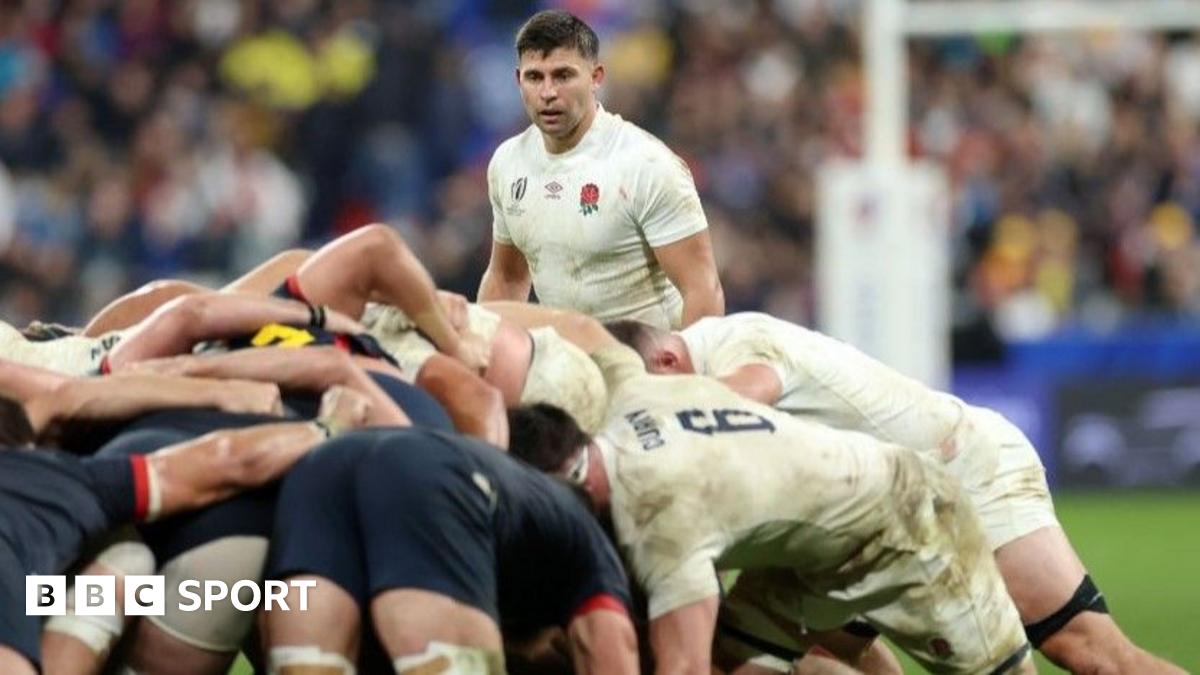
I could not hold it together any more. I had to step away.
As I made my way down the stand, tears streamed down my face. I took a moment to look over the pitch, took a deep breath, and returned to give my former England and Leicester Tigers team-mate Lewis Moody a big hug.
As tough as it was discussing his diagnosis of motor neurone disease (MND), what set us both off was talking about the sport we love – rugby.
Despite a number of high-profile former rugby players having had the disease, there is no scientific evidence definitively linking MND with repeated concussion. Even if there was, Moody – nicknamed ‘Mad Dog’ in the Tigers dressing room – has no regrets about the hard-hitting way he played our wonderful game.
Rugby is beautiful but also brutal, and with that comes the risk of head injury.
I started wondering, is the game ‘Mad Dog’ and I played at the highest level really that safe? Is the game I take my young son Boris to play every Sunday really that safe?
Ben Youngs Investigates: How Safe Is Rugby?
When I first got the call about taking part in the BBC documentary – Ben Youngs Investigates: How Safe Is Rugby? – I was sceptical and worried about what I might find out.
Concussion, long-term health issues, former players struggling – those stories have dominated the conversation around my sport.
I want more people playing rugby, rather than being scared to take the field.
But the more I thought about it, the more I realised this was an opportunity to peek behind the curtain and find out what rugby is doing to combat head injuries.
My career started in an era when there was no such thing as an on-field head injury assessment – if you went off, you were letting your team down.
It ended at a time when Ireland’s Garry Ringrose pulled himself out of a 2025 British and Irish Lions Test – which would have been one of the biggest matches of his life – because of concussion symptoms.
My former England team-mate Anthony Watson revealed to me in the documentary he cheated the head injury assessment (HIA) system – by learning the five words he knew he would be asked to repeat – to return to the field in the second Lions Test in 2017.
When my former team-mate Tom Croft asked if I would have pulled out of the 2019 Rugby World Cup final if I had felt concussion symptoms, I was honest and said no.
That was the biggest game I ever played, and I still stand by the statement that I would have dealt with the consequences afterwards.
- 17 minutes ago
To play this video you need to enable JavaScript in your browser.
‘I would not let my children play rugby’ – Thompson
Moody and Ant had no regrets, but I also caught up with another former team-mate and World Cup winner Steve Thompson, who has early onset dementia.
I loved playing with Steve, as he was one of the senior players who took me under his wing at the 2011 World Cup.
‘Tommo’ – a hard-nosed hooker – did not feel protected during his career, and I was shocked to hear how brutal training sessions were in the early days of professionalism, which was before my time.
They were doing two training sessions a day, hitting up to 100 live scrums at times. Concussion was not recognised, and players would be moved to the side if they were knocked out.
A regular comment from players and coaches would be: “It is all right – he is just having a little sleep.”
‘Tommo’ is part of a concussion lawsuit against the sport’s authorities, who deny liability, and was clear he would not let his children play, as he feels the game is still not safe despite the various measures that have been introduced because players are now bigger, faster and stronger at all levels.
The fact he would swap a World Cup – which he cannot even remember winning – to have worked on a building site reflects his current thoughts on the game.
During the interview he often lost his train of thought and opened up about experiencing suicidal thoughts.
I struggled after the interview to come to terms with it all – it was like someone had replaced the guy I played with.
To play this video you need to enable JavaScript in your browser.
A culture shift – how the past informs the present
Truthfully, my meeting with Lindsay Starling – the science and medical manager for World Rugby – surprised me.
The past has led us to where we are now and, despite being a former player, I was not aware of the level of detail that has gone into head-injury studies.
So much investment has been made into making the game safer, and things like the introduction of smart mouthguards – and an independent doctor at matches to oversee head injury assessments – now take the decision away from the player about whether they should continue playing.
My professional career spanned from 2007 to 2025, while Thompson and Moody retired in 2011 and 2012. I am incredibly grateful I was around when the full HIA protocol was introduced in 2015.
The experiences of my generation – for example England World Cup winner Kat Merchant telling me how she ended up cowering in a dark room because of the impact of bright lights and loud sounds on her head after multiple concussions – remains important in keeping the conversation going about safety.
Seeing the science behind why and how certain calls are made – like when Starling talked me through how the smart mouthguard works to alert the pitchside doctor of the need for an HIA – improved my understanding, and I am passionate about increasing awareness around head injuries and symptoms.
I have also seen first-hand how this has trickled down to grassroots. As I stood with my dad and brother Tom – both former England players – watching one of my son Boris’ matches, we saw one of his team-mates coming off the field for an HIA.
To play this video you need to enable JavaScript in your browser.
I want brain testing to be the norm
The Rugby Football Union (RFU) has a free brain test available to any retired elite English player.
I would have gone if I felt any symptoms after my playing career, but I never did.
Deep down, I felt that I had been protected and that I was going to be OK. As a scrum-half, I played in a position that involved the least amount of contact.
The documentary was the reason I went for a brain test, but ultimately it was not just about me as I want to make it the norm for other former players to follow.
My brother Tom, who I played with during my professional career, is a perfect example of someone who should consider being tested, as he played in the front row.
Lying under the MRI scanner and having my brain scanned brought nerves I was not expecting.
No matter the growth and investment, there is always a risk in playing a contact sport.
I was so glad to be calling my family to tell them that my results were clear.
When you are living your dream, you do not tend to take a step back from the sport you love to consider how safe it really is.
Having done all this, rugby has surpassed my interpretation of how much is going on.
The sport really is pioneering in the way it is trying to look after players and do as much research as possible.
It has also learnt from previous mistakes in terms of reducing contact in training and improving the HIA protocol, which is simply now too hard to cheat as the words are constantly changing.
Going forward, we need to be looking at things like reducing the length of the season and further cuts to the amount of contact in training, and we will also always need to tread carefully between player responsibility and safety protocols.
To play this video you need to enable JavaScript in your browser.
Related topics
- Insight: In-depth stories from the world of sport
- Rugby Union

Leave a Reply