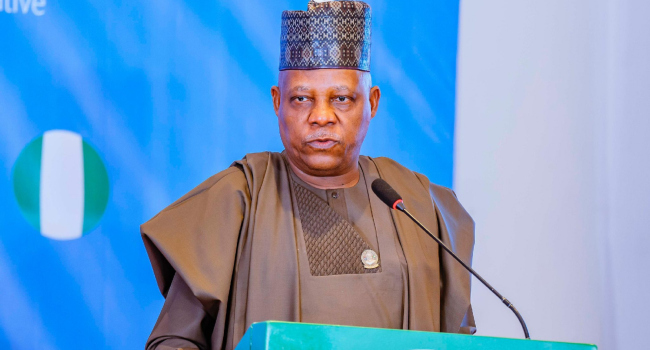
Vice President Kashim Shettima has said the federal government’s ongoing tax reforms are designed to improve the lives of Nigerians and reduce the burden on small businesses and low-income earners, rather than impoverish them.
Shettima made the remarks on Wednesday in Abuja while speaking on behalf of President Bola Tinubu at an interfaith breaking of fast held at the State House to mark the observances of Ramadan and Lent.
According to the vice president, the tax reforms are aimed at eliminating multiple levies and charges that have long burdened small businesses and ordinary Nigerians.
He said the policies were carefully designed to improve livelihoods and reduce poverty, contrary to claims by critics of the administration.
“The same people who are shouting hoarse that the tax reform is meant to pulverise further and pauperise the poor are far from the truth, but we have to go out and tell the truth to the people.
“We have to educate them. We have to mount the pulpits and take our government to the Nigerian people and tell them the truth,” Shettima said.
READ ALSO: New Tax Laws Don’t Impose 25% Levy On Building Materials, Others — Presidential Committee
He urged senior government officials to serve as advocates of the administration’s reforms by communicating the policies and their benefits to citizens across the country.
The vice president also highlighted some outcomes of the government’s broader economic reforms, including improved foreign exchange reserves, the streamlining of exchange rates, and the removal of the long-standing fuel subsidy.
Shettima commended President Tinubu for what he described as the courage to address structural economic challenges that previous administrations had avoided.
The former Borno State governor said that although the removal of the fuel subsidy was not initially mentioned in the President’s 2023 inaugural speech, the decision became necessary because the subsidy regime was draining national resources needed for development.
“Three years down the road, the economy has bounced back,” he said.
The vice president also expressed appreciation to government officials for their continued support of the administration’s policies.
“On behalf of the president, I want to thank you all for comradeship, support, and partnership,” he added.
Tax Reforms

Nigeria’s 2025 Tax Reform Acts, which took effect January 1, 2026, aim to simplify tax administration, remove nuisance taxes, and shift the burden from low-income earners to high-income individuals and large corporations.
It was signed into law last year after months of controversy and heated debates by Nigerians, especially the opposition members and civil society organisations.
The four bills – the Nigeria Tax Bill, the Nigeria Tax Administration Bill, the Nigeria Revenue Service (Establishment) Bill, and the Joint Revenue Board (Establishment) Bill – were passed by the National Assembly last year after months of extensive debates.
With the tax laws, lower-income earners benefit from higher income tax thresholds, while small businesses with lower turnover may receive exemptions.
Corporate tax is reduced to 25%, and a 4% development levy plus a 15% minimum tax for large multinationals is introduced. Essential goods like food and healthcare are zero-rated for VAT.
The Federal Inland Revenue Service has been renamed the Nigeria Revenue Service to serve as the central tax agency.

Leave a Reply