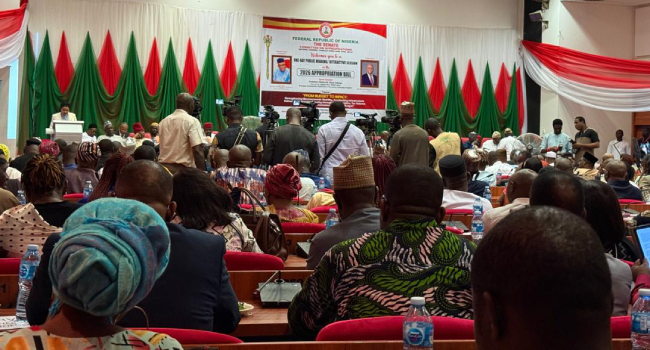
The Senate, on Monday, said any agency benefiting from service-wide votes without proper accountability would no longer be tolerated.
This is according to the Chairman of the Senate Committee on Appropriations, Senator Adeola Olamilekan, who warned that the 2026 budget would mark a decisive break from past spending practices.
READ ALSO: Peter Obi Joins Occupy National Assembly Protest Over E-Transmission Of Election Results
Speaking at a one-day public hearing on the 2026 Appropriation Bill, Senator Olamilekan stated that every expenditure item would be subjected to strict scrutiny to determine how public funds are utilised.
He called on ministries, departments and agencies (MDAs) to cooperate fully with oversight institutions to promote transparency, efficiency and fiscal discipline across government.
The lawmaker also declared that the National Assembly will no longer extend the implementation of federal budgets beyond December 31, insisting that delays undermine fiscal planning and accountability.
Olamilekan equally highlighted the electricity sector as a major drain on public finances, underpinning the urgent need for comprehensive reforms, including unbundling of the power sector.
He noted that electricity subsidies, which run into several trillions of naira annually, must be addressed to free up revenue for national development.
Heavy Debt-Servicing
He further expressed concern that government revenue remains inadequate to fund the proposed 2026 budget, which carries a deficit of ₦25.1 trillion.
According to him, budgeting without sufficient revenue raises serious questions about fiscal sustainability.
Responding to comments by a economic consultant, Mr. Adetilewa Adebayo, who warned that Nigeria’s estimated $3 trillion economic potential is being eroded by weak leadership and unsustainable borrowing, Senator Olamilekan noted that continued borrowing had become unavoidable due to heavy debt-servicing obligations inherited from previous administrations, including the military era.
Again, he said that high debt-to-revenue ratios were not unique to Nigeria, explaining that government revenues come in irregular inflows rather than bulk sums.
“If we project ₦5 trillion in a month, we may only realise ₦1 trillion, but the government must go on,” he stated.
The senator further stated that Nigeria must continue to service its debts to avoid a downgrade by international institutions such as the World Bank and the International Monetary Fund (IMF), warning that failure to meet financial obligations would damage the country’s credibility.
“Our debt service is a problem; we are servicing debt from previous administrations, even from the military era. We have no choice but continue to pay.
“An attempt by us to fail to meet any financial obligations, our rating will drop both in the World Bank and the IMF, and that’s not good for the country. We must try and free up so much of our revenue to address the deficit challenges confronting us,” Olamilekan added.

Leave a Reply