- 48 Comments
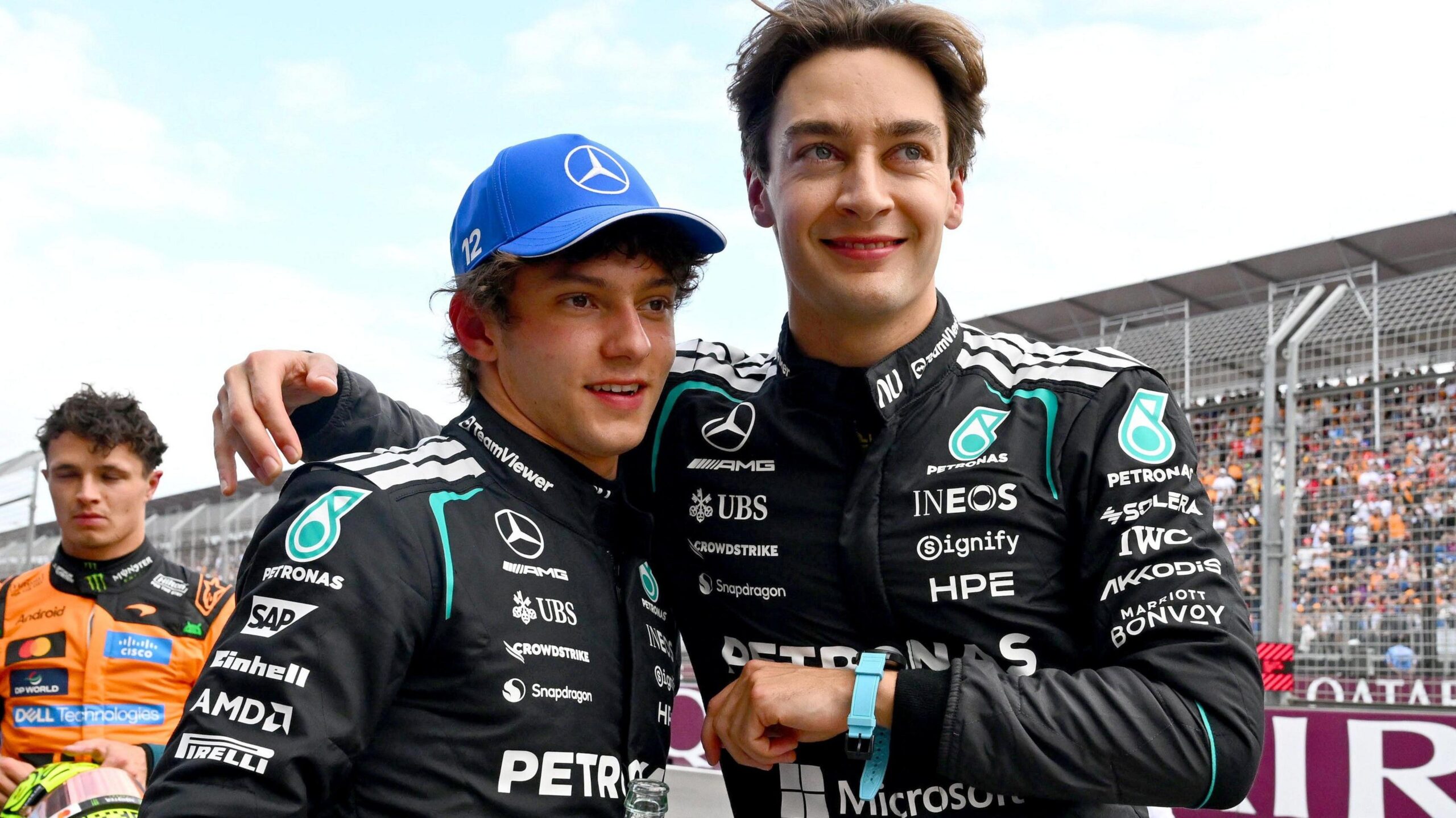
George Russell said he believed a “perfect storm” accounted for the chasm between Mercedes and their rivals in qualifying at the first race of the new Formula 1 season.
The Briton’s remarks were a reference to the fact that Max Verstappen, whom Russell said Mercedes believed was their closest rival, crashed without setting a time.
But it may also be that the remark works as a more general reflection of an Australian Grand Prix grid that looks as if it was a function of possibly the most controversial set of new rules F1 has ever seen.
McLaren’s Lando Norris, the world champion, said after qualifying sixth in Melbourne: “We’ve come from the best cars ever made in Formula 1, and the nicest to drive, to probably the worst.”
Norris was talking about the impact of electrical energy management on the way drivers operate their new cars, with engines that have a 50-50 split between internal combustion and electrical power, and the unusually large impact optimising that has on lap time.
- 3 hours ago
- 3 hours ago
- 3 days ago
“You just decelerate so much before corners,” Norris said. “You have to lift everywhere to make sure the (battery) pack’s at the top. If the pack’s too high, you’re also screwed.”
Not having the information one needs to maximise the engine has an impact on this – and Norris had lost out by reliability issues on Friday.
“It’s certainly just not been an easy weekend for me,” he said. “Just not a lot of laps, a lot of issues.
“The problem is now, it’s not like you can just get back in the car and drive what you once knew and just click. This car is just odd.
“Just getting into the rhythm of lifting everywhere to go quicker and using gears you don’t want to use and just understanding that when you lift more, you brake later but you have to brake less.
 Getty Images
Russell ended the day leading a Mercedes one-two from team-mate Kimi Antonelli and 0.785 seconds quicker than the first driver not in a Mercedes, Red Bull’s Isack Hadjar.
Russell said: “We knew we had a fast car beneath us. I don’t think we ever anticipated it to be this fast, but Max wasn’t there.
“We had him down as our top rival and if you look at his pace difference historically over the last seven years to his team-mate, you would have expected him to be in that mix as well.
“It was a bit of a perfect storm.”
There may be a significant element of truth to that, but there is no doubt that Mercedes have the fastest car and that they are going to take some beating for a while.
McLaren also have a Mercedes engine but their fastest driver, Oscar Piastri in fifth, was more than 0.8secs slower than Russell.
Most of McLaren’s time loss was on the long ‘straight’ run between Turns Six and Nine of the Albert Park circuit. Mercedes were simply able to deploy more energy along there – because they arrived at Turn Six with their battery more highly charged.
Team principal Andrea Stella said that the Mercedes was also faster in most of the corners but added: “How you exploit these power units to the best of their potential, this moves quite a lot of lap time.”
Why can McLaren not compete in this way yet? Because Mercedes are the works team. They built the engine, so for now have a more complete understanding of how it works.
Mercedes’ advantage is not just in power-unit management, however. They have also built a very good car.
Stella said: “Mercedes are quick in the corners, not only in the straights. There are a few corners in which we can compete with them, but overall they are faster in the grip-limited sections.”
But he added that this could also be partly to do with engine usage.
Australian Grand Prix
The fact that qualifying was run in cool conditions, when achieving the optimum tyre temperature is more difficult, could also have influenced this – as Russell pointed out, the Mercedes is better the cooler the conditions become, as it was for the past two years.
“We saw that McLaren, probably Ferrari as well, they kind of lost performance in relative [terms] through this qualifying as it got colder and colder,” Stella said.
Many of the drivers have made it clear they are not fans of these new rules, and the way they affect the use of engines – the need to lift before corners, or for speed to drop towards the end of the straights to harvest energy at full throttle and so on.
Norris said: “It’s certainly different, not like it was last year. Not like, ‘push this corner more,’ because sometimes if you push more, you lose the battery and go slower. You have to understand how to do things.
“Mercedes have obviously understood that, they are a good team and it’s their own engine. We will get there, it just takes time.”
 Getty Images
Russell said: “There are lots of mixed views on the new regs as a whole, but I do think the car regulations for everyone are definitely a step forward.”
The new engines could also have an impact in the race.
Starts are known to be difficult, because the removal of the motor that recovered energy from the turbo, which was also used to spin it up, has made it harder to get the turbos up to the right speed and get the cars off the line.
Some believe Ferrari have an advantage on this front with their engine, although not all agree.
But Charles Leclerc, 0.8secs slower than Russell in fourth place, does not sound optimistic that he can challenge the Mercedes in the race, even if by some electric start he can get into the lead.
Leclerc said that he had thought Mercedes would be ahead – but the size of the gap had surprised him just as much as it had Russell.
“It’s very surprising but at the same time we can only respect what they have done with their engine and the amount of performance they have found compared to the others,” he said.
“In the race, I can’t do anything. Yesterday in practice they were super strong and they didn’t have the engine turned up as much as this morning [in final practice].
“I don’t even know if they were full power in qualifying. Maybe they left a little bit because this morning was just crazy.
Related topics
- Formula 1
- 2 hours ago

- 3 days ago

- 5 days ago


Leave a Reply