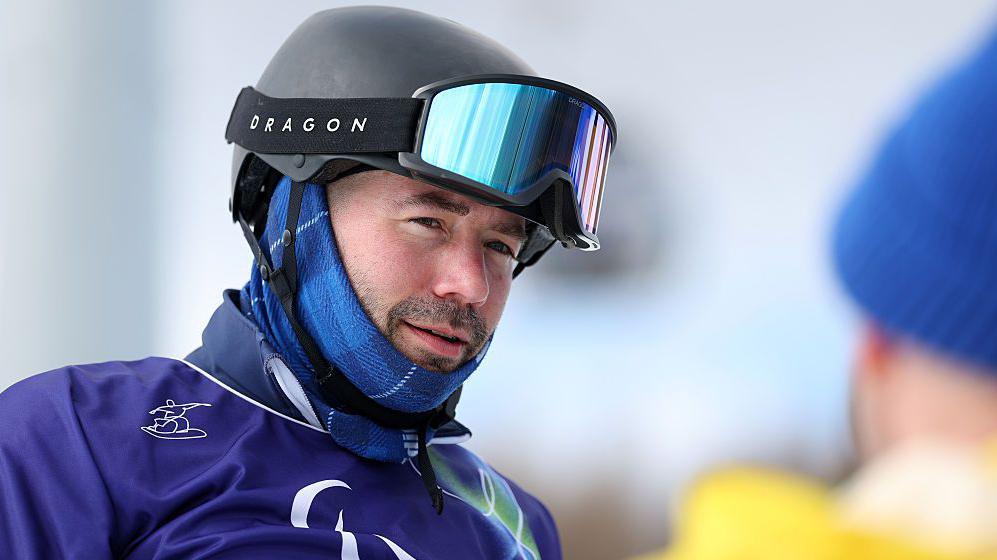
As Davy Zyw took his place in the start gate in Cortina on Sunday, eyes locked on the snowboard cross course in front of him and tartan snood pulled high around his neck, he stood as the very epitome of defiance in the face of adversity.
Surrounded by the rugged landscape of the Dolomites, Zyw was not expected to be here.
Diagnosed with motor neurone disease at the age of 30, he had been told he had just 18 months to live.
And yet, seven – nearly eight – years on, he has defied all expectation – and become the first athlete with MND to compete at a Winter Paralympics.
“The outlook can look pretty bleak, my health is going one way,” he told BBC Sport.
“I look at my health like I’m sliding down an icy slope and I’ve got to run up the other way just to maintain strength, maintain my function.
“But the pride, the positivity, the memories, the strength, the resilience I’ll take from this Paralympic experience is going to fortify the rest of my life.
When Zyw was diagnosed with MND, he was working as a sommelier and wine buyer in London. His first symptom was his left thumb going numb.
Initially misdiagnosed as carpal tunnel syndrome, Zyw “had no reason to think about this impossible, improbable diagnosis at the time”.
A third of those diagnosed with the devastating disease die within a year, half die within two. Zyw is one of the “lucky ones”.
While his disease has progressed slowly, he has now lost most of the functionality in his hands, and the muscles in his upper body are wasting away.
A return to snowboarding was one of the positives in the dark aftermath of his diagnosis.
Having learned to snowboard as a child on a dry slope in Edinburgh, he competed as a freestyler into his early 20s before a knee injury put paid to that.
“I learned very quickly that the only aspect of this diagnosis in my control is my attitude towards it,” he added.
“I couldn’t affect how quickly the disease was going to manifest itself, how quickly I was going to fall off a cliff, how quickly I was going to lose motor functions.
“When I held on to that positive message, every day became easier and that’s what I’ve done every day since.”
The Davy Zyw Fan Club has been out in full force at the Games, flying British and Scottish flags and donning blue beanies emblazoned with his surname to watch him in action.
On a bus up to the snowboard park, an impromptu chant of “No Davy, No Party” sounded out, renditions of which carried on throughout the day.
Among those singing course-side were Zyw’s wife Yvie and four-year-old son Aleksander, who was “shouting his head off in celebration and admiration” as his daddy whizzed past during the opening run.
That race, however, did not end as he had hoped – in hospital with two broken ribs after a heavy crash, having already injured his knee in official training.
Such is the pain from his broken ribs, he cannot laugh nor sneeze but nothing was going to stop him being back in the start gate for Friday’s banked slalom.
In that, he finished 19th – but that is irrelevant. This Paralympic experience was never about the medals or results.
“Two years ago I wouldn’t have been classifiable as a Para-athlete and in two years’ time I’m not going to be a competitive snowboarder,” he said.
“So I’m in this sort of tragic period of my diagnosis where I’m ill enough to be classified as a Para-athlete, but well enough to still be able to rip down on my snowboard.
 Getty Images
Since he was diagnosed back in 2018, Zyw has ploughed his efforts into raising money for MND causes, including the My Name’5 Doddie Foundation founded by late Scotland rugby player Doddie Weir.
He has cycled the 264-mile ‘High Five’ route in the Scottish Highlands, and from Edinburgh to Rome, but after achieving his biggest feat of reaching the Paralympics, he does not know what his next challenge will be.
He will return home to Edinburgh next week, the sacrifice he has made to spend so much time away from his wife and son “weighing heavy” given their time together is so precious.
“I’ve received some incredible messages from carers and loved ones of people who live with MND, people who’ve had loved ones lost to MND, and people who have just been recently diagnosed,” he said.
“I’m acutely aware I’m one of the lucky ones, so I feel very lucky to be here, use my platform and be here riding my snowboard.
“Every athlete dreams of medals, but the medal for me was to get here and represent the motor neurone disease community.
Related topics
- Winter Sports
- Disability Sport
- 17 hours ago

- 2 March


Leave a Reply