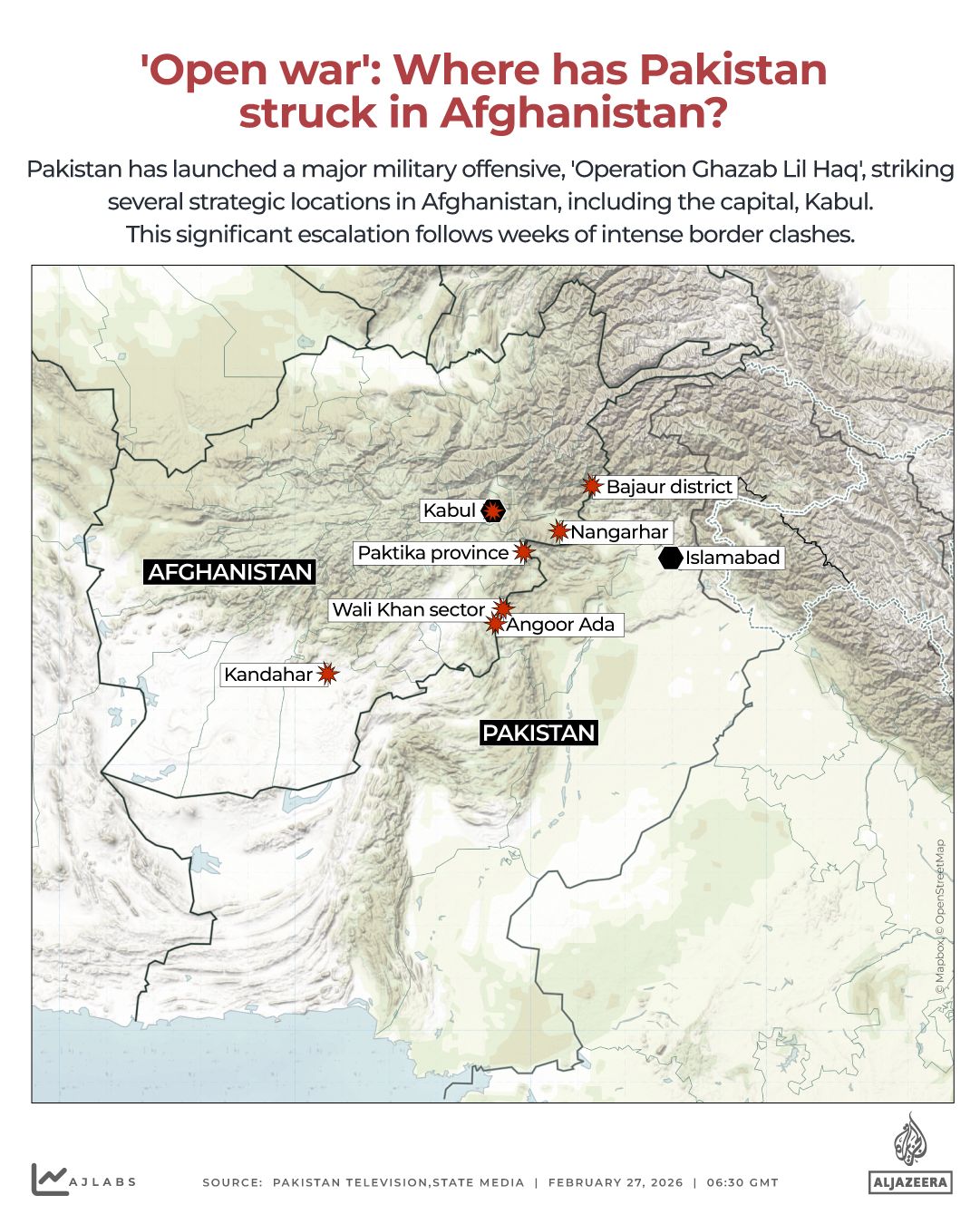
Pakistan has launched air strikes on Afghanistan’s capital, Kabul, and other cities, as clashes escalate along the two countries’ shared border.
On Friday, Pakistan’s Defence Minister Khawaja Asif said Islamabad’s patience had run out with the Taliban authorities in Afghanistan, declaring that Pakistan will now wage “open war”.
Recommended Stories
list of 2 itemsend of list
The declaration came hours after Taliban spokesperson Zabihullah Mujahid said Afghanistan was carrying out “large-scale offensive operations” against the Pakistani military along the Durand Line, which separates the two countries.
This follows weeks of fighting along the countries’ shared border, with both sides claiming that dozens of people have been killed.
Hostilities are taking place against a backdrop of an escalation in tensions between Pakistan and Afghanistan’s Taliban authorities since the latter’s return to power in 2021.
Here is what we know so far:
What has happened?
On Friday, Pakistani officials said Afghan forces had attacked military positions close to the border, prompting Islamabad to launch air strikes on targets inside Afghanistan, including in the capital, Kabul, and in other cities.
The first Pakistani strike occurred at about 1:50am local time on Friday (21:20 GMT on Thursday), Al Jazeera’s correspondent Nasser Shadid reported, with Afghan forces responding with anti-aircraft fire.
“Our cup of patience has overflowed. Now it is open war between us and you,” Pakistani Defence Minister Khawaja Asif said on X.
Pakistan called this Operation Ghazab lil Haq, which translates to “righteous fury”.
Which areas in Afghanistan have been hit by Pakistan?
Pakistan’s Information Minister Attaullah Tarar wrote on X that “Afghan Taliban defence targets” had been struck in Kabul, the southeastern Paktia province and southern Kandahar, while Defence Minister Khawaja Asif declared what he described as an “open war” with the Taliban government.
Afghan government spokesperson Mujahid also confirmed in an X post that these three provinces had been hit.
The Associated Press reported that the attacks had destroyed two brigade bases in Afghanistan, citing two senior Pakistani security officials who spoke to the agency on condition of anonymity as they were not authorised to speak to the media.
Pakistani state media outlet Pakistan TV claimed in a report that the country’s forces had “destroyed” a number of Taliban locations in a few hours.
According to the outlet, the locations attacked in Afghanistan included a Taliban brigade headquarters and ammunition depot in Kandahar, as well as Taliban posts in the Wali Khan sector, near the Shawal sector, in the Bajaur sector and in Angoor Adda.
Pakistan’s Ministry of Information said it was also targeting Afghan Taliban forces in several districts of Pakistan’s Khyber Pakhtunkhwa province: Chitral, Khyber, Mohmand, Kurram and Bajaur.
Later on Friday, gunfire and shelling were reported near the key Torkham border crossing between Afghanistan and Pakistan.
Al Jazeera’s Kamal Hyder, reporting from Islamabad, and the AFP news agency reported that shelling had been heard near the crossing in the morning.
AFP reported Afghan soldiers were heading towards the frontier.
The Torkham crossing has remained open for Afghans returning en masse from Pakistan, despite the land border being largely shut since fighting between the neighbours in October.
What do we know about casualties?
Reports from each side are conflicting.
Mosharraf Zaidi, the spokesperson for Pakistan’s prime minister, wrote on X early on Friday that in the attack on Friday morning, 133 Afghan Taliban forces had been killed and more than 200 were wounded.
He added that 27 Afghan Taliban posts had been destroyed, and nine had been captured. More than 80 “tanks, artillery pieces, and armed personnel carriers have been destroyed”, he wrote.
Pakistani news outlet Dawn reported that two Pakistani military personnel had died in the ongoing clashes.
Al Jazeera could not independently verify the casualty figures released by Pakistan.
The Taliban government, however, said only eight Taliban fighters were killed and 11 were wounded.
Afghanistan said its military had launched its attack on Pakistani military bases and outposts along the border early on Friday in retaliation against Pakistani strikes across the Afghan border on Sunday. It claimed its forces had killed 55 Pakistani soldiers, and captured two military bases and 19 military posts. Pakistan has dismissed this claim.
For its part, Pakistan said its air strikes last Sunday killed at least 70 “militants”, a claim dismissed by Mujahid, according to news outlets. Mujahid, instead, wrote on X that the attacks “killed and wounded dozens, including women and children”.
The provincial director of the Afghan Red Crescent Society in Nangarhar province, Mawlawi Fazl Rahman Fayyaz, said 18 people had been killed and several others were wounded on Sunday.
Former Afghan President Hamid Karzai, who does not hold an official position but remains an influential political figure, said the country “will defend their beloved homeland with complete unity in all circumstances and will respond to aggression with courage”.
“Pakistan cannot free itself from the violence and bombings – those problems it has created itself – but must change its own policy and choose the path of good neighbourliness, respect, and civilised relations with Afghanistan,” he wrote in an X post on Friday.
Why are Pakistan and Afghanistan fighting?
The current flare-up of violence between the two countries is the culmination of months of tension.
In October 2025, Afghanistan and Pakistan agreed to an immediate ceasefire during talks mediated by Qatar and Turkiye following a week of fierce and deadly clashes along their border.
The border between Afghanistan and Pakistan is called the Durand Line and spans 2,611km (1,622 miles). Afghanistan does not formally recognise this border, which it argues was an imposed colonial demarcation that illegitimately divided ethnic Pashtun areas between the two countries.
The neighbours have been embroiled in frequent clashes since the Taliban took over in 2021. Sami Omari, an expert in South and Central Asian security and strategic affairs, told Al Jazeera there have been 75 clashes between Afghan and Pakistani forces since 2021 – the same year that US and NATO forces withdrew from Afghanistan.
In particular, Pakistan wants the Taliban to rein in armed groups such as the Pakistan Taliban, known by its acronym TTP, which it says Afghanistan is harbouring. The TTP emerged in Pakistan in 2007 and is separate from the Taliban in Afghanistan, but shares deep ideological, social and linguistic ties with the group.
Armed attacks in Pakistan by the TTP and the Balochistan Liberation Army (BLA), which operates in the resource-rich Balochistan province, have surged in recent years. Khyber Pakhtunkhwa and Balochistan, which border Afghanistan, have borne the brunt of the violence.
“The Afghan Taliban, however, appear unwilling to seriously crack down on the TTP, partly due to prior affinities between the two groups but also out of fear of TTP militants defecting to its main rival, the Islamic State Khorasan Province,” Pearl Pandya, South Asia senior analyst at the US-based Armed Conflict Location & Event Data (ACLED), an independent, impartial conflict monitor, told Al Jazeera.
Pandya added that a serious escalation is “inevitable” if the Taliban in Afghanistan do not crack down on the TTP.
Elizabeth Threlkeld, director of the South Asia programme at the Stimson Center think tank in Washington, DC, told Al Jazeera that the latest clashes are not surprising, as they stem from months of “frayed” tensions between Pakistan and Afghanistan.
“It is significant to the extent that it represents perhaps a shift in strategy,” Threlkeld said, noting the “more aggressive, kinetic attacks” from Pakistan.
“But since then, we’ve seen a couple of terrorist attacks within Pakistan that were quite significant. So, no, I’m not surprised that after those cumulative attacks, that tensions have frayed and things have again gone in this direction, unfortunately.”
How has the world reacted?
“India strongly condemns Pakistan’s air strikes on Afghan territory that have resulted in civilian casualties, including women and children, during the holy month of Ramadan,” India’s Ministry of External Affairs spokesperson Randhir Jaiswal said.
“It is another attempt by Pakistan to externalise its internal failures,” he said.
United Nations Secretary-General Antonio Guterres has urged both sides to adhere to international law, according to a statement delivered by his spokesperson, Stephane Dujarric.
Iran’s Foreign Minister Abbas Araghchi has urged Afghanistan and Pakistan to resolve their differences through dialogue and good neighbourly principles.
“In the blessed month of Ramadan, the month of self-restraint and strengthening solidarity in the world of Islam, it is fitting that Afghanistan and Pakistan manage and resolve their existing differences within the framework of good neighborliness and through the path of dialogue,” Araghchi wrote in an X post.

Leave a Reply