Slider1
previous arrow
next arrow

News

Wales recall Mee against Ireland in Six Nations

Chris Kirwan

BBC Sport Wales
  • 141 Comments

Wing Ellis Mee returns to the Wales starting line-up for Friday night’s Six Nations game against Ireland in Dublin.

The Scarlets back will replace Gabriel Hamer-Webb at Aviva Stadium, while 21-year-old uncapped Bath centre Louie Hennessey could make his debut from the replacements bench.

Mee, 22, is one of three starting changes from the 26-23 defeat by Scotland with fly-half Dan Edwards and flanker James Botham coming in for the injured Sam Costelow and Taine Plumtree.

There is one positional switch with Alex Mann moving from open-side flanker to blind-side to accommodate Botham.

The Cardiff pair will pack down in the back row alongside in-form number eight Aaron Wainwright, who has been named in the side despite reports of a fitness concern.

    • 18 hours ago
    • 1 hour ago
    • 1 day ago

Tandy explains Wales changes for Ireland

Mee started against England and France in the first two rounds, but missed out against the Scots, when Hamer-Webb made his Test debut.

The Leicester wing showed flashes, but was also centre stage for the try by Darcy Graham that was created by Finn Russell’s sharp thinking from a quick restart.

The Scotland and Lions fly-half exploited the space left by former Cardiff back Hamer-Webb after he had chased Jarrod Evans’ successful penalty kick.

Murray came on for Hamer-Webb when he suffered an early nose injury and then was a permanent replacement for the final quarter.

Mee, who is strong in the aerial game, gets the nod for Dublin.

Botham came on in the first half of the game against Scotland and was an impressive performer, although he was also caught out by Russell’s restart.

Ospreys fly-half Edwards, who had started seven matches before being dropped against Scotland, will pull the strings after Costelow’s bright display was ended by an ankle injury.

Harlequins’ Jarrod Evans is again a replacement having been used off the bench five times by Tandy while not starting a Test match since 2021.

“There are a couple of enforced changes this week due to injury and then Ellis had played well in the opening couple of rounds, so we feel he deserves the opportunity again,” said Tandy.

Hennessey, who has played centre and wing for Bath, is in his second campaign with Wales after being an unused member of the squad in November 2025.

“Louie was unfortunate not to get his opportunity in the autumn, but he’s trained well,” said Tandy.

“He had a bit of a bump on his hand at the start of this campaign, but the way he’s recovered and put performances in the training environment has been very impressive. We’re all excited to see Louie go out in Dublin.”

Ireland v Wales, Aviva Stadium

2026 Six Nations

Watch on iPlayerListen on Sounds

Will Wales’ wait for a Six Nations win go on?

Tandy will ask his players to back up their encouraging performance against the Scots as they bid to cause an upset and end a 14-game losing run in the Six Nations that stretches back three years.

Wales have suffered 24 defeats in 26 internationals and have not beaten Ireland away in the Six Nations since 2012 or achieved a victory in Dublin since 2015 which was in a World Cup warm-up game.

The Irish suffered an opening round defeat by France in Paris, but have since beaten Italy and England to keep alive their title hopes, while they can also win the Triple Crown.

“This week it’s about backing up the performance against Scotland,” said Tandy.

“Going away from home is a different type of environment for our group, but the focus for us is improving on what we did last game.

“I thought the defence against Scotland was much improved, so we definitely want to double down on that going to Ireland.

Wales team to play Ireland

Wales: Rees-Zammit; Mee, James, Hawkins, Adams; Edwards, T Williams; Carre, Lake (capt), Francis, D Jenkins, Carter, Mann, Botham, Wainwright.

Related topics

  • Welsh Rugby
  • Wales Rugby Union
  • Irish Rugby
  • Rugby Union
  • Ireland Rugby Union

‘It’s better to be chased’ – the mentality of a title race

To play this video you need to enable JavaScript in your browser.

Michael Emons

BBC Sport journalist
  • 198 Comments

This season’s Premier League title race is finely poised and set for a thrilling conclusion.

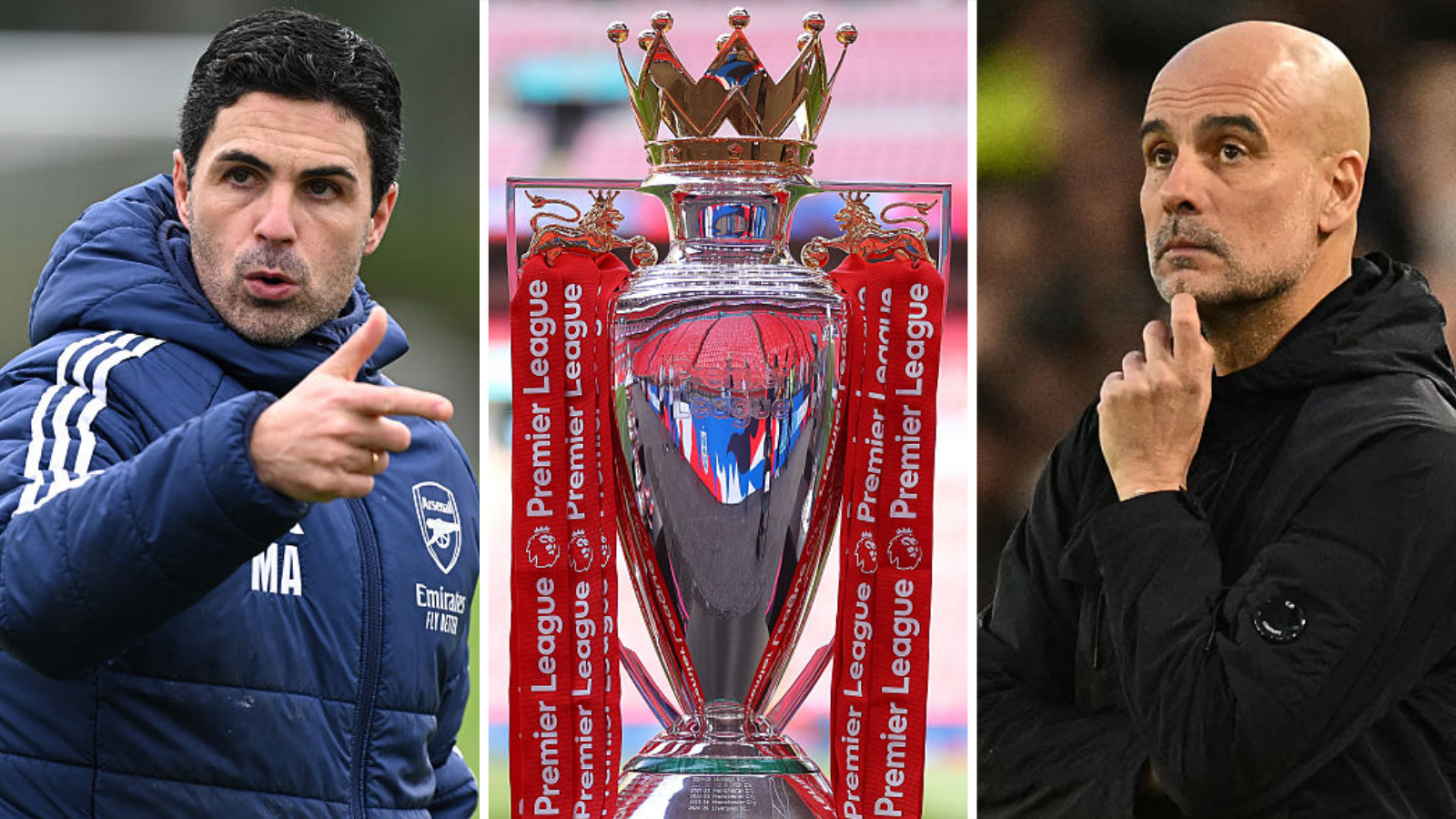
Arsenal, without a championship in 22 years, have nine games to go and hold a five-point lead over Manchester City, who have won the league in six of the past eight campaigns.

City have a game in hand and host the Gunners in April, meaning either team will win the league if they win all their remaining matches.

In 11 of the past 30 seasons, the teams that have been top after 28 matches have not won the Premier League title, with Arsenal failing to do so when leading in both 2023 and 2024.

So who will be feeling under the most pressure? Is it better to be the hunted or the hunter?

“It’s better to be chased,” said Premier League record goalscorer Alan Shearer, who won the league with Blackburn in 1994-95, a year after Rovers missed out to Manchester United.

“When you are at the top of the league it’s in your hands and if you keep winning your games, as difficult as it is, the teams that are chasing you don’t have any answers.

“It does depend on if you have been in that position before. In my second year at Blackburn we were top or second, it was slipping and sliding backwards and forwards. But because we had not been in that situation before and Manchester United were a team that had been successful then it was more difficult for us.

“The season after we were mostly top of the league but United were closing us down. They were saying and doing everything they could, including getting the correct results when we slipped up, and we found it difficult but we managed to find a way.”

Steph Houghton won three Women’s Super League (WSL) titles, two with Arsenal and one with Manchester City, and has experienced both sides of the championship race.

“The pressure is massive in both situations, but it is nice pressure when you are trying to chase trophies and league titles,” said Houghton.

    • 2 days ago
    • 3 days ago

‘You need to create a steely, calm determination’

For Manchester City and boss Pep Guardiola, ending strongly to win a title is nothing new. Two seasons ago they went unbeaten through their last 23 league matches, winning 19 of them, to finish two points clear of Mikel Arteta’s Arsenal.

City are also used to piling on the pressure before their title rivals play.

On the past 15 times when City have played a day before Arsenal, Guardiola’s side have won 11 of them, with three draws and just one loss – a 2-1 defeat by Newcastle in November.

Former Gunners defender Martin Keown, a three-time Premier League winner, thinks how Arsenal, runners-up in each of the past three seasons, cope with the pressure will define their campaign.

“It’s normal when you want something so much, sometimes it can get the better of you,” said Keown. “But there’s plenty of time to learn from it.

“They’ve not been in this situation where they’ve been in front too often. It’s almost about doing a reset here, which they’ve talked about in the past. If we were starting the season afresh, you’d just go after your opponent and just finish the job off.

“You also have to trust your team-mates in the moment. You need to try to create a steely, calm determination.”

Steve Bruce, who won three Premier League titles with Manchester United in the 1990s, said: “Arsenal have shown remarkable consistency so far.

“Every game, no matter where you play and who you play, it becomes difficult, especially if you’re in a title race and especially if you’re Arsenal, because they haven’t won it in so long.

“What you want at this time is the big players to perform. I was fortunate enough to play in a team where a certain Frenchman came to the fore – we always thought ‘Eric [Cantona] will get us out of trouble’.”

Joe Hart, a two-time Premier League winner with Manchester City, added: “There will be a lot of questions, a lot of noise on Arsenal – that is life at the top. There is no point in worrying, you have to live in your own world.

Title race ‘takes over your life’

William Saliba and Erling Haaland battle for the ballGetty Images

For the next few months, it will be tough for the players of both sides to not be thinking about winning the Premier League – even if they do not admit it publicly.

“We always talked about the title race in the dressing room,” added Bruce.

“You sometimes have to wait, because you don’t play at the same time. It drives you mad and you watch [your rivals]. There’s this nonsense that you don’t take any notice of it.

“Now is the real critical point, the big question mark is how you handle the pressure.”

Hart said the title race “takes over your life” and added: “It is difficult. Manchester City and Arsenal players will be living in a bubble now – no time to breathe, no time for anything else. It’s a great time of the season to be involved in.

“You will never appreciate these days, but you can’t enjoy them more at the time because you are involved in them.

Carabao Cup final could give winners momentum

There may be an indication of what will happen in the final two months on 22 March when Arsenal face Manchester City in the Carabao Cup final, with the winners gaining a potential psychological advantage in the title race.

Keown drew parallels with the 1998-99 season when Manchester United, Arsenal and Chelsea were involved in a thrilling title battle. United beat Arsenal 2-1 after extra-time in an FA Cup semi-final replay before going on to win the Treble of Premier League, Champions League and FA Cup.

“We’ve seen it in the past,” said Keown. “I remember being involved in 1999 when Manchester United beat us in that epic FA Cup semi-final, and they went on and won all before them.

“We didn’t fall off a cliff by any means, we only lost the league by a point and there was a lot of resolve there. But it could give you that extra energy that finally you’ve been rewarded as winners.

Related topics

  • Premier League
  • Manchester City
  • Arsenal
  • Football
    • 17 October 2025
    A graphic of Premier League players from every team in the division in 2025-26 season, with the Premier League trophy in front of them.
  • Quiz logo

More on this story

Will the US put ‘boots on the ground’ in Iran?

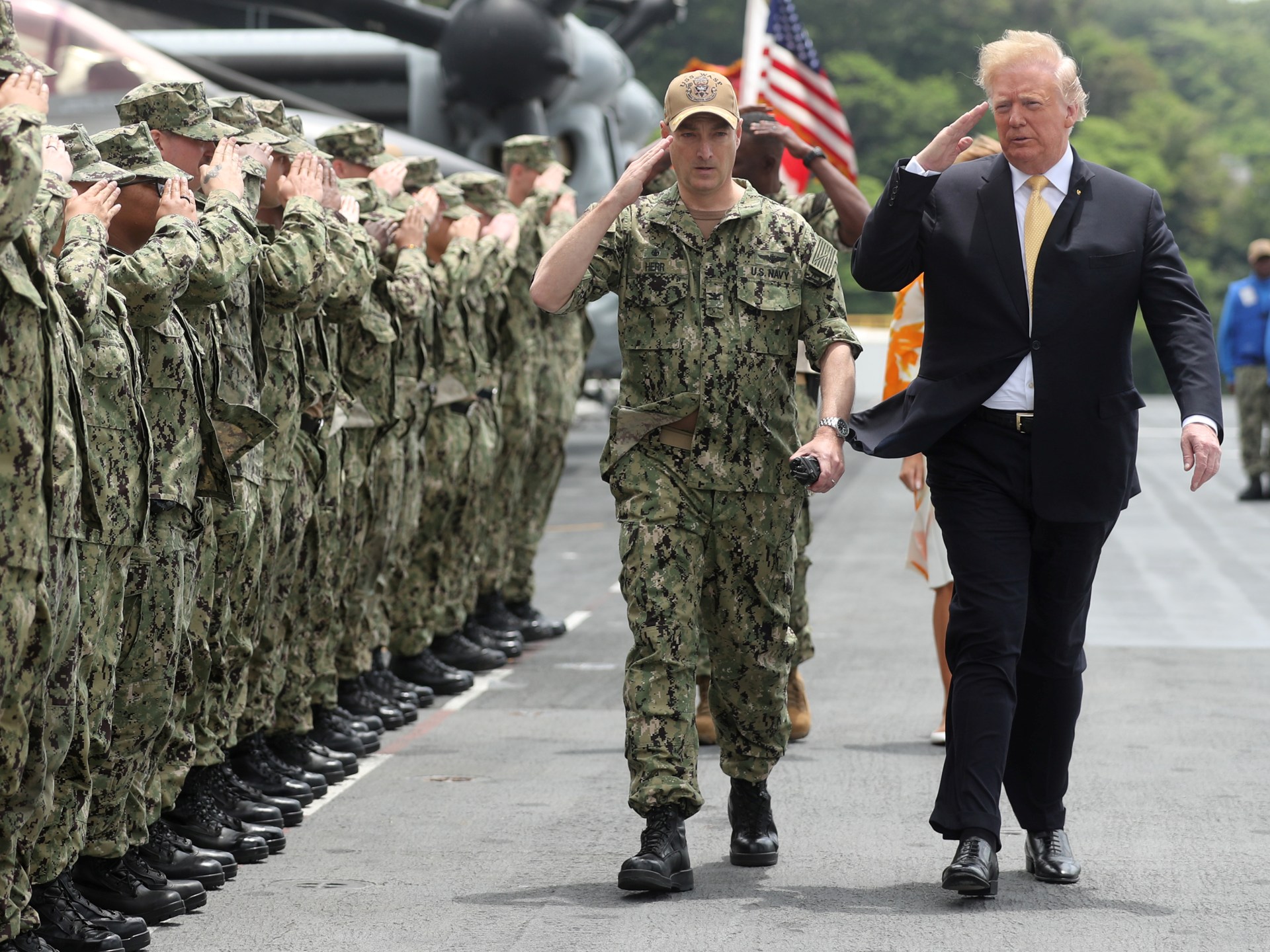
When US President Donald Trump casually floated the idea of putting US “boots on the ground” in Iran, he openly defied a longstanding presidential taboo. “Like every president says, ‘There will be no boots on the ground’. I don’t say it,” Trump declared amid the ongoing US-Israeli strikes on Iran.

But while the political rhetoric from Washington hints at a sprawling conflict, military experts argue that the reality on the rugged Iranian terrain will look vastly different from a traditional invasion.

Military and strategic analyst Colonel Nidal Abu Zeid told Al Jazeera it is unlikely the US is contemplating a traditional ground invasion involving tanks and massed infantry, but rather a different pattern of warfare.

‘Boots on the ground’ vs ‘pick-up’ operations

In his interview with The New York Post on Monday, Trump left the door open for the arrival of ground forces while expressing confidence in the current aerial campaign, dubbed “Operation Epic Fury“.

“I don’t have the yips with respect to boots on the ground – like every president says, ‘There will be no boots on the ground.’ I don’t say it,” Trump said following the strikes that killed Supreme Leader Ayatollah Ali Khamenei and dozens of other officials. “I say ‘probably don’t need them,’ [or] ‘if they were necessary’.”

US Secretary of Defence Pete Hegseth echoed this at a Pentagon news briefing, confirming no US troops are currently inside Iran but leaving the option on the table. “You don’t have to roll 200,000 people in there and stay for 20 years,” Hegseth said.

According to Abu Zeid, Hegseth’s and Trump’s comments align with what is militarily known as “pick-up” or selective operations. This involves limited efforts by special forces infiltrating specific points to execute precise sabotage or intelligence-gathering missions, followed by rapid extraction.

A traditional invasion to occupy territory is not viable, Abu Zeid said, citing Iran’s complex geopolitical environment, rugged geography and demographic density, all of which provide Tehran with a distinct defensive advantage. He noted that Israel has also previously declared a ground operation in Iran to be impractical.

The nuclear pretext and a shifting timeline

Trump revealed that the decision to launch the joint US-Israeli strikes came after “final talks” in Geneva collapsed on Thursday. The trigger, he claimed, was intelligence showing Iran had surreptitiously moved its nuclear enrichment programme to a “totally different site”.

In June last year, Trump had claimed that US strikes, known as “Operation Midnight Hammer,” had “obliterated” known Iranian nuclear facilities. “So then we found them working on a totally different area, a totally different site, in order to make a nuclear weapon through enrichment – so it was just time,” Trump said.

Trump said the operation is “way ahead of schedule”. Originally estimating the war would last around four weeks, Trump said the primary objective of eliminating the leadership structure – killing 49 top officials – had been achieved in a single day.

However, Abu Zeid pointed out that Trump’s initial reference to a four-week timeline is not merely operational; it is tied to US domestic law. The US Constitution restricts the president’s authority to wage war beyond 30 days without Congressional approval, making the “four-week” window a critical legal and political calculation.

The missile war and naval propaganda

While the Iranian command structure has taken a severe hit, Tehran has continued to retaliate. At least six US service members have been killed in action during the conflict with Iran, according to the US military.

Simultaneously, Iran’s Islamic Revolutionary Guard Corps (IRGC) claimed to have fired four cruise missiles at the US aircraft carrier USS Abraham Lincoln, which is stationed in waters close to Iran. Abu Zeid dismissed this claim as media “propaganda” designed to target the morale and prestige of the US military.

He explained that the carrier is protected by advanced RIM-116 Rolling Airframe Missile systems capable of high-altitude interception, backed by a multi-layered defensive umbrella from escorting destroyers. Furthermore, US reconnaissance aircraft, notably AWACS early-warning planes, maintain constant surveillance, making undetected missile launches highly improbable.

Approximately 72 hours into the confrontation, Abu Zeid said, a drop to a medium-intensity level in Iranian missile attacks was observed. He attributed this decline to the likely destruction of Iranian launch platforms. While higher estimates suggest Iran possesses about 3,000 ballistic missiles, it relies on only a few hundred launchers. In a missile war, the destruction of platforms is just as critical as the depletion of the missile stockpile itself.

Domestic pushback

Despite the military momentum, Trump faces scepticism at home. A Reuters/Ipsos poll showed only 27 percent of Americans approved of the strikes, while a CNN/SSRS poll placed approval at 41 percent.

Trump dismissed the numbers, insisting a “silent majority” supports the preemptive action to prevent “crazy people” from acquiring a nuclear weapon and citing a 47-year history of Iranian hostility that includes the 1979 embassy hostage crisis and the 1983 Beirut barracks bombings.

Meanwhile, Abu Zeid noted that US and Israeli intelligence may have underestimated Iran’s ability to quickly repair its chain of command. By adopting a doctrine of “centralised planning and decentralised execution”, Tehran has managed to absorb the initial shock and maintain its missile barrage despite heavy US electronic jamming and technological superiority.

Heated Doncic interaction ‘very normal’ – Redick

Ben Collins

BBC Sport journalist
  • Comments

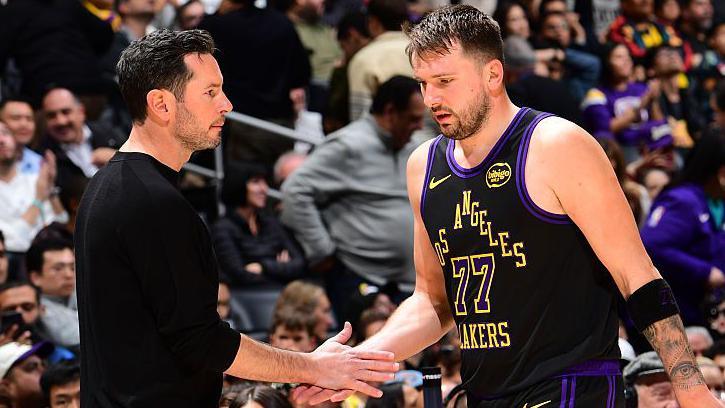
Los Angeles Lakers coach JJ Redick says he and star player Luka Doncic have a “great relationship” despite a heated exchange between the pair that went viral.

The Lakers were on a three-game losing streak going into Saturday’s game at the Golden State Warriors but were leading comfortably when Doncic was replaced late in the first quarter.

The Slovenian, 27, tried to avoid a fist bump from Redick as he walked to his seat on the bench, and the Lakers coach then followed Doncic down the sideline.

The pair exchanged words as Doncic took his seat before Redick turned to walk back towards half court.

As he did, Doncic got back to his feet and said more towards Redick while his team-mate Jarred Vanderbilt stood up, ostensibly to clap encouragement for the Lakers but also putting a barrier in front of Doncic, who sat back down moments later.

Speaking before Tuesday’s 110-101 win over the New Orleans Pelicans, Redick said: “I don’t know why it went viral. It felt very normal to me.

“I didn’t think much of it at the time, to be honest with you. I don’t think Luka did either.”

Doncic had claimed four points and three assists by that point, and returned on Saturday to finish with a game-high 26 points.

The six-time All-Star scored another game-high 27 points as the Lakers won a third straight game on Tuesday to stay sixth in the Western Conference standings.

“He and I have a great relationship,” Redick added. “I really value our relationship. And I think those things happen. Not every game, but they happen very frequently.

“It’s a competition. And there’s two guys here who, in this case, are trying to win a basketball game and be on the same page about stuff.”

The Western Conference leaders Oklahoma City Thunder beat the Chicago Bulls 116-108 on Tuesday while second-placed San Antonio Spurs thumped the Philadelphia 76ers 131-91.

Related topics

  • Basketball

More on this story

    • 1 day ago
    Giannis Antetokounmpo, wearing number 34, dribbles the ball against Hugo Gonzalez, the Boston Celtics's 28

What we know on day five of US-Israeli attacks on Iran

The United States and Israel have continued to carry out strikes on Iran, bombing government, military and civilian infrastructure as the conflict spreads to Lebanon, where Israel has been carrying out an intense bombardment.

The US consulate in Dubai was in flames on Tuesday as Iranian retaliatory strikes continued in the Gulf, escalating tensions in the Middle East.

Recommended Stories

list of 1 itemend of list

Iran has launched hundreds of missiles and drones as it expanded its attacks to energy infrastructure and diplomatic compounds.

The conflict, which entered its fifth day on Wednesday, has also sparked political debate in the US, with the opposition Democrats questioning Trump’s decision to attack Iran.

Here is what we know:

In Iran

  • Nuclear facilities: The Natanz nuclear facility was struck during the military operations, though Iranian media reports that no radioactive leakage has been recorded.
  • Iranian retaliation: According to US Admiral Brad Cooper, Iran has launched more than 500 ballistic missiles and 2,000 drones in retaliation.
  • These attacks have hit the US embassy in Saudi Arabia and struck near the US consulate in Dubai in the United Arab Emirates.
  • Ongoing operations: Israeli PM Benjamin Netanyahu confirmed that Israeli pilots are flying over Iran and Tehran, stating that Israel will continue to strike the country “with force”.
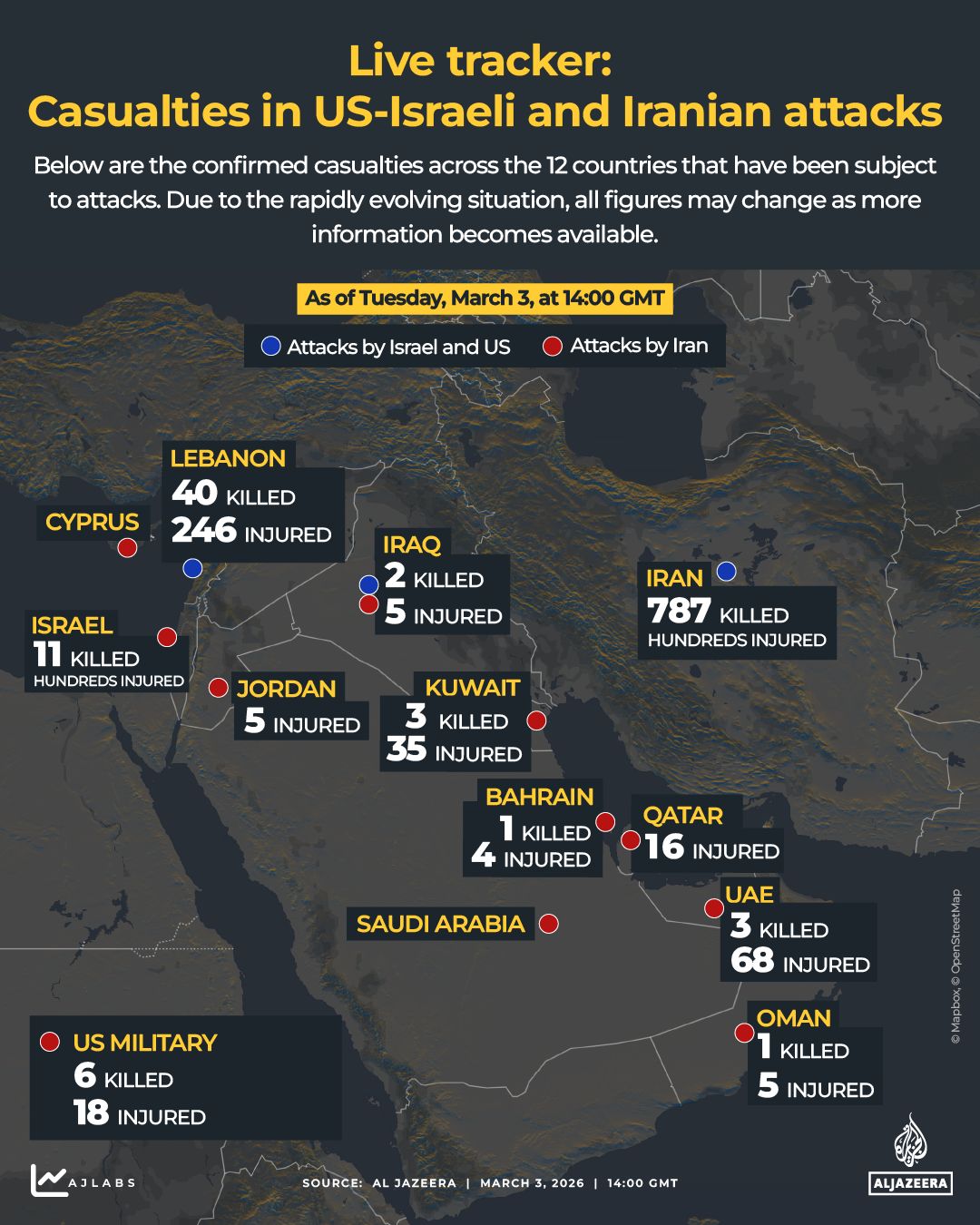
  • Rising death toll: After four days of fighting, officials report that nearly 800 people have been killed in Iran, and 50 in Lebanon.

In Gulf nations

  • Regional security and infrastructure threats: Iran has launched strikes on energy infrastructure across the Gulf and warned that it will target “all economic centres in the region” if US-Israeli attacks continue.
  • Qatar: Qatari air defence systems intercepted projectiles in the skies over Doha, causing loud bangs.
  • The Gulf country has also said it has arrested 10 suspected spies operating for the Islamic Revolutionary Guard Corps (IRGC).
  • Saudi Arabia: Saudi authorities reported that two drones struck the US embassy in Riyadh, which caused a limited fire and minor damage.
  • Oman: Citing “ongoing activity,” the US embassy in Muscat instructed its staff and all American citizens in Oman to shelter in place and find secure locations until further notice.
  • Vessel Struck off UAE Coast: The British maritime security tracker (UKMTO) reported that a vessel was hit by an unknown projectile 7 nautical miles east of Fujairah, United Arab Emirates. Separately, a drone struck near the US consulate in Dubai.
Smoke rises after reported Iranian missile attacks, following United States and Israel strikes on Iran, as seen from Doha, Qatar
Smoke rises after reported Iranian missile attacks on Qatar following United States and Israeli strikes on Iran, as seen from Doha [FILE: Mohammed Salem/Reuters]

In Israel:

  • Attacks inside Israel: The Lebanese armed group Hezbollah claims to have fired rockets at Israeli forces in the northern town of Metula.
  • Additionally, the Iran-aligned Hezbollah announced that it has carried out a missile attack on a naval base in Haifa.
  • Israeli military operations: Israel is a primary actor in the continuing multi-front conflict, actively bombarding targets in both Iran and Lebanon. In Lebanon, Israeli air attacks have killed at least 50 people and wounded 335.
  • Air strikes on Hezbollah: The Israeli military has struck approximately 60 Hezbollah targets in southern Lebanon, hitting weapons storage facilities, command centres and missile launchers.
A missile launched from Iran is intercepted, amid the U.S.-Israeli conflict with Iran
A missile launched from Iran is intercepted, amid the US-Israeli conflict with Iran [Amir Cohen/Reuters]

In the United States

  • US political stance: Trump stated that “the big scale hitting goes now,” promising that Iran is “in for a lot of hurt”.
  • Despite the heavy military action, Trump maintains that a US-led regime change is not the primary goal, suggesting instead that “someone from within” the current Iranian government might be the best choice to take power once the war concludes.
  • Political fallout: Domestically, the war has led to intense political debate due to shifting justifications from the Trump administration. Trump stated he ordered the attacks because he believed Tehran was preparing to strike first.
  • The US Senate is scheduled to vote on the War Powers Act in an attempt to test whether President Trump has the authorisation to wage these military operations.
  • US-UK diplomatic rift: Trump heavily criticised UK Prime Minister Sir Keir Starmer, stating, “This is not Winston Churchill we’re dealing with.” This comes after Starmer refused to support the military operation or allow the US to launch attacks from the joint UK-US base at Diego Garcia.
  • Lawmakers warn of a ground war: Following a three-hour briefing by Secretary of State Marco Rubio, Democratic lawmakers are sounding the alarm that the US could be drawn into a prolonged ground war.
  • Death toll: The US identified four American soldiers who were killed during an Iranian retaliatory strike on a military facility in Kuwait, bringing the total confirmed US deaths to six.
Demonstrators display signs as they march past Trump Tower, while taking part in a protest against the U.S.-Israel conflict with Iran
Demonstrators display signs as they march past Trump Tower, while taking part in a protest against the US-Israeli conflict with Iran [Reuters]

In Lebanon, Iraq and Jordan

  • Lebanese government stance: The Lebanese government officially banned Hezbollah’s military activities on Monday and demanded that the group hand over its weapons to the state.
  • Pressure from Israel: Israel’s ambassador to the UN, Danny Danon, agreed with the calls for Hezbollah to disarm, but urged the Lebanese government to “act now,” emphasising that “statements do not dismantle rockets… only action does.”
  • Iraq: Airstrikes have targeted sites used by pro-Iran armed groups, including Kataib Hezbollah and Asa’ib Ahl al-Haq, in western and northeastern Iraq.
  • Czech Evacuations: The first Czech government evacuation plane, a military Airbus carrying about 40 passengers, flew out of Jordan and successfully landed in Prague.
  • Slovak Evacuations: Similarly, the first two evacuation flights organised by the Slovak government flew out of Jordan and landed in Bratislava, bringing 127 people to safety.

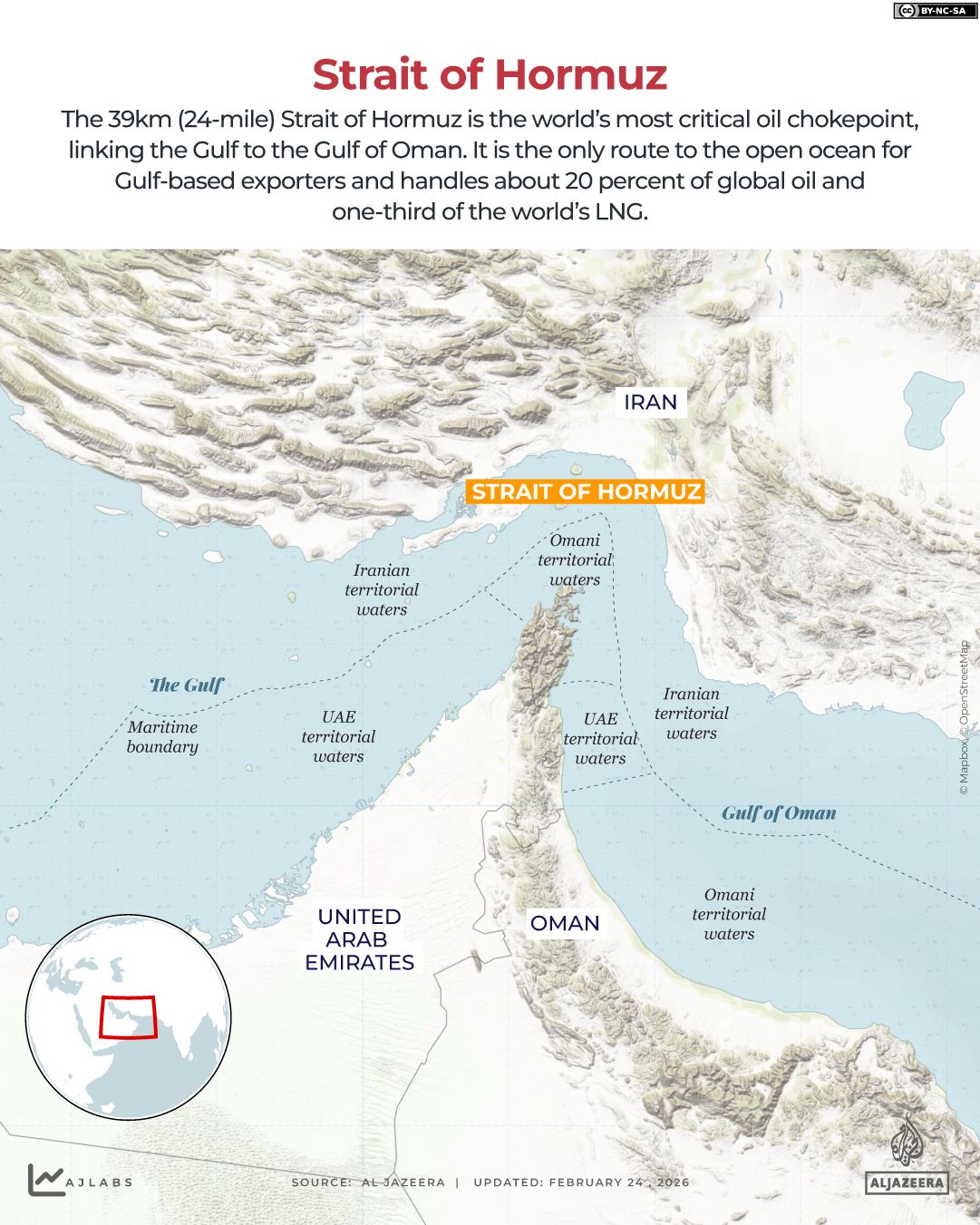
IRGC says Iran in ‘complete control’ of Strait of Hormuz amid Trump threats

Iran’s Islamic Revolutionary Guard Corps (IRGC) has said it maintains full control of the Strait of Hormuz, where United States President Donald Trump has said he is prepared to deploy the navy to escort tankers.

“Currently, the Strait of Hormuz is under the complete control of the Islamic Republic’s Navy,” IRGC Navy official Mohammad Akbarzadeh said on Wednesday in a statement carried by Iran’s Fars news agency.

Recommended Stories

list of 3 itemsend of list

About a fifth of the world’s oil is shipped through the all-important narrow passage of water.

However, a Reuters news agency report said in a rare voyage, an oil tanker sailed through the Strait of Hormuz en route to a United Arab Emirates port to load crude.

The tanker, Pola, switched off its AIS tracker late on Monday, when it approached the strait, and the vessel reappeared on Tuesday off Abu Dhabi, according to sources and ship-tracking data, Reuters added.

The US-Israeli war on Iran is disrupting the global supply chain, with shipping closed in the vital Strait of Hormuz and planes carrying air cargo grounded by the closure of airspace in the Middle East.

Al Jazeera’s Tohid Asadi, reporting from Tehran, said the IRGC stated it was “impossible for any ships to pass through” and that more than 10 oil tankers were targeted.

Clarksons Research, which tracks shipping data, estimates that about 3,200 ships, or about 4 percent of global ship tonnage, are idle in the Gulf, although that includes about 1,230 that likely operate only within the Gulf, The Associated Press news agency reported.

Meanwhile, about 500 ships, or 1 percent of global tonnage, are currently “waiting” outside the Gulf in ports off the coast of the UAE and Oman, according to the firm.

Amid Iran’s stranglehold on tanker movement through the strait, Brent crude prices rose to more than $82 a barrel, up more than 13 percent since the start of the conflict and the highest since July 2024.

Trump said in a post on Truth Social on Tuesday that the US Navy will begin escorting tankers through the Strait of Hormuz “as soon as possible”.

“No matter what, the United States will ensure the FREE FLOW of ENERGY to the WORLD,” he added. “The United States’ ECONOMIC and MILITARY MIGHT is the GREATEST ON EARTH — More actions to come,” he said.

Pakistan seeks alternatives

Islamabad has asked Saudi Arabia to route oil supplies through the Red Sea port of Yanbu after the closure of the Strait of Hormuz disrupted shipping, the Ministry of Energy of Pakistan said in a press release on Wednesday.

“Saudi Arabian sources had assured security of supplies through the Port of Yanbu on the Red Sea, which can help meet energy requirements,” read the release, adding that one vessel has been arranged to sail to Yanbu to lift crude for Pakistan.

Riyadh reaffirmed it would support Pakistan in meeting its emergency energy needs, it added.