A favourite tactic of war is to try to decapitate the enemy leadership. While such strategies might work in certain contexts, in the Middle East, they have proven to be a disastrous choice.
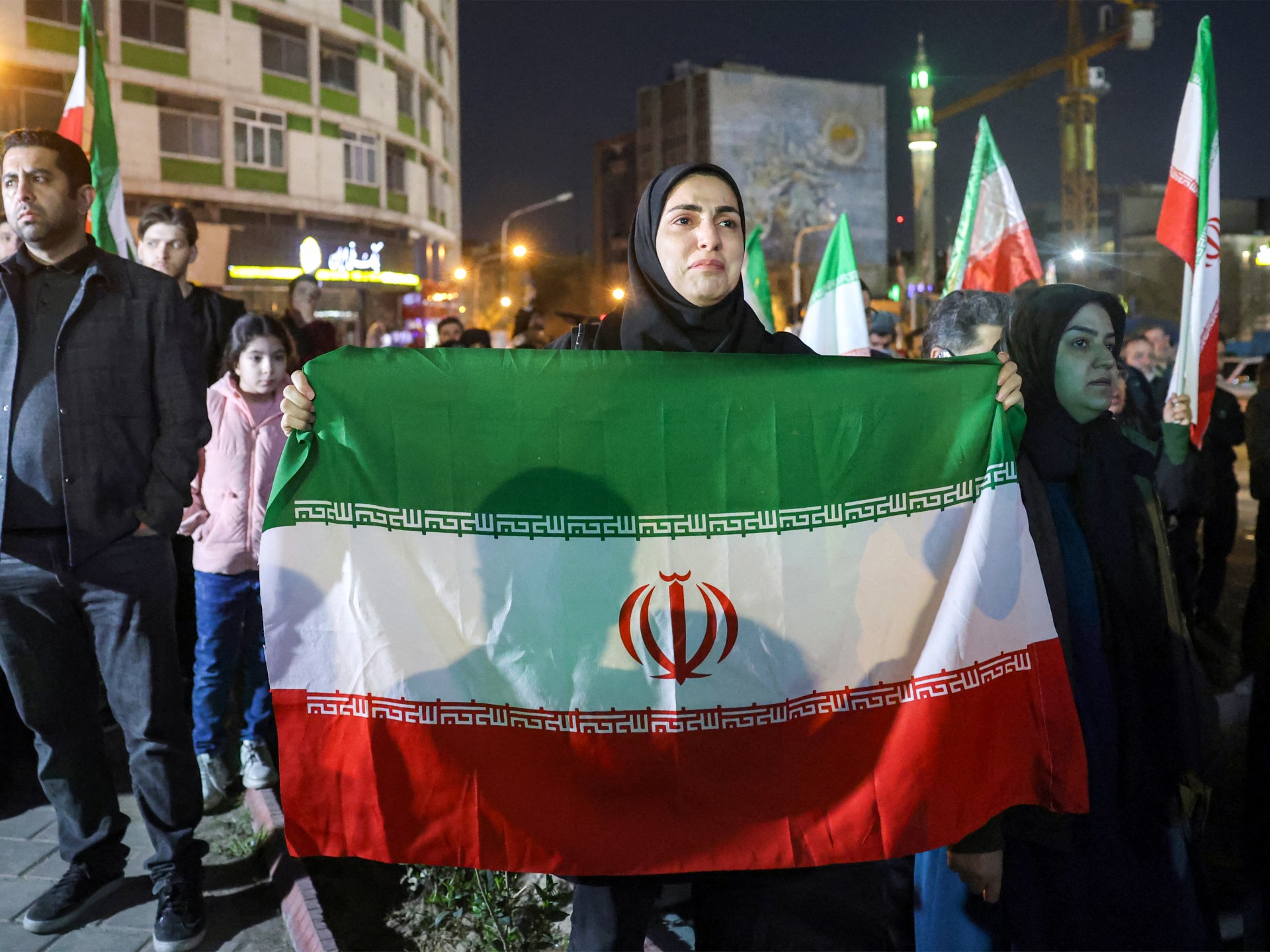
For sure, the assassination of an enemy leader might give a quick boost of popularity amid war. Certainly, United States President Donald Trump and Israeli Prime Minister Benjamin Netanyahu are basking in the limelight of their perceived “success” in assassinating Iranian Supreme Leader Ali Khamenei.
But killing an 86-year-old man who had already been planning his succession due to his ill health is not that much of a feat considering the overwhelming firepower that the US and Israel together possess. More importantly, eliminating him does not necessarily mean that what follows would be a leadership or a regime that would accommodate Israeli and US interests.
That is because leadership assassinations do not lead to peaceful outcomes in the Middle East. They can open the door for much more radical successors or for chaos that leads to violence and upheaval.
A brief glance at recent history shows that whenever Israel and the US have tried the idea of leadership “decapitation” in various conflicts in the region, the results have been disastrous. In the case of Iraq, its leader Saddam Hussein was captured by US forces and handed over to allied Iraqi forces who executed him. This ended a regime that was openly antagonistic to Israel, but it also opened the doors for pro-Iranian forces to take power.
As a result, in the following two decades, Iraq served as a launching pad for Iran’s regional proxy strategy, which saw it build a powerful network of nonstate actors that threatened US and Israeli interests.
The security vacuum created by the US invasion triggered various insurgencies, the most devastating of which was the rise of ISIL (ISIS), which swept through the Middle East, killing thousands of innocent people, including US citizens, and triggering a massive refugee wave towards US and Israeli allies in Europe.
Another case in point is Hamas. Since the early 2000s, Israel has repeatedly tried to assassinate its leaders. In 2004, it succeeded in killing its founder Sheikh Ahmed Yassin and then his successor Abdel Aziz Rantisi, who was considered a moderate. A few assassinations later, Yahya Sinwar was elected head of Hamas in Gaza and went on to plan the October 7, 2023, attack.
Hezbollah has a similar history. Its late leader Hassan Nasrallah, who successfully led the expansion of the group to a formidable nonstate power, ascended to its leadership after Israel assassinated his predecessor Abbas al-Musawi.
Two and half years of war and mass killing of leadership may now have devastated both armed groups, but Israel has failed to assassinate the idea behind them: resistance to occupation. The current lull in fighting may be the quiet before another storm.
In the Iranian case, it is highly unlikely that whoever replaces Khamenei would be as open to negotiations as he was. The statements by the Omani interlocutors during the talks in Muscat and Geneva pointed to major concessions on the nuclear issue that Iran under Khamenei was prepared to make. It is unlikely that his replacement would have the political space to follow suit.
If Israel and the US continue their campaign and really push for state collapse in Iran, what comes out of that ensuing chaos could be anyone’s guess. But if we are to go by recent experiences in Iraq and Libya, a security vacuum in Iran would have devastating consequences for US allies in the region and in Europe.
That raises the pertinent question of what Israel and the US stand to gain from their “decapitation” strategy in Iran.
For Netanyahu, the assassination of Khamenei is a major success. Facing crucial elections that could mean the possible end of his political life and maybe his imprisonment over four corruption charges, the short-term gain in popularity and votes is worth it. Israeli leaders do little thinking and planning on the mid- to long term and do not have to bear the consequences of military adventurism abroad. After all, Israeli society is very much in favour of it.
But for Trump, the gains are not as apparent. He gets to brag about killing an 86-year-old ailing leader of a faraway country to a public that has no appetite for war. At a time of a continuing cost-of-living crisis in the US, he is spending billions of taxpayer dollars to fight a war against a country that posed no imminent threat, a war that many Americans are increasingly identifying as “Israel’s war”.
Instead of projecting power, Trump risks showing weakness and being seen as a US president fooled into starting a costly war to ensure the political survival of the prime minister of a foreign country.
It is clear for now that the US president has drawn a line at putting US boots on the ground. At some point, he will have to end the bombardment campaign and pull US troops. He will leave behind a disaster that US allies in the region will have to bear the brunt of. US regional alliances are sure to suffer. Domestic audiences are sure to ask questions.
This will be yet another US military adventure in the region that will cost US taxpayers’ money, US soldiers’ lives and foreign policy clout and offer no return. The hope is that Washington may finally learn its lesson that assassinations and decapitation strategies don’t work.
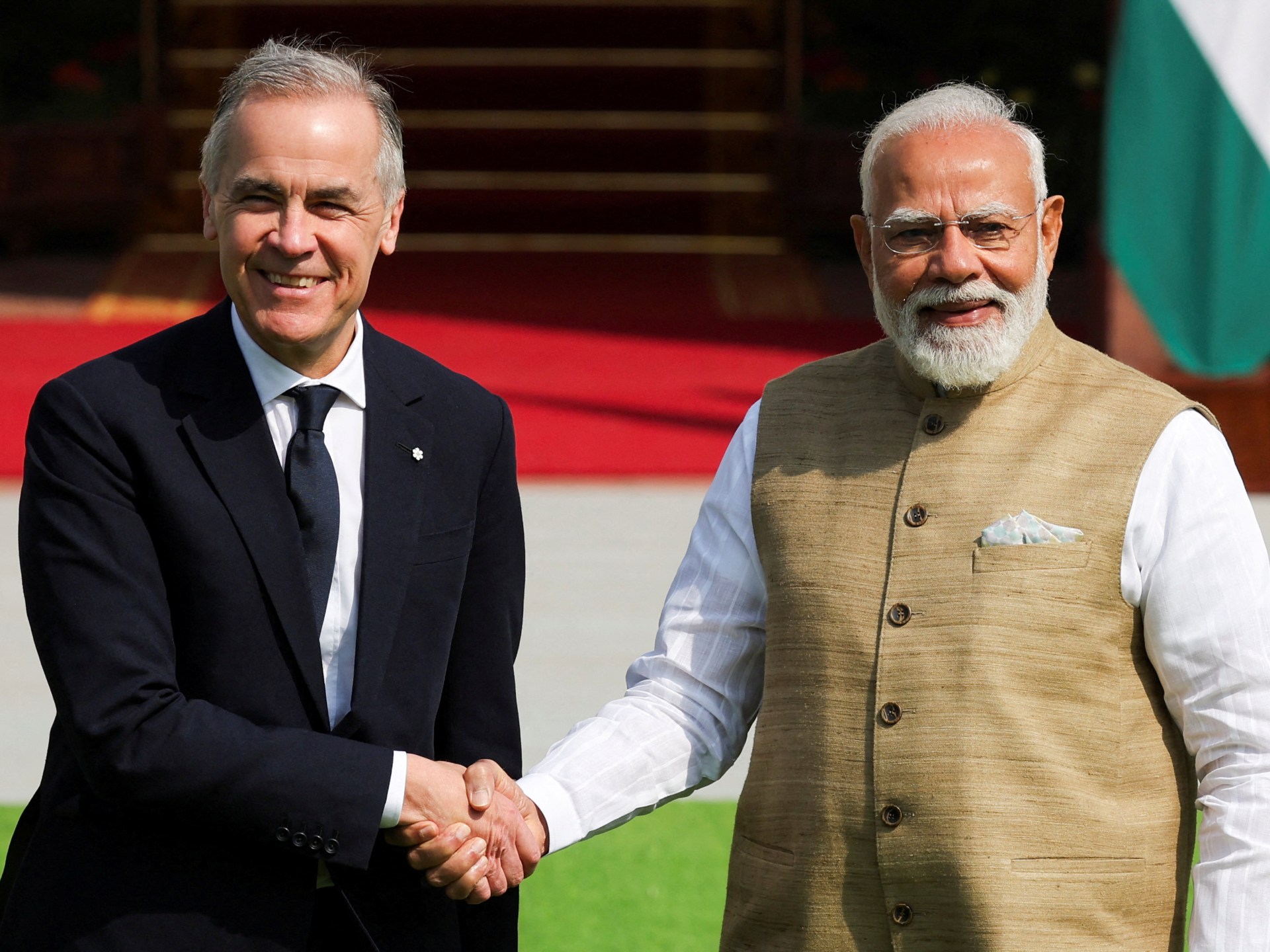
India and Canada will aim to conclude a free trade pact by the end of this year, says Canadian Prime Minister Mark Carney, as the two countries seek to boost economic ties after two years of a strained relationship.
Speaking after talks with Carney, Indian Prime Minister Narendra Modi on Monday said the two countries would soon finalise a “comprehensive economic partnership” which is expected to increase bilateral trade to $50bn by 2030 from nearly $9bn in 2024-25.
Recommended Stories
list of 4 itemsend of list
India and Canada began advancing negotiations on a long-pending trade agreement last year. Carney said the two sides were aiming to conclude the deal by the end of the year.
“This is not merely the renewal of a relationship. It is the expansion of a valued partnership with new ambition, focus, and foresight,” he said on his first official trip to New Delhi.
The two sides also agreed on a $2.6bn uranium deal and will work on building small modular nuclear reactors and advanced reactors.
“In civil nuclear energy, we have concluded a landmark deal for the long-term supply of uranium,” Modi said.
The Indian government and Canada’s Cameco have signed a uranium supply agreement to support India’s nuclear ambitions and to work towards a clean, reliable base load power, Carney added.
The two countries would also work to strengthen defence industries and enhance maritime domain awareness, Modi said.
Carney’s four-day visit to India is a key step forward in ties that effectively collapsed in 2023 after Ottawa accused the Modi government of orchestrating a deadly campaign against suspected Sikh separatist activists in Canada, accusations New Delhi rejected as “absurd”.
The dispute deepened and led to expulsions of diplomats and the freezing of trade negotiations.
“There has been more engagement between the Canadian and Indian governments in the last year than there has been in more than two decades combined,” Carney said in a speech alongside Modi.
“This is not merely the renewal of a relationship. It is the expansion of a valued partnership with new ambition, focus, and foresight, a partnership between two confident countries charting our own course for the future.”
Both India and Canada are looking to diversify trade away from the United States due to tariff announcements and deepen cooperation in areas such as clean energy, critical minerals and agricultural value chains.
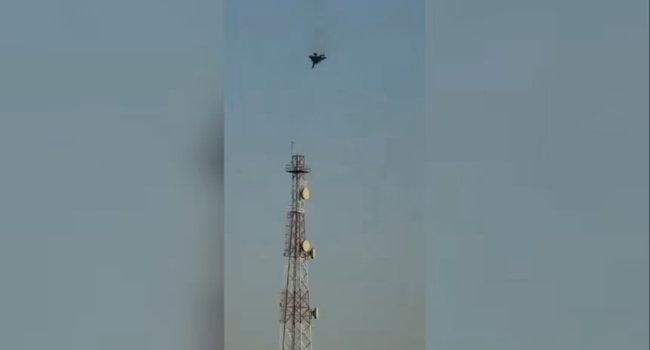
Several American warplanes crashed in Kuwait on Monday morning but their crew survived, Kuwait’s defence ministry said, as Iran pressed on with a third day of strikes in the Gulf.
“Several US warplanes crashed this morning. Confirming that all crew members survived,” a defence ministry spokesman said in a statement, adding that the cause was under investigation.
“Authorities immediately initiated search and rescue operations, evacuating the crews and transporting them to a hospital for medical evaluation and treatment. He noted that their condition is stable,” the statement added.
Black smoke rose from the US embassy in Kuwait on Monday, an AFP correspondent saw, while US warplanes crashed without causing casualties, as Iran pressed on with a third day of retaliation in the Gulf.
A US base and a power station were also targeted, in what was the most dramatic escalation for the small Gulf country in decades, after the 2003 US invasion of Iraq and Baghdad’s attempt to take over Kuwait in 1990.
Blasts also rang out over the Gulf cities of Abu Dhabi, Dubai, Doha and Manama as Iran targets America’s Gulf allies after the killing of its supreme leader in US-Israeli strikes.
READ ALSO: US Announces Destruction Of Iranian Force’s HQ, First US Deaths
The embassy in Kuwait did not announce it had been hit, but issued a security alert urging people to stay away.
“There is a continuing threat of missile and UAV (drone) attacks over Kuwait. Do not come to the embassy,” the statement said, adding: “US embassy personnel are sheltering in place.”
The Iranian attacks have so far killed five people in the Gulf, according to authorities, including one person in Kuwait.
The small, oil-rich country has a large US military presence stemming from the 1990 Iraqi invasion, which was repelled by a US-led coalition aiding the Kuwaiti army.
Worried residents
In northern Kuwait, smoke billowed over a power station, three witnesses told AFP.
An energy ministry spokeswoman said a fuel container at the station had been hit by shrapnel as air defences were intercepting drones, causing a limited blaze.
Separately, Iran’s army said it targeted the Ali Al Salem air base hosting US troops in Kuwait, as well as vessels in the Indian ocean, firing 15 cruise missiles.
Also on Monday, shrapnel fell at Mina Al Ahmadi refinery, one of Kuwait’s biggest, injuring two workers, but did not disrupt production, the Kuwait National Petroleum Company said.
Sirens sounded over Kuwait City on Monday to warn of incoming strikes. An unspecified number of drones was intercepted at dawn, the interior ministry said.
Dana Abbas, a Kuwait City resident and engineer, said she was worried about the escalation and had rushed to fill her car with petrol and stock up on basic necessities.
On Sunday, the UAE said fallen debris hit the facade of Etihad Towers, which houses diplomatic embassies include Israel’s, causing minor injuries to a woman and a child.
Iran’s unprecedented bombardment has hit military bases but also civilian infrastructure such as residential buildings, hotels, airports and sea ports, rattling a region long seen as a refuge from Middle East conflict.
West African nations have agreed to activate a regional standby force to combat waves of violence by cross-border armed groups in the region.
The decision was made last week at a days-long security meeting of military chiefs of the Economic Community of West African States (ECOWAS) in Sierra Leone, the Anadolu news agency reported. The bloc held the meeting at a time when the region faces what experts said is an “existential security threat” that has seen thousands of people killed and hundreds of thousands displaced.
Recommended Stories
list of 3 itemsend of list
The plan includes mobilising an initial 2,000 soldiers by the end of 2026 to tackle the armed groups, which are expanding their territory and sharpening tactics in the region.
Armed groups ideologically linked to al-Qaeda and ISIL (ISIS) have routinely attacked military outposts and civilian settlements from Mali to Nigeria. Countries are responding but in a fractured manner.
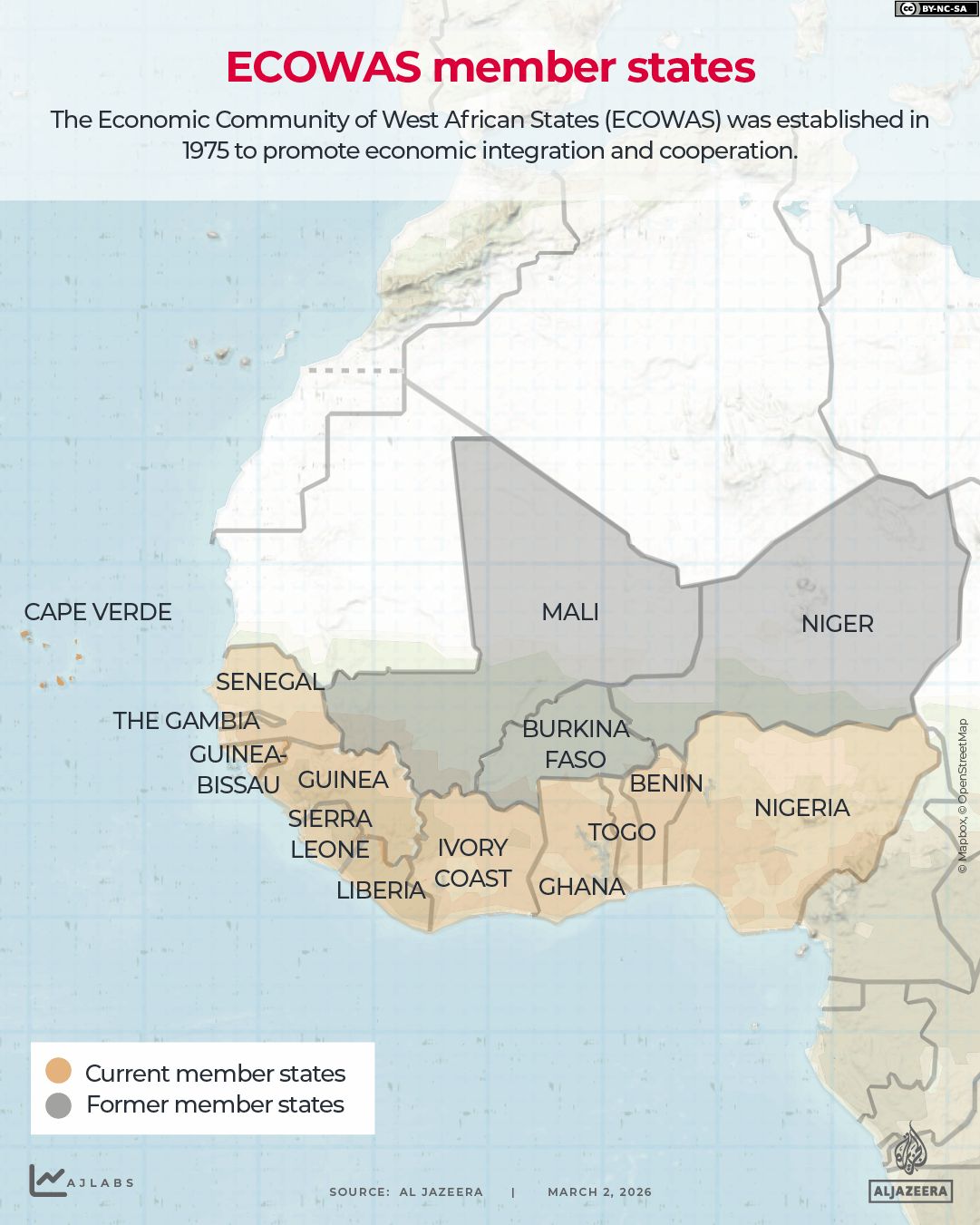
In particular, armed groups have targeted the Sahelian countries of Mali, Niger, Burkina Faso and Nigeria. Increasingly, they are pressing into the coastal states of Togo and Benin.
Although fighters typically operate in rural areas with a weak government presence, recent attacks have been launched in major urban areas, and some groups are using more sophisticated weapons.
In one daring attack, an ISIL-allied group targeted the international airport in Niamey, the capital of Niger, at the end of January. In an ongoing operation, an al-Qaeda-linked faction has blocked fuel supplies from reaching the Malian capital, Bamako, since September, crippling mobility and essential services in the country.
If ECOWAS plans to deploy troops, however, it will have to overcome two major challenges, analysts said: funding and infighting that caused military-led Niger, Mali and Burkina Faso to split from the bloc in January 2025 to form their own Alliance of Sahel States (AES).
“Those challenges will persist, … but they’ll also have to think about this as not just a military response but a holistic operation that’ll include social interventions to halt the influence of these groups that allows them to recruit members,” said Dakar-based Beverly Ochieng of the intelligence firm Control Risks.
Here’s what we know about the plan so far and what challenges it might face:
What is the ECOWAS Standby Force?
The ECOWAS Standby Force (ESF) was officially formed in 1999 although it had begun deployments in the early 1990s. The force includes thousands of military, police and civilian staff contributed by ECOWAS member states.
The ESF has been crucial in ending several conflicts in the region and in stabilising states in transition. It is largely regarded as the first successful attempt at establishing a regional security alliance in Africa. Southern and East African states later created their own forces in 2007 and 2022, respectively.
Previously called the ECOWAS Monitoring Group (ECOMOG), the West African contingent was instrumental in ending protracted civil wars in Liberia and Sierra Leone from 1990 to 2003. Nigeria and Ghana sent the largest number of soldiers.
Unlike typical United Nations missions that focus on peacekeeping, ECOMOG engaged in combat. However, its troops were heavily criticised for rights violations as they struggled to differentiate rebels from the larger population.
The ESF intervened as a peacekeeping mission during the Ivorian civil war (2002-2003) and in the Mali crisis (2012-2013). The troops also helped force longtime Gambian President Yahya Jammeh to step down and hand over power to Adama Barrow, whom he had lost an election to. Most recently, the ESF supported the military of Benin to prevent rebels from seizing power in December.
Military heads of the AES states, from left, Mali’s Assimi Goita, Niger’s Abdourahamane Tiani and Burkina Faso’s Ibrahim Traore [File: Mahamadou Hamidou/Reuters]
What will the force do now, and what are the concerns?
As regional leaders plan a new mobilisation of thousands of soldiers, the proposed activation would specifically respond to threats posed by ideological armed groups, Anadolu News reported.
It would be the first time the ESF would face such armed groups as opposed to political rebels.
Such violence has resulted in thousands of deaths and the displacement of tens of thousands more in the region. From January to June 2025 alone, the region recorded 12,964 conflict-related fatalities in 5,907 incidents with nearly all deaths being in Nigeria, Burkina Faso, Mali and Niger, according to the Center for Democracy and Development.
The ECOWAS deployment is a belated response, and there are several concerns, Ochieng said. Funding, coordinating the force and a rift that has essentially fractured the bloc are the main issues.
Nigeria typically has provided 75 percent of personnel to ECOWAS missions and has been a major funder of ECOWAS, which has its headquarters in Abuja.
However, Nigeria of the 1990s was very different from the Nigeria of today, Ochieng noted. The country’s status as West Africa’s giant has declined in the face of economic mismanagement resulting in high inflation in 2023, adding to stress from the COVID-19 pandemic. The economy is slowly recovering.
Besides this, Nigeria’s defence forces are stretched on many fronts as they combat several armed actors. Ideological groups are operating in the northeast and increasingly collaborating with criminal bandit gangs in the northwest and north-central regions. In the country’s south, armed groups fighting for an independent state are also active.
One possible source of funding, Ochieng said, could be the United States, which has been working with Nigeria since December to fight armed groups after initially falsely accusing the country of enabling a “genocide” against Christians amid the insecurity. Another could be France, which is increasingly close to Abuja.
There’s also the issue of coordinating to fight at least eight armed groups that use heavily forested areas as hideouts and corridors to travel between countries. ECOWAS will have to “prioritise where operations should be and if there should be a focus on others, such as pirates or criminal gangs taking advantage of the security lapses”, Ochieng said.
Social interventions in rural areas from which armed groups recruit are crucial, she added. The groups often secure local buy-in by collecting taxes and providing resources such as fertiliser, building mosques or promising security.
A car is refuelled in Bamako, Mali, which has faced fuel shortages caused by a blockade on routes to the capital by the JNIM armed group [File: Hamada Diakite/EPA]
Could the ECOWAS vs AES rift undermine the force?
There are also concerns about how ECOWAS would collaborate with the AES.
ECOWAS fractured last year after the regional bloc used sanctions to try to pressure the post-coup AES states to hold elections and return their countries to civilian rule.
All three AES countries are at the heart of the armed groups crisis with several armed groups operating along their shared borders.
The Malian army seized power in 2020, blaming the civilian government for failing to combat these fighters. Later, in 2022, Burkina Faso’s military followed, citing the same reasons, and in 2023, Niger did the same. They exited ECOWAS and officially banded together in 2025.
The AES has collectively turned away from France, its historical ally and former colonial power, which had contributed about 4,000 soldiers to combat armed groups, as Paris faced accusations of overly interfering in national security issues.
About 2,000 Russian fighters, initially from the paramilitary Wagner Group and now from the Russian state-controlled Africa Corps, have been deployed in the three countries as the AES has turned to Moscow as an ally.
The AES exit was a blow to ECOWAS, reducing the bloc’s size and influence. ECOWAS has tried to persuade the AES states to return through mediator states like Senegal, which maintains friendly ties with the Sahelians. The bloc has also maintained an open-door policy by inviting them to meetings.
But the military leaders have proved to be hardliners and have shunned those approaches, Ochieng said. The AES is working on building its 6,000-man combined force and wants to prove that it can compete with ECOWAS by successfully combating armed groups, she added.
Thus, a close collaboration where both sides deploy and fund a single regional force may not happen. However, ECOWAS’s new focus on countering armed groups could soften the AES’s stance over time.
“Because when AES left, one of their criticisms was that ECOWAS did not support counterterrorism and was overly focused on politics and elections,” Ochieng pointed out.
If ECOWAS continues to build on the friendly ties maintained by Senegal as well as Ghana and Togo, there could be room for intelligence sharing, joint surveillance and joint missions in the long term, she said.
What are the main armed groups?
Jama’at Nusrat al-Islam wal-Muslimin: JNIM is the main al-Qaeda-allied faction in West Africa. It formed in 2017 after four Malian armed groups banded together (Ansar al-Din; al-Murabitun; the Macina Liberation Front, or MLF; and al-Qaeda in the Islamic Maghreb, or AQIM). JNIM operates in Mali, Burkina Faso, Benin, Niger and has recorded at least one attack in Nigeria. Presently, JNIM is blocking fuel from reaching Bamako by attacking and burning fuel tankers travelling on highways. It is estimated to have 5,000 to 6,000 members.
Boko Haram: The group is also known as Jama’at Ahl al-Sunna li al-Da’wa wa al-Jihad. Originating in Nigeria’s Borno State in 2010, Boko Haram initially launched widespread attacks across northern Nigeria, including in the capital, Abuja. It then spread to Cameroon, Chad and Niger. The group is notorious for kidnapping more than 300 schoolgirls in Chibok in 2014. Boko Haram has been severely weakened since the death of its leader, Abubakar Shekau, in 2021 but is still operating with an estimated 1,500 fighters.
ISIL affiliate in West Africa Province: ISWAP broke off from Boko Haram due to differences in how to treat Muslim civilians. Boko Haram indiscriminately kills Muslims and Christians. Both have increasingly engaged in violent battles. ISWAP mainly operates in northeastern Nigeria, and according to some estimates, has 3,500 to 5,000 fighters.
ISIL affiliate in Sahel Province: The ISSP or IS-Sahel group was formed in 2015 and also pledges allegiance to ISIL. It operates mainly in Niger and Mali. ISSP claimed the attack on Niamey’s international airport in January. Analysts speculated that components of ISWAP were involved, revealing the extent to which the groups collaborate across porous borders. Figures from 2018 put its fighters at more than 400.
Lakurawa: Although its alliances are unclear, Lakurawa appears to be made up of fighters from Mali. Some analysts believe the group’s members arrived in rural counties of northern Nigeria’s Kebbi State after locals invited them to battle criminal groups that were kidnapping people for ransom. Other scholars disputed this and said the Lakurawa members were originally cattle herders from Mali who morphed into fighters after arriving in the northwestern state of Sokoto. The group was the focus of Christmas Day air strikes by the US last year. It is believed to have about 1,000 fighters.
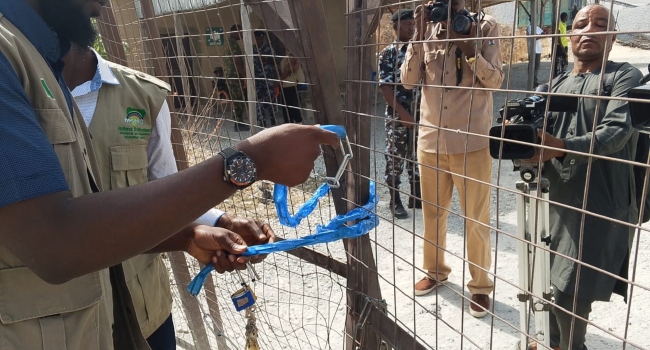
The National Environmental Standard and Regulations Enforcement Agency (NESREA) has sealed the quarry site operated by Dai Jin Jia Investment Limited in the Abuja Municipal Area Council (ACO Estate) following reports of incessant and unregulated blasting activities.
NESREA took the action after public outcry by residents over the company’s operations.
Reports indicated multiple environmental violations allegedly committed by the firm, contravening environmental laws and standards applicable to such establishments in Nigeria.
Earlier, agency officials reportedly faced a heated confrontation when security personnel deployed to the site initially prevented the closure of the facilities.
READ ALSO: NESREA Seals 21 Facilities In Abuja Over Environmental Violations
The company is accused of several infractions.
NESREA further alleged that the company’s blasting activities had damaged residential structures and contributed to the death of a young child, placing families’ safety at risk.
NESREA officials are seen sealing up the quarry in the Abuja Municipal Area Council (popularly known as ACO Estate), Abuja on March 2, 2026.
The agency also stated that the company lacked the necessary permit and certification for its blasting plan.
See photos from the exercise below:
The company is accused of several infractions.
NESREA officials are seen sealing up the quarry in the Abuja Municipal Area Council (popularly known as ACO Estate), Abuja on March 2, 2026.
NESREA officials are seen sealing up the quarry in the Abuja Municipal Area Council (popularly known as ACO Estate), Abuja on March 2, 2026.
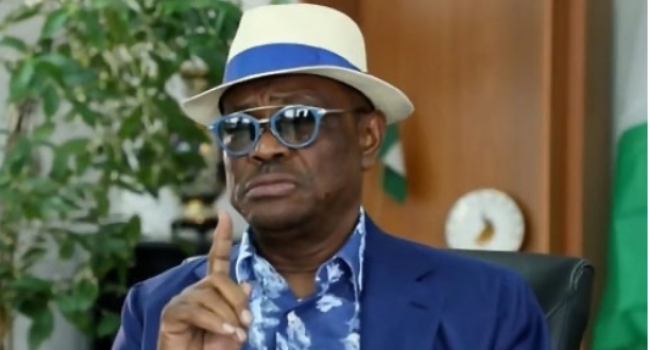
The Minister of the FCT, Nyesom Wike, has defended the imposition of a curfew in the build-up to the council polls in the nation’s capital.
Speaking at a media chat on Monday in his office, the minister said he has the rights as the ‘governor of the FCT’ to declare curfew.
He told journalists that contrary to claims, the action was approved by President Bola Tinubu.
The former Rivers State governor stated that his movements during the February 21 area council elections did not influence the outcome of the polls.
“I have the rights, I am the governor of 3,000 polling units. For security, I have to find out what is going on. I don’t have to be told, I am not a candidate for the election,” the minister stated.
“Somebody has said I move about. How many polling units in FCT? FCT has not less than 3,000 polling units. Assuming I went to 10 polling units to check what was going on, how will it affect 3,000 polling units?
“As a candidate, I cannot move around. I must have my agents. As the Chief Security Officer. I have a right to have a view of what is going on and how does it affect, influence the election?”
He also blamed the opposition party of not preparing well for the exercise, saying the success recorded by the All Progressives Congress (APC) showed the performance of President Tinubu-led Federal Government.
Wike had come under attack by Nigerians and opposition for restricting of human and vehicular movement in the FCT from 8pm on Friday to 6pm on Saturday.
Among them is senator representing the Federal Capital Territory (FCT), Ireti Kingibe, who accused the minister of being autocratic.
Kingibe said Wike’s decision to impose a curfew across the FCT without broad consultation with critical stakeholders is “a direct affront to democratic governance and the constitutional rights of residents”.