Slider1
previous arrow
next arrow

News

Fury on Pakistan streets, 20 dead, after US-Israel strike kills Khamenei

Islamabad, Pakistan – Protests erupted across Pakistan on Sunday, with 20 people dead and dozens wounded nationwide, after the United States and Israel confirmed the killing of Iran’s supreme leader, Ayatollah Ali Khamenei, in coordinated air strikes on Tehran.

The deaths included 10 people in Karachi, at least eight in Skardu and two in the capital, Islamabad, as demonstrations largely led by members of Pakistan’s Shia Muslim community escalated and security forces fired tear gas and rubber bullets at protesters.

Recommended Stories

list of 4 itemsend of list

Pakistan, a country of more than 250 million people, is predominantly Sunni Muslim, but Shia account for more than 20 percent of the population and are spread across the country.

In Islamabad, thousands gathered near the Red Zone, the heavily fortified district that houses the parliament, government offices and foreign embassies. Protesters chanted, “Those who side with the US are traitors” and called for “revenge against Israel”.

Between 5,000 and 8,000 people, including women and children, assembled near one of the capital’s largest hotels, holding placards bearing Khamenei’s image.

Syed Nayab Zehra, a 28-year-old protester, said she had joined the rally with her family to express solidarity with Iranians, even if “our government is not with you”.

“We want to show the world that, don’t take us Shia lightly. We are here to remind the world that we will seek revenge. We cannot expect or hope anything from our own government, but we will stand up for our community,” she told Al Jazeera.

Pakistan’s government has condemned the joint US-Israel military attack on Iran in which Khamenei was killed. It has also criticised Iran’s subsequent attacks on Gulf nations.

On Sunday, some people in the crowd urged demonstrators to march towards the diplomatic enclave, while others shouted instructions to maintain “discipline”.

Ali Nawab, a worker for the Majlis Wahdat-e-Muslimeen, a Shia political party, said organisers had agreed with local authorities to keep the protest peaceful.

“There are a few people you can see here deliberately trying to make provocative gestures and making us do things we are not supposed to. We are here for a cause, and we will make our way forward when we are told to,” he said.

Authorities had sealed roads leading to the Red Zone, which houses the US Embassy and other diplomatic missions. When protesters attempted to push through, security forces fired tear gas and rubber bullets. Witnesses said live rounds were also heard.

As the crowd retreated, further volleys of tear gas were fired, injuring several people.

Mouwaddid Hussain, a 52-year-old protester, said the government had betrayed them.

“Are we the enemy of the state? We were here to mourn the death of our leader, and we cannot even grieve here? They promised to let us be here and protest, but they violated their commitment,” he said.

Al Jazeera saw several people wounded by rubber bullet shrapnel. Doctors at Islamabad’s government-run Poly Clinic said the hospital had received at least two bodies and treated at least 35 injured people.

Karachi turns deadly

The bloodiest scenes unfolded in Karachi, Pakistan’s largest city, where hundreds gathered outside the US Embassy and Consulates on Mai Kolachi Road.

A group of young men scaled the consulate’s outer gate, entered the driveway and smashed windows in the main building. The crowd was eventually dispersed with tear gas and gunfire. It was not immediately clear whether the firing came from law enforcement personnel deployed at the site.

At least 10 people were killed and 60 wounded in the clashes, police surgeon Summaiya Syed said in a statement.

The chief minister of Sindh province, which Karachi is part of, Murad Ali Shah, described the incident as “extremely tragic” and ordered an impartial investigation.

“At a time when the country is facing a war-like situation, it is inappropriate to sabotage peace and order,” he said, while also expressing solidarity with Iran and its people.

The US Embassy in Islamabad said in a brief statement on X that it was “monitoring reports of ongoing demonstrations” at US facilities in Karachi, Lahore and Islamabad, and advised US citizens to avoid large crowds.

Sunday’s violence was not without precedent. In November 1979, a crowd stormed and set fire to the US Embassy in Islamabad, killing two Americans and two Pakistani staff members.

The attack came days after Ruhollah Khomeini, the leader of Iran’s Islamic revolution, broadcast claims, later proven false, that the US and Israel were behind the seizure of the Grand Mosque in Mecca.

The rumour spread rapidly across Pakistan, drawing crowds that overwhelmed security forces. The episode remains one of the most serious attacks on a US diplomatic facility in the country’s history.

Violence in the north

In Gilgit-Baltistan, the mountainous northern region with a significant Shia population, unrest was also severe.

At least eight people were killed in the city of Skardu after protesters set fire to offices of the United Nations Military Observer Group in India and Pakistan. Other buildings, including a school, were damaged.

Authorities imposed a three-day curfew in Skardu, and officials described the situation as tense.

In the city of Lahore, hundreds gathered outside the US Embassy. Some attempted to force their way inside before police dispersed them with tear gas. No deaths were reported there.

Protests were also held in Peshawar, Multan and Faisalabad, where large crowds took to the streets to denounce the US and Israel and mourn Khamenei’s death.

Calls for calm

Earlier on Sunday, Minister for Interior Mohsin Naqvi visited parts of Islamabad to review security and ordered reinforcements around the diplomatic enclave. In a video message, he appealed for restraint.

“After the martyrdom of Ayatollah Khamenei, every citizen of Pakistan is saddened in the same way as the citizens of Iran are grieving,” he said.

“We are all with you. We request the citizens not to take the law into their hands, and to record their protest peacefully,” Naqvi added.

Prime Minister Shehbaz Sharif later expressed his “grief and sorrow” over Khamenei’s death in a social media post.

“Pakistan also expresses concern over violation of the norms of international law. It is an age-old convention that the Heads of State/Government should not be targeted. We pray for the departed soul. May God Almighty grant patience and strength to the Iranian people to bear this irreparable loss,” the prime minister said.

Deputy Prime Minister and Foreign Minister Ishaq Dar had spoken with his Iranian counterpart, Seyed Abbas Araghchi, shortly after the strikes began a day earlier.

According to Pakistan’s Ministry of Foreign Affairs, Dar “strongly condemned the unwarranted attacks against Iran” and called for an immediate halt to escalation through diplomacy.

Pakistan shares a more than 900km (559-mile) border with Iran, and maintains trade and energy ties with its neighbour. It does not recognise Israel and has long supported a two-state solution to the Israeli-Palestinian conflict.

Israel bombs Beirut after Hezbollah launches rocket attack

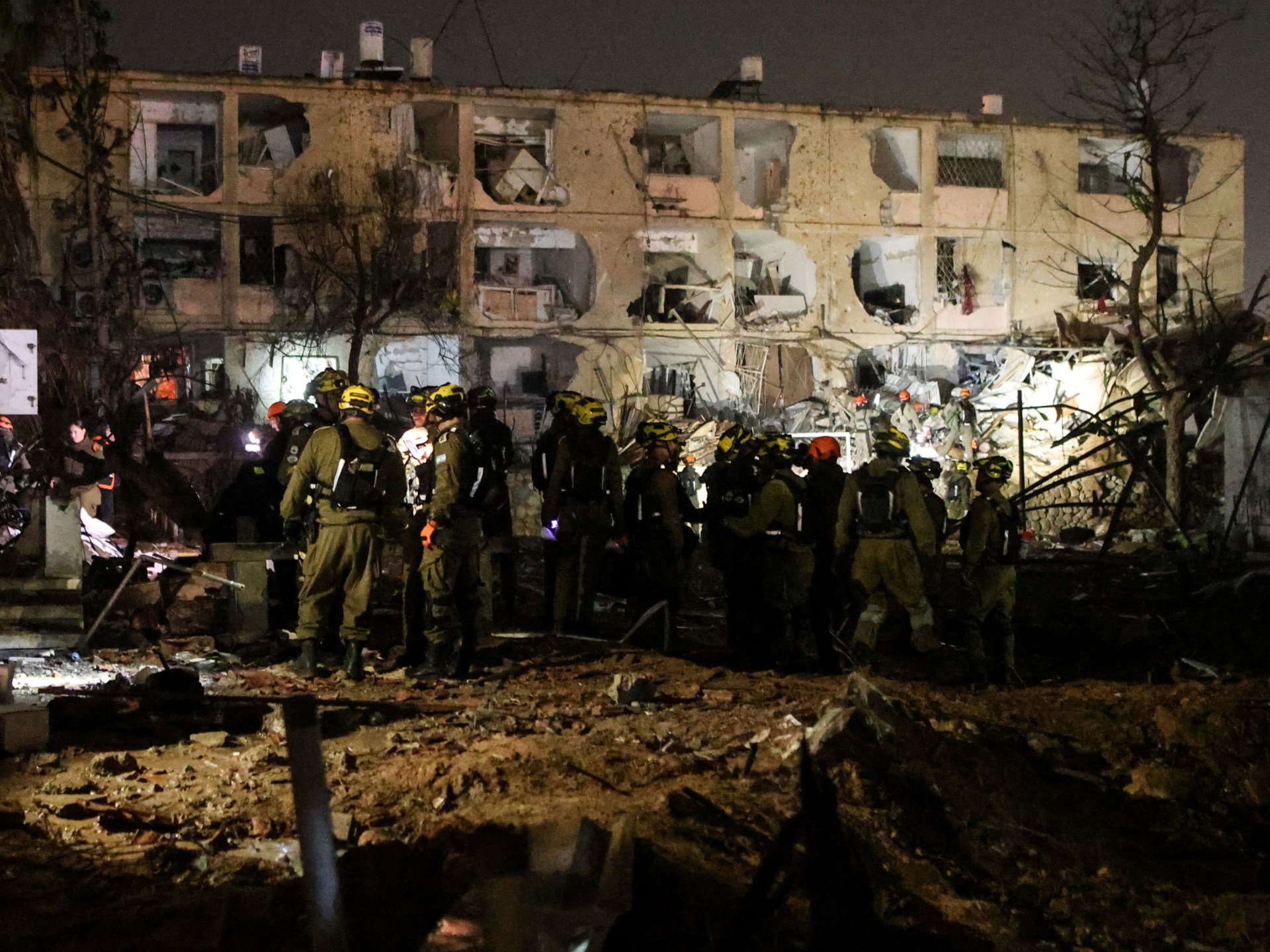
Israeli jets have bombed Lebanon’s capital, Beirut, after Hezbollah launched what it said was a rocket and drone attack against a military base near Haifa in northern Israel.

The Iran-allied Lebanese armed group said early on Monday that its attack was in retaliation for the killing of Iranian Supreme Leader Ayatollah Ali Khamenei, “in defence of Lebanon and its people” and “in response to the repeated Israeli aggressions”.

Recommended Stories

list of 3 itemsend of list

“The resistance leadership has always affirmed that the continuation of Israeli aggression and the assassination of our leaders, youth and people gives us the right to defend ourselves and respond at the appropriate time and place,” the group said in a statement, referring to the near daily Israeli attacks on Lebanon.

“The Israeli enemy cannot continue its 15-month-long aggression without a warning response to halt this aggression and withdraw from the occupied Lebanese territories.”

The violence marks a major escalation in what is becoming a regional war between the United States and Israel, on one side, and Iran and its allies on the other.

Hezbollah, which operates independently from the Lebanese government, has been weakened by the 2024 war, which saw Israel kill most of the group’s military and political leaders. It is not clear how much damage it can inflict on Israel or whether its intervention can meaningfully alter the balance of power for Iran.

Israel was quick to respond with air strikes in southern Beirut. Local news outlets also reported Israeli attacks in several villages in south Lebanon, as well as the Bekaa Valley in the east of the country.

The Israeli military said it was “vigorously attacking Hezbollah” throughout Lebanon.

“The [Israeli military] will act against Hezbollah’s decision to join the campaign, and will not allow the organisation to pose a threat to [Israel] and harm the residents of the north,” it said.

“The Hezbollah terror organisation is destroying the state of Lebanon. Responsibility for the escalation lies with it, and the [Israeli military] will respond forcefully to this harm.”

The Israeli military later said that it targeted “senior” Hezbollah members in the Beirut area and a “key” figure in south Lebanon, without providing details.

Israel also called on people in more than 50 villages in south Lebanon and Bekaa the Valley, including the town of Bint Jbeil, to evacuate their homes and stay at least 1km (0.6 mile) from the buildings.

The warning for such a vast area appears to mirror the mass displacement orders Israel would issue during its genocidal war on Gaza.

The escalation could deepen the crisis in Lebanon, which has been suffering from economic and political woes for years.

Hezbollah and Israel reached a ceasefire in November 2024, but Israel has been violating the truce and carrying out attacks across the country almost daily.

The Lebanese group had refrained from responding to Israeli strikes, urging the Lebanese government to assume its responsibility and protect the country instead.

The authorities in Beirut have been pleading with the international community to pressure Israel to end its violations to no avail.

In January, Beirut filed a complained with the United Nations documenting 2,036 Israeli violations of Lebanese sovereignty in the final three months of 2025.

Last year, the Lebanese government issued a decree to disarm Hezbollah, but the group rejected the decision, arguing that its weapons are needed to protect the country against Israeli expansionism.

On Monday, Lebanese Prime Minister Nawaf Salam said the Hezbollah attack was “an irresponsible and suspicious act that jeopardises Lebanon’s security and safety and provides Israel with pretexts to continue its aggression”.

UK PM Starmer says US can use UK bases for ‘defensive strikes’ on Iran

NewsFeed

UK Prime Minister Keir Starmer says he’s accepted a request from the US to let his country’s military bases be used for attacks on Iran aimed at stopping retaliatory missile strikes. The UK had originally denied access over fears it violated international law.

Iranian ballistic missile strike on West Jerusalem

NewsFeed

Several people have been injured after an Iranian ballistic missile struck a road in West Jerusalem. Missiles could be seen bypassing air defences in the city.