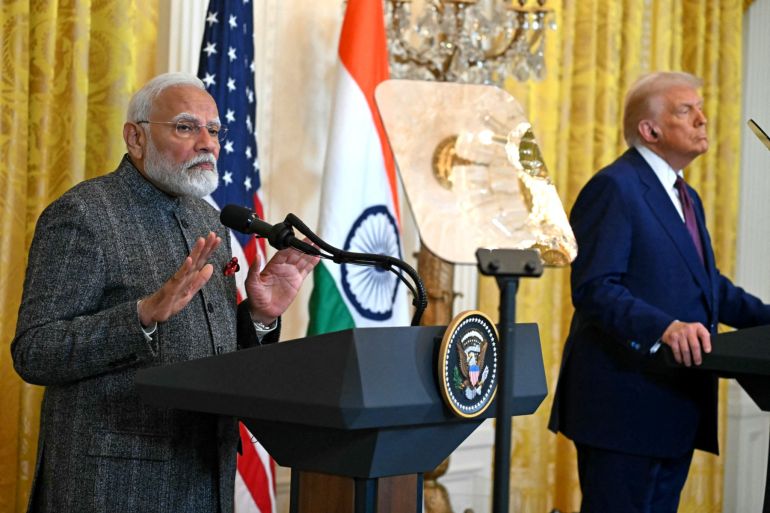
New Delhi, India – United States President Donald Trump has announced what he described as a “trade deal” with India to reduce market barriers between the two countries, which have a combined gross domestic product of $33 trillion.
On Monday, Trump said he would reduce trade tariffs on Indian goods from 50 to 18 percent after New Delhi agreed to stop buying Russian oil – one of the major sticking points between the two sides.
Trump said he reached the agreement with Indian Prime Minister Narendra Modi in a telephone call. The agreement comes at the end of the first year of Trump’s global trade war – of which India had been one of the worst casualties and which had seen relations between the two countries fall to new lows in recent months.
On Tuesday, India’s commerce minister, Priyush Goyal, confirmed that the two countries would sign a deal “shortly”. A joint statement will be released when the final details have been agreed, he said. However, he gave no further details about the contents of the agreement.
Beyond Trump’s announcement about tariffs on Indian goods, therefore, uncertainty about the future of US-India trade relations remains. For one, while Trump claims New Delhi has agreed to buy oil from the US instead, India has not publicly confirmed this.
And, while Trump claimed that Modi had agreed to eliminate Indian tariffs on US goods altogether, this has also not been confirmed by India.
Subsequent announcements from Trump and Modi about the agreement the two had reached also differed greatly, geopolitical observers and economists told Al Jazeera.
We unpack what we know, what we don’t, and why Modi is facing criticism at home following the announcement.

What have Trump and Modi said about this agreement?
On Monday, Trump wrote on his Truth Social platform that he had spoken with Modi – calling him “one of my greatest friends” – about several issues, including ending Russia’s war in Ukraine.
“He [Modi] agreed to stop buying Russian Oil, and to buy much more from the United States and, potentially, Venezuela,” Trump said.
Then, Trump wrote that upon Modi’s request, and out of “friendship and respect” for him, Washington “agreed to a Trade Deal”, whereby the US “will charge a reduced Reciprocal Tariff, lowering it from 25% to 18%”.
White House officials were quoted in US media confirming that the additional 25 percent tariffs levied on Indian goods last year as punishment for buying Russian oil would also be dropped. In total, that would bring 50 percent tariffs down to 18 percent.
In turn, India would reduce “their Tariffs and Non Tariff Barriers against the United States, to ZERO”, Trump wrote.
Trump added that Modi had also committed to “‘BUY AMERICAN’, at a much higher level, in addition to over $500 BILLION DOLLARS of U.S. Energy, Technology, Agricultural, Coal, and many other products”.
“Our amazing relationship with India will be even stronger going forward,” he wrote.
Shortly after, Modi’s statement was posted on X. In it, he completely avoided mention of a “trade deal”, or of any agreement to stop purchasing Russian oil, or committing to buy $500bn worth of goods from the US.
Instead, Modi simply confirmed that “Made in India products will now have a reduced tariff of 18%,” and expressed his gratitude over “this wonderful announcement”.
Then, he hailed Trump, writing: “President Trump’s leadership is vital for global peace, stability, and prosperity. India fully supports his efforts for peace.”
Analysts said these statements leave too much uncertainty, however.
“It’s no deal, but just a declaration by both leaders when nothing has been signed,” said Jayati Ghosh, an economist and professor at the University of Massachusetts Amherst.
“So far, whatever little has been revealed, it’s already a bad deal for India. I feel it could be even worse in detail,” she told Al Jazeera.

How are India-US trade relations?
For years, the US and China have remained India’s top two trading partners.
Last year, the US took the top slot with bilateral trade with India worth $129.2bn, according to US government trade data. That was only a little higher than India-China trade worth $127.7bn.
But, unlike China, where the bilateral balance sheet is highly skewed towards Beijing, which has a trade deficit with India of about $95bn, India has a much more favourable trade balance with Washington.
In 2024, US exports to India amounted to about $41bn. While oils and fuels account for a nearly 30 percent share at $13bn, they are followed by precious pearls and stones, amounting to $5.16bn. India also imports parts for nuclear reactors, electrical machinery and equipment, and medical instruments from the US.
By comparison, Indian exports to the US, its biggest market, totalled nearly $87bn in 2024, including pearls, electrical machinery, and pharmaceutical products among the lead export products.
Now, Trump says Modi has agreed to buy unspecified US goods worth more than $500bn across several sectors, including energy, technology, coal, and agricultural products, among others.
But $500bn on its own is a promise to increase purchases by 1,150 percent.
Last week, the Modi government unveiled its annual budget, which included total spending plans of $590bn. Trump’s claimed promise from Modi would be worth about 85 percent of India’s annual budget.
This seems a stretch, analysts say.
“This is a come-down for the government of India. This deal is quite disconcerting for New Delhi,” said Biswajit Dhar, a trade economist who has worked on several Indian trade deals.
“So, the US will impose 18 percent tariffs on India, and India is going to give them duty-free access. That is 0 versus 18,” Dhar told Al Jazeera. “Can this be a cause of celebration on the Indian side?”

Is India really opening up its agricultural sector?
Agriculture has been one of the main sticking points in trade talks between the US and India for years. Washington has demanded that New Delhi open its market to genetically modified crops from the US – a sore point for Modi in India.
Almost half of India’s 1.4 billion-strong population, the largest in the world, is still reliant on agriculture to earn a living, and the country has kept the sector guarded from foreign trading to protect farmers’ interests.
Furthermore, since Modi came to power in 2014, among of the most sustained protests he has faced have been from farmers opposed to new farm laws that the government wanted to bring in. In the end, Modi was forced to back down, in a rare win for dissenters under his rule.
Amid growing pressure from the US during trade talks, Modi in August declared at a public event that he was willing to pay a personal “price” for defending the interests of farmers.
“For us, the welfare of our farmers is of the highest priority. Bharat will never compromise on the interests of its farmers, dairy farmers, and fishermen,” he said, referring to the Hindi name for India. “And I am fully aware that I may have to pay a very heavy price personally, but I am prepared for it.”
But on Monday, US Secretary of Agriculture Brooke Rollins wrote in a post on X: “New US-India deal will export more American farm products to India’s massive market, lifting prices, and pumping cash into rural America.”
She added: “In 2024, America’s agricultural trade deficit with India was $1.3 billion. India’s growing population is an important market for American agricultural products, and today’s deal will go a long way to reducing this deficit.”
An unnamed Indian government official was quoted by the Reuters news agency on Monday as saying that India had agreed to buy US goods, including in the telecoms and pharma sectors, and offered market access for some agricultural products as part of India’s commitments under the deal. Publicly, however, New Delhi has been silent on this.
“This is really quite, quite disastrous,” said Dhar, the trade economist. “That goes against the verbatim commitment by PM himself that farmers’ interests would be protected.
“The US agri-companies are really large and the bottom line of any trade negotiation – to save Indian farmers – seems to have been dropped now,” Dhar told Al Jazeera.
Ghosh, the Indian economist, said she doubted “if the domestic politics would even allow Modi to open the agriculture sector to Trump”.
“India cannot afford to do that. The impact would be huge and the farmers’ protest will be even bigger amid a lot of discontent,” she told Al Jazeera.

Is India in a more favourable position now?
On the face of it, the 18 percent US trade tariff on Indian goods makes India better placed than neighbouring rivals, such as Pakistan with 19 percent, Bangladesh and Vietnam with 20 percent, and China with 34 percent.
However, nearly all of India’s neighbours are beneficiaries of the US’s Generalized System of Preferences concession, under which Washington facilitates duty-free entry for selected goods from developing countries to support their exports.
New Delhi, which was previously the biggest beneficiary of this, was removed from that list in 2019 amid trade tensions as India resisted opening up its markets.
What other things do we not know about this ‘deal’?
Most importantly, we do not know if an India-US Free Trade Agreement (FTA) has been formally negotiated and concluded.
India signed a major FTA with the European Union last week, hailing it as the “mother of all deals”. While that deal, which creates a new $27bn market, has yet to go through legal scrutiny, it offers clarity on key areas relating to non-tariff barriers, investments and selective limits to market access, unlike Trump’s announcement.
Dhar told Al Jazeera there are significant areas of contention which could stoke anxiety in stock markets. “What happens to India’s intellectual property laws, especially patent laws?” he asked, arguing a change could lead to a significant hike in medical bills, for example, for patients in India.
“What are the other conditions that have been imposed, like with respect to environment and labour standards?” Dhar added.
Another example, Ghosh said, was that while India is planning to implement a digital service tax, whether US tech giants would be included in that – or exempted – has not been clarified.
“India has already given in far too much,” she said. “Not just at the cost of domestic security, but health, safety, and now livelihoods and employment.”

What have the reactions in India been?
Modi held a meeting with members of parliament on Tuesday morning, in which he was reportedly congratulated over the supposed deal.
India’s home minister, Amit Shah, hailed “the historic India-US trade deal”, writing in a post on X that the “agreement will open new doors of opportunities for every Indian. This deal, which will give a new momentum to our economy, will not only boost employment but will also prove to be a milestone in realising our resolve to make India a leader in every sector by 2047.”
Despite giving no further details about the agreement when he confirmed it in a press conference on Tuesday, India’s commerce minister, Piyush Goyal, was similarly effusive.
“It will protect the sensitive sectors – the interests of our agriculture and our dairy sectors,” Goyal said, without explaining how. “It will open up huge opportunities for our labour intensive sectors and export sectors. This is truly a deal every Indian can be proud of.”
But Trump’s announcement from Washington drew ire from the political opposition in India, which pressed the Modi government to reveal the details of the deal.
“The main thing is that our PM is compromised. The public needs to think about this. Narendra Modi ji has sold your hard work in this trade deal because he is compromised. He has sold the country,” said Rahul Gandhi, the leader of the opposition in the Indian parliament.
Does this mark an upturn in India-US relations?
The public statements by Trump and Modi seem to signal a major thaw in relations that had turned frosty since the US president took office in January last year, experts say.
Sources of tension have anged from the handling of Indian immigrants to the US, a steep fee hike for the US’s H-1B worker visa, India’s continued purchase of Russian oil, and stalling trade negotiations. In addition, Trump has repeatedly claimed to have brokered a ceasefire between India and Pakistan following their four-day hostilities last May. While Pakistan hailed the US president’s role and nominated him for the Nobel Peace Prize, India denied that Trump had played a major role.
“Trump is playing to the domestic theatre to show that there’s a major victory coming out of this,” Harsh Pant, vice president of the New Delhi-based Observer Research Foundation think tank, said. “It is equally important for Modi to showcase that he’s able to withstand the pressure from Washington.
“This is the beginning of a new phase where the relationship will take on a different texture with clarity on lots of things [for leaders],” Pant told Al Jazeera. However, he cautioned that it will likely still take time to restore confidence fully between the two sides, particularly from India’s perspective.
Pant also added that issues like the purchase of Russian oil will persist, as New Delhi will try to protect its traditional ties with the Kremlin, as well.

Leave a Reply