To play this video you need to enable JavaScript in your browser.
When Nina Sparks was diagnosed with multiple sclerosis in 2021, she decided very quickly it was going to be the making of her.
“Diagnosed in March, classified to compete internationally in November,” she tells BBC Sport.
“It was a very quick upwards trajectory to being an athlete.”
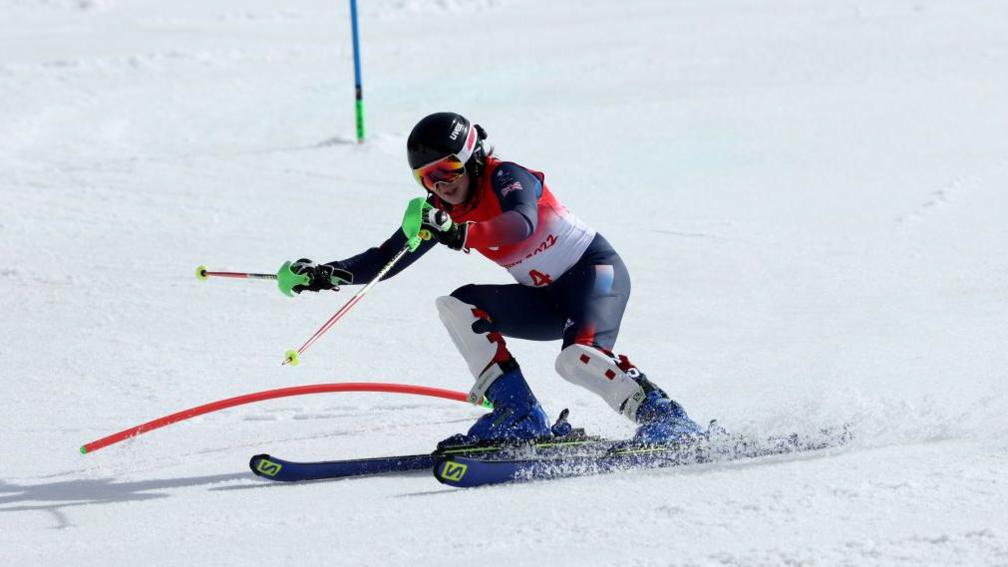
Now, history beckons. At this month’s Winter Paralympics, Sparks will become Great Britain’s first female Paralympic snowboarder.
“It’s taken me a while to adjust to the fact that it’s quite a big thing,” she says.
That love for the mountains blossomed the moment she first saw them. Adopted as a 10-month-old, her parents first took her skiing when she was five or six. She later switched to snowboarding at 13.
It is, to her, “the closest thing you can get to flying”.
But the sport was always just a hobby, a once-a-year trip. When Covid hit in 2020, she was working as a full-time peripatetic music teacher, and as learning moved online, she realised she was no longer tied to the UK.
And so she moved her life to the mountains, teaching piano, trumpet and saxophone her “side hustle”. But it was while she was living in Austria that she first noticed signs that something wasn’t right.
“I woke up and had a numb right foot. That spread up my right leg and then my left leg, and from about mid-November [2020] I got to the point where I couldn’t feel temperature very well.
“Going through diagnosis was really tough, and certainly for me – I was in Austria by myself.
“I just thought ‘let’s make something of this’. I always knew about the Paralympics, and I knew about Kadeena Cox, a very famous British Paralympian with MS.
Heading into the Milan-Cortina Paralympics, which start on Friday, Sparks is a four-time World Cup and two-time World Championship medallist across the LL2 snowboarding events, for athletes with a lower limb impairment with less activity limitation than their LL1 counterparts.
Because of her MS, a condition that affects the brain and spinal cord, she uses an orthotic to walk and competes with an ankle foot orthosis in her boot.
“The biggest thing for me is that I now need to nap, every day, without fail,” she says.
“We come in from the mountain and I’m straight to bed.
“Some days, I may be able to do five runs, some days I may be able to do 25 runs, maybe the next day I need an extra day off because I’m super tired. Quality over quantity, is what one of my coaches says a lot.”
Sparks is joined by fellow snowboarders James Barnes-Miller, Ollie Hill, Matt Hamilton and Davy Zyw in the 25-strong ParalympicsGB squad.
On 14 March, she will compete in the women’s LL2 banked slalom, a technical discipline raced against the clock on a course of tight turns.
“In our sport, a big thing is just showing up. We often have really small numbers in our competitions, just because worldwide there aren’t many women with disabilities involved in Para-snowboarding,” Sparks says.
“Certainly I’m not going to be the only woman making history for their nation at these Games. So showing up and giving it a go is half the battle.
Related topics
- Winter Sports
- Disability Sport
- 24 February
- 24 February


Leave a Reply