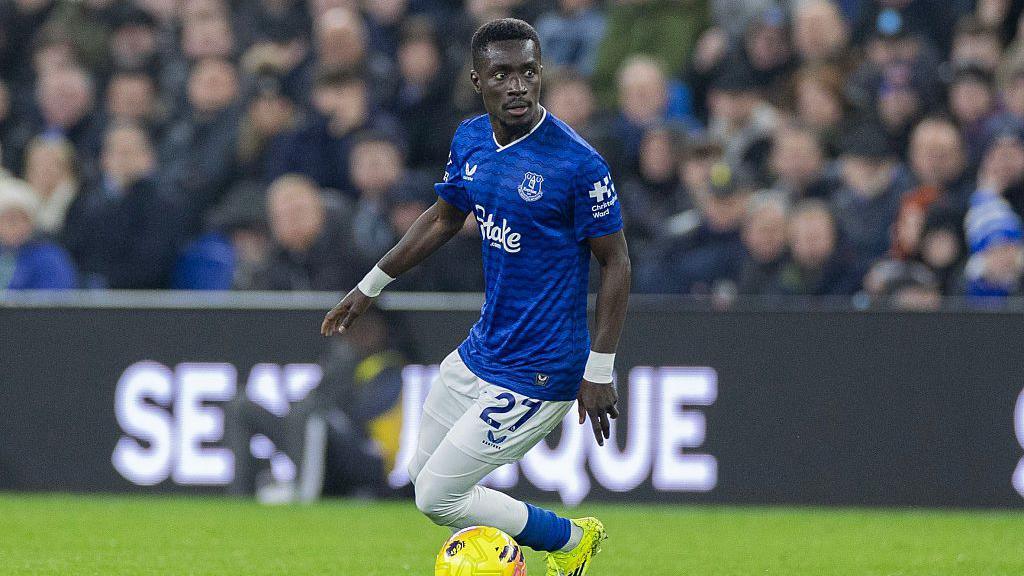
Everton midfielder Idrissa Gueye caught the eye again when he wore a pair of bright white leggings for Monday’s Premier League match against Manchester United.
It’s certainly not the first time a player has stood out because of their kit choice.
Some of those decisions are because of warmth and comfort – and some are for marginal gains.
Get in touch
Undershorts and leggings
Undershorts and undershirts are a familiar sight, but full-length leggings like those worn by Gueye are much more unusual.
The leggings, which must match the colour of the shorts on top, are primarily worn for an additional layer of warmth and – in some cases – comfort.
Manchester United legend Ryan Giggs once wore black support leggings as he returned from hamstring injury.
Gloves
 Getty Images
In principle, the idea of outfield players wearing gloves is fine. But there are certain circumstances when it has been questionable.
In 1999, Nicolas Anelka scored twice for France during a match against England… while wearing a pair of goalkeeper gloves.
Further back, in the 1980s former Nottingham Forest defender John Metgod wore brown gloves that looked more suited to gardening than the football pitch.
For purists, the jury is out on whether wearing gloves with short sleeves is acceptable…
Holes cut in socks
 Getty Images
One of football’s more recent fashion trends has been players cutting holes in the back of their socks.
Players are doing it to relieve pressure on their calf muscles when running in tight socks.
Tracksuit bottoms
 Getty Images
One of the rarer football fashion choices is that of tracksuit bottoms, which goalkeepers are allowed to wear.
They are among the game’s more retro fashion choices, though former Crystal Palace No 1 Gabor Kiraly famously wore them throughout his career.
“I’m a goalie, not a model,” he once said. “I’ve played on clay or grass that’s been frozen in winter; it makes your legs hurt when you fall so jogging bottoms seemed obvious.”
Former Manchester United goalkeeper Massimo Taibi wore tracksuit bottoms during his short stint at Old Trafford, while former Colombia keeper Rene Higuita was wearing them while making his famous scorpion-kick save against England in 1995.
Goalkeeper cap
 Getty Images
Caps are a more traditional piece of attire for goalkeepers, who tend to wear them to aid visibility when there is a chance the sun will get in their eyes.
In recent seasons, Crystal Palace’s Dean Henderson and Tottenham’s Guglielmo Vicario have both sported club-branded caps during matches.
Headbands and Alice bands
 Getty Images
Headbands and Alice bands are becoming increasingly popular sights in men’s football.
England internationals Anthony Gordon and Noni Madueke are regular headband-wearers, while Tottenham midfielder Yves Bissouma wore one during Sunday’s north London derby against Arsenal.
They are largely worn by players with longer hair to stop it falling over their eyes.
Footballers are not allowed to wear branded headbands, though, and in 2022 former Newcastle winger Allan Saint-Maximin was fined by the Football Association for wearing one with a designer branding.
Snoods
 Getty Images
Players have been banned from wearing snoods during matches since 2011, but prior to that Carlos Tevez, Samir Nasri and Ashley Young were among those who donned them during fixtures.
Players and coaches still wear them frequently during pre-match warm-ups and training for an added layer of warmth.
Undershirts
 Getty Images
Another accessory more commonly worn during colder months, skin-tight undershirts give players an added layer of warmth.
Players did used to be able to wear a different coloured undershirt to their kit, but that was outlawed to prevent clashes.
With a number of shirt manufacturers opting not to make long-sleeved shirts that can be worn in Premier League matches, players often wear either short-sleeved shirts over undershirts or replica long-sleeved shirts that are made for commercial sales to supporters.
Wrist and finger tape
 Getty Images
Players commonly wear wrist tape in matches in order to stabilise their joints and limit the risk of sprains or injuries sustained in collisions or tackles.
At times, players also wear tape around their fingers for similar reasons.
The International Football Association Board – the body responsible for making the laws of the game – no longer allows players to wear tape over jewellery, which is not permitted to be worn.
Small shinpads
 Getty Images
Shinpads are very much a necessity – and an Ifab requirement for players – but the size of some has become a talking point.
Burnley winger Marcus Edwards was among those pictured sporting particularly small shinpads during their Premier League defeat by West Ham.
Jack Grealish has also previously worn smaller shinpads – designed for increased mobility, comfort and ankle flexibility.
Footless socks
 Getty Images
Another recent trend is for players to wear football socks that do not have ‘feet’ on them – usually known is footless socks.
Players commonly cut the bottom of socks off themselves or buy them pre-made.
Instead, players wear separate ankle socks for comfort and more flexibility in football boots compared to wearing a traditional one-piece sock.
Holes in the back of boots
Similarly to socks, some players have been cutting holes at the back of their football boots to make them more comfortable.
Some footballers have Haglund’s deformity – a condition in which people get an enlarged bony bump on the back of their heels which can rub against the inside of football boots.
Other players cut their boots to put less pressure on their feet, with former Brazil internationals Neymar and Philippe Coutinho among those to do this.
Acceptability: 9/10
More questions answered…
Related topics
- Premier League
- Football
- Women’s Football

Leave a Reply