New Delhi, India – At a private event in November 2019, Sandeep Chakravorty, India’s then consul general in New York, was caught on camera calling for New Delhi to adopt an “Israeli model” in Indian-administered Kashmir.
At the time, millions in Kashmir were already reeling under a crippling military lockdown and communication blackout: Prime Minister Narendra Modi’s Hindu majoritarian government had stripped the region of its semi-autonomous status months earlier, jailing thousands of people, including the region’s political leaders – even those who are pro-India.
The senior Indian diplomat was musing about Israel’s far-right settlements in the occupied Palestinian territory, in reference to the resettling of thousands of Kashmiri Hindus, who had to flee their homeland in a 1989 exodus after an armed rebellion against Indian rule started in the Himalayan region.
“It has happened in the Middle East. If the Israeli people can do it, we can also do it,” Chakravorty told the gathering, adding that the Modi government was “determined” to do so.
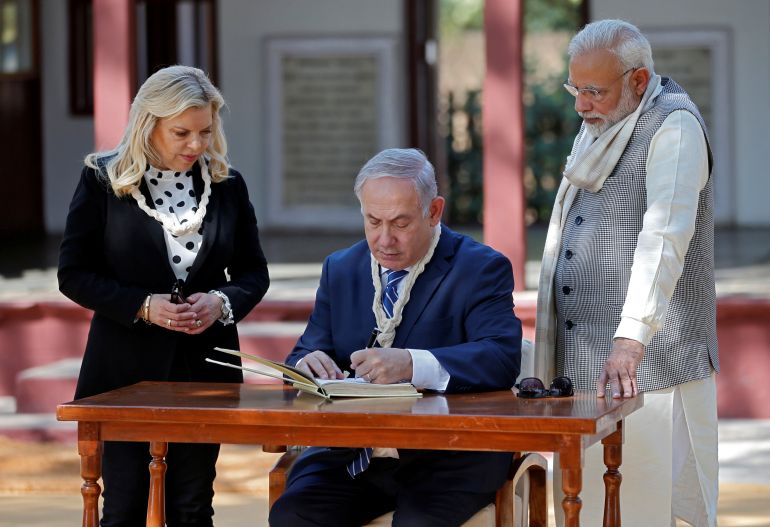
Six years later, Chakravorty’s words ring truer than ever. As Modi prepares for his second visit to Israel starting on February 25, the two countries are bound by more than just friendship, trade and military partnerships – they are increasingly, say some analysts, also joined at the hip in certain facets of their models of governance.
Under Modi, India has openly embraced Israel – at the expense of its longstanding support for the Palestinian cause, say analysts. But New Delhi, they add, also appears to have imported multiple elements of Israel’s security and administrative approach to Palestinians, and unleashed them into its domestic policies since Modi took power in 2014.

‘Hostile subjects under occupation’
At the heart of these deepening ties, say analysts, is a shared ideological vision.
Modi’s Bharatiya Janata Party (BJP) has roots in a philosophy, Hindutva, that seeks to turn India into a Hindu nation and a natural homeland for Hindus anywhere in the world – similar to Israel’s view of itself as a Jewish homeland.
“The India-Israel relationship under Modi is a bond between two ideologies that see themselves as civilisational projects and Muslims as demographic and security threats,” said Azad Essa, author of the 2023 book Hostile Homelands: The New Alliance Between India and Israel.
“The friendship works because they have similar supremacist ends,” Essa told Al Jazeera. “Under Modi, India and Israel became strategic partners, and Delhi began to see Israel as a template and as key to India’s move toward becoming a great power.”
One of the most apparent examples of India borrowing from Israel is the so-called “bulldozer justice” policy of Modi’s party.
Over the past decade, authorities in several BJP-ruled states have demolished the homes and shops of hundreds of Muslims and also razed multiple mosques. These demolitions have been carried out, for the most part, without legal notices being issued to occupants or owners of the establishments. They have usually followed religious tensions in the particular neighbourhood, or protests against Modi government policies – and sometimes, after just a local argument that had taken on religious overtones.
One of the BJP’s top leaders, Yogi Adityanath, the chief minister of India’s largest state, Uttar Pradesh, is now known by his supporters as “Bulldozer Baba” (Daddy Bulldozer).
It’s a leaf straight out of Israel’s playbook. Israel has demolished thousands of Palestinian homes in the occupied West Bank and East Jerusalem and displaced their residents, making way for illegal Israeli settlements. And during Israel’s genocidal war on Gaza, almost all of the Palestinian territory’s homes, offices, hospitals, schools, universities and places of worship have been destroyed or badly damaged.
“The Hindu nationalist belief system is steeped in affinity for Zionism and Israel,” said Sumantra Bose, a political scientist whose work focuses on the intersection of nationalism and conflict in South Asia. “Generations of [Rashtriya SwayamSevak Sangh, the ideological fountainhead of the BJP] cadres, Modi included, have been indoctrinated in this ideology and have imbibed the love of Israel.”
The nation-state of Israel, which Bose characterised as majoritarian and supremacist, is the model Hindu nationalists are implementing in India in the Modi era, he argued. “The Israeli ideal finds reflection in many policies and measures of Modi’s government.”
Muslims in India have faced a range of social boycotts in recent years. It is increasingly difficult to rent a home, Muslim children often face bullying and harassment at school, and the community has mostly fled a number of villages after attacks.
In November 2024, India’s top court ruled that government authorities cannot demolish any property – even if belonging to people accused of a crime – without following due legal process. However, on the ground, such demolitions continue.
Essa, the author of Hostile Homelands, said both India and Israel use the bulldozing of homes and properties “to target and punish certain populations and underscore a political message to communities, including who may belong to the nation and who is an outsider”.

Overarching shadows of security doctrine
At the forefront of India-Israel bilateral ties are their defence relations and an overlapping security doctrine. India is the largest buyer of Israeli weapons, pumping in billions of dollars in purchases.
India has also supplied weapons to Israel amid its ongoing genocidal war on Gaza. Israel has provided joint training sessions for Indian soldiers with the Israeli army, alongside a wide array of Israeli systems, including UAVs, air defence systems, and advanced radar and surveillance technology.
But among advocates of a deeply securitised Indian state, Israel has long had an appeal that extends far beyond its supply of advanced weapons.
After gunmen killed 26 civilians in the tourist town of Pahalgam in Indian-administered Kashmir on April 22, 2025, India bombed multiple locations in Pakistan and Pakistan-administered Kashmir, accusing Islamabad of being behind the attack on tourists.
Pakistan, which denied any role, hit back, firing missiles and drones as the nuclear-armed neighbours engaged in an intense four-day air war.
During that period, debates and shows on several Indian TV news channels were rife with references to Israel after the attack in Kashmir. Arnab Goswami, an anchor, stated: “22 April is to India what 7 October was to the Israelis,” referring to the day when Hamas fighters attacked southern Israel in 2023. A guest on the programme said, “We demand we turn Pakistan into Gaza.”
A retired top policeman, who was posted in Indian-administered Kashmir, told a Hindi newspaper that “we must respond like Israel.”
Among Israel’s most controversial security exports to India is the sophisticated spyware, Pegasus, made by the Israeli software firm NSO Group.
Siddharth Varadarajan, cofounder of The Wire, a nonprofit news website publishing from New Delhi, was one of the journalists targeted by the spyware that an Israeli firm reportedly sold to the Modi government under an undisclosed defence deal.
“[The Israeli spyware] turns an iPhone into a personal spying device,” Varadarajan told Al Jazeera, recounting his experience, adding that it could secretly record and transmit video and photographs.
“This Israeli model of using spyware to keep an eye on any possible arena of opposition or criticism is something that the Modi government has adopted and embraced wholeheartedly,” he said.
India’s Supreme Court appointed an expert committee, which found malware in some phones but said it could not conclusively attribute it to Pegasus, citing limited cooperation from the Modi government.
Varadarajan said that even if some repressive ideas are not exclusively Israeli, the Indian government has been “a happy adopter”. India ranks at the top among democracies that impose internet restrictions, and the country has slid in multiple democracy indices in recent years.
Referring to the overlapping patterns in India and Israel’s policies, Varadarajan said, “It is a great pity that methods that the Israelis use against occupied people are being used by the Modi government against its own citizens.”

‘Treat populations like external threats’
To be sure, India has long battled a series of internal security challenges of its own, as it has tried to unify and hold together a large and diverse landmass: Separatist movements have ranged from its northeast to Kashmir. In 1966, then Prime Minister Indira Gandhi ordered helicopter gunships to bomb parts of the northeastern state of Mizoram to quell a rebel movement.
Other regions, especially India’s deep south, have long worried about the Hindi-speaking north trying to dominate them culturally – this has led to sporadic tussles over language and resources.
But amid all of that, “what Israel has done is help provide India with the technology and expertise to become more oppressive, authoritarian, and militarised, like Israel,” Essa told Al Jazeera. “And these methods are all-encompassing: They treat populations as external threats.”
Nowhere is that clearer than in Indian-administered Kashmir.
One of the world’s most militarised zones, Kashmir has since August 2019 been stripped of not just its earlier semi-autonomous status, but of most democratic power – as a region – that other provincial authorities have. The Modi government’s move to kill political dialogue or diplomatic engagement when it comes to Kashmir also mirrors Israel’s approach, said Bose, also a professor of international politics at Krea University, in India.
“It echoes Netanyahu’s approach of rejection and non-engagement with the Palestinians and the exclusive reliance on military power,” he added.
To be sure, Kashmir and Palestine have a very distinct past and present. Still, India’s approach to Kashmir increasingly carries parallels with Israel’s treatment of the West Bank, said Essa.
“There is the militarisation, population management, and the legal regimes that allow both India and Israel to conduct their occupations and maintain daily control over the people – from checkpoints to raids and communication blackouts,” Essa told Al Jazeera.

Leave a Reply