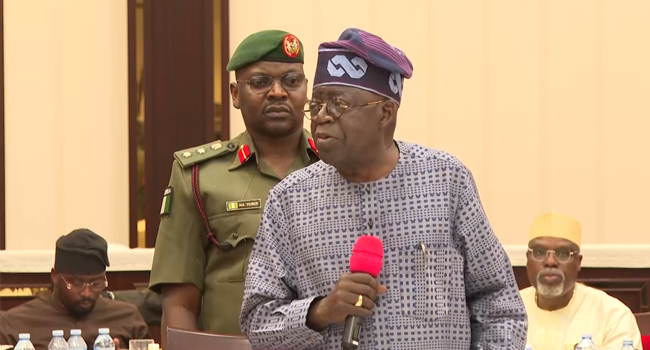
The 2026 International Women’s Day was a chorus of celebration, with Nigerian leaders from state to federal levels vowing to do more for women, including making governance more inclusive and providing better opportunities for them.
However, beyond the buzz of this year’s “Give to Gain” theme and the polished tributes that flooded mainstream and social media lies a far more complex reality for women across the country.
In all regions of the nation, the message from women’s rights advocates and leaders from different strata was simple and clear: Nigeria must go past the era of polished commentaries and take urgent steps toward better women’s representation.
Their worry is justified as Nigeria continues to record low levels of women’s representation in several spheres, especially in the political space, despite decades of advocacy for gender inclusion.
[embedded content]Women are severely under-represented in Nigeria’s elective political leadership space. For instance, in the 10th National Assembly, which was inaugurated in 2023, only four out of the 109 senators are women. The situation is similar in the House of Representatives, with just 17 female members out of 360 lawmakers.
At the moment, Nigeria, with 36 states, does not have a female governor. In fact, no woman has ever been elected as a governor in the nation, underlining the age-old gap between advocacy for women’s inclusion and the reality of political leadership.
For advocates, the figures are a stark reminder of the structural barriers that continue to limit the participation of women in politics.
“We are tired of being ‘honoured’ every March 8th while being locked out of the decision-making rooms on March 9th. If you want to ‘Give to Gain,’ start by giving us the legal framework to lead,” a visibility and thought-leadership expert, Glory Edozien, said.
[embedded content]According to analysts, the issue goes beyond the numbers. From the high cost of party nomination forms to other bottlenecks, the structural barriers make it very difficult for women to gain access to leadership positions.
For years, advocates have pushed for more women’s representation, including the Special Seats Bill, seeking to reserve a percentage of legislative seats for women.
The bill has faced setbacks in passage, but proponents say it would be a huge step towards bridging the gender gap in Nigeria’s political leadership.
Speaking on how important such measures are, a former Country Director for ActionAid, Ene Obi, said, “The Special Seats Bill before the House of Representatives has been the focus of extensive advocacy and lobbying for constitutional amendment — just as other climes around the world do.
“You have a Federal Character Commission that ensures diversity in appointments; why can’t we do the same for political representation?”
But the challenge is not limited to the political space. In different sectors such as business, education, technology, and corporate leadership, women face systemic hurdles, limiting their opportunities.
Systemic biases, limited mentorship opportunities, and high costs are some of the barriers hindering women from certain roles, and entrepreneur Tara Fela-Durotoye believes individual effort is not enough — institutional change is critical to narrowing the gender gap.
“As entrepreneurs, we have become a school of values. We must commit that everyone who works within our organizations is trained not just in skills, but in the soft skills and values that build a better version of a person for the world,” the founder of the House of Tara said.
READ ALSO: DJ, Iya Loja, Korope Driver, Poultry Farmer: Celebrating Diverse Women on IWD
[embedded content]Away from the corporate and business spaces, Tara noted that even in traditional institutions, there is room for progress. She cited her community in the Niger Delta region, which established the Office of the Queen, as an example of efforts to formalise women’s influence in local leadership.
According to her, this recognises the role of women in decision-making, a role that was absent in the past.
She said, “When my king was enthroned about five years ago, one of the first things he did was to put an Office of the Queen that never existed. Today, the office of the Olori of the Warri Kingdom is a structured office.
“The idea is to create a model so that men can see women are also being recognized — not just in terms of an office, but in terms of authority, power, and influence. Ten years ago, this would not have been possible, but we are seeing change now. These are the small steps of progress we are making.”
Today, on International Women’s Day, I celebrate the women of Nigeria, at home and abroad.
Across our homes, farms, markets, offices, and the halls of leadership, Nigerian women continue to demonstrate strength, courage, and determination that help hold our nation together.… pic.twitter.com/Ee24UOjqSC
Tara’s community is a shining example that change is possible and that deliberate efforts from institutions and government leaders can drive that.
During this year’s celebrations, President Bola Tinubu reiterated his government’s commitment to women’s empowerment.
“Our duty as a government and as a society is to continue creating the conditions where every Nigerian girl can learn, every woman can thrive economically, and every voice can contribute to our national development,” Tinubu said, with many governors echoing similar commitments to inclusion and opportunity for women.
“We’ve had decades of rhetoric. What we need now isn’t another speech at a banquet; we need the National Assembly to prove their commitment to Nigerian women by revisiting the gender bills. If we are ‘Giving to Gain,’ the government must ‘give’ us the legal framework so the nation can ‘gain’ from our leadership.”
For First Lady, Remi Tinubu, International Women’s Day is another time of “celebrating the strength, courage, tenacity, and achievements of women and girls across Nigeria and around the world”.
She said, “empowering women is not an act of charity; it is an investment in our collective future.
“When we give women access to education, healthcare, economic empowerment, leadership platforms, justice, and equity, we gain stronger families, more prosperous communities, and a more inclusive nation. When women rise, Nigeria rises!” the First Lady wrote.
[embedded content]Despite these assurances, groups such as the International Federation of Women Lawyers (FIDA) want governments and authorities to move from promises to actions.
“International Women’s Day must not be reduced to a celebration while many women continue to navigate broken systems,” FIDA wrote in a statement to mark the 2026 International Women’s Day.
The celebrations and speeches may fill the day, but the real stories are being told by women across different walks of life, silently pushing boundaries.

Leave a Reply