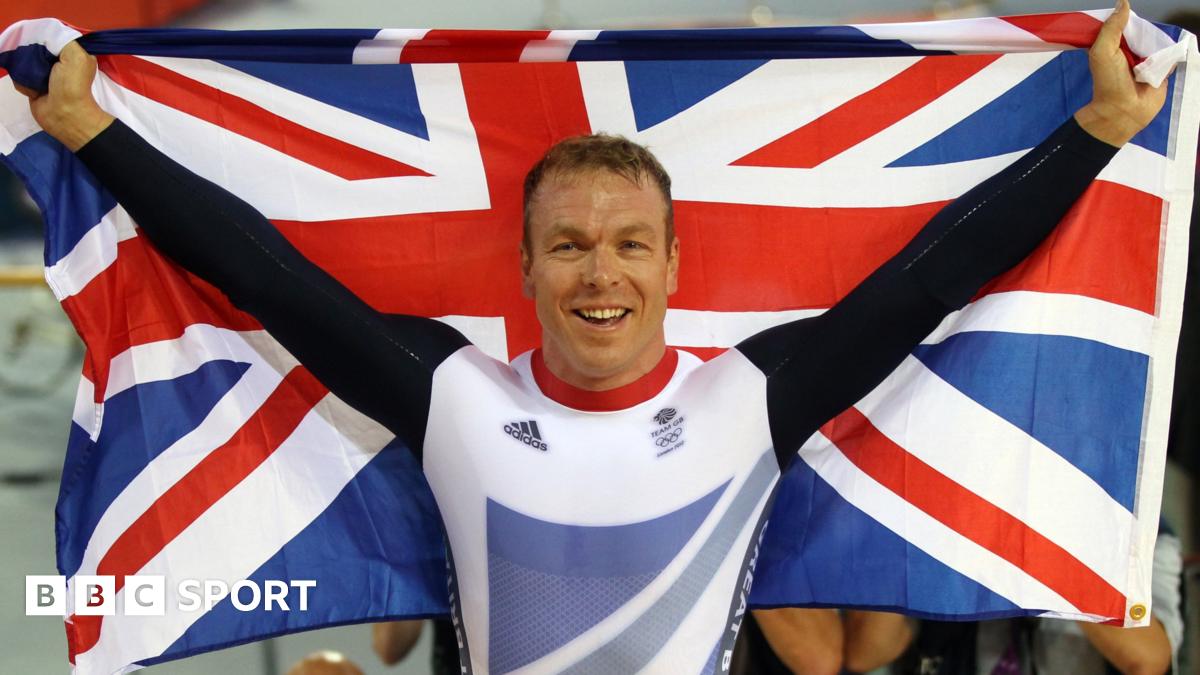
Sir Chris Hoy is in his kitchen, chatting about early-morning coffee and fry-ups.
And mindsets.
An Olympic champion’s mindset to be exact.
An exacting, leave-no-stone-unturned, meticulous mindset that defined a career in which he won six gold medals and one silver across four Olympic Games.
This is the same mindset he is relying on more than ever to reframe his entire existence and purpose following a terminal cancer diagnosis.
“We normally have a fry-up for breakfast but, when you guys are here, we need to make an effort,” he jokes.
The “you” in this instance are the BBC cameras that have been following Hoy and his family and friends for the past 12 months for the documentary Sir Chris Hoy: Cancer, Courage and Me.
The programme will be broadcast for the first time at 21:00 GMT on Thursday, 18 December on BBC One and available from 22:00 GMT on BBC iPlayer and the BBC Sport website and app.
Sir Chris Hoy: Cancer, Courage and Me
As he weighs his coffee – perhaps the number one area where Hoy’s obsessive eye for detail manifests itself – the Scot is in an upbeat mood, laughing and joking with wife Sarra about their imagined usual morning scenario of a full English breakfast compared to the omelette and green homemade smoothie they are actually tucking into.
It has not been anywhere near this rosy for much of the past two years, however, as Hoy explains a few minutes later when the cameras are rolling properly.
“It’s about five miles from the hospital back home,” he says, describing his return journey from seeing doctors after learning of his cancer diagnosis in September 2023. “I just walked back in a daze. I don’t remember the walk. I was just thinking, how am I going to tell Sarra? What am I going to say?
“As soon as I said the words, I broke down.”
What Hoy had to articulate was a terminal cancer diagnosis. Incurable secondary bone cancer. Between two and four years to live.
“In my sporting career it used to be about process, not outcome,” he says. “Focus on what you have control over. But if you win or lose, it’s not life and death.
Hoy has shrewdly taken on support for this difficult time in his life.
Steve Peters is a man that Hoy knew could make a difference.
The list of sportspeople that Peters has worked with – the public list he is happy to talk about on the record – is a high-profile ‘who’s who’ ranging from Steven Gerrard to Ronnie O’Sullivan.
The donkeys in the front paddock of the psychiatrist’s countryside home bely that glitzy, glamourous list.
But their tranquil nature make complete sense when you spend a few hours in the company of Peters and Hoy.
Peters was Hoy’s first port of call throughout his career when it came to training and calming his mind to be at its peak in and around Olympic competition.
He was also one of the first people Hoy called when he got his terminal diagnosis last year.
At first Peters was part of the firefighting phase of what Hoy’s wife Sarra describes as a “deep grief” in the first few days post-diagnosis.
But in time, with Peters’ help, Hoy set about finding a new purpose.
Firstly, it is to raise awareness of the limitations of the current provision for prostate cancer in the UK. Both Hoy’s father and grandfather have had prostate cancer.
Understandably, given an earlier diagnosis could have shifted his diagnosis from terminal to manageable, the 49-year-old Scot argues eloquently that a national screening programme should be made a priority for men from their 45th birthday onwards.
But, crucially, his approach is also to show other people living with cancer that sport and exercise can still be a positive part of their lives, even through their treatment.
Peters explains: “What Chris did when he was presented with this illness is he said: ‘Right, what’s the plan?’ After we worked through the initial stages of the shock and grief of it, then he came out the other side and he picked up on the purpose.
To play this video you need to enable JavaScript in your browser.
Peters knows all too well how unstoppable Hoy can be when a mission takes him over.
The pair have now worked together for more than 20 years, with perhaps their crowning moment coming at the Athens 2004 Games.
It was in the Greek capital that Peters’ “pink elephant” technique helped Hoy win his first Olympic gold. In the run-up to Athens, Peters had encouraged Hoy to pre-empt a scenario in which his rivals broke the world record in the men’s kilometre time trial before the Scot had his chance to ride. The scenario became reality on three occasions, but rather than falter, Hoy, the last to ride, responded with a world record of his own to take gold.
The mindset of that moment is one he is tapping into again with his approach to cancer. Control the controllables, but don’t waste time worrying about the end result.
Just like in Athens.
“As I went to the start line, a personal best would have got me third,” Hoy remembers.
“Recognising what you have control over is such an important part of life. Focus on what you have control over – but the outcome itself, you don’t have control over.
“Steve helped me to access the best of myself, and get the best out of myself.”
The BBC Breakfast and BBC Sport cameras witnessed Hoy, with the help of Lady Sarra – who herself is dealing with her own diagnosis of multiple sclerosis – making the best of his cancer diagnosis in the last 12 months.
They have followed Hoy and his family to doctor and physio appointments and out on mountain bike rides in Wales with a GB Olympic cycling A-list group of riders and friends.
‘Overwhelming’ response to Hoy mission
To play this video you need to enable JavaScript in your browser.
It is just after 9am in a back room of the Sir Chris Hoy Velodrome in Glasgow – a few minutes before Hoy’s charity mass participation cycling event, the Tour de Four, is due to get under way.
The ride was set up, and given its title, in an effort to change perceptions around stage four cancer.
Every time the door opens, a member of British Olympic and Paralympic royalty walks through it.
Sir Mark Cavendish, Sir Jason Kenny, Becky James, Dani King, Sir Ben Ainslie, Sir Steve Redgrave, Dame Sarah Storey…
In and among the clip-clop of cycling cleats comes another sporting knight.
This one is wearing tennis shoes.
Hoy goes over to check in with Sir Andy Murray about his readiness and is met with a typical sardonic quip from his fellow Scot.
Hoy asks: “Are you feeling ready mate?”
- 3 December 2025
- 3 December 2025
As it turns out, the two-time Wimbledon champion was woefully ill-prepared – completing the ride in tennis shoes and boxer shorts. Not typical road cycling gear, but typical of the response of Hoy’s friends to his diagnosis.
“The response of friends has been quite overwhelming at times,” Hoy says.
The friend response has been mirrored by that of the public.
September’s Tour de Four raised more than £3m for cancer charities across the UK.
However, the highs of that success were followed in November by the UK National Screening Committee’s recommendation that a prostate screening cancer programme for all men in the UK was not justified.
For Hoy, the fight to raise money and raise awareness is his new Olympic-sized mission and his response therefore was dignified, yet resolutely determined.
“I was quite astonished,” he said. “I can’t believe that the answer to this situation is to sit on your hands and do nothing. There are 10,000 men a year in the UK who find out they have prostate cancer too late – it’s incurable.
“We’re failing these men if we don’t do something proactive. Regardless, I’m going to keep pushing.”
Again, we meet his Olympic-honed mindset, targeted on a bigger mission.
“The Olympics was something that was my life for so many years and drove me on,” Hoy says.
“I’m still incredibly proud of it now and I look back with great fondness, but this is something on an entirely different level.
To play this video you need to enable JavaScript in your browser.
Related topics
- Insight: In-depth stories from the world of sport
- Cycling

Leave a Reply