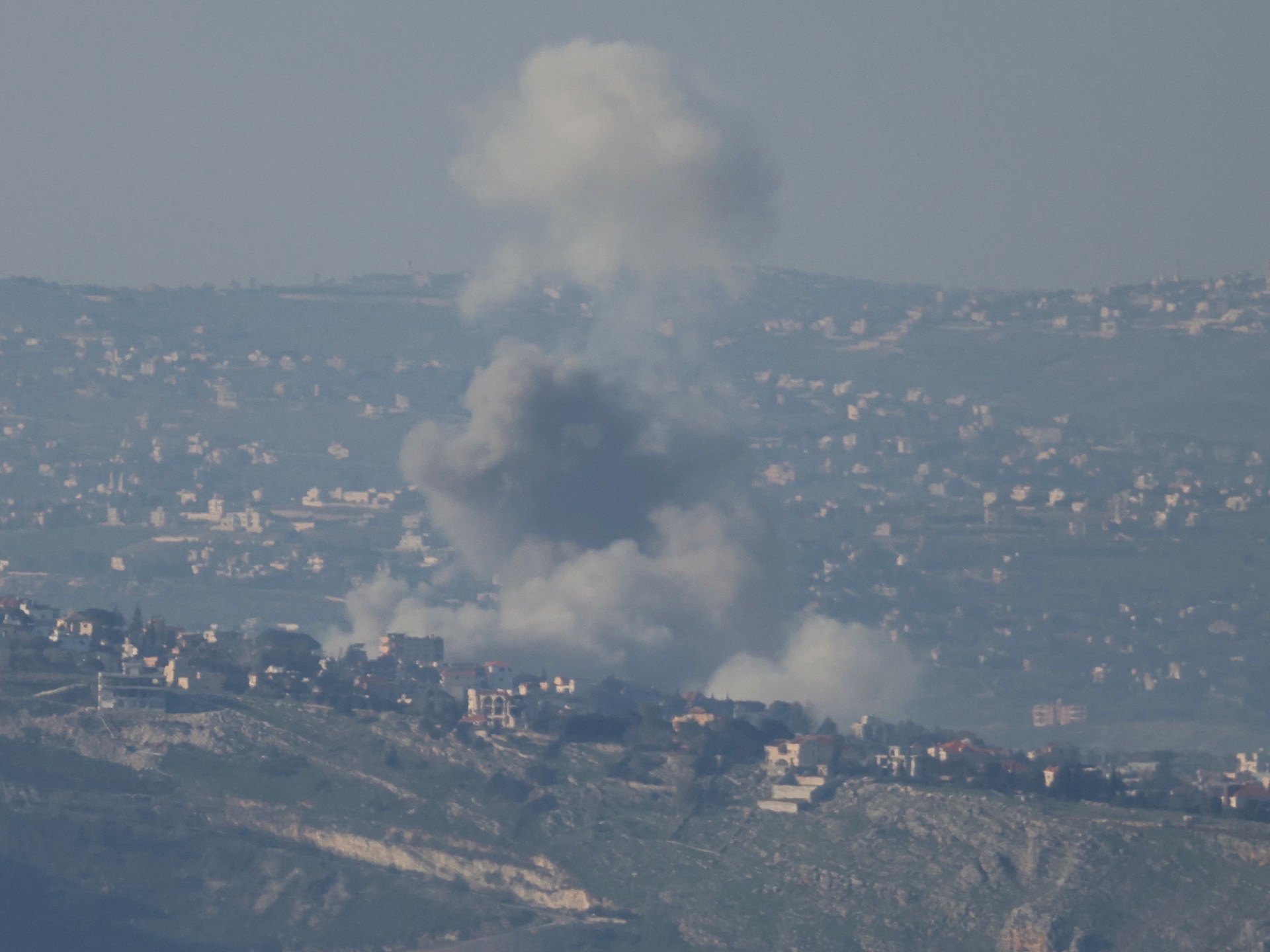
Beirut, Lebanon – About 2:30am (04:30 GMT), Nader Hani Akil was awoken by Israeli attacks on Dahiyeh, Beirut’s southern suburbs. He got his family ready, jumped in the car and left behind their home in Dahiyeh’s Burj al-Barajneh neighbourhood.
“I was sleeping when bombing and rocket attacks started,” he told Al Jazeera on Monday while standing in front of the Jaber Ahmad al-Sabah school in Beirut. Locals told Al Jazeera that the scene on the way out of the southern suburbs was chaotic with bumper-to-bumper traffic, people fleeing on foot and children crying.
“This situation for me is normal. We accept any aggression. We accept any bombing. We accept death. We accept martyrdom. We accept anything in this situation that we live,” Akil said as a drone buzzed overhead and displaced families sat along the school’s exterior. “One way or another, death will come. We either die with honour and dignity, or let us not die at all.”
Overnight, Hezbollah responded to Israeli attacks for the first time in more than a year by firing a barrage of missiles and drones towards an Israeli military site in the northern city of Haifa.
Israel said it killed senior Hezbollah leaders in the attacks on southern Lebanon and Dahiyeh. It also delivered mass displacement notices to more than 50 towns and villages in southern and eastern Lebanon. The scenes of bumper-to-bumper cars fleeing the areas recalled the worst days of Israel’s war on Lebanon in 2023 and 2024.
Hezbollah said the attack was in response to the assassination of Iran’s supreme leader, Ayatollah Ali Khamenei, who was killed on Saturday by Israeli strikes on the Iranian capital, Tehran.
United States officials told MTV Lebanon that they now considered a ceasefire in Lebanon that began in November 2024 to be over and they will not interfere to stop Israel’s attacks on Lebanon, the television station reported. They said they didn’t expect Lebanon’s airport or ports to be targeted but demanded that the Lebanese state designate Hezbollah as a “terrorist organisation”, “otherwise, there will be no distinction between the two.”
On Monday, the Lebanese government outlawed Hezbollah’s security and military activities and ordered the arrest of those who carried out the rocket strikes.
When Israel, which has attacked Lebanon almost daily despite the ceasefire, responded on Monday to Hezbollah’s barrage, loud booms woke up residents of the capital. Lebanon’s Ministry of Public Health said 31 people were killed and 149 wounded.
Israel then issued evacuation warnings for more than 50 towns in southern Lebanon and the Bekaa Valley, leading to scenes reminiscent of September 23, 2024, when Israeli attacks killed about 500 people and displaced more than one million in a single day.
Hezbollah’s response
During the 2023-2024 war between Israel and Hezbollah, Israel killed more than 4,000 people in Lebanon, including Hezbollah Secretary-General Hassan Nasrallah and most of the group’s senior military leadership.
Israel also invaded southern Lebanon and, despite agreeing to withdraw its troops in the November 27, 2024, ceasefire, has held on to five points in Lebanon.
Meanwhile, Israel has continued to attack the south and the Bekaa Valley despite the ceasefire. It also reportedly sent an indirect message to Lebanon that it would strike civilian infrastructure, including Beirut’s airport, should Hezbollah decide to respond to the attacks.
Hezbollah’s attack late on Sunday and early on Monday has drawn strong responses from its critics in Lebanon, who blamed it for giving Israel an opening to resume widespread retaliation.
The group said its attack on Israel was “in retaliation” for the assassination of Khamenei, who was “unjustly and treacherously killed by the criminal Zionist enemy”, and “in defense of Lebanon and its people, and in response to repeated attacks”.
The group said in a statement that it had fired “a barrage of precision missiles and a swarm of drones” at the Mishmar al-Karmel missile defence facility south of Haifa.
Lebanese Prime Minister Nawaf Salam convened an emergency cabinet meeting on Monday morning. In a statement after the meeting, the cabinet announced outlawing Hezbollah’s security and military activities, calling them “illegal acts” and demanding the group hand over its weapons.
Justice Minister Adel Nassar said the public prosecutor had ordered security forces to arrest those who had fired at Israel. Since the ceasefire, Lebanon has arrested other individuals who have fired rockets across the border although none of them was reported to be Hezbollah members.
Hezbollah has yet to comment on the announcements.
The Israeli bombardment of Dahiyeh continued on Monday. No attacks were reported on the Beirut-Rafic Hariri International Airport, but most flights in and out were cancelled, according to the airport’s website.
Meanwhile, local news broadcasts showed footage of traffic-filled roads leading out of southern Lebanon and Beirut’s southern suburbs northwards. Many people also fled on foot.
Lebanon’s government sent out a list of schools around Beirut that were open to receive the displaced. Critics of Salam’s government, including many Hezbollah supporters, have expressed anger and disappointment that the government has not protected the people affected.
Akil, who took his family to one of the schools on the list, said he didn’t blame the government because it is under external pressure.
Some local residents who fled or had family fleeing from impacted areas told Al Jazeera they were in disbelief at Hezbollah’s actions. Before the attacks, 64,000 people were internally displaced in Lebanon, mostly due to destruction from Israel’s war on Lebanon.
But others doubled down on their support for Hezbollah.
“We are the resistance, and we will remain with the resistance,” Akil said. “Us, our children, our children’s children are with the resistance and will stay with the resistance.”
Another woman in front of the school who fled her home in the Haret Hreik neighbourhood of Dahiyeh said any blame should be directed at Israel. She did not want to give her name.
“Anyone with dignity would get sad leaving their home,” she said as a baby cried nearby. “But the Israelis have no humanity. Just imagine, you leave your land and they make a country on your land.”
A woman sitting next to her from the southern border village of Hula jumped in: “But this doesn’t break us. Our heads are held high, and with God’s permission, our land will stay ours.”
Hezbollah has supported some of the displaced with rent payments and other financial support, but many Lebanese said it hasn’t been enough to cover their basic needs.
Ali, a displaced man living in Burj Qalaway, a village struck by Israel early on Monday, said he was waiting for the roads to clear before heading to Beirut but the situation “was not good.”
“There are many strikes and many drones [overhead],” he said.
Strategic desperation
After initial Israeli-US attacks on Iran on Saturday and Iran’s retaliation on targets around the region, there were initial doubts Hezbollah would get involved. Hezbollah released a statement saying it would “meet its responsibilities toward the resistance”.
Iran is both Hezbollah’s primary benefactor and ideological guide. Hezbollah is also a key member of the Iranian-backed “axis of resistance”, a loose affiliation of groups that also includes Hamas, Yemen’s Houthis, Iraq’s Popular Mobilisation Forces and, until it fell in December 2024, Bashar al-Assad’s regime in Syria.
Analysts said Hezbollah likely knew before its attack that it would have severe consequences on Lebanon’s Shia community, from which Hezbollah gets the overwhelming majority of its support.
“It was a handful of rockets, and it looks like they aimed at open areas rather than proper targets to inflict damage or cause casualties,” Nicholas Blanford, a nonresident senior fellow with the US-based Atlantic Council think tank, told Al Jazeera. “But it has given the Israelis an excuse, if they needed one in the first place, to come in and really start battering Hezbollah in the south, Bekaa and Dahiyeh more heavily.”
Blanford described the move as a mistake but said it may have been out of the group’s hands. “The Iranians have been playing a more commanding role of Hezbollah in the last year or so, so it’s hard to see where things are going to go. I don’t think Hezbollah is going to continue retaliating because it is just backfiring on them domestically and it would be pointless,” he added.
“Hezbollah’s response should be understood as an act of strategic desperation,” Imad Salamey, a political scientist at the Lebanese American University, told Al Jazeera. “The response was taken despite its repercussions for Lebanon. Survival of the axis outweighs domestic cost.”

Leave a Reply