In little over 100 days, the United States will co-host a football World Cup that Iran have qualified for.
On Saturday, the US attacked Iran as part of a joint operation with Israel, sparking retaliatory strikes across the Middle East.
So what could the conflict mean for Iran, for the US, and for what was already set to be a highly politicised World Cup?
Will Iran still play at the World Cup?
Iran’s group matches in what would be their fourth consecutive World Cup are against New Zealand and Belgium in Los Angeles, then Egypt in Seattle.
The team were not withdrawn from the competition last summer when the US bombed three nuclear facilities in the country, but the head of its football federation has now reportedly cast doubt on their participation.
“With what happened… and with that attack by the United States, it is unlikely that we can look forward to the World Cup, but the sports chiefs are the ones who must decide on that,” Mehdi Taj is reported to have told Iranian television.
But in the aftermath of the killing of Iran’s Supreme Leader Ayatollah Ali Khamenei, and amid huge uncertainty over the future political landscape in the country, predicting such a decision – or even who would make it – is impossible.
“For Tehran, this is not a short 12-day war or a contained round of escalation that can be paused and reset,” said Dr Sanam Vakil – director of the Middle East and North Africa Programme at international affairs think-tank Chatham House.
“This new stage of conflict is existential and clearly about regime survival. It is also unlikely to end quickly.”
Fifa – football’s world governing body – has said it is monitoring developments but, at this stage, officials are privately saying they expect Iran to be at the World Cup. On Saturday, Fifa’s general secretary Mattias Grafstrom said “our focus is to have a safe World Cup with everybody participating.”
If Iran were to boycott the tournament, Fifa rules dictate they could be replaced with an alternative team from the Asian Football Confederation (AFC). Iraq, who could qualify anyway via a continental play-off at the end of the month, or the UAE, who missed out on qualification, would be favourites to step in.
Iran’s women’s team, meanwhile, are preparing for their first match of the Asia Cup in Australia. The squad trained as planned on the Gold Coast on Sunday.
The AFC said in a statement it continued to “closely monitor the recent developments in the Middle East during this challenging period”.
It added: “The AFC’s foremost priority remains the welfare, safety and security of all players, coaches, officials, and fans. In this regard, we are in close and regular contact with the Iran women’s national team and officials on the Gold Coast and are offering our full support and assistance.”
 Getty Images
‘We are in uncharted territory’
US President Donald Trump last year signed an executive order banning nationals from 12 countries – including Iran – from entering the US, citing an effort to manage security threats. World Cup players and coaching staff are exempt.
But if Iran do play, there is now likely to be even more scrutiny on safety around the team’s matches, and the squad’s planned training base in Arizona.
Security had to be increased at the 2022 World Cup when the country’s matches in Qatar – including against the US – took place against a backdrop of mass anti-government protests in Iran.
During their second match against Wales, there were even confrontations between fans with opposing views about Iran’s government, and given Trump’s hopes for regime change there, it is possible a similar scenario could play out this summer.
“We are in uncharted territory in that we are just over three months away from the start of the World Cup and the hosts have just launched a war of aggression against a participating country,” says Nick McGeehan of human rights advocacy group FairSquare.
“If Iran withdraws its team – an outcome that seems entirely plausible – Fifa is likely to breathe a sigh of relief given the scope for protest and unrest.”
But even if Iran are absent, security will be even more of a focus, especially given the event will also be used to celebrate the 250th anniversary of the US Declaration of Independence, and Trump is expected to be a highly visible presence, as he was at the Club World Cup and Ryder Cup last year.
The conflict began just days after US government officials were warned there could be “catastrophic” security consequences if the 11 US cities hosting matches do not receive funding that has been frozen amid a partial government shutdown, with preparations said to be behind schedule.
There has also been mounting concern over the use of Immigration and Customs Enforcement (ICE) agency at the tournament, and an outbreak of cartel violence in neighbours and co-hosts Mexico.
Over the weekend, Andrew Giuliani – head of the White House’s World Cup taskforce – praised Trump’s strikes on Iran, posting on social media it would “make the world a safe place”.
“We’ll deal with soccer games tomorrow,” he added. “Tonight we celebrate [the Iranian people’s] opportunity for freedom.”
How about the Fifa ‘Peace Prize’?
To play this video you need to enable JavaScript in your browser.
In December, Fifa awarded Trump its inaugural ‘Peace Prize’ at the 2026 World Cup draw ceremony, saying he had “played a pivotal role” in establishing a ceasefire between Israel and the Palestinians, and that he had sought to end other conflicts.
In the few weeks since, the US has taken military action in Venezuela, Nigeria and Iran, and has hinted at possible further operations in Greenland, fellow World Cup co-host Mexico, and Colombia – another participant in the tournament. In January, Trump also told Cuba to “make a deal” or face consequences.
Trump has fiercely defended his foreign policy, insisting he is acting in the United States’ interests.
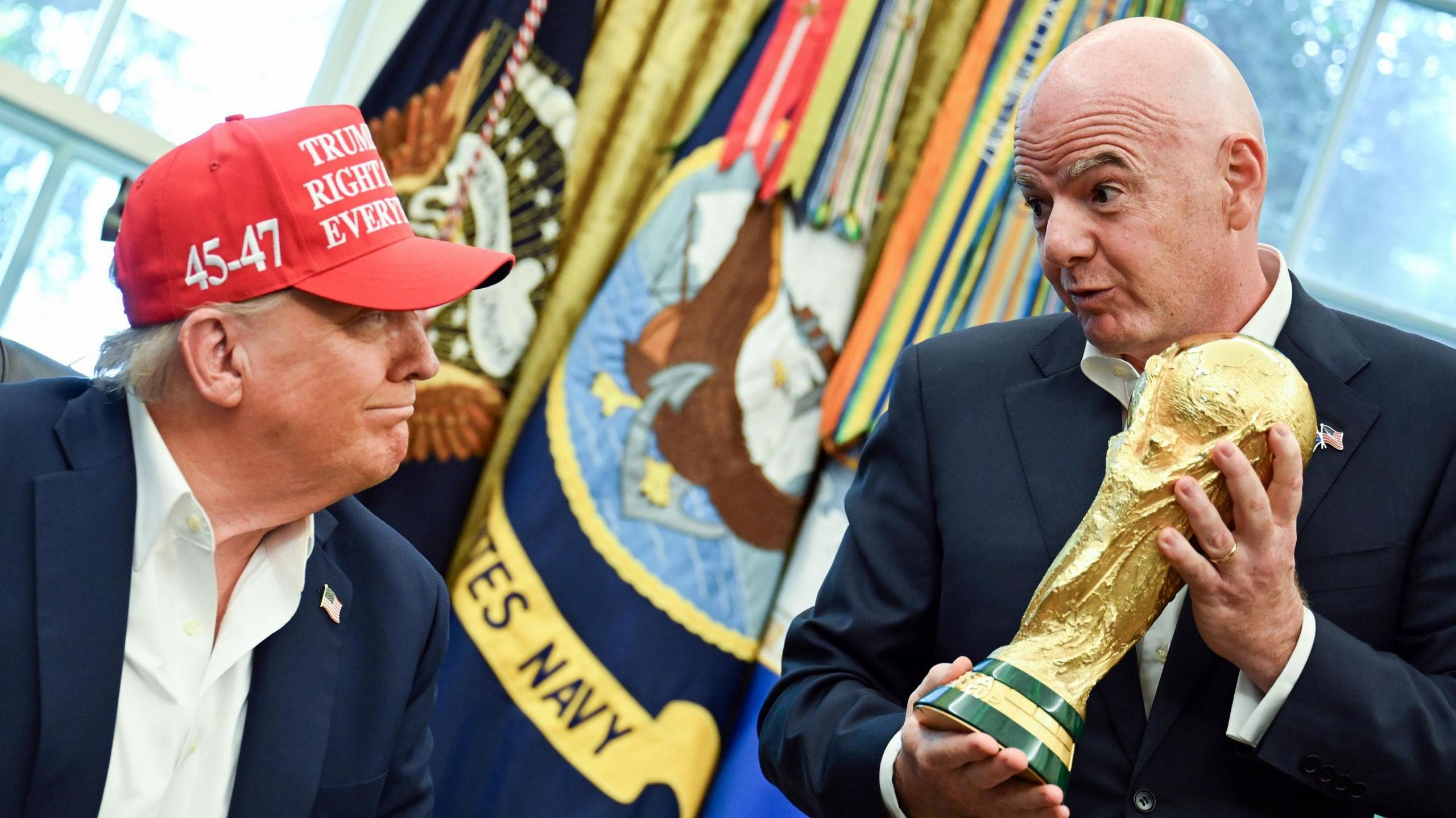
Last month, Infantino defended the awarding of the ‘Peace Prize’, even appearing at the first meeting of the US President’s Board of Peace while wearing a Trump-themed ‘USA’ cap branded with ’45-47′ in reference to his terms of office.
Trump’s decision to attack Iran has received both support and condemnation, but what is certain is it will lead to more scrutiny of Fifa’s decision to align itself with him, with critics arguing it undermined the governing body’s political neutrality.
In January, 27 politicians from Labour, the Liberal Democrats, Green Party and Plaid Cymru signed a motion in parliament calling on international sporting bodies to consider expelling the US from major international competitions, including the World Cup. The motion said such events “should not be used to legitimise or normalise violations of international law by powerful states”.
The same month, an official from the German Football Association said it was time to consider a boycott of the 2026 World Cup in the wake of Trump’s actions.
Such demands could now be repeated, and there could also be calls by Gulf states for Iran to be punished for its retaliatory attacks on their territory.
Fifa insists as an organiser of football events it has a statutory duty to remain neutral, and this is not the first time it has come under pressure over the political actions of a World Cup host.
In 2018, the tournament went ahead in Russia despite the country annexing Crimea four years earlier. Russia also stood accused of cyber attacks, meddling in western elections and carrying out the Novichok nerve-agent attack in Salisbury.
Russia was eventually banned by Fifa in 2022 over its invasion of Ukraine, after a number of European countries refused to compete against it.
But Infantino has recently said the punishment has not worked, and that he wants it lifted. There is no sign he has any appetite to sanction the US, regardless of how controversial its foreign policy is.
Related topics
- Football
- FIFA World Cup
- 17 October 2025

- 16 August 2025


Leave a Reply