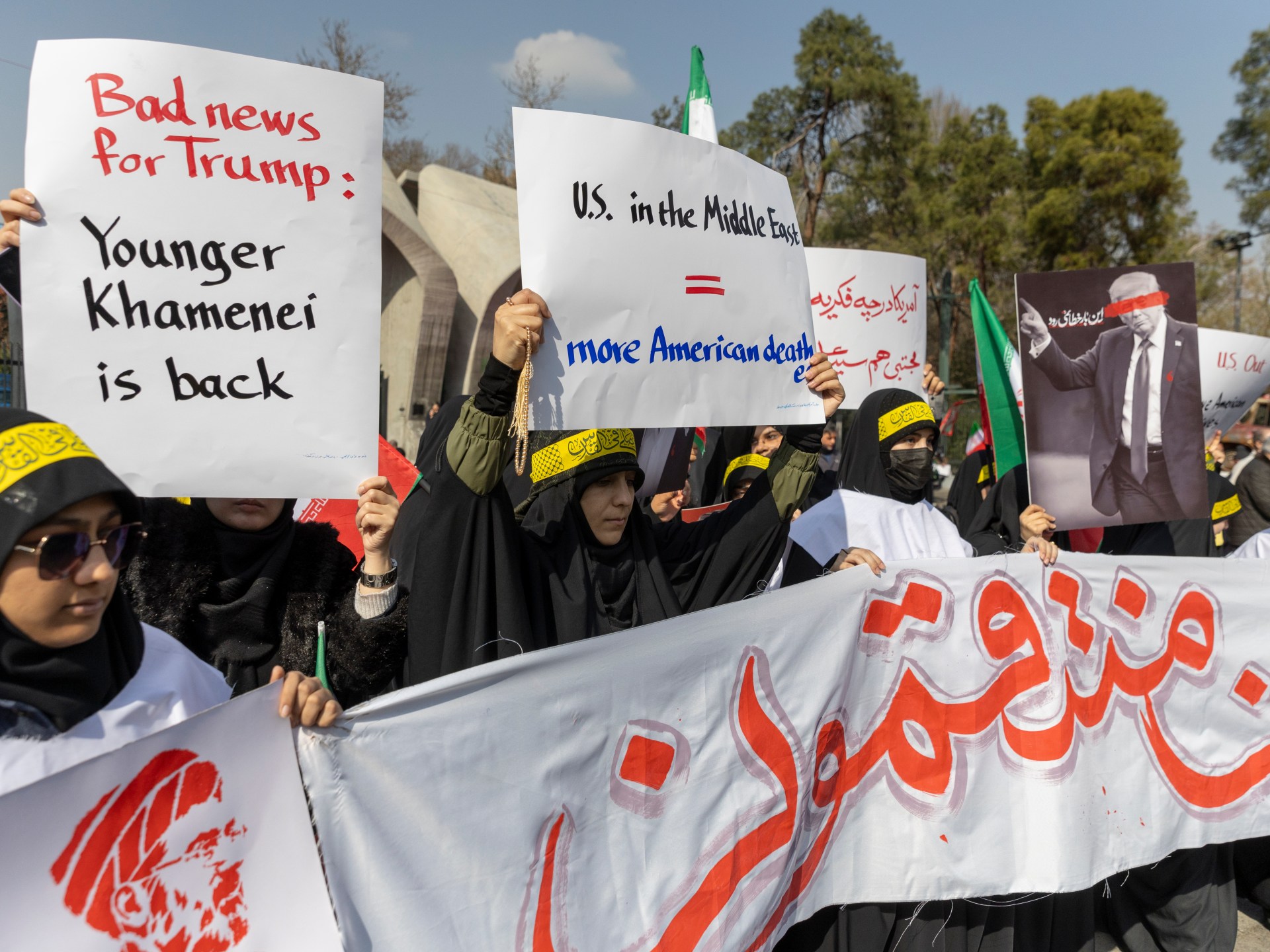
Tehran, Iran – Iranian authorities are organising street-level events across the country over the coming days to maintain security control and send more messages of defiance to the leaders of the United States and Israel in the third week of their war.
Wednesday is the last day in the Iranian calendar, and Iranians have for thousands of years marked it with Chaharshanbe Suri, a festival of fire and celebration to symbolise the triumph of light over darkness and welcome Nowruz, or the Persian New Year.
Recommended Stories
list of 4 itemsend of list
The general prosecutor’s office in Tehran sent text messages to people on Monday to say they are prohibited from using fireworks and explosives or from lighting fires during celebrations, as is the custom, since they may be “misused by spying or rioting elements of the enemy”.
But state television urged Iranians to mark this year’s festivities by making and setting ablaze effigies of US President Donald Trump and Israeli Prime Minister Benjamin Netanyahu.
“We must turn Chaharshanbe Suri into a devil-burning ceremony. Using whatever we can, from pieces of cloth to cardboard, let’s make figures of Trump and Netanyahu and burn them in the squares and streets,” state television said.
It said the Islamic Revolutionary Guard Corps (IRGC) will continue to create a “regional Chaharshanbe Suri” by firing ballistic missiles and drones at other countries as the US and Israel bomb Tehran and cities across Iran.
The IRGC released footage of a Sejjil long-range ballistic missile being fired for the first time during this war on Sunday, and reported more attacks on Monday while vowing to “pursue and kill” Netanyahu. The missile has a range longer than 2,000km (1,240 miles).
Tehran has ruled out any negotiations with Washington, and says it expects reparations and a guarantee against future attacks if the war is to stop.
A giant mural unveiled at Valiasr Square in downtown Tehran this week showed Iranian ballistic missiles, accompanied by the text, “Until the world finds rest”.
The streets of Tehran show a fraction of their usual hustle and bustle, but some businesses remain open for limited hours during the day, and the atmosphere turns more security-focused when night falls.
There are numerous patrols by the paramilitary Basij forces of the IRGC, and pro-establishment supporters heed calls from authorities to congregate in mosques and at main city squares and streets to shout “Allah akbar” and “Death to America”.
Multiple residents of the capital who spoke with Al Jazeera said pro-state groups have been organising nightly motorcades moving through various neighbourhoods, during which people wave their mobile phone lights and chant religious slogans using loudspeakers.
“You are certain to face multiple checkpoints and roadblocks and have your belongings searched if you go out at night. You’ll see some during the day, too,” said a resident, who asked not to be named due to security concerns.
“The checkpoints are often manned by several cars and sometimes heavy vehicles with mounted machine guns, and you see masked men with assault rifles. Some of them look to be very young,” he said.
The Israeli army has started using its heavy surveillance and attack drones like Hermes and Heron variants to monitor and then launch munitions towards a number of major checkpoints in Tehran over recent days. Multiple Basij local commanders have since been killed, prompting state forces to stay on the move or set up checkpoints in tunnels and under bridges.
The IRGC-affiliated Fars news agency on late Saturday released footage showing pro-establishment people queuing up at night to sign up for checkpoint or patrol duty for the Basij force.
State media have also been widely circulating images of young women, dressed entirely in black chadors and veils and wearing black masks, wielding assault rifles and waving flags.
Mohammad Zahraei, a senior Basij commander, confirmed on Sunday that the force is recruiting as much as possible, and said it will continue to operate as part of the security apparatus during the war.
In a message last week, hardline parliament chief and former top IRGC commander Mohammad Bagher Ghalibaf said state supporters must only keep in mind one thing: “Street, street, street”.
Iranian authorities have issued threats of using lethal force against any public anti-establishment sentiment or street protests, saying arrested dissidents will face severe punishments, including execution and confiscation of assets.
“Now the vile enemy, frustrated by not achieving field combat goals, is once again seeking to instill fear and chaos in the streets; but a blow even stronger than January 8 awaits the ‘neo-Daeshis’,” the intelligence directorate of the IRGC said in a statement last week.
This was in reference to thousands being killed during nationwide protests in January, mostly on the nights of January 8 and 9, which the government blamed entirely on “terrorists” and “rioters” armed and funded by the US and Israel.
The United Nations and international human rights organisations accuse Iranian state forces of being behind the killings. They have also called for the release of tens of thousands arrested during and in the aftermath of the protests.
Iranian authorities continue to announce arrests linked with the ongoing war, noting this week that dozens were arrested for sending videos of impact points and checkpoints to “terrorist” media outlets outside of the country using tools to circumvent internet filtering.
The internet remains entirely shut down more than two weeks since the start of the war, while signal-jammed satellite television networks offer the only alternative to state media outlets, which mostly focus on statements from local officials and successful IRGC attacks across the region.

Leave a Reply