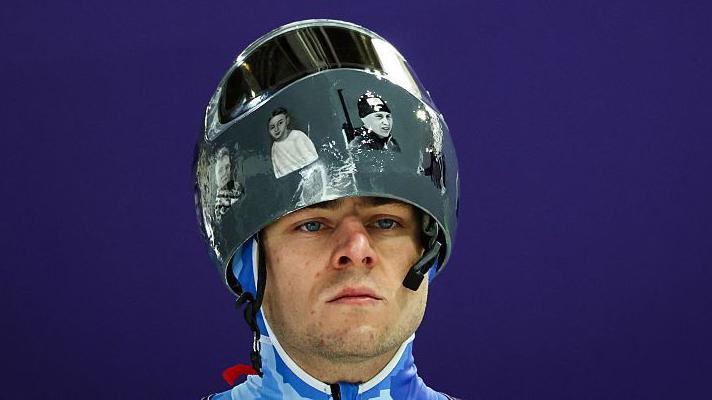
Ukrainian skeleton racer Vladyslav Heraskevych has been banned from wearing a helmet featuring images of people killed during the Russian invasion of his home country at the Winter Olympics.
The International Olympic Committee (IOC) said the helmet broke the rules laid down in the Olympic Charter, but he will be allowed to wear a black armband in remembrance of those who have lost their lives.
Heraskevych, who wore the helmet during a training session in Cortina, said the decision “breaks my heart”.
The 26-year-old told Reuters many of those pictured on his ‘helmet of remembrance’ were athletes, including teenage weightlifter Alina Peregudova, boxer Pavlo Ishchenko and ice hockey player Oleksiy Loginov, and some of them were his friends.
Rule 50.2 of the Olympic Charter states “no kind of demonstration or political, religious or racial propaganda is permitted in any Olympic sites, venues or other areas”.
“We have addressed from the beginning the issue, the IOC fully understands the desire of athletes to remember those who have lost their lives in that conflict and other conflicts around the world,” IOC spokesman Mark Adams said.
“We have to focus on athlete performance and sport, and it is fundamental there are equal rights for all athletes, and keep it free from all interference.
- 15 hours ago
Heraskevych has said he will respect Olympic rules while still raising awareness about the war in Ukraine at the Games.
“We have over 90 countries competing here, thousands of athletes, there are a range of things people want to commemorate,” Adams added.
“We want in the Olympics a safe space to compete away from that, while allowing them to express themselves.
“He can wear an armband with no text. However much we agree with an expression, we have to keep a fine balance.”
Adams said people will always “push rules to their limit” and the IOC will assess each case on an individual basis.
“Our rule is that we have to protect the field of play, it is difficult and there will be people who try to game the system, that’s where we have to ban slogans,” Adams said.
“Where there is good reason, black armbands will also be allowed for other athletes.”
He said Toshio Tsurunaga, the IOC representative in charge of communications between athletes, national Olympic committees and the IOC, had been to the athletes’ village to tell him.
“The IOC has banned the use of my helmet at official training sessions and competitions,” Heraskevych, who was a Ukraine flagbearer in Friday’s opening ceremony, said on Instagram on Monday.
“A decision that simply breaks my heart. The feeling that the IOC is betraying those athletes who were part of the Olympic movement, not allowing them to be honoured on the sports arena where these athletes will never be able to step again.
“Despite precedents in modern times and in the past when the IOC allowed such tributes, this time they decided to set special rules just for Ukraine.”
Ukraine president Volodymyr Zelensky thanked Heraskevych “for reminding the world of the price of our struggle” in a post on X.
Heraskevych, Ukraine’s first skeleton athlete, held up a ‘No War in Ukraine’ sign at the 2022 Beijing Olympics, days before Russia’s invasion of the country.
Following Russia’s full-scale invasion of Ukraine in 2022 athletes from Russia and Belarus were largely banned from international sport, but there has since been a gradual return to competition, although not under their national flags.
‘We love our country’ – Ruohonen
 Getty Images
Elsewhere, American curler Richard Ruohonen has spoken out about the USA’s Immigration and Customs Enforcement (ICE).
Protests have taken place across the US over the past few weeks after intensive care nurse Alex Pretti, 37, and fellow American citizen Renee Good, 37, were both killed by ICE agents in Minnesota in January.
“What’s happening in Minnesota is wrong,” Ruohonen said.
“There’s no shades of grey – it’s clear. I really love what’s been happening there now, with people coming out, showing the love, the compassion, integrity and respect for others that they don’t know and helping them out. We love Minnesota for that.
“I’m proud to be here to represent Team USA and to represent our country, but we’d be remiss if we didn’t at least mention what’s going on in Minnesota, and what a tough time it’s been for everybody.”
On Monday, Team GB skier Gus Kenworthy, who was born in England but grew up in America, said he had received death threats after posting a graphic image relating to ICE on Instagram.
American skiers Chris Lillis and Hunter Hess voiced their concerns about the actions of ICE and ongoing tensions in the US.
President Donald Trump later criticised the American duo and called Hess a “real loser” and said he shouldn’t have “tried out for the team”.
“I want to make it clear that we are out here, we love our country,” Ruohonen said.
“We’re playing for the US, we’re playing for Team USA, we’re playing for each other, and we’re playing for our family and our friends that sacrificed so much to get here today.
“What the Olympics means is excellence, respect, friendship, and we all, I think, exemplify that.
- 15 hours ago
Winter Olympics 2026
6-22 February
Related topics
- Winter Sports
- Skeleton
- Winter Olympics

Leave a Reply