Tokyo, Japan – In Tomoko Ida’s household, rice is on the menu less often than it used to be.
Ida, a 48-year-old graphic designer and mother of two who lives in Tokyo, finds it difficult to justify eating Japanese rice on a daily basis amid soaring prices for the food staple.
Recommended Stories
list of 4 itemsend of list
“I remember that a few years ago, 5kg (11lbs) of rice cost around 3,000 yen ($19), but now it costs about 4,000 to 5,000 yen ($25 to $32),” Ida told Al Jazeera.
“My family consumes about 10kg (22lbs) of rice every month, and now we have no choice but to eat pasta or noodles a few times a week to save rice,” she said.
Ida is among millions of Japanese voters for whom rising living costs are the top concern in Sunday’s general election, which pits Japanese Prime Minister Sanae Takaichi’s Liberal Democratic Party-led (LDP) coalition against the opposition Centrist Reform Alliance.

For average Japanese people, making ends meet has become more difficult over the past year amid the persistent failure of wages to keep pace with rising prices.
Inflation-adjusted wages fell 2.8 percent in November, the 11th straight month of decline in people’s pay cheques, according to Japanese government statistics.
While Japan’s overall rate of inflation hovers at about 2 to 3 percent, the price of food has been rising much faster.
Rice prices soared nearly 68 percent last year, the result of shortages caused by a poor harvest in 2023.
Prices of imported foods, such as coffee and chocolate, have also risen sharply due to the weak yen, which has sapped consumers’ purchasing power.
“I went to a department store to buy some British tea as a treat, but it was over one and a half times the price from a few years ago, so I decided not to buy it,” Nao Hanaoka, a 29-year-old IT consultant in Tokyo, told Al Jazeera.
“Last year, I had plans to travel overseas for a conference, but the weak yen made it impossible to pay the conference fees,” Hanaoka added.
In a survey carried out by public broadcaster NHK last month, 45 percent of respondents said that measures to reduce prices would be the most important factor in their vote.
“Prices are going up without tangible increases in income, so people feel that even basic necessities are getting harder to afford,” Koichi Nakano, an associate professor of political science at Sophia University in Tokyo, told Al Jazeera.
Along with rising prices, “higher taxes and social security contributions in an ageing society with more spending commitments” have put households under growing strain, Nakano said.

‘Focus on policies that improve our lives’
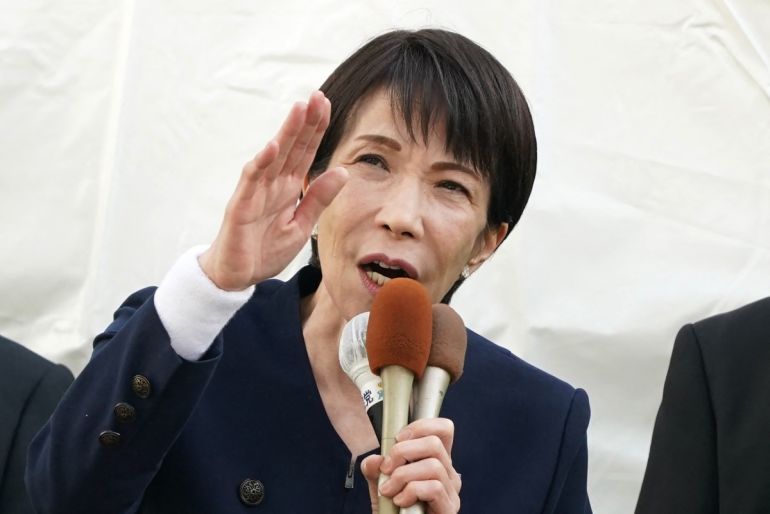
Prime Minister Takaichi, a staunch conservative who is seeking to shore up her mandate less than four months after becoming Japan’s first female leader, has put the cost of living at the forefront of her election campaign.
Takaichi, an advocate of former Prime Minister Shinzo Abe’s policy of ultra-loose monetary policy and big spending to reverse Japan’s longstanding economic stagnation, has promised to suspend the country’s 8 percent tax on food and non-alcoholic beverages for two years if her coalition is returned to power.
The Japanese leader’s tax pledge follows the approval last year of Japan’s largest stimulus package since the COVID-19 pandemic, a 21.3 trillion yen ($136bn) injection into the economy heavily focused on cost-of-living relief measures, including energy bill subsidies, cash handouts and food vouchers.
Takaichi’s economic plans have raised concerns about the sustainability of Japan’s finances on her watch, particularly overseas, amid a rapidly ageing society and a debt-to-GDP ratio of 230 percent, the highest among advanced economies.
After Takaichi unveiled her plan to cut the consumption tax while announcing the dissolution of the lower house of parliament last month in preparation for elections, foreign investors rushed to sell off Japanese government bonds, sending yields to record highs.
Japanese voters, too, reacted to Takaichi’s plan to cut the consumption tax with scepticism amid questions about how the government would cover the estimated cost of some 10 trillion yen ($63.7bn).
In an opinion poll published by The Nikkei newspaper last month, more than half of respondents said they did not believe the consumption tax pause would effectively address rising prices.
In recent campaign appearances, Takaichi has notably avoided any mention of her pledge.
“Sanae Takaichi changes her stance so quickly that she’s untrustworthy,” said Hanaoka, the IT consultant, who plans to vote for the Centrist Reform Alliance.
“I still have time to doubt Takaichi’s politics and look into things, thinking, ‘Is this really true?’ But people who are truly struggling probably don’t have time to research amid their daily work,” she said.
“I want politicians to focus on policies that improve our lives 10 or 20 years down the road, not just immediate cash handouts,” she added.
Still, Takaichi’s coalition appears to be on course for a comfortable victory over the opposition alliance, a merger of former Prime Minister Yoshihiko Noda’s Constitutional Democratic Party of Japan and ex-transport minister Tetsuo Saito’s Komeito.
An opinion poll published by The Asahi newspaper on Monday suggested the LDP and its junior coalition partner, the Japan Innovation Party, are on track to win 300 seats in the 465-member House of Representatives.
With just days to go to the election, Ida, the mother of two, said she had not decided who to vote for, but she was weary of the choices on offer.
“Honestly, I am tired of seeing new political groups with the same faces, just changing their party names,” she said.

Leave a Reply