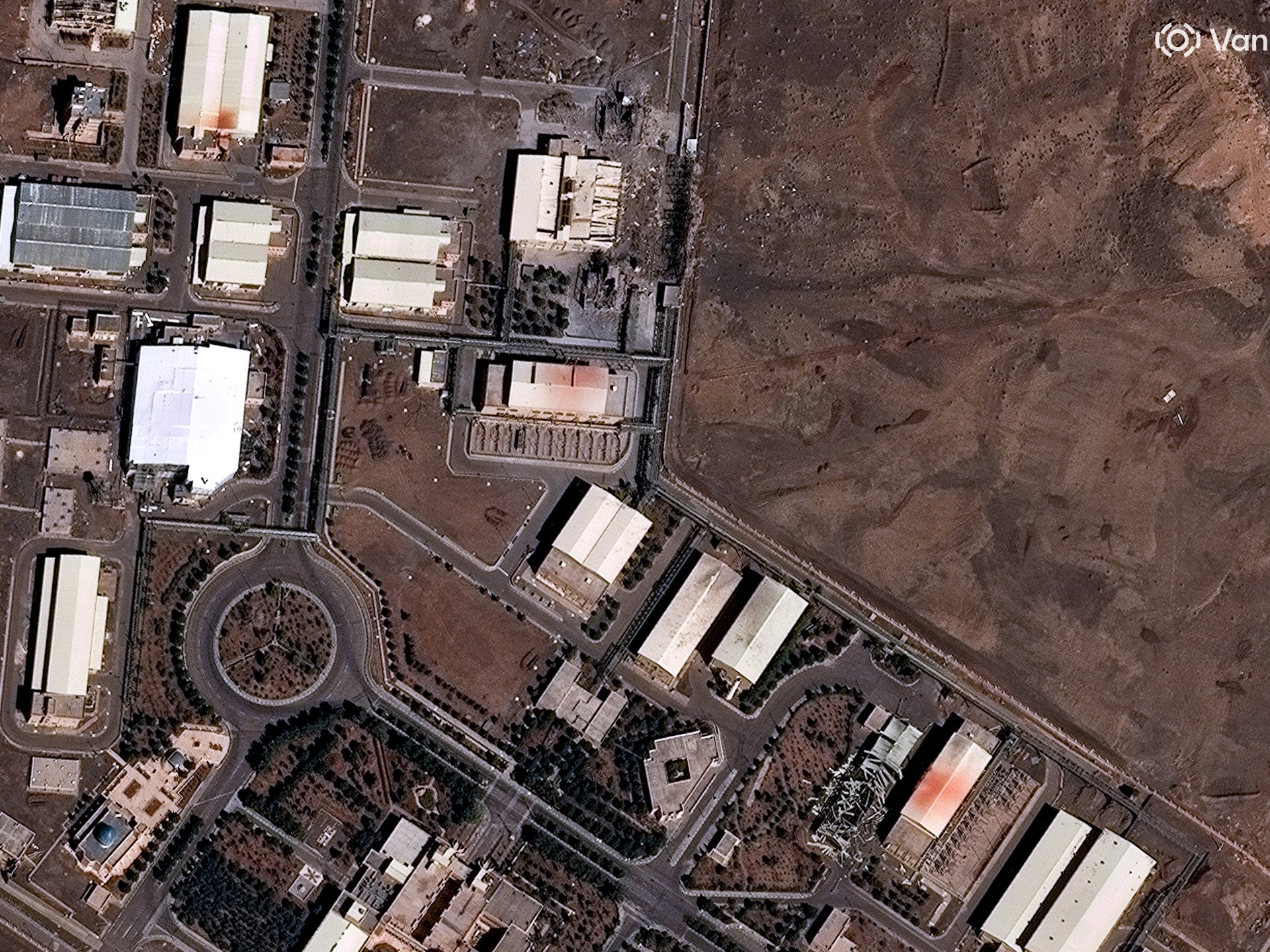
The United Nations’ nuclear watchdog has said the Natanz nuclear enrichment facility in Iran has suffered “some recent damage” as US-Israeli attacks on the country continue for a fourth day.
In a short statement on Tuesday, the International Atomic Energy Agency (IAEA) said damage was confirmed at entrance buildings to the underground fuel enrichment plant (FEP).
Recommended Stories
list of 3 itemsend of list
“No radiological consequence expected and no additional impact detected at FEP itself,” the agency said, adding the facility was “severely damaged” during the 12-day war Israel and the US waged on Iran last year.
Located outside the city of Qom, the FEP is one of Iran’s three uranium-enrichment plants that are known to have been operating when Israel and the US carried out strikes on Iranian nuclear facilities in June 2025.
The country’s nuclear infrastructure was expected to be among the targets of the renewed military offensive that was launched by the US and Israel against Iran on Saturday, killing at least 787 people across the country, according to the Iranian Red Crescent Society.
The bombing campaign has sparked retaliatory attacks by Iranian forces across the wider Middle East, killing several people in a number of countries, including at least six US service members and 11 people in Israel.
On Monday, IAEA chief Rafael Grossi said the agency was following the conflict “with concern”.
The agency’s Incident and Emergency Centre (IEC) was “collecting information and assessing the situation”, said Grossi, adding that “so far, no elevation of radiation levels above the usual background levels has been detected in countries bordering Iran”.
He also said the IAEA had “no indication that any of the nuclear installations, including the Bushehr Nuclear Power Plant, the Tehran Research Reactor or other nuclear fuel cycle facilities have been damaged or hit”.
That was refuted by Reza Najafi, Iran’s envoy to the IAEA, who said Natanz was hit on Sunday.
“Again, they attacked Iran’s peaceful safeguarded nuclear facilities yesterday. Their justification that Iran wants to develop nuclear weapons is simply a big lie,” Najafi told reporters at the IAEA headquarters in Austria’s capital, Vienna.
The Institute for Science and International Security, a US-based think tank, said on Monday that satellite imagery showed two strikes on access points to the underground uranium enrichment plant at Natanz.
David Albright, a former UN nuclear inspector and founder of the institute, said the strikes appeared to have occurred sometime between Sunday afternoon and Monday morning local time, based on the satellite imagery his group reviewed.
He was unable to identify whether the US or Israel hit the Natanz complex.
Meanwhile, on Tuesday, Grossi at the IAEA said that, despite claims from Israel and the US, the agency’s inspectors had not found any evidence of a coordinated Iranian programme to build nuclear weapons.
Grossi told NBC News that the UN agency had not identified “elements of a systematic and structured programme to manufacture nuclear weapons” in Iran.
At the same time, he confirmed that Tehran has enriched uranium to 60 percent purity – a level far beyond civilian energy needs that Grossi said raised serious questions.
This enrichment, he said, was “the source of the concerns we had”, and there was “no clear objective” for accumulating material at that level.
“The centrifuges were spinning constantly and producing more and more of that material,” he said, adding that theoretically this would have been “enough to produce more than 10 nuclear warheads. But do they have them? No.”

Leave a Reply