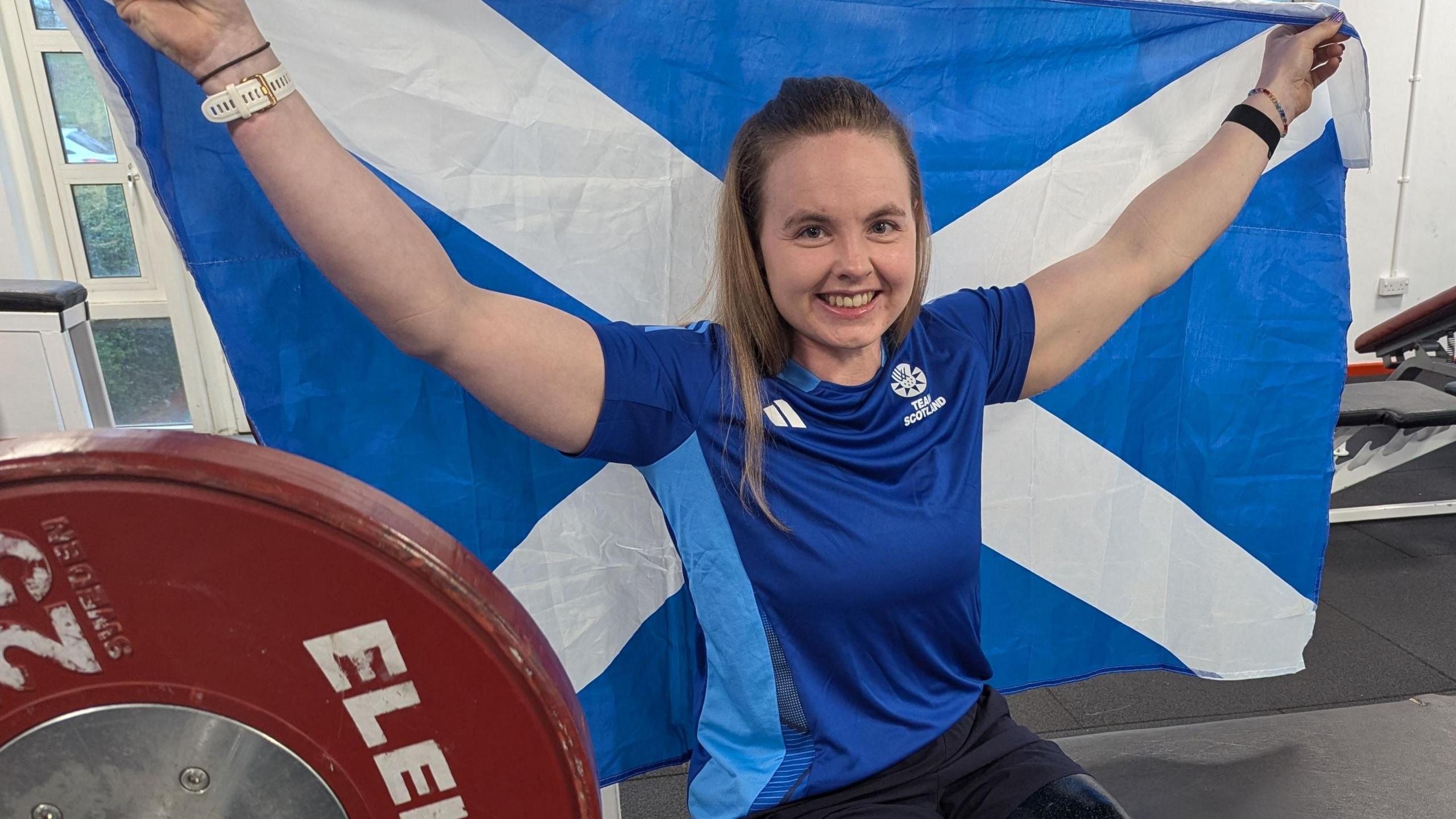
Hope Gordon remembers looking longingly out of the window of Yorkhill Children’s Hospital for day after day as a teenager.
She remembers seeing Glasgow outside. Remembers the SEC Armadillo being in the foreground. Remembers wondering what “the real world” outside the walls of her ward would hold for her.
The 31-year-old might have had to wait almost a couple of decades, but she will get her answer next summer.
Gordon will be part of Team Scotland for the Commonwealth Games in her home country, and will get to compete in the Armadillo in Para-powerlifting.
“To go from being that kid in that hospital bed, looking out of those windows, to actually being able to compete in that venue… it’s going to be really special,” she tells BBC Sport Scotland.
Glasgow, hospitals and ultimately the amputation of her left leg are a long way from the tiny settlement of Rogart, around 50 miles north of Inverness.
Growing up there, Gordon was always playing one sport or another so a little pain in her left knee was written off as just a natural consequence of that.
But one day, at the age of 12, the leg “stopped working” while she was at school.
“I thought I’d wake up the next day and be fine,” she says. “But one year later I was diagnosed with a condition called complex regional pain syndrome.”
The following nine years were gruelling. Repeated 450-mile round trips to Glasgow for an assortment of unsuccessful treatments. Hospital stays. Time in a wheelchair. But all the while, Gordon kept playing sport. It was her escape.
At the age of 21, she made the most consequential decision she ever could. “I eventually had it off,” she says of her left leg. Partially to stem any spread of the condition, partly to ease the pain, entirely to improve the quality of her life.
From canoeing, to skiing & now powerlifting
 Getty Images
And how. A swimmer of some repute during her teenage years, Gordon maintained that initially but found herself keen to try something else.
That something would be para-canoeing. “You’ve still got the the water element and, if you’ve got a disability, water gives somebody such a sense of freedom because it’s easier to move around on water than on land,” she says. “It just ticked the boxes.”
Soon, she was invited on to the British team, moved to Nottingham and has been there since, winning world medals and Paralympic silver in Paris in 2024.
Gordon even found time to dip into winter sports, going to the 2022 Winter Paralympics as a nordic skier after being cajoled into giving it a go by 2026 Games flagbearer Scott Meenagh.
Canoeing is her main sport, though, to the extent that she will be competing at a World Cup event and World Championships either side of the Commonwealths.
And it is her training for that that led Gordon to choose powerlifting as her means of fulfilling a life’s dream of being part of Team Scotland.
“Bench press is one of the key exercises for canoeing so when the programme was announced, I looked at the list and I thought that might be the one,” she explains.
“I had to unlearn quite a bit and learn it again but hopefully it will benefit me on the water too.”
Gordon is keen to temper medal expectations, insisting these Games are actually about something much bigger for her than podium places.
Having watched some of the swimmers she trained with win gold in 2014 – “I was in the crowd and able to to sing Flower of Scotland three times watching Hannah Miley, Ross Murdoch and Dan Wallace” – she has long wanted to represent Scotland.
“Commies has been such a big dream for me,” explains the aspiring bagpiper, sitting in her English home surrounded by Scottish memorabilia. “More so than what some people might argue are bigger goals, like a Paralympics.
Related topics
- Disability Sport
- Commonwealth Games

Leave a Reply