To play this video you need to enable JavaScript in your browser.
Nine seconds of silence.
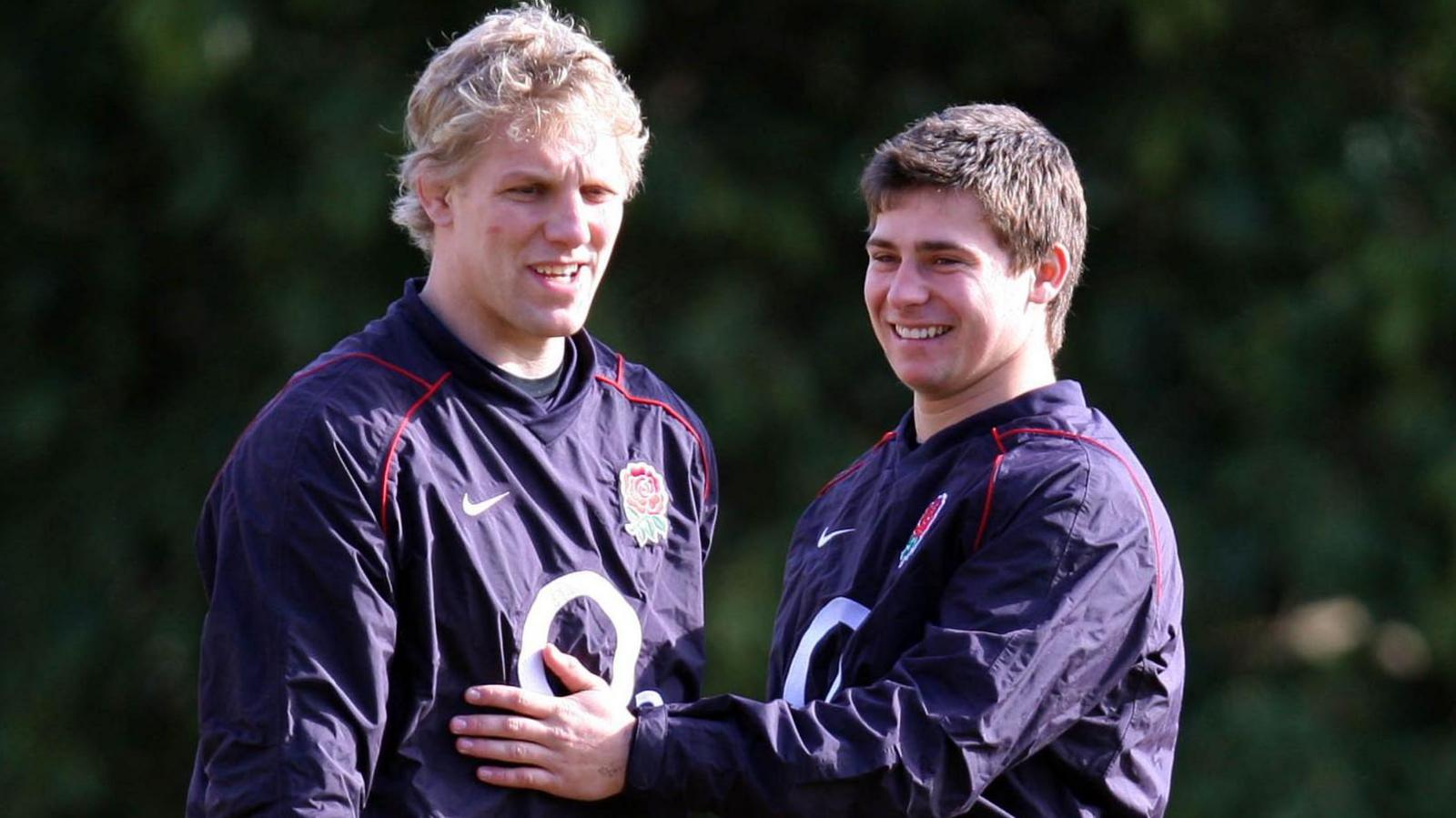
After Ben Youngs asks whether Lewis Moody ever saw a risk to playing rugby, his former team-mate takes his time before beginning his answer.
There is a lot to consider.
Moody played alongside Youngs at the highest level. He won 71 caps for England. He toured with the British and Irish Lions. He won domestic and European titles as part of a notoriously hard-edged Leicester team.
Through it all, Moody was famed for his full-throttle commitment. His disregard for pain and his endless appetite for collisions and close-quarters combat earned him the nickname ‘Mad Dog’.
In his playing days, the only risk Moody seemed to be concerned with was that some ounce of effort would be left unspent in pursuit of victory.
Looking back, the 47-year-old says it wasn’t that simple.
“I do think I was very aware of the risks rugby presented, when you go and smash yourself into another human being week in week out, day in day out,” Moody tells a new BBC documentary – Ben Youngs Investigates: How Safe Is Rugby?
“I think I was acutely aware of the risks that come with injury and concussion, but I was happy that the reward and the joy of playing the sport far outweighed any of those.
“I enjoyed what I did so much that I was prepared to put up with that, and I would do again. I loved it… I absolutely loved it.”
Last year, Moody was diagnosed with motor neurone disease (MND) – a degenerative muscle-wasting condition.
Several rugby players have had the same news.
Rugby league legend Rob Burrow died in June 2024. Scotland international Doddie Weir and former Springbok Joost van der Westhuizen also died with the condition.
Ed Slater, whose career at Leicester overlapped with Moody’s by a season, retired from playing in July 2022 after tests showed he too had MND.
There is no proven link between rugby of either code and MND, though elite athletes in general are disproportionally affected by the condition.
It is thought low levels of oxygen in the body during intense exercise damage motor neurone cells, triggering the disease in those who are susceptible either though genetics or environmental factors.
Despite that, Moody recognises rugby has become linked with MND in much of the public’s mind.
“I don’t get frustrated by it,” he says.
“It is an easy assumption to make, because you have had a couple of high-profile rugby players with MND, that playing rugby makes you more likely to get MND. But that is not the truth.
Ben Youngs Investigates: How Safe Is Rugby?
Moody retired from rugby 14 years ago. It was a very different game then.
In September 2007, Moody faced Tonga in a must-win Rugby World Cup pool-stage match for England.
Less than two minutes in, attempting to charge down a kick, his head was rocked back by the opposition fly-half’s knee. Moody sprawled still on the turf, his arms limp by his side.
A medic ran on, helped Moody into a sitting position, gave him a sip of water, a sponge to the back of the neck and a pat on the back before the flanker gingerly got to his feet to cheers from the crowd.
Shortly after half-time, Moody was caught heavy and high as opposite number Nili Latu jumped into a tackle. The slow-motion big-screen replay, showed Moody’s head rocked back by the impact, drawing winces and groans from fans inside Parc des Princes in Paris.
Moody lay on his side, eyes shut, slumped on the turf. The referee awarded a penalty and gave Latu a gentle ticking-off. Moody eventually got up and played on once again.
A day later, England had a day off. Against the advice of the team doctor, Moody joined his team-mates on a day out at EuroDisney.
“I went on some ride – I think it was called the Black Hole – and as soon as it started, my head was ringing,” remembers Moody.
- 11 minutes ago
It was a realisation the game was waking up to, as well.
Unlike with MND, there is a proven link between repeated blows to the head and brain injury.
Five years after Moody’s match against Tonga, American Football’s National Football League agreed a compensation settlement with former players for concussion-related brain injuries.
Payments in the years since have exceeded a billion dollars.
A group of former rugby players are in the process of taking their own legal action against the game’s authorities, claiming more should have been done to protect them.
Elite rugby now has arguably the most stringent measures around concussion.
Head contact is rigorously policed. The tackle height has been lowered. Players are sent off for tackles that would barely have raised an eyebrow, never mind a red card, a generation ago.
High-tech mouthguards measure the impact of each collision, triggering touchline alerts if thresholds are exceeded. Independent matchday doctors review collisions on monitors. Stand-down periods for any player with a concussion are mandatory and guided by medical experts.
“I think the game now is safer than it’s ever been,” adds Moody, who was cleared of early onset dementia when he took part in a study at University of Edinburgh.
But he has seen close up what his fellow World Cup winner Steve Thompson has gone through. Thompson, 47, has early onset dementia and is part of that legal action against the game’s authorities.
“I roomed with ‘Thommo’ for years, and I’ve seen him and spent time with him since, and he’s genuinely struggling,” says Moody.
“I’m glad those studies exist because there are plenty of lads that are struggling and do need support.
“The whole concussion campaign and movement at the time was really important in highlighting that there is a challenge and a problem that we have been ignoring for a long time.
To play this video you need to enable JavaScript in your browser.
Moody says, since going public with his diagnosis in an interview with BBC Breakfast in October, he has been learning to live with the uncertainty over his future and the development of his own case of MND
“Without getting too ‘woo woo’, there is a Buddhist saying on a podcast that ‘yesterday’s dead, tomorrow isn’t born, there is only today’,” he says.
“That helped me simplify how life with MND continues because there is no certainty around what the future looks like.
“I’ve met people that have been living with it for 12 years, 15 years and I’ve also met people who have it for six months and it’s really aggressive.
“Everything that I’ve experienced so far and have been told is that mine is slow-progressing. For me, it’s about being as normal as possible until things aren’t normal. And then it’s readjusting to that new normal.
“That may sound really difficult for people to understand, but it’s how I simplify living with it. It’s how I deal with it now and it’s good now, so that’s all that matters.”
Moody is also ready to start using his platform to raise awareness of MND, like Burrow, Weir and Slater have done, though has yet to announce what shape that might take.
“Doddie and Rob came into the MND world with far less information and not much hope,” Moody said. “I come in now because of those guys and I have almost been handed the baton, almost like ‘here you go’.
“I have been in conversation with Ed. With the messaging and awareness, I feel in a unique position where I can piggyback off the work they have all done and impact going forward in that MND space.
“I want to use my platform for as big an impact as I can.
Related topics
- England Rugby Union
- Rugby Union

Leave a Reply