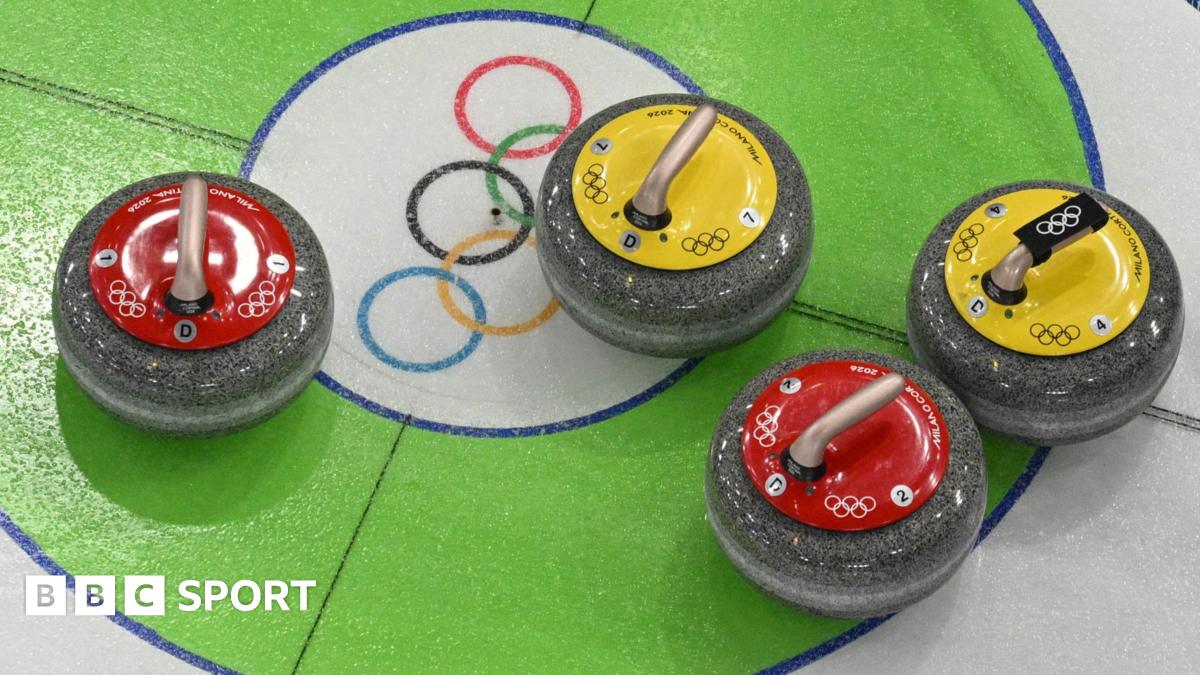
One of the first things you notice is the number of cameras. They’re everywhere, trained on the four ice sheets at a variety of angles. Some fixed. Some swooping down on cables. Others manoeuvred on long arms.
Coaches clad in anoraks and armed with laptops discuss data posted on large screens, their conversations punctuated by the clunk of granite on granite as Team GB’s curlers hone their games on the perfectly prepared ice.
This is the National Curling Academy in Stirling. From the outside, it’s just a public leisure centre on the edge of town, with sprightly pensioners staying flexible in aerobics classes and excitable kids in for swimming lessons.
But slipping past the joyful chaos in reception and through a side door takes you to another world. A world in which British Curling leads the way.
- 12 hours ago
From housewives with brooms to Olympic lifters
It’s now 24 years since Rhona Martin delivered the Stone of Destiny in Salt Lake City, watched by millions of rapt viewers at dark o’clock in the UK.
Britain’s first Winter Olympics gold in 18 years had been won by a group of Scottish housewives in an odd little sport. ‘Look at them on the ice with their daft wee brooms…’ was the perception by some.
That derogatory view wasn’t correct then and it is even further from the truth now.
The 10 curlers who are representing Team GB in Cortina right now lift weights like sprinters, strategise like chess players, and fuel like Tour de France cyclists.
Every weekday morning, the athletes on the GB programme will start training at 08:30. Each day includes two, two-hour ice sessions and one in the gym.
Across a week, three of those gym sessions are strength-based and two conditioning. Most will add another at the weekend, just to keep themselves right.
They are supervised – no sitting on a bench next to the weights while doomscrolling for this lot – and are specifically designed with curling in mind.
“It’s Olympic lifts we’re doing – clean and jerk, snatches, squats, the lot,” says Hammy McMillan, who’s gold medal-tipped men’s rink start their campaign on Wednesday. “And we’re using ski machines, rowers, and assault bikes to really condition our bodies.”
“The numbers we put up, I don’t think people would expect them,” adds Bobby Lammie, who is credited alongside McMillan as having changed the physicality expected of sweepers.
“It’s allowed us to separate ourselves slightly from the rest of the world.”
Similar can be said of the women’s game, where 2022 gold medallist Jen Dodds – one of the world’s best with a brush – is lifting just as much as some of the men. “More than me, to be fair,” admits men’s vice-skip Grant Hardie.
“Jen is incredible in the gym,” says Team GB women’s skip Rebecca Morrison, who takes a slightly different view of the gym work.
“You need a lot of core strength to even stay upright on the ice,” she says.
To play this video you need to enable JavaScript in your browser.
‘I want them not to want a Mars Bar’
When you consider the schedule of curling competitions, the fitness regime begins to make more sense.
During the Olympics, for example, Mouat will play for 17 consecutive days – often more than once – should the men reach the semi-finals as expected. Mixed doubles partner Dodds, at least, will get a day off before the women’s event starts.
Then layer up the travelling during the season – five or six times to Canada or the United States as well as shorter European jaunts and occasionally to Asia – and suddenly the demands look daunting.
To do it and still perform, you need to be fit. And you need to be properly fuelled.
British Curling employs a nutritionist who successfully argued that there is no reason curlers should not approach food in the same way as a Tour de France team.
And while it’s unlikely cyclists are munching the cereal bars and sweets favoured by the curlers when on the ice, many of the same principles are the same.
“Our nutritionists would never say ‘you can’t eat a Mars bar’, but I want the athletes to not want to eat the Mars bar,” says Gibson. “That’s the culture we’re trying to create.
“One of our Paralympic athletes said our nutritionist is great because he realises he’s a 40-year-old man who’s not suddenly going to start eating salads.
“But he’s managed to make little changes, like eating berries before going to bed at night to help with sleep.
“We’re not looking at them being perfect 100% of the time – it’s more looking at what are the areas we can really target that will make a difference to performance.”
To play this video you need to enable JavaScript in your browser.
‘Not every athlete needs the kitchen sink’
All of that falls within British Curling’s ‘what it takes to win’ model.
That plan covers any number of areas, including performance lifestyle advisors – who can talk to the athletes financial planning and work-life balance – and psychology.
That can range from on-ice aspects such as pre-shot routines and performing under pressure, to team dynamics and communication.
And every person is different, which heightens the challenge for Gibson and her team. Some, like men’s alternate Kyle Waddell, likes to “just turn up, have a chat, and crack on”, but others need energy plans to manage their state of mind building up to matches.
“Not every athlete needs everything,” Gibson says. “And part of it is learning to not throw the kitchen sink at everybody, because some people just will not cope with that. And it’s not how we get the best out of them.
To play this video you need to enable JavaScript in your browser.
‘They don’t just rock up, throw stones & go to the pub’
So how might things change for the next Olympic cycle? Gibson points to two key areas – physicality and artificial intelligence.
While stopping short of conceding that today’s curlers will look out of shape by the 2034 Games, she does believe sweepers will become bigger, stronger, and able to put more pressure on the brush.
“They will end up training like 400m sprinters,” she says.
But it is in the area of AI that the most significant developments might come.
British Curling already collects reams of data on training sessions and competitions, but how might that be better used to develop match strategies? Could they run simulations based on every conceivable shot played in an end, for example?
“We’re looking for these guys to be making 96% of their shots, so one wrong shot can decide a game and be the difference between gold and silver,” Gibson says. “So every little innovation we make could matter a whole lot.
“This is the top of the sport, but I don’t think people would expect us to do all this stuff. It’s very much not just ‘rock up, throw 32 stones and then go to the pub’.
Winter Olympics 2026
6-22 February
Related topics
- Curling
- Winter Sports
- Winter Olympics

Leave a Reply