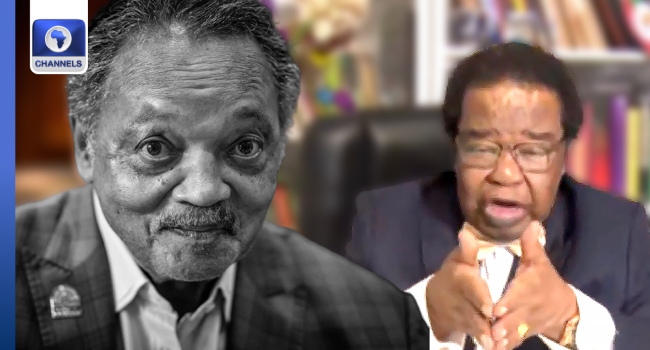
Former Minister of External Affairs, Bolaji Akinyemi, has eulogised the late US civil rights leader Jesse Jackson, recalling how he was part of Nigeria’s June 12 struggle, a day that reflects the country’s arduous journey toward democratic governance.
Speaking on Channels Television’s Politics Today, Akinyemi, a professor, said Jackson contributed a lot to Nigeria and must be remembered.
READ ALSO: US Civil Rights Leader Jesse Jackson Dies At 84
“Jesse Jackson invested part of his political career in Nigeria. He was part of us in the National Democratic Coalition (NADECO). Yes, the President of the United States had appointed him a Special Envoy for Democracy.
“But that was just a cover for him to be involved in the June 12 struggle in Nigeria. To show you he paid particular attention to me, whenever we were in the United States demonstrating, he would ask me to please stand aside and not be arrested by the Washington Police. He took that particular interest, not only in me but on other Nigerians in the struggle,” he said.
The diplomat cited instances where Jackson played a crucial role in the formation of Nigeria’s foreign policy.
“He was not doing this for every country; it was just Nigeria. He also sought to get me involved with the activities of the Africans in the diaspora.
“I had to point out to him that as Foreign Minister, protocols dictate that there are some events that I couldn’t associate myself with,” Akinyemi said.
“That was when he explained to me that Nigeria was key to what the black race became in the world, not just the African race, the Nigerians in the diaspora, but the black race, and that the success of Nigeria was intertwined with the success of the black race in the world.
“If you understand that, you will understand why he became part and parcel of the Nigerian foreign policy establishment,” he added.
Each year, Nigeria commemorates June 12 as Democracy Day, a day of solemn remembrance.
Far beyond a mere public holiday, it symbolises the Nigerian people’s resilience, sacrifice, and unwavering determination.
On 12 June 1993, Nigerians united across ethnic, religious, and regional divides to participate in what is widely considered the freest and fairest election in the nation’s history.
Chief Moshood Kashimawo Olawale (MKO) Abiola, a revered businessman and philanthropist, emerged as the presumed winner.
Jackson died peacefully in his sleep on Monday.

Leave a Reply