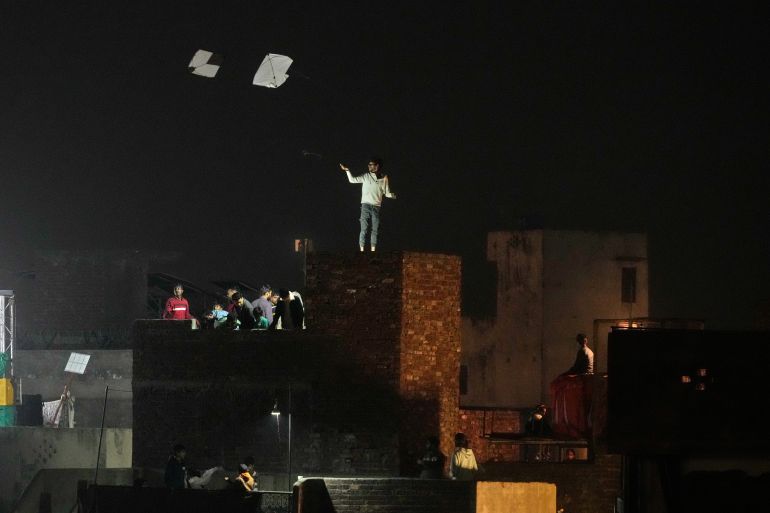
Lahore, Pakistan – As the clock struck midnight between Thursday and Friday, Lahore’s sky erupted in fireworks as the crowds that gathered along one of the city’s main avenues cheered in jubilation.
Amid the commotion, Aamer Iqbal, a 50-year-old banker, took a deep breath and asked his daughter to let go of the kite she was helping to launch. It was the first time in nearly two decades that Iqbal was able to engage in an activity that had defined his childhood: the simple act of flying a kite.
Recommended Stories
list of 4 itemsend of list
Rooftops across Lahore blared music as thousands shouted in joy, sending kites soaring into the night sky, marking the return of the centuries-old spring festival of Basant to the city it calls home.
“Kite flying is a whole experience, and the moment I let it go, my entire childhood came flooding back in my mind like a vivid reel, about the times I spent with my brother and my parents flying kites,” he told Al Jazeera from his home in Lahore’s Shah Jamal neighbourhood.
Iqbal says kite flying creates the illusion of controlling something high in the air, forging a link between “heaven and Earth”.
“You just want to have that feeling, even for the most fleeting moment, to be able to beat the gravitational force and break free,” he said.
He was not alone.
Six kilometres (3.7 miles) away, Muhammad Mubashir, a 41-year-old businessman, stood on the rooftop of a friend’s house in Lahore’s historical Gawalmandi neighbourhood. He said it took him a few minutes to fully absorb that the hobby on which he had spent his childhood and pocket money had finally returned.
But what struck him most was watching a young boy struggle to tie the central knot that gives a kite balance.

“He was completely out of his depth and had no idea what he was doing. It was at that moment when I realised that the ban on Basant in Lahore had been on for so long that people growing up in last two decades have no clue at all about an activity that we learnt about in our childhood more rigorously than even doing our homework,” he told Al Jazeera.
Origins of Basant
The origins of Basant stretch back centuries and are deeply embedded in the cultural fabric of Punjab, the region that straddles the India-Pakistan border.
The word “Basant” derives from the Sanskrit “Vasant,” meaning spring, and traditionally marks the transition from harsh winter to the blooming of spring.
The seasonal shift coincides with the harvest in Punjab’s agricultural heartland, when mustard fields turn brilliant yellow, giving the festival its distinctive colour.
Among several origin stories, one of the most popular links the festival to the 13th-century Sufi saint Hazrat Nizamuddin Auliya of Delhi, who fell into deep depression after the death of his nephew.
According to this account, his disciple, the legendary poet and musician Amir Khusro, dressed in yellow women’s clothing and danced before his master while singing, lifting his spirits. Basant thereafter became an annual celebration at Sufi shrines across Delhi and beyond.
But it was during the 19th-century Sikh Empire that Basant became inseparable from Lahore.
According to research by Amjad Parvez, a former professor at the University of Punjab, Maharaja Ranjit Singh, who ruled Punjab from 1801 to 1839, institutionalised the festival at the imperial level.
“Lahore is considered as the main hub of celebrations associated with Basant,” Parvez, a veteran kite flyer who has studied the festival’s history and kite design, wrote in his 2018 research paper.
Partition and transformation
Before the 1947 British colonial partition that created Pakistan and India, Basant was celebrated across religious lines in undivided Punjab.
According to Parvez, Hindu, Muslim and Sikh communities alike participated, flying kites from “elaborately decorated rooftops, wearing yellow clothing and sharing traditional foods”.

Mian Yousaf Salahuddin, 74, grandson of Pakistan’s national poet Muhammad Iqbal and a prominent patron of arts and culture, vividly recalls the post-partition era. Speaking to Al Jazeera at his Haveli Barood Khana (traditional residence) in Old Lahore days before Basant, he said the festival was always tied to the city’s walled quarters.
“For us residents of the “Androon Lahore”, or inner city, it was a dynamic festival, celebrated by community here, before its mass popularity,” he said.
Salahuddin remembers Basant primarily as a daytime celebration.
But the transformation of Basant from a localised walled-city tradition into an internationally recognised festival has a remarkable origin story, one which involved Salahuddin and Imran Khan.
Khan, a former prime minister and World Cup-winning cricket captain, has been in jail since August 2023 on convictions he says are politically motivated.
Salahuddin, who has known Khan since their school days at Lahore’s Aitchison College, and has old family ties, said he received a call from him in the early 1980s while Khan was playing county cricket in England.
“He rang and said he wanted to bring some of his friends from England to my haveli on the occasion of Basant that year,” Salahuddin recalls. “Khan himself was fond of kite flying, and at my invitation, he brought the Duke and Duchess of Somerset, who had studied with him at Oxford,” he said.
“When the Duke and Duchess of Somerset climbed onto the roof, they expressed their delight as well as shock [to] what kind of festival this was, where the entire city is on rooftops and the sky is filled with colourful kites,” he said.
The duke asked Salahuddin why this festival was not promoted and not well-known globally.
Fortunately, Salahuddin was also friends with Mir Shakil ur Rehman, the owner of the country’s largest media group and convinced him to publish Basant photos in his Urdu newspaper the following year, and soon after, the festival became the most sought-after event in the country.
At its peak, Parvez recalls, Basant resembled a “great party,” with large rooftops rented out, food stalls set up and music blaring.
“When I was young and in school, my heart used to beat with Basant festival. Our teachers would forbid us from skipping school and yet we still did it, just because of our fanatic love for kite flying,” the 66-year-old said.
By the 1980s, organised teams had formed under masters known as ustads, who founded “Gharana” schools of kite flying. By the late 1990s and early 2000s, Basant had evolved into a major tourist attraction drawing visitors from around the world.
The art of ‘patang’
Basant’s rituals extend beyond a single day. The sport has its own vocabulary, customs and precise rules of construction.
Traditional Punjabi kites follow specific patterns, most commonly rhombus-shaped designs known as “gudda” or “guddi”. The colloquial term “patang”, often used generically, actually refers to a “curvilinear shape,” Parvez said.
“The kite design is based on a cross which is made up by two bamboo sticks placed, and tied up with thread, over each other,” he explained.
Even the size of the kite mattered for flying and had its naming convention according to the size of the paper sheet that was used to make a kite.
For Mubashir, much of this specialised knowledge is missing today. Strict government regulations on kite size and string safety mean veteran flyers must adapt.

Festival under watch
Amid the celebrations, following a suicide bomb attack on Friday at a Shia mosque in Islamabad’s suburbs that killed at least 31 people, Punjab Chief Minister Maryam Nawaz Sharif announced she would “cancel” her official Basant engagements on Saturday, the second day of the festival.
The public, however, was allowed to continue kite flying, with the government closely monitoring events before deciding future policy.
Marriyum Aurangzeb, a senior provincial minister, said authorities would conduct a detailed post-event evaluation based on safety outcomes, compliance levels and overall impact.
“The priority is to first demonstrate that Basant can be celebrated responsibly under strict regulations. Future policy decisions will follow a comprehensive review,” she told Al Jazeera.
Some say the government is seeking political gain from the revival. Parvez argues that the reopening was not necessarily political, though any government taking such a risk could benefit.
“I have seen Maryam Nawaz’s father, Nawaz Sharif, fly kites, and he was a proper participant, who was very good at kite fighting, and was not just an amateur at it. I am sure he would have approved of this decision,” he said.
Mubashir believes this compliance reflects public enthusiasm despite high kite prices driven by demand.
“There is a whole sense of excitement and joy in people. This is such a great feeling in the city where for the past one week, I have not seen people on street losing their cool, or getting into fights, when otherwise it is a norm here. The whole atmosphere is transformed and there is a lot of cheerfulness,” he said.
But perhaps most significantly, the revival of Basant has allowed the older generation to reconnect with the newer one, based on nostalgia and lived experience.
For Iqbal, the banker, teaching his kids how to fly a kite was akin to training them how to walk, how to ride a bicycle or how to swim.

Leave a Reply