- 34 Comments
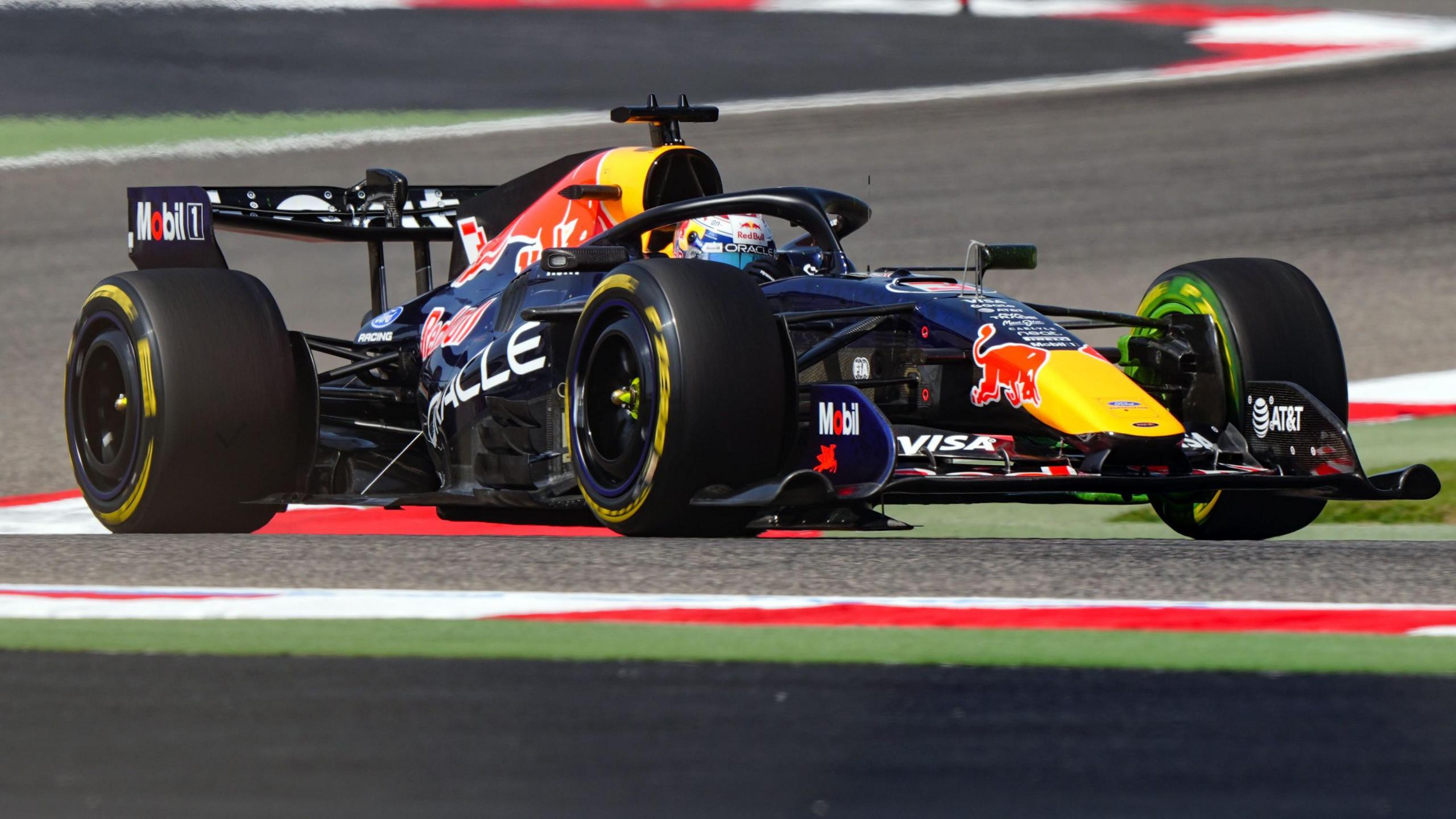
There were two key talking points at the first of two pre-season tests in Bahrain – whether the new cars were still “Formula 1”, and the performance of the new Red Bull engine.
Four-time champion Max Verstappen said the revised cars and engines had turned the highest level of motorsport into an exercise in “management”.
“As a pure driver, I enjoy driving flat out,” Verstappen said. “And at the moment, you cannot drive like that. A lot of what you do as a driver, in terms of inputs, has a massive effect on the energy side of things. For me, that’s just not Formula 1.”
The reigning world champion Lando Norris did not agree, saying the new cars were “a lot of fun” and pointing out that Verstappen was welcome to race somewhere else if he didn’t like it.
Mercedes’ George Russell – who has a tense relationship with Verstappen and a friendly, wind-up one with Norris – was somewhere in the middle.
- 5 hours ago
‘The chef can drive the car’ – Alonso
If you watched the hour’s worth of coverage shown on television at the end of each day, you might have been wondering what all the fuss was about.
The cars are clearly different in some ways from previous years, but they still look and sound recognisably like F1 cars on a superficial level.
In the cockpits, though, they are very different, as a consequence of the biggest regulation change in the sport’s history.
The cars, engines and tyres are all built to new rules this year and they are running for the first time on carbon-neutral sustainable fuel.
The engines are at the heart of the drivers’ concerns, whether enjoying the cars or not.
The cars are energy starved – the electrical part of the engine now produces about half its total power, while the batteries are about the same size as last year.
The various ways of recovering the energy so it can be deployed to maximum lap-time effect are changing the traditional sense of what being a racing driver is about.
The demand for energy recovery is forcing teams to run the electrical motors against the engines along the straights and in the corners.
That means the engines have to rev high in the corners, so drivers are using lower gears. As Russell pointed out, drivers have to take the corners in ways that maximise energy use over a lap, rather than simply go as fast as they can at all times. As a consequence, they will not always be on the limit of grip.
Veteran Fernando Alonso, a two-time world champion who is regarded by his peers with the highest possible levels of respect, said the team’s chef could drive his car around Turn 12, so far below the limit was he in the attempt to save electrical energy.
“Here in Bahrain, Turn 12 has historically been a very challenging corner,” Alonso said, referring to an uphill right-hand sweep towards the end of the lap.
“You used to choose your downforce level to go Turn 12 just flat. So you remove downforce until you are in Turn 12 just flat with new tyres and then in the race. So it was a driver skill, decisive factor to go fast in a lap time.
“Now in Turn 12 we are, like, 50km/h slower because we don’t want to waste energy there and we want to have it all on the straights.
“So to do Turn 12 at 200km/h instead of 260, you can drive the car, the chef can drive the car at that speed.
“So I understand Max’s comments. But at the same time this is Formula 1 and it has been always like that.
“Now it is the energy, last year or two years ago, when he won all the races, it was downforce. He could go in the corners at 280km/h and we could go in the corners at 250km/h because we didn’t have the downforce.”
Alonso urged caution before jumping to too many conclusions at this early stage of the new rules.
- 22 hours ago
 Getty Images
Are Mercedes hiding pace?
Judging competitiveness in testing is always difficult because there are so many variables and teams do not reveal the specification in which they run their cars. Indeed, in many cases teams may try to deliberately fool people.
But that did not stop Red Bull’s rivals noticing something striking about their new engine – it seemed able to deploy more energy for longer on a more consistent basis than other teams.
Although Verstappen set only the seventh fastest absolute lap time of the test, Russell said Red Bull’s underlying pace was “pretty scary”.
He said that, on current evidence, Red Bull were “going to be ahead” at the first race, adding: “We hope we can catch up.”
Red Bull technical director Pierre Wache rejected this analysis, saying “clearly the top three teams – Ferrari, Mercedes and McLaren – are in front of us”.
Race simulations are usually the best way of judging relative pace, and there Verstappen was consistently gaining about 0.6secs a lap on Norris on the straights when they were running concurrently. Fuel loads and engine modes are not known, of course.
But the quickest race simulation of the week was done by Mercedes’ Kimi Antonelli, who had the edge on pace over Lewis Hamilton’s Ferrari when running at the same time on Friday.
Hamilton was matching the pace set by team-mate Charles Leclerc the day before, which was a chunk quicker than Norris was managing at the same time.
The complication here is that there may well be an element of politicking involved, because in the background there is a rumbling row about the engine rules, with Mercedes at its centre.
Their rivals believe Mercedes have found a loophole in the rules defining the engines’ compression ratios. The claim is that this allows them to comply with the rule that dictates the compression ratio is measured at ambient temperature, but then run the engine on track at a higher ratio by clever exploitation of thermal expansion.
Ferrari, Honda, Red Bull and Audi are said to be pushing for a ruling from the FIA before the first race that would stop this.
So when Mercedes F1 boss Toto Wolff described Red Bull as the “benchmark” on the first day of the test, there were those who wondered whether he was doing so in an attempt to persuade the powers that be that a rule change before the first race was not necessary.
But perhaps Mercedes’ rivals were playing this game, too. Verstappen described Wolff’s remarks as “a diversion tactic”. Leclerc said he believed Mercedes were “hiding a lot more”.
On the competitive picture, according to Leclerc, Red Bull and Mercedes were at the front, with Ferrari a little behind, “but it doesn’t seem to be too much of a gap for now”. World champions McLaren, he said, were “a little bit more difficult to understand”.
- 1 day ago
‘The bottom line is we are slow’
 Getty Images
Behind the top four, there appears to be a gap of in the region of 1.5 to two seconds before a midfield group comprising Haas, Alpine and Audi, followed by Racing Bulls and Williams. At the back are Cadillac and Aston Martin, who are the one team being completely transparent about their performance.
There is so much attention and expectation on Aston Martin, with Alonso at the wheel, design legend Adrian Newey at the helm since March, and Honda their new works engine partner.
But the year has started badly. The car is way off the pace – around four seconds, Alonso’s team-mate Lance Stroll said on Thursday.
Break that down over the lap using GPS data available to all teams, and it seems about 1.5secs of it is from the engine and the rest from the car, which performs worse the slower the corner gets.
How, one might wonder, is this possible?
The answer seems to be a combination of the car design process being behind, partly because of Newey’s late arrival, partly because the team are building their own gearbox for the first time ever, and Honda being behind because… well, there is no clear answer to that one.
Honda officially pulled out of F1 at the end of 2021, and dismantled much of its engine department before changing its mind in 2023. But it still had people working on upgrading its existing engine in the meantime, and its lead time for the new regulations has not been very different from Red Bull’s, and yet the Japanese company seem to be nowhere in comparison.
Alonso was not happy about Aston Martin’s performance on Thursday, throwing his gloves down at one stage after getting out of the car. And who can blame him?
This could be his final season in F1. He is 45 in July and out of contract at the end of the year. Spending it at the back was not what he was expecting.
“Definitely we are not in the position we wanted to be,” Alonso said, pointing out they had been late to start testing, that reliability was still not good, and that was costing them time to hone the car.
The former F1 driver Pedro de la Rosa, who has been with the team as long as Alonso and has now been appointed team representative to take some of the load off Newey, said: “Looking back is always easy. If we had possibly started earlier, if Adrian would have been here not 2 March, but a few months earlier, if Honda wouldn’t have gone and then come back – it’s ifs and buts.
“Bottom line is we are slow. We’re not where we want to be. Let’s get a plan together. Let’s look ahead, not back [at] what went wrong.
“It was many reasons. The important thing is that we we know what they are. That’s what gives us the confidence that slowly, gradually, the difference will shrink.”
Fastest lap times, Bahrain test one
1 Kimi Antonelli (Ita) Mercedes one minute 33.669 seconds
2 George Russell (GB) Mercedes 1:33.918
3 Lewis Hamilton (GB) Ferrari 1:34.209
4 Charles Leclerc (Mon) Ferrari 1:34.273
5 Oscar Piastri (Aus) McLaren 1:34.549
6 Lando Norris (GB) McLaren 1:34.669
7 Max Verstappen (Ned) Red Bull 1:34.798
8 Oliver Bearman (GB) Haas 1:35.349
9 Esteban Ocon (Fra) 1:35.578
10 Franco Colapinto (Arg) Alpine 1:35.806
11 Nico Hulkenberg (Ger) Audi 1:36.291
12 Isack Hadjar (Fra) Red Bull 1:35.610
13 Gabriel Bortoleto (Brz) Audi 1:36.670
14 Pierre Gasly (Fra) Alpine 1:36.765
15 Alex Albon (Thi) Williams 1:36.793
16 Liam Lawson (NZ) Racing Bulls 1:36.808
17 Valtteri Bottas (Fin) Cadillac 1:36.824
18 Carlos Sainz (Spa) Williams 1:37.186
19 Arvid Lindblad (GB) Racing Bulls 1:37.470
20 Lance Stroll (Can) Aston Martin 1:38.165
21 Fernando Alonso (Spa) Aston Martin 1:38.248
Related topics
- Formula 1
- 2 days ago

- 17 December 2025

- 10 December 2025


Leave a Reply