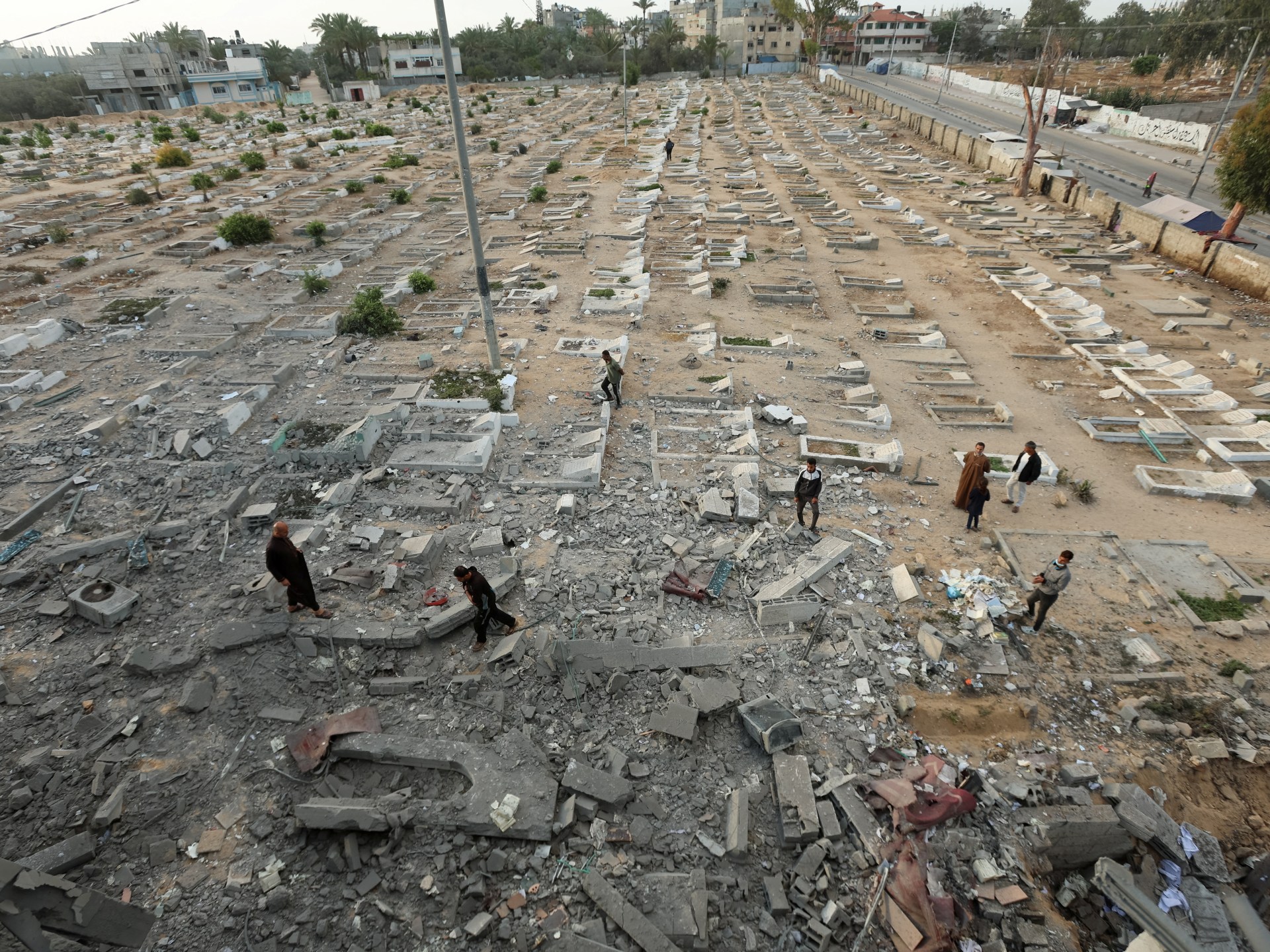
On Tuesday, Israeli Prime Minister Benjamin Netanyahu hailed what he called an “extraordinary achievement”. Israeli forces retrieved the body of Ran Gvili, an Israeli man, who died on October 7, 2023, from a Palestinian graveyard in northern Gaza. Israeli TV showed Israeli soldiers singing a Hebrew song at the site. Western media spoke about the importance of the operation and this “moment of national healing”.
Here in Gaza, the Israeli operation to retrieve the body spread fear, pain and death. Israeli soldiers killed four Palestinians near the graveyard and desecrated hundreds of Palestinian graves. Hundreds of Palestinian families now have to search for and gather the remains of their loved ones, and four families have had to dig new graves.
What was presented to the rest of the world as a “standard military operation”, was in reality, a serious crime under international law. Grave desecration constitutes a violation of a key provision of the Geneva Convention, which stipulates that dead bodies and graves must be respected.
In the Palestinian context, the attack on cemeteries is yet another form of collective punishment. It sends a clear message: that the Palestinian people will be denied dignity even in death.
This is, of course, not the first time Israel has committed crimes against the Palestinian dead.
Throughout the war, Israel has been attacking, bulldozing and digging up graveyards across the Gaza Strip. By January 2024, CNN reported that at least 16 Palestinian cemeteries in Gaza had been desecrated. Israel justified its actions by claiming that Hamas was using the cemeteries for “military purposes”. Satellite imagery and footage revealed that entire cemeteries were levelled, with Israeli troops converting some into military positions.
The excuse that Palestinian graveyards are desecrated only out of military necessity does not hold, however. Palestinian burial sites in the occupied West Bank are also regularly attacked. Just earlier this month, Israeli civilians stormed a Muslim cemetery in Jerusalem and destroyed graves. In January 2023, a Christian cemetery, where a lot of senior Christian leaders were buried, was also defaced in Jerusalem.
And it is not just resting places for the dead that Israel is ravaging. Even Palestinian dead bodies themselves are a target. Last year, the Israeli army sent hundreds of bodies of Palestinians to Gaza. Many of them had clear signs of torture; others were so mutilated that they could not be recognised, forcing the local authorities to bury them in mass graves.
In other cases, the Israeli authorities have withheld Palestinian dead bodies from their families as yet another form of collective punishment. Currently, Israel holds the bodies of Palestinians who died as far back as the 1967 war. In 2019, the Israeli Supreme Court officially allowed the Israeli state to hold bodies for the purpose of “negotiations”.
All of this – the desecration, the exhumation, the mutilation, the withholding of dead Palestinians and its legalisation – is meant to wipe out the memory of the deceased and prevent their loved ones from mourning them and having closure. It is meant to punish; it is meant to humiliate. Even in death, Palestinians cannot have safety and peace.
All of these crimes against the Palestinian dead have not received even a fraction of the media attention that the burial of the dead Israeli captives released from Gaza did. The humanising stories, the extensive photoshoots, the reports on official ceremonies were not afforded to Palestinian victims, whose bodies Israel has dug out and desecrated.
There were no reports on the Palestinian families who went to the graveyard and experienced the horror of seeing the remains of the graves of their loved ones scattered. There was no global sympathy for their suffering and pain.
By now, we have seen and experienced all kinds of unimaginable crimes committed by Israel. What has made them that much worse has been the global silence about them.
It is tragic that we should have to remind the world that graves are sacred and protected spaces under international law, including Palestinian ones.

Leave a Reply