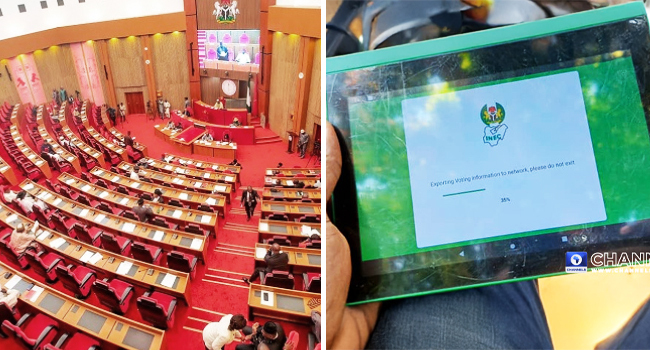
In 2022, millions of Nigerians celebrated what many described as a new dawn that promised to end the era of ballot-snatching—thanks to technology. Fast forward four years, and that dream is facing its ultimate test.
Inside the Senate, while the air-conditioning hums within the Red Chamber, the atmosphere is “unusually rowdy.” Lawmakers are on their feet as they debate a bill that could reshape Nigeria’s electoral future.
At the heart of this struggle is the Electoral Act (Amendment) Bill 2026. But a single phrase in the proposed piece of legislation, “manual fallback,” is feeling like a step backward to a nation still nursing the scars of its last general election.
The firestorm started when the Red Chamber moved to amend Clause 60(3), a development that touched on the third rail of election conduct in Nigeria: the transmission of results.
“The presiding officer shall electronically transmit the results from each polling unit to the IREV portal in real time, and such transmission shall be done after the prescribed Form EC8A has been signed and stamped by the presiding officer and/or countersigned by the candidates or polling unit agents…” the proposed amendment read.
Although many in the opposition and civil society organizations wanted “real-time” transmission of the results, the Senate approved the electronic transmission of results but allowed for the manual option via Form EC8A in case of internet failure.
The Senate defended the move, saying it was a necessity based on the realities of Nigerian society.
“We must be realistic about internet penetration,” Hon. Akin Rotimi (Ekiti North I), a lawmaker and spokesperson for the House, said on Channels Television’s Politics Today. “You cannot disenfranchise millions of voters simply because a server in a remote village cannot connect to the IReV in real-time.”
Senate spokesman Yemi Adaramodu echoed a similar sentiment, arguing that the lawmakers were thorough in their job.
“We don’t do something that we just wake up just on impulse… You have to be very thorough. You have to be very painstaking,” the spokesman added. “It must be so painstakingly done that the flaws must not be so latent to the extent that it can repudiate whatever good trust that Nigerians will have in our system.”
But for many, the manual result collation option triggers memories of the 2023 Presidential Election Petition Judgment. During that cycle, the Independent National Electoral Commission (INEC) reported “technical glitches” in the IReV (INEC Result Viewing Portal).
In a landmark judgment, the Supreme Court ruled that the Electoral Act 2022 did not explicitly compel INEC to use electronic transmission for result collation. According to the court, Form EC8A—the paper result—was the primary method of determining the outcome of elections.
Before then, the Labour Party (LP) had approached the Federal High Court in Abuja, seeking to compel INEC to adopt an electronic method for transmitting results. However, Justice Emeka Nwite dismissed the case and ruled that Section 60(3) and (5) of the Electoral Act allowed INEC to choose its method.
The court said the IReV portal appeared only in INEC’s Regulations and Guidelines, lacking legal force, and its use remained discretionary.
Indeed, Nigeria’s elections have for a long time been marred by allegations of manipulation during the collation stage. To address this, INEC introduced the Bimodal Voter Accreditation System (BVAS) and the IReV ahead of 2023.
The goal was to ensure that once results are counted and signed at polling units, they are uploaded online for everyone to see. Both judgments effectively ensured the million-naira IReV portal was basically a viewing tool, a development critics believe makes technology an “option” in the 2026 Bill.
A Coalition of Dissent
Beyond the Senate’s defense, a chorus of dissent is growing louder. Ex-vice president Atiku Abubakar, who officially joined the opposition African Democratic Congress (ADC) in November 2025 as part of a coalition move, is among the vocal critics. He believes a mixture of two options will invite chaos.
“Nigerians were expecting real-time electronic transfer… But what we got is a mixture of electronic and manual transmission, which is going to cause more confusion or chaos,” he said after meeting with ex-military leader Ibrahim Babangida in Minna.
“This is not about me contesting elections. It is about Nigerians who want electronic transmission of election results.”
Peter Obi, the former Labour Party (LP) presidential candidate, joined the #OccupyNASS protest at the National Assembly on February 9, 2026.
“Most importantly, election results must be transmitted electronically and in real time to protect the people’s mandate and eliminate manipulation. Claims that certain states lack network coverage are no longer acceptable,” he said.
He argued that if the banking sector can function flawlessly, elections have no excuse.
“If banking systems function seamlessly, our electoral system can and should do the same,” Obi said, cheered on by hundreds of demonstrators.
That protest ground was filled with placards and chanting. Some of the protesters included the activist Aisha Yesufu, who stood alongside civil society advocates, accusing lawmakers of last-minute changes to favor political interests.
“All we are asking for is real-time electronic transmission of the electoral results. We are here, and we are waiting for the lawmakers we sent to Abuja to pass the bill the way it should be passed. All citizens are asking for is electronic transmission, real-time. I do not see any reason why that is a problem,” Yesufu said.
Legal experts have also weighed in on the matter, including Olisa Agbakoba (SAN), who pointed out that without the “real-time” mandate, the IReV portal remains legally vulnerable.
According to him, the 2026 amendment is a “missed opportunity” to give the digital results primacy over paper records in court.
The Senate’s position contrasts sharply with that of the House of Representatives, which, in its amendment, mandated the electronic transmission of results. According to Clause 60(3) of the House version, INEC is to electronically transmit results to the IReV in real-time, alongside the physical collation, and even imposes stiffer penalties for vote-buyers.
This discrepancy has created a legislative deadlock. To address it, Senate President Godswill Akpabio has constituted a 12-member Conference Committee led by Senator Simon Lalong. The high-powered committee includes:
The members are:
1. Senator Simon Bako Lalong – Chairman
2. Senator Mohammed Tahir Monguno – Member
3. Senator Adamu Aliero – Member
4. Senator Orji Uzor Kalu – Member
5. Senator Abba Moro – Member
6. Senator Asuquo Ekpenyong – Member
7. Senator Aminu Iya Abbas – Member
8. Senator Tokunbo Abiru – Member
9. Senator Niyi Adegbonmire (SAN) – Member
10. Senator Jibrin Isah – Member
11. Senator Ipalibo Banigo – Member
12. Senator Onyekachi Nwebonyi – Member
“When you meet, you should recognize that this is a matter of urgency,” Akpabio told the committee during the emergency plenary. “I believe that if you are able to conclude within the next few days or one week, the President should be able to sign the amended Electoral Bill into law within the month of February.”
That urgency is real, especially with the 2026 FCT Area Council elections and the governorship polls in Ekiti and Osun later in the year.
Ahead of these elections, the INEC Chairman, Joash Amupitan, has re-echoed the need for a clear legal framework for the commission to avoid the pitfalls of the past.
The story of the 2026 Electoral Act is more than just debates about servers and election result sheets; it is what many have described as a fight for the soul of the Nigerian polls.
Although lawmakers and some politicians are being pragmatic over calls for “real-time” election results transmission, civil societies and members of the opposition argue that without it, the 2027 elections would be dead on arrival.
“Once they put that law that you must transmit from the polling unit, I am okay. So any polling officer would not leave the polling unit,” a member of the ADC and an actor-turned politician said.
“The House of Representatives should go further to say that where it is not possible to transmit from the polling unit, that election should be cancelled.”
When asked if it would be fair to cancel an entire process where electronic transmission of results doesn’t happen, Okonkwo said the reason for accreditation and voting is for the result.

Leave a Reply