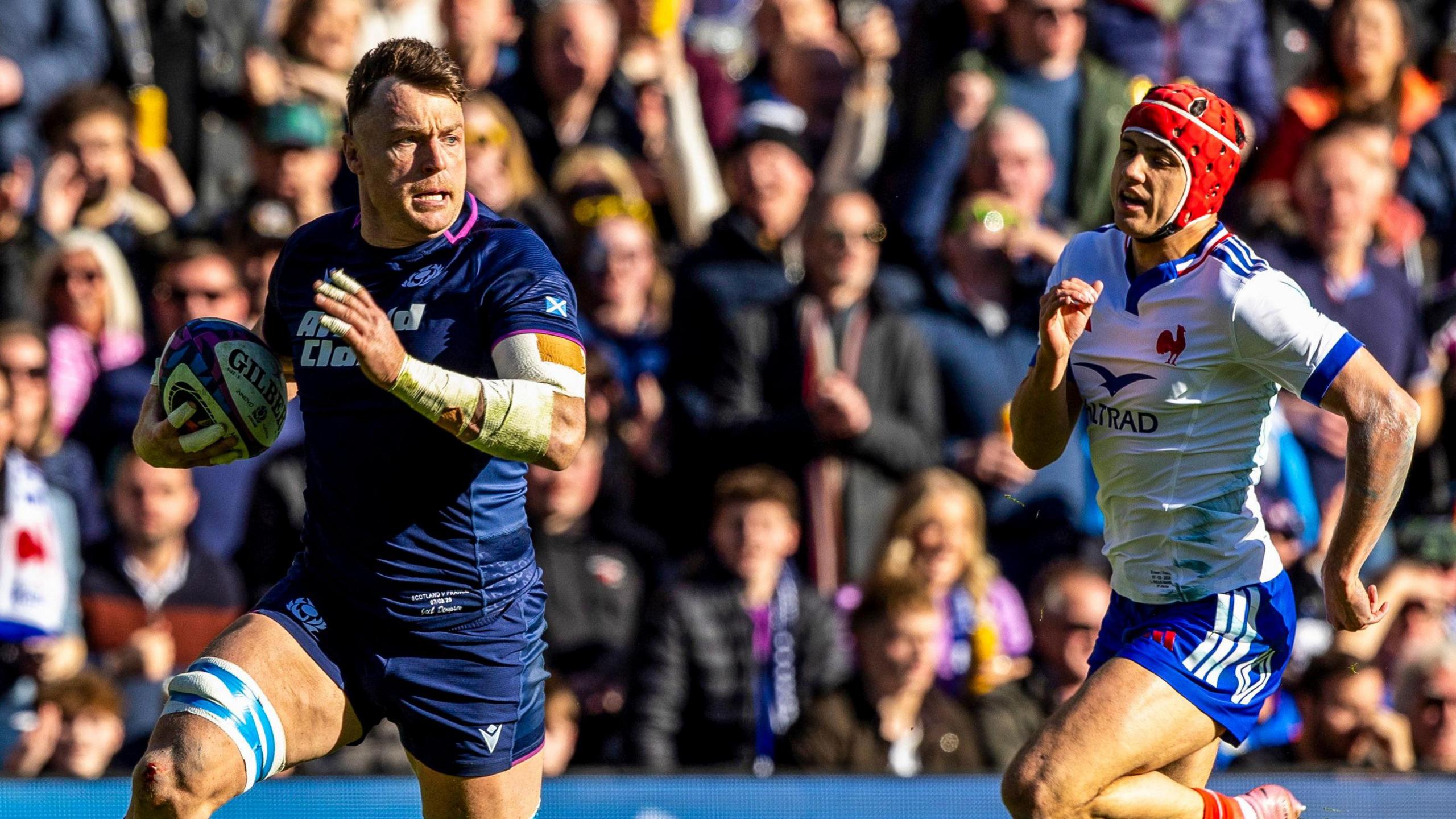
Watching Jack Dempsey’s towering displays for Scotland in this Six Nations, it is hard to believe he was cast aside by his native Australia for lacking physicality.
Their loss has been Gregor Townsend’s gain since the 31-year-old switched allegiance in 2022. Dempsey has made his own a position that for a long time was a problem for the Scots.
There have been some capable Scottish number eights in the Six Nations era. Some versatile back-rowers who slotted in when required.
Some who were out-and-out eights who carried hard but only fleetingly or for chunks of games, failing to get Scotland enough front-foot ball to survive against the big guns.
- 19 hours ago
- 2 days ago
- 19 hours ago
“If you look at the professional era, Dempsey is probably the best we’ve had,” says former Scotland number eight Johnnie Beattie.
“Simon Taylor would be – when he was fit – the best we’ve had, and now probably Dempsey. His performances this year have been right up there.
“He’s really dynamic, impactful, has tireless workrate and he’s got a real point of difference. He gives us go forward and metres that are hard earned.”
Dempsey’s route to the Scotland team was one of the more unusual paths in Test rugby. “A long and weird road”, as he once described it.
He played 14 times for Australia and appeared at the 2019 Rugby World Cup.
But then he fell out of favour when Dave Rennie, the former Glasgow coach who has recently taken charge of the All Blacks, was named Wallabies head coach in 2020. “We always felt he lacked a bit of physicality,” Rennie once explained.
‘Everyone likes lining up with a tough bloke’
To play this video you need to enable JavaScript in your browser.
Physicality has not been a problem for Dempsey in the dark blue jersey. He is famously single-minded in his approach to the game.
“I’m not the first one on the team sheet for my defence. I’m there to get the ball in my hands,” he told the BBC’s Scotland Rugby Podcast in 2023.
He combines power and clever footwork to ensure he is not easily put down, and contact is normally taken on his terms.
Dempsey’s powerful carries have generated precious front-foot ball and been a focal point for a Scottish attack that has shredded both England and France in this Six Nations. He was a standout performer in both games.
A sliding doors moment in Scotland’s campaign was Dempsey recovering from what looked like a tournament-ending bicep injury suffered against England.
He missed the victory over Wales in Cardiff, but unexpectedly returned to take his place in the starting team to face France, played the full 80, and was immense.
“Everybody likes lining up with a tough bloke,” says Scotland defence coach Lee Radford.
“To be able to bounce through the pain barrier like he has, how physically he plays the game, both with the ball and without it, there’s a lot of the little stuff.
“There was the clip of him snapping his bicep. He finds his way out to an edge defensively, but stays on the field and then makes a right shoulder shot that should have been a left because he’d snapped his bicep.
“So to stay on the field and come up with those plays says a lot about the character of the bloke.
From Rome to rapture – Townsend’s revival rolls toward Dublin
BBC Scotland rugby podcast
11/03/26
Dempsey is a fascinating character.
He rarely appears in front of the media, but when he does, he tends to have a captive audience. He speaks thoughtfully, with refreshing candour and, much like his ball-carrying, he is direct and to the point.
He has spoken about the adjustment of swapping Sydney for Glasgow. At the Waratahs, he would invariably hit the beach after training – not an option available to him most of the year round in the West of Scotland.
Having spent nine months out injured last year, Dempsey spoke after his return in October how tough his spell on the sidelines had been.
“I love Glasgow, it’s my home, but there’s not a huge amount to do when you’re not playing rugby,” he said.
Getting back on to the pitch and doing what he does best was the sole focus during that period. His performances for club and country since have been those of a man playing every game as if it’s his last.
“I think he offers a point of difference that none of the other back rows have in terms of his ability to break a tackle, generate space and time for others, and move Glasgow or Scotland up the field,” Beattie said.
To play this video you need to enable JavaScript in your browser.
Related topics
- Scotland Rugby Union
- Scottish Rugby
- Rugby Union

Leave a Reply