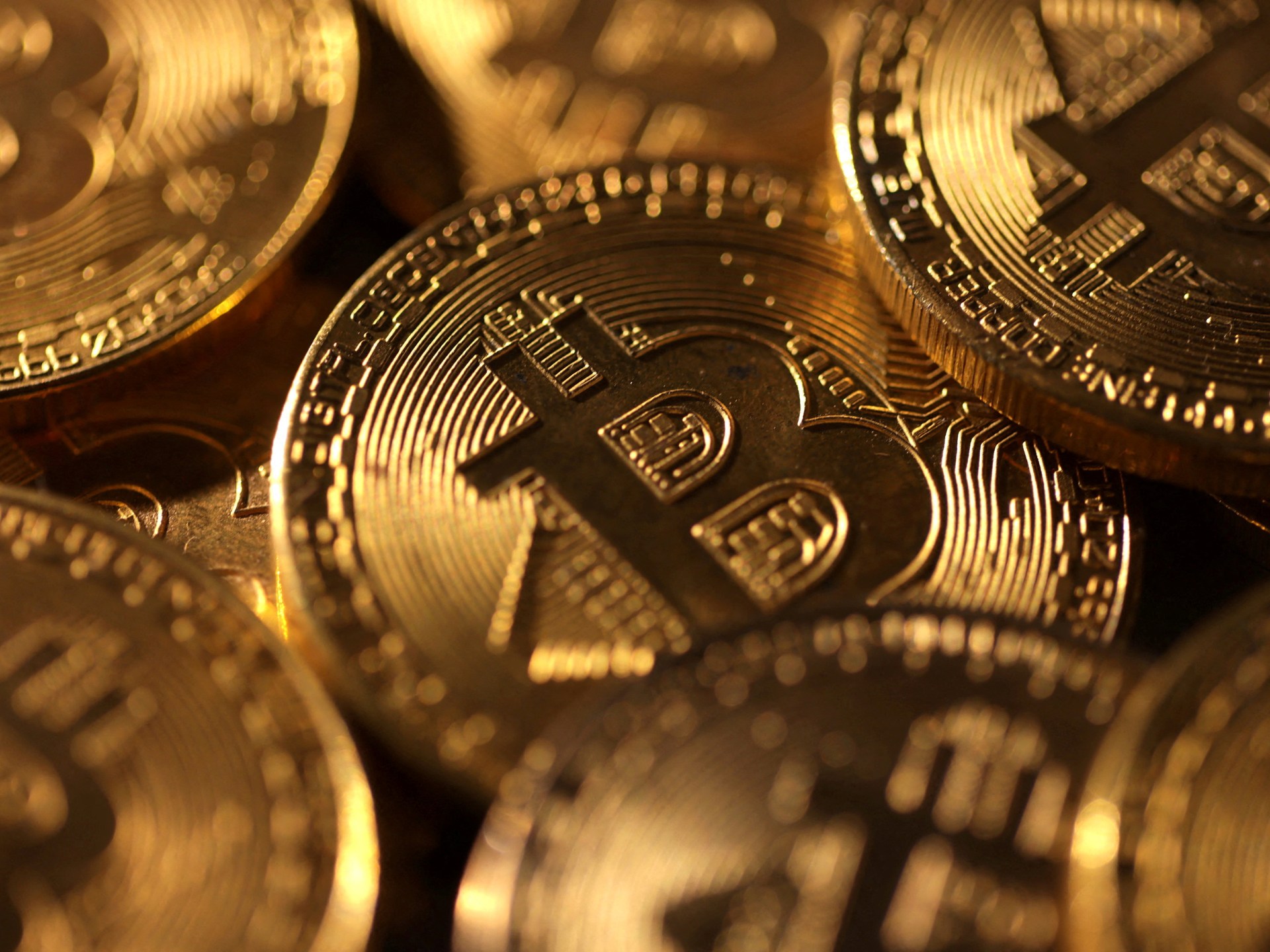
Crypto markets came under pressure this week when the price of the world’s most popular cryptocurrency, Bitcoin, tumbled to its lowest level in more than a year.
On Thursday afternoon, the price of Bitcoin fell below $66,000 and was hovering at about $62,900 on Friday morning.
Recommended Stories
list of 3 itemsend of list
The fall in the price of the digital asset kicked off in the last weekend of January, when it fell below $80,000.
In October last year, Bitcoin hit an all-time peak of more than $127,000 before falling back to about $90,000 in December.
Following its latest tumble, Bitcoin is currently down by about 30 percent more since the start of the year.
Here’s what we know about what’s going on in the world of cryptocurrency:
Why is the price of Bitcoin falling?
Volatility in other markets is one of the main drivers.
Analysts say a sell-off of global stocks amid geopolitical uncertainty and recent volatility in the price of gold and silver are part of the reason for the drastic fall in the price of Bitcoin.
“Institutional demand has reversed materially,” CryptoQuant, an organisation which provides analysis of global markets to cryptocurrency investors, wrote in a report on Wednesday.
The report noted that US exchange-traded funds (ETFs) – a form of pooled investment – which had been buying up Bitcoin last year, are selling it this year.
Deutsche Bank analysts wrote in a note to clients this week that these ETFs “have seen billions of dollars flow out each month since the October 2025 downturn”, referring to investors in the funds cashing out of them.
Furthermore, they added that specialised US spot Bitcoin ETFs suffered outflows of more than $3bn in January this year, following outflows of about $7bn and $2bn in November and December 2025, respectively.
“This steady selling in our view signals that traditional investors are losing interest, and overall pessimism about crypto is growing,” the analysts said.
Adam Morgan McCarthy, product specialist at Kaiko, an organisation that provides crypto market data and analyses, told Al Jazeera: “The fall in Bitcoin prices has been largely tied to less interest in the markets and lower trading volumes. This leads to less liquidity, so any move higher or lower is exacerbated.”
He explained that the crypto market relies heavily on “hype-driven” cycles where people buy due to a fear of “missing out” on an opportunity.
“This hype forms the foundation of trading volumes, and that is what we mean by liquidity. Essentially, more trading volumes mean more liquidity, as it makes it easier to quickly buy and sell Bitcoin,” he said.
“Right now, that foundation is disappearing and this tends to happen during bear markets or ‘crypto winters’, making it much harder to effectively trade assets, and they become even less appealing then. So it’s quite a vicious circle that leads to these downward spirals,” he added.
A “crypto winter” is an extended period of declining or stagnant prices, something that can be driven by worsening macroeconomic conditions or tightening market regulations, among other reasons.
Volatility in gold and silver prices in the past two weeks has also dampened market sentiment, affecting the price of cryptocurrencies. Analysts say geopolitical instability and the prospects of a rising US dollar have led investors to sell precious metals, resulting in the sudden downturn.
Then, last week, prices came back sharply, with the price of gold hitting a record peak of almost $5,595 an ounce, while silver hit an all-time high of nearly $122.
But this peak did not last long, and this week, the prices of these precious commodities plunged – again – with gold falling to $4,872.83 per ounce on Thursday and silver falling to $77.36 an ounce.
Other cryptocurrencies like Ether, the second-largest cryptocurrency, have also fallen. The price of Ether has fallen by 19 percent this week, closing at $1,854 late on Thursday.
Does this mean ‘crypto-friendly’ policies in the US aren’t working?
The price of Bitcoin soared after United States President Donald Trump’s return to the White House last year, with analysts expecting he would adopt a “crypto-friendly” regulatory regime.
At a Bitcoin conference in July 2024, as part of his pre-election rally, Trump had said the US is the “crypto capital of the planet” and pledged to also create a Bitcoin “strategic reserve” if he became president.
In March 2025, on taking office, Trump announced his government would create a national strategic crypto reserve which would include five cryptocurrencies – Bitcoin and Ether as well as smaller currencies XRP, Cardano and Solana.
In July last year, Trump also announced the GENIUS Act, a new cryptocurrency legislation that would establish regulations and consumer protections for “stablecoin”, a type of cryptocurrency whose value is linked to a fixed currency or commodity.
Then, last month, the US also unveiled draft legislation that would create a regulatory framework for cryptocurrency, which, if signed into law, would clarify financial regulators’ jurisdiction over the cryptocurrency sector.
The US president has a personal interest as his family owns the cryptofirm World Liberty Financial (WLFI).
Last March, WLFI launched its own “stablecoin” – a dollar-pegged cryptocoin backed by US treasuries – called USD1.
But the president’s personal interest in cryptocurrencies and supportive policies have not shielded the digital asset from external market factors.
Have we seen ‘crypto winters’ before?
Yes.
A crypto winter was triggered after Bitcoin peaked in December 2017 and then tumbled in December 2018 due to intense regulatory crackdowns in the US, Canada and other countries, among other reasons.
Another such winter occurred in November 2022 after a peak in October 2021, due to the FTX currency exchange scandal. In November that year, crypto exchange FTX initiated US bankruptcy proceedings after a liquidity crisis prompted intervention from regulators around the world.
In a Thursday briefing note, analysts at Kaiko said the downward trend in prices “truly accelerated” after Trump appointed Kevin Warsh as the new Federal Reserve Chair.
Warsh will replace Jeremy Powell, who Trump has lambasted for not lowering interest rates.
The Kaiko briefing note stated: “Powell’s recent announcement on January 28th that interest rates would remain unchanged, combined with the appointment of the new Chairman, constituted a true turning point, acting as a catalyst for a sharp acceleration of the decline. The reaction was all the more pronounced given that the crypto market, particularly sensitive to changes in the macroeconomic regime, was already weakened,” the report said.
What will happen next?
Hougan noted that crypto winters typically last for about 13 months and assured investors that the current “winter” will not last for long.
“As a veteran of multiple crypto winters, I can tell you that the end of those crypto winters feels a lot like now: Despair, desperation, and malaise. But there is nothing about the current market pullback that’s changed anything fundamental about crypto,” he said in his report.
“I think we’re going to come roaring back sooner rather than later. Heck, it’s been winter since January 2025. Spring is surely coming soon,” he added.

Leave a Reply