United States President Donald Trump has said he is “thinking about taking over” the Strait of Hormuz so that it remains open. The strait links the Gulf to the Gulf of Oman. It is the only route to the open ocean for oil producers in the Gulf.
The war in Iran entered its 11th day on Tuesday, as attacks continue on Iran as well as on Israel and US assets in the Middle East, including in Bahrain, Kuwait, the United Arab Emirates and Saudi Arabia.
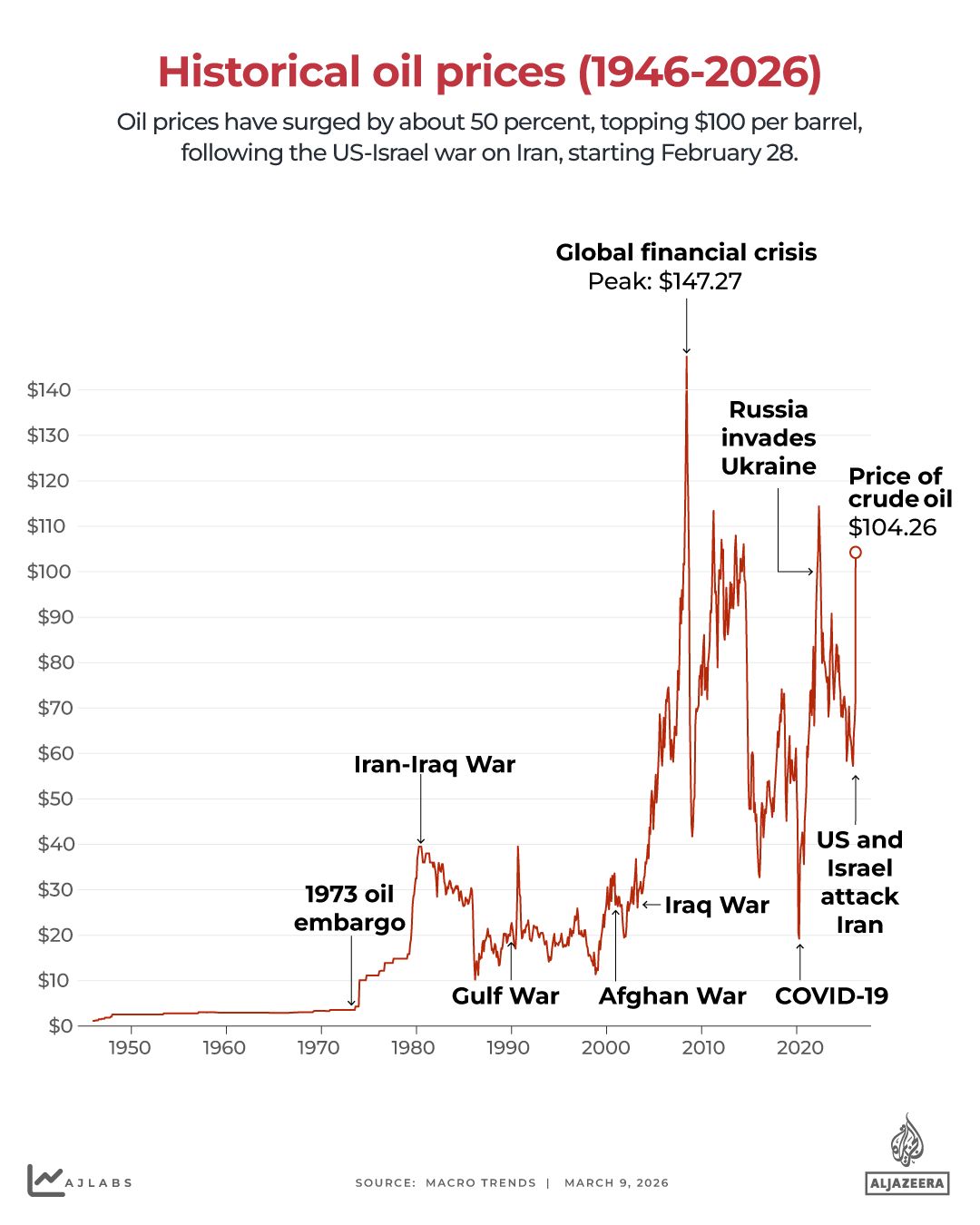
The war has sent oil prices soaring. As well as attacking US military assets and infrastructure in Middle East countries in retaliation against the US-Israeli campaign, Iran has threatened to attack ships traversing through the Strait of Hormuz, putting the route at severe risk for about one-fifth of the world’s oil supply.
Why has the price of oil soared?
One major reason is the closure of the Strait of Hormuz.
Ebrahim Jabari, a senior adviser to the commander-in-chief of Iran’s Revolutionary Guard Corps (IRGC), said on March 2: “The strait is closed. If anyone tries to pass, the heroes of the Revolutionary Guard and the regular navy will set those ships ablaze.
“We will also attack oil pipelines and will not allow a single drop of oil to leave the region. Oil price will reach $200 in the coming days,” Jabari wrote in a post on the IRGC’s Telegram channel.
As a result, oil prices had shot up by more than 30 percent by Sunday, when the international benchmark Brent crude at one point topped $119 a barrel. The price of crude has since seen a decline, but remains above the price it was before the war began on February 28. On Tuesday, it was hovering around $93 a barrel.
Placing further pressure on fuel prices, Qatar’s state-run energy firm and the world’s largest producer of LNG, QatarEnergy, halted LNG production last week following Iranian attacks on its operational facilities in Ras Laffan and Mesaieed in Qatar.
Saudi Arabia shut down operations at the Ras Tanura plant, its largest domestic oil refinery, which is operated by Saudi Aramco, after a fire broke out at the facility, which officials said was caused by debris from the interception of two Iranian drones.
Iranian officials have publicly denied attacking QatarEnergy or Aramco.
The volatility in energy markets caused by the war on Iran will worsen over time, members of the industry have warned.
“There would be catastrophic consequences for the world’s oil markets, and the longer the disruption goes on, the more drastic the consequences for the global economy,” Aramco CEO Amin Nasser told reporters on Tuesday.

What has Trump said about the Strait of Hormuz?
During an interview with CBS News on Monday, Trump said he was “thinking about taking over” the Strait of Hormuz to ensure it remains open.
Trump also threatened to increase attacks on Iran if it disrupts the flow of oil in the Hormuz Strait.
“If Iran does anything that stops the flow of Oil within the Strait of Hormuz, they will be hit by the United States of America TWENTY TIMES HARDER than they have been hit thus far,” Trump said during a news conference in Florida on Monday.
“I will not allow a terrorist regime to hold the world hostage and attempt to stop the globe’s oil supply. And if Iran does anything to do that, they’ll get hit at a much, much harder level.”
Trump also said he expects the war to be over in a short amount of time.
Earlier on Monday, Trump told Republicans at his golf club in Doral, Florida: “We took a little excursion because we felt we had to do that to get rid of some people. We’ve already won in many ways, but we haven’t won enough.”
Earlier, Trump said that the war, which began on February 28, could last “four to five weeks” and that the US military had the “capability to go far longer than that”.
Can the US occupy the Strait of Hormuz?
During his CBS interview, Trump did not explain what the US plans for “taking over” the Strait would be. Technically, the US cannot “occupy” the strait, however.
Alexander Freeman, a partner in the shipping team at UK-based law firm Hill Dickinson, said: “The United States has no jurisdiction over the Strait of Hormuz, which are not international waters under UNCLOS [the United Nations Convention on the Law of the Sea]. Without the consent of Iran and Oman – whose sovereign territorial waters cover the Strait – the US taking over the Strait would likely amount to an incursion on Iran and Oman’s jurisdiction – even where it is aimed to protect the safe passage of vessels.”
In the absence of a ceasefire and the reopening of the strait, however, it is possible that ships could be escorted through the strait by US or international navies.
During an interview last week, Trump said the US Navy would escort ships in the waterway “if necessary… as soon as possible”.
In Florida, on Monday, Trump reiterated this, saying: “We’ll perhaps go alongside them for protection.”
Speaking in Cyprus on Monday, French President Emmanuel Macron said France and its allies are also preparing a “purely defensive” mission to escort vessels through the Strait of Hormuz once the “most intense phase” of the US-Israeli war on Iran ends.
Macron did not provide further details, but he said the “purely escort mission” must be prepared by both European and non-European countries.
How has Iran responded, and what is its strategy?
Iranian leaders have not shown any signs of backing down over the war or the closure of the Strait of Hormuz.
The country’s Foreign Minister Abbas Araghchi said on Tuesday that Iran would keep fighting for as long as necessary.
In an interview with CNN, Kamal Kharazi, foreign policy adviser to the office of the supreme leader, ruled out diplomacy and said the war would continue.
“I don’t see any room for diplomacy any more. Because Donald Trump had been deceiving others and not keeping with his promises, and we experienced this in two times of negotiations – that while we were engaged in negotiation, they struck us,” Kharazi said.
He suggested that Gulf and other countries need to place economic pressure on the US and Israel to end the war in Iran for diplomacy to be back on the table.
Rob Geist Pinfold, a lecturer in international security at King’s College London, told Al Jazeera that Iran has been engaging in a “completely different approach to war fighting” than in the past, when it seemed to opt for slow and steady escalation.
Pinfold said Iran’s claim that it is attacking only US assets in the Gulf “has to be taken with far more than a pinch of salt”. Iran’s targets are primarily large-scale infrastructure and civilian ones, he added.
“What they’re doing now is trying to unleash as much chaos as possible to destabilise the region and global markets, hurt the economy, hurt the GCC states, in order that the US will at some point decide that this conflict is no longer worth its while any more and will push for a ceasefire.”
What could happen next?
Scott Lucas, a professor of US and international politics at University College Dublin, told Al Jazeera that if the domestic situation worsens for Trump, there may be an opening for the Gulf states to ask for a pullback.
Lucas added that this would be “especially true” if there is another surge in the price of oil in the coming days.

Leave a Reply