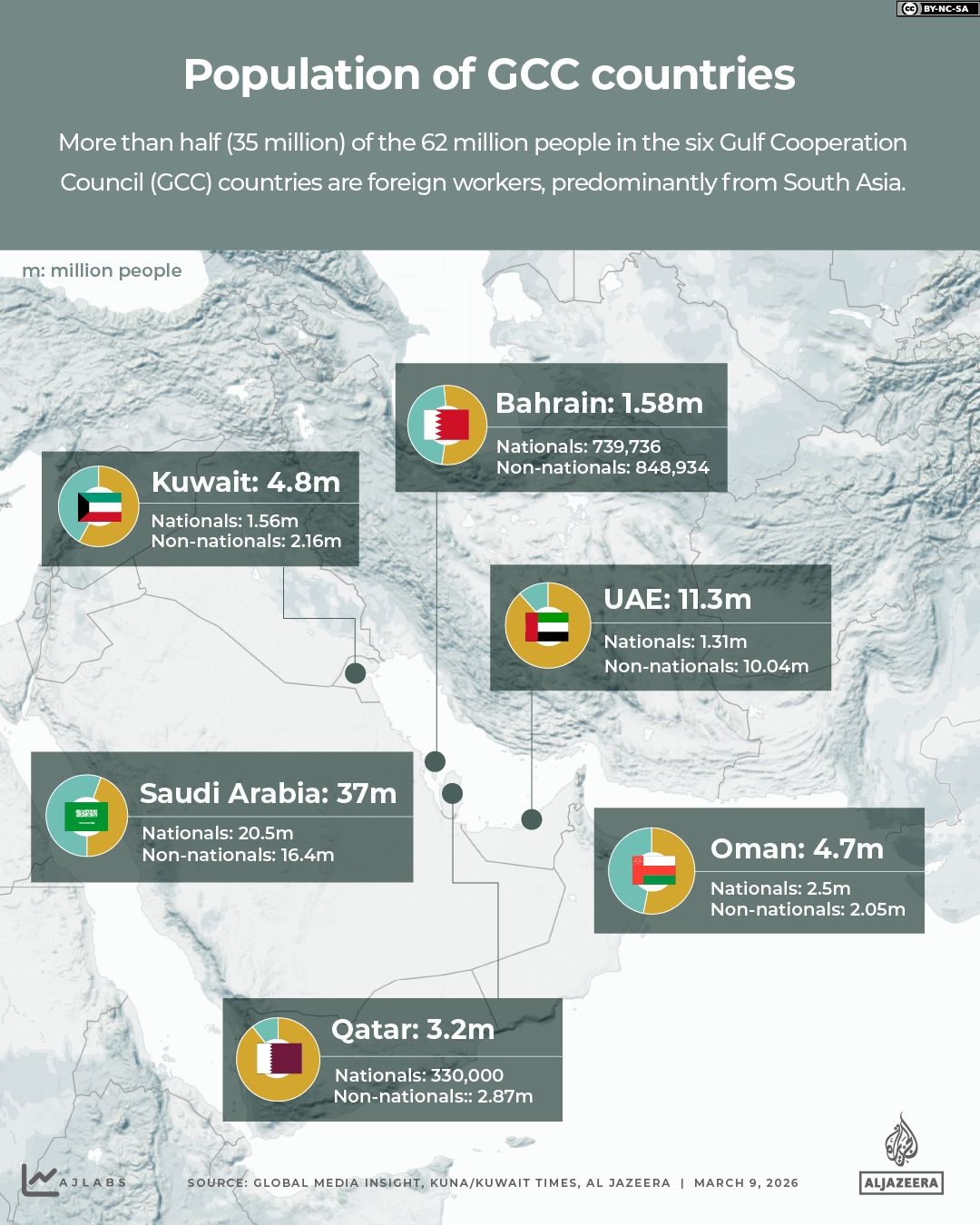
Where do the 35 million foreigners living in the GCC come from?

Nearly 62 million people living in the six Gulf Cooperation Council (GCC) countries have been caught in the crossfire of the latest US-Israel war on Iran.

Known for their economic opportunities, these countries, including Bahrain, Kuwait, Oman, Qatar, Saudi Arabia and the United Arab Emirates (UAE), collectively host nearly 35 million foreign workers from around the world, predominantly from South Asia.

Recommended Stories

list of 4 itemsend of list

With the exception of Saudi Arabia and Oman, foreign workers make up the bulk of the populations of people living in the remaining four GCC countries.

The map below illustrates the national and non-national populations in each of the GCC countries.

Where do GCC foreign workers come from?

Generations of foreign workers in the GCC countries have significantly contributed to the workforce, including labourers, construction workers, household staff, security personnel, and cleaners, all vital to building the modern infrastructures that Gulf nations are known for.

Millions consider the Gulf their home, despite holding nationalities from other countries.

Additionally, highly skilled foreign workers have a long history in industries such as banking, finance, technology, engineering, aviation, medicine and the media.

According to Global Media Insight, a digital marketing agency based out of the UAE,  the 10 largest groups of non-nationals living across the six GCC countries are from:

  • India: 9.1 million
  • Bangladesh: 5 million
  • Pakistan: 4.9 million
  • Egypt: 3.3 million
  • Philippines: 2.2 million
  • Yemen: 2.2 million
  • Sudan: 1.1 million
  • Nepal: 1.2 million
  • Syria: 694,000
  • Sri Lanka: 650,000

Interactive_WhereDo_Expats_GCC_COUNTRY_NATIONALITY_MARCH9_2026

Saudi Arabia

Saudi Arabia is the largest of the six GCC countries, with a population of nearly 37 million.

riyadh
Aerial view of Riyadh city is seen from Mamlaka tower, a 99-story skyscraper, in Riyadh, Saudi Arabia [Amr Nabil/AP Photos]

The oil-rich country has a local population of about 20.5 million and an additional 16.4 million foreign residents.

The five largest groups of non-nationals living in Saudi Arabia are people from:

  • Bangladesh: 2,590,000
  • India: 2,310,000
  • Pakistan: 2,230,000
  • Yemen: 2,210,000
  • Egypt: 1,800,000
  • Sudan: 1,000,000

The UAE

The United Arab Emirates has the second-largest population in the GCC, totaling some 11.3 million people.

Dubai skyline
Dubai skyline is visible with the Burj Khalifa, the world’s tallest building, during the COP28 U.N. Climate Summit, in Dubai, United Arab Emirates, Thursday, November 30, 2023 [Kamran Jebreili/ AP Photo]

It consists of seven emirates, including the capital Abu Dhabi, Dubai, Sharjah, Ajman, Umm Al Quwain, Ras Al Khaimah, and Fujairah.

Emiratis make up nearly 12 percent of the population, with foreigners at almost 88 percent.

The five largest groups of non-nationals living in the UAE are from:

  • India: 4,360,000
  • Pakistan: 1,900,000
  • Bangladesh: 840,000
  • Philippines: 780,000
  • Iran: 540,000
  • Egypt: 480,000

Kuwait

With a population of 4.8 million, Kuwait has the third-largest population in the GCC.

Kuwait
A drone view shows Kuwait City in Kuwait, February 28, 2026 [Stephanie McGehee/Reuters]

Approximately 1.56 million are Kuwaiti citizens, and 2.16 million are foreign workers.

The five largest groups of non-nationals living in Kuwait are from:

  • India: 1,000,000
  • Egypt: 700,000
  • Bangladesh: 350,000
  • Philippines: 250,000
  • Pakistan: 200,000
  • Nepal: 120,000

Oman

Oman’s population stands at approximately 4.7 million people. Oman’s 2.5 million citizens account for nearly 59 percent of the population, while the remaining 2.05 million (or 41 percent) are foreign workers.

Oman
General view of old Muscat the day after Oman’s Sultan Qaboos bin Said was laid to rest in Muscat, Oman, January 12, 2020 [Christopher Pike/Reuters]

The five largest groups of non-nationals living in Oman are from:

  • India: 766,735
  • Bangladesh: 718,856
  • Pakistan: 268,868
  • Egypt: 46,970
  • Philippines: 45,213
  • Uganda: 20,886

Qatar

Qatar skyline
The Doha skyline, seen here [Showkat Shafi/Al Jazeera]

Qatar has a population of some 3.2 million people, with 2.87 million foreign workers accounting for about 88 percent of them. Qatari citizens number around 330,000, making up 12 percent.

The five largest groups of non-nationals living in Qatar are from:

  • India: 700,000
  • Bangladesh: 400,000
  • Nepal: 400,000
  • Egypt: 300,000
  • Philippines: 236,000
  • Pakistan: 180,000

Bahrain

With a total population of 1.58 million, Bahrain has the smallest population in the GCC. Bahraini citizens make up just under half of the population.

Manama
A general view of residential buildings in the Juffair district of Manama, Bahrain, June 22, 2025 [Hamad I Mohammed/Reuters]

The five largest groups of non-nationals living in Bahrain are from:

  • India: 350,000
  • Bangladesh: 150,000
  • Pakistan: 120,000
  • Philippines: 80,000
  • Egypt: 60,000
  • Nepal: 35,000

World reacts to appointment of Mojtaba Khamenei as Iran’s supreme leader

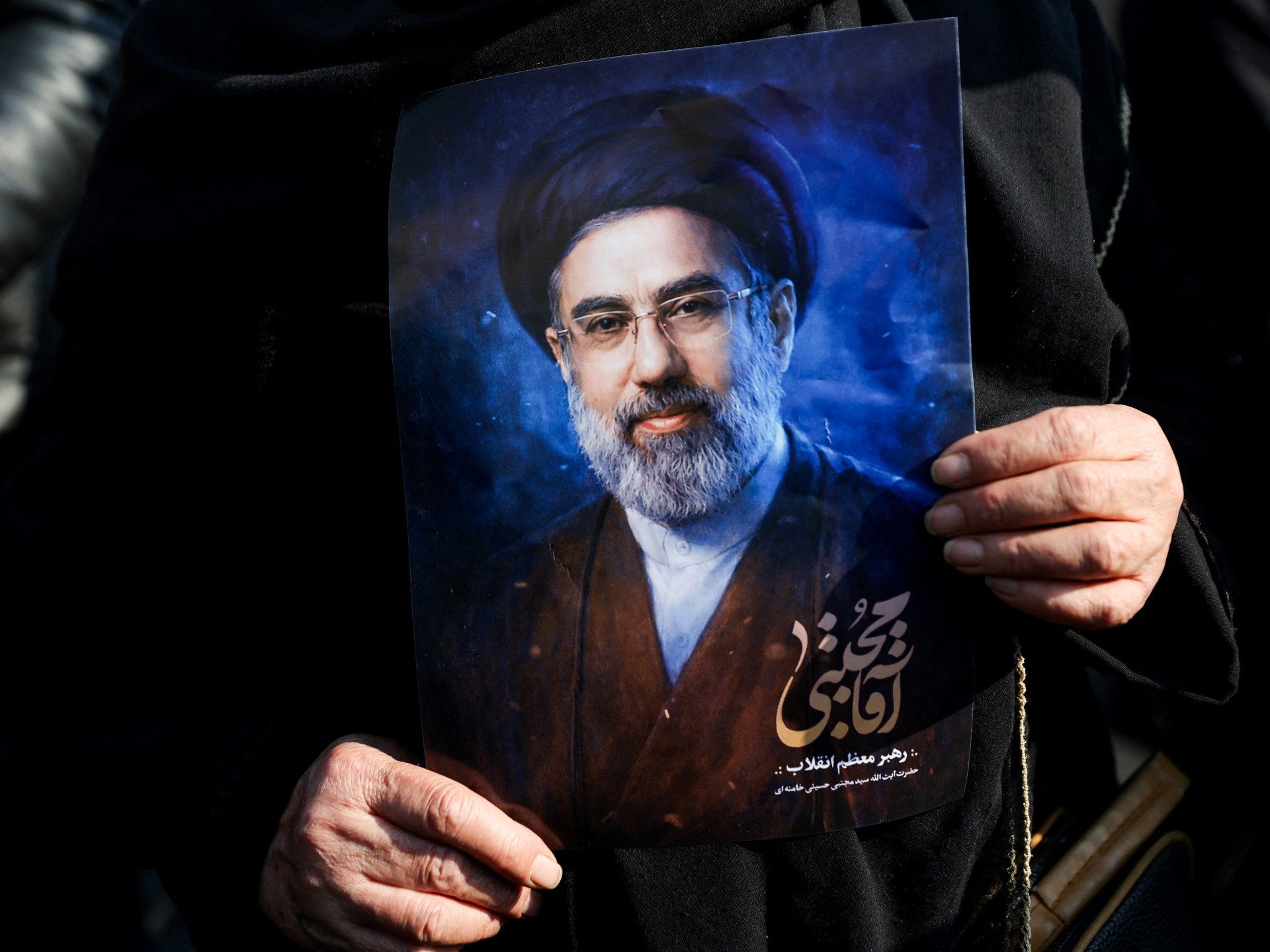
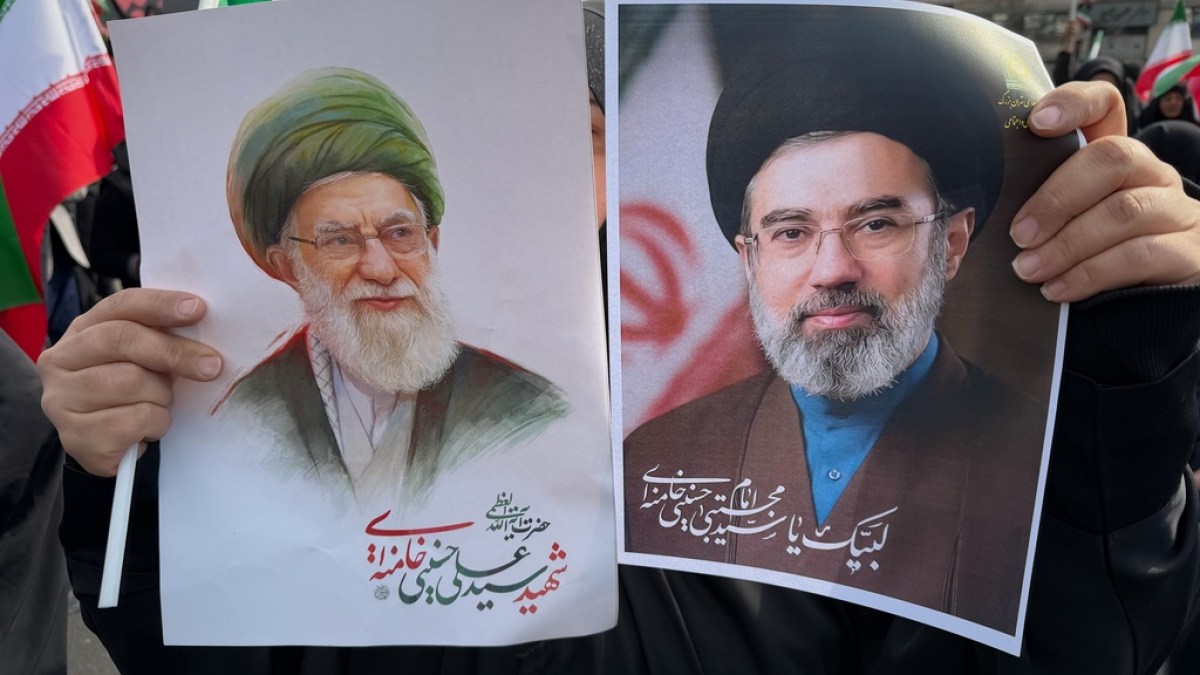
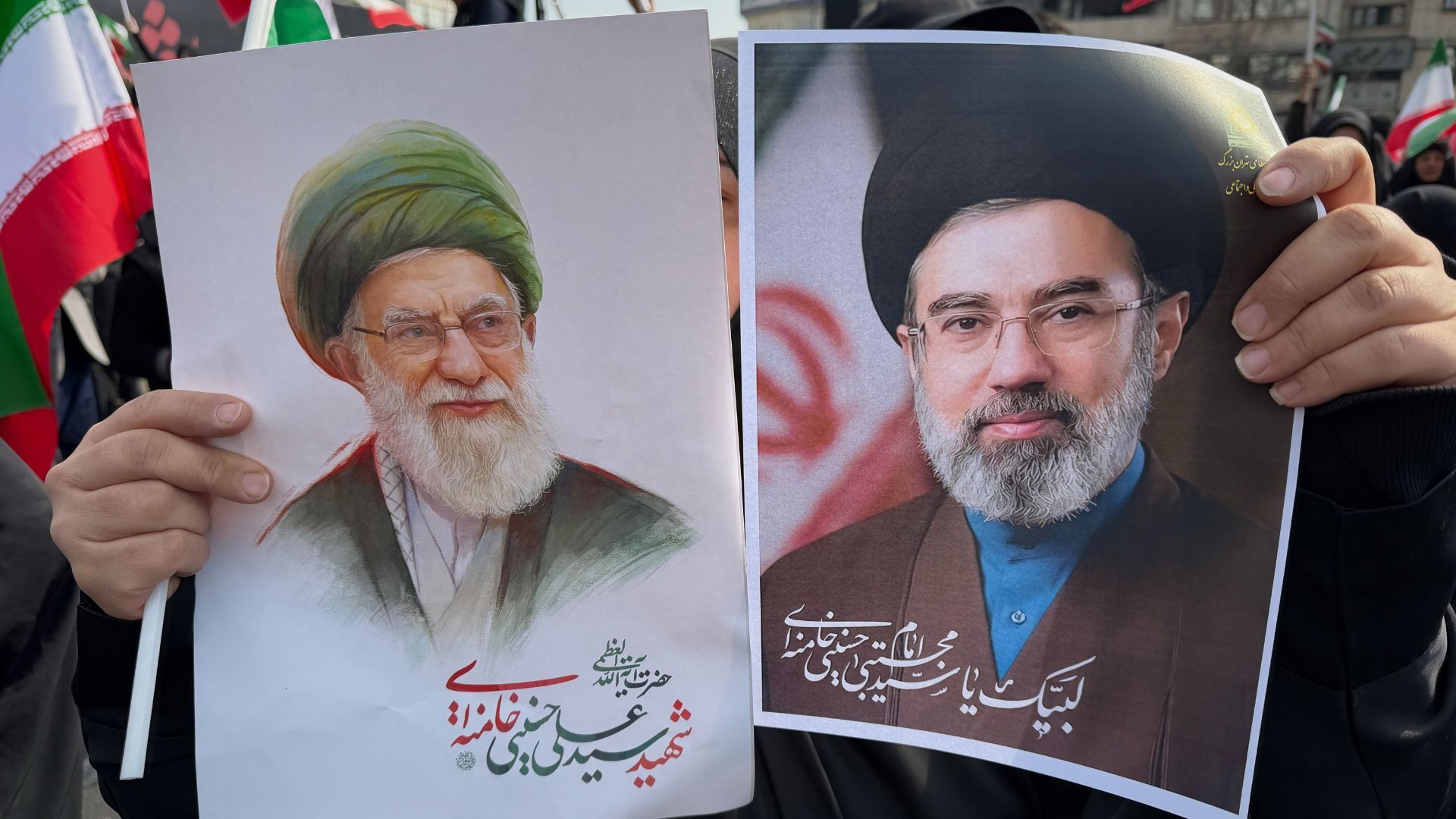
Iran’s new Supreme Leader Mojtaba Khamenei has never held a formal position in government, but his appointment as his late father’s successor amid the US-Israeli war on his country was not unexpected.

Iran’s Assembly of Experts appointed the 56-year-old mid-ranking religious scholar to the position on Sunday, just over a week after his late father, Ayatollah Ali Khamenei, was killed in United States-Israeli strikes.

Recommended Stories

list of 3 itemsend of list

Khamenei, who has strong ties with the Islamic Revolutionary Guard Corps (IRGC) and his late father’s still-influential office, is seen as a hardliner who will provide continuity in the country.

His appointment, which came after he lost both his father and his wife in strikes, was interpreted as a defiant choice signalling continuity as the Islamic Republic faces the biggest crisis in its 47-year history.

Khamenei received immediate backing from figures in Iran’s political and security establishment, including IRGC leaders, President Masoud Pezeshkian and Ali Larijani, secretary of the Supreme National Security Council.

Outside the country, reactions were mixed:

Oman

Oman was a mediator in recent talks between Iran and the United States, which collapsed when the US and Israel unleashed their war on Iran last month.

Oman’s Sultan Haitham bin Tariq Al Said on Monday sent a “cable of congratulations” to Khamenei on his appointment as Iran’s new supreme leader, according to the official Oman News Agency.

Iraq

Iraqi Prime Minister Mohammed Shia al-Sudani also congratulated Khamenei on his appointment on Monday.

“We express our confidence in the ability of the new leadership in the Islamic Republic of Iran to manage this sensitive stage, and continue to strengthen the unity of the Iranian people in facing the current challenges,” al-Sudani said in a statement.

He reaffirmed Iraq’s solidarity and support for Iran and “all steps aimed at ending the conflict and rejecting military operations against its sovereignty, in order to preserve the stability of other countries in the region”.

United States

US President Donald Trump had previously dismissed Mojtaba Khamenei as a “lightweight”, and insisted he should have a say in appointing a new Iranian leader, which Tehran rejected.

On Monday, Trump told NBC News, “I think they made a big mistake. I don’t know if it’s going to last. I think they made a mistake.”

Later on Monday, he told CBS News: “I have no message for him.”

Trump said he has someone in mind to lead Iran, but did not elaborate.

Israel

The ⁠Israeli ⁠military has already threatened to kill any replacement for the late Ali Khamenei.

Israel’s Foreign Ministry said Monday that Mojtaba Khamenei was a “tyrant” like his slain father, and would continue what it described as the Iranian “regime’s brutality”.

In a post on X featuring a picture of Mojtaba Khamenei and his father Ayatollah Ali Khamenei, holding guns, the ministry wrote: “Mojtaba Khamenei. Like Father Like Son”.

“Mojtaba Khamenei’s hands are already stained with the bloodshed that defined his father’s rule. Another tyrant to continue the Iranian regime’s brutality,” said the ministry.

Russia

Russian President Vladimir Putin on Monday pledged “unwavering support” to Iran.

“I would like to reaffirm our unwavering support for Tehran and solidarity with our Iranian friends,” Putin said in a message to Khamenei, adding that “Russia has been and will remain a reliable partner” to Iran.

“At a time when Iran is confronting armed aggression, your tenure in this high position will undoubtedly require great courage and dedication,” the Russian leader said.

China

China’s Foreign Ministry spokesman Guo Jiakun told reporters on Monday that Iran’s decision to appoint the younger Khamenei was “based on its constitution”.

“China opposes interference in other countries’ internal affairs under any pretext, and Iran’s sovereignty, security, and territorial integrity should be respected,” he said when asked about the threats against the new leader.

Beijing is a close partner of Tehran and condemned the killing of the former supreme leader, but it has also criticised the Iranian counterstrikes against Gulf states.

Yemen’s Houthis

Yemen’s Houthi rebels on Monday welcomed the appointment of the new supreme leader.

“We congratulate the Islamic Republic of Iran, its leadership and people, on the selection of Sayyid Mojtaba Khamenei as Supreme Leader of the Islamic Revolution at this important and pivotal juncture,” the group said in a statement on Telegram.

Qatar releases video of interception of Iranian missiles

NewsFeed

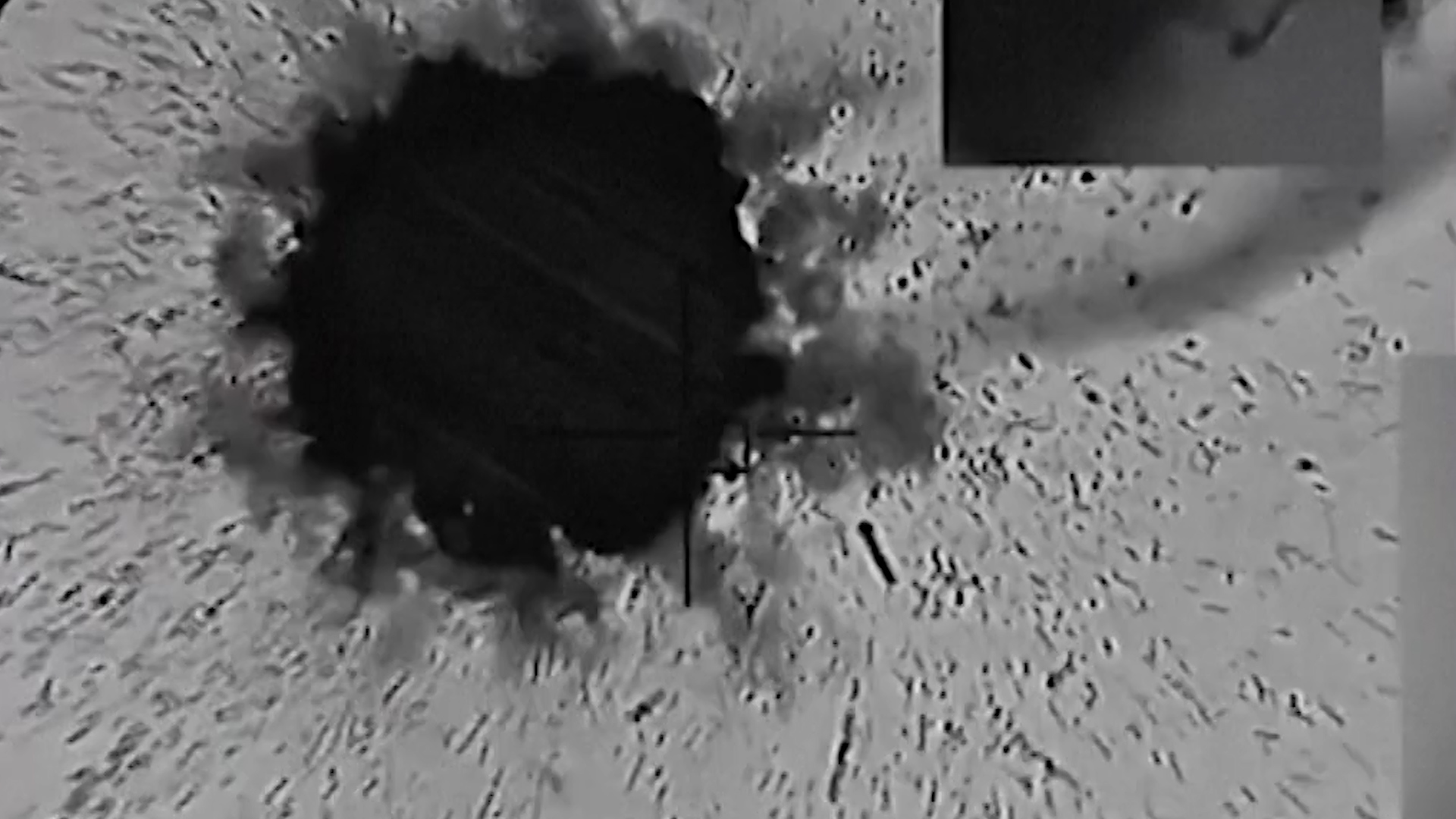
Footage released Monday by the Qatari Ministry of Defence shows Iranian missiles and drones being intercepted over the Gulf nation. The ministry said earlier that it had intercepted a total of 17 ballistic missiles and six drones launched from Iran that day.

Trump slams Mojtaba Khamenei’s appointment as Iran projects defiance

Donald Trump says he is “not happy” with the selection of Mojtaba Khamenei as Iran’s new supreme leader.

The United States president had warned repeatedly against electing the son of assassinated Supreme Leader Ali Khamenei to lead the country as the US-Israeli conflict with Iran intensified.

Recommended Stories

list of 3 itemsend of list

“I’m not going through this to end up with another Khamenei. I want to be involved in the selection,” Trump told Time magazine on Friday.

Two days later, Iran’s Assembly of Experts did exactly that – it replaced the slain Khamenei with his 56-year-old son.

The decision was a show of defiance against the US president, who had been stressing for days that Iran would follow the path of Venezuela in selecting a leader willing to answer Washington’s demands.

“I think they made a big mistake,” Trump said on Monday of Khamenei’s appointment.

He also suggested that the new supreme leader may be targeted and killed like his father.

“I don’t know if it’s going to last. I think they made a mistake,” the US president said.

In an interview with the New York Post earlier, Trump declined to provide details about his plans for dealing with the new Iranian leader.

“Not going to tell you. I’m not happy with him,” he said.

Calls for killing the new Iranian leader

Republican Senator Lindsey Graham, a close ally of Trump, also acknowledged that Mojtaba Khamenei was “not the change” the US was looking for.

“I believe it’s just a matter of time before he meets the same fate as that of his father — one of the most evil men on the planet,” Graham said on X.

Mark Levin, a pro-Israel commentator close to Trump, who called for killing the elder Khamenei for weeks prior to the war, was quick to shift his messaging after Mojtaba was selected as his father’s successor.

“Get the boy Khamenei!” Levin wrote in a social media post on Monday.

The US and Israel launched a joint attack on Iran on February 28, killing Khamenei and several top officials in the opening strikes, which were followed by thousands of attacks that devastated the country and claimed the lives of more than 1,250 people.

Iran responded with hundreds of missiles and drone launches against Israel and US military assets across the Middle East.

Iranian attacks have also hit energy installations and civilian targets in the Gulf region and largely succeeded in closing down the Hormuz Strait – a major shipping lane for the oil trade.

War has also broken out between Israel and Hezbollah in Lebanon.

Despite the regional turmoil, which has led to a historic spike in oil prices, Trump has said that he is seeking Iran’s “unconditional surrender”.

He has also suggested that the war was “already won”.

The US president reiterated that sense of confidence on Monday, telling CBS News that the war is progressing “very far ahead of schedule”.

“I think the war is very complete, pretty much,” Trump said, adding that Iran has “nothing left” militarily.

But Trump’s repeated assertions that Iran is on the verge of collapse and that he would be involved in choosing the country’s next leader were met by ridicule in Tehran.

On Friday, Parliament Speaker Mohammad Bagher Ghalibaf said Iran’s fate would be decided by Iranians themselves, not by Jeffrey Epstein’s “gang”, referring to the late sex offender who had ties to rich and powerful figures in the US.

Ryan Costello, policy director at the National Iranian American Council (NIAC), said Trump’s rejection of Mojtaba Khamenei may have inadvertently boosted the newly elected supreme leader’s candidacy.

“It became not a question of who is the best candidate for the next supreme leader, but ‘what do we need to do to protect Iranian sovereignty in the face of this aggression and desire to dictate to Iran what we do internally,’” Costello told Al Jazeera.

“It’s possible Mojtaba Khamenei had the inside track all along, but I do think Trump’s disapproval made it very hard for the system to go in any other direction.”

‘Intense’ blowback

Costello added that although Trump is setting a high ceiling for the war, the US president has lost control of the conflict.

“Trump had very different expectations coming in, that Iran was weak and that they would fold like a deck of cards in a matter of hours,” he said.

Instead, Iran appears to have been able to withstand the initial onslaught despite the heavy blows it absorbed from the US and Israel.

There have been no major defections or significant protests against the ruling system since the war began. And the Iranian military has managed to keep steady fire against Israel and the region.

With Hormuz closed, the price of oil skyrocketing and markets starting to feel the strain of the disruption, the blowback from the US-Israeli war has been “strong and intense”, said Costello.

“The notion that Trump was going to be able to dictate his will inside Iran is very much getting pushed back upon about 10 days into the conflict,” he added.

Some of Trump’s Democratic rivals at home have underscored the selection of Mojtaba Khamenei to accuse the US president of lacking a clear vision for the war that he and Israel started.

Democratic Congressman Jake Auchincloss said Trump replaced “an 86-year-old terrorist dictator with a 56-year-old terrorist dictator”, referring to the Khamenei father and son.

He predicted that the new supreme leader would escalate attacks across the region and “race for nuclear capability”. Iran denies seeking a nuclear weapon.

Who is Iran’s new supreme leader, Mojtaba Khamenei?

Mojtaba Khamenei replaces his assassinated father Ayatollah Ali Khamenei.

A new supreme leader in Iran – Mojtaba Khamenei – has replaced his assassinated father.

His selection sends a defiant message to the United States and Israel as they attack the country.

So, who is Iran’s new leader – and what does his appointment mean?

Presenter: Tom McRae

Guests:

Hassan Ahmadian – Associate professor at the University of Tehran

Mehran Kamrava – Professor at Georgetown University in Qatar and director of the Iranian Studies Unit at the Arab Center for Research and Policy Studies

Why Israel’s war on Hezbollah keeps returning

Israel has tried for decades to weaken Hezbollah through wars and assassinations. Why has the group endured?

Israel’s latest attacks on Lebanon come after decades of conflict with Hezbollah. Wars, assassinations and pressure have failed to break the group, which continues to launch rockets and fight Israeli forces. Why has Hezbollah endured, and what does the latest escalation reveal about the long war between Israel and Hezbollah?

In this episode:

  • Hala Jaber (@HalaJaber), Journalist

Episode credits:

This episode was produced by Noor Wazwaz and Tuleen Barakat with Sarí el-Khalili, Monah Hamade, Gerard Baldadad, Adhil Veetil, Shreshtha Sanghvi, and our guest host, David Enders. It was edited by Noor Wazwaz. 

Our sound designer is Alex Roldan.  Our video editors are Hisham Abu Salah and Mohannad al-Melhemm. Alexandra Locke is The Take’s executive producer.

Connect with us: