What is the Hezbollah-linked financial institution Al-Qard Al-Hassan?

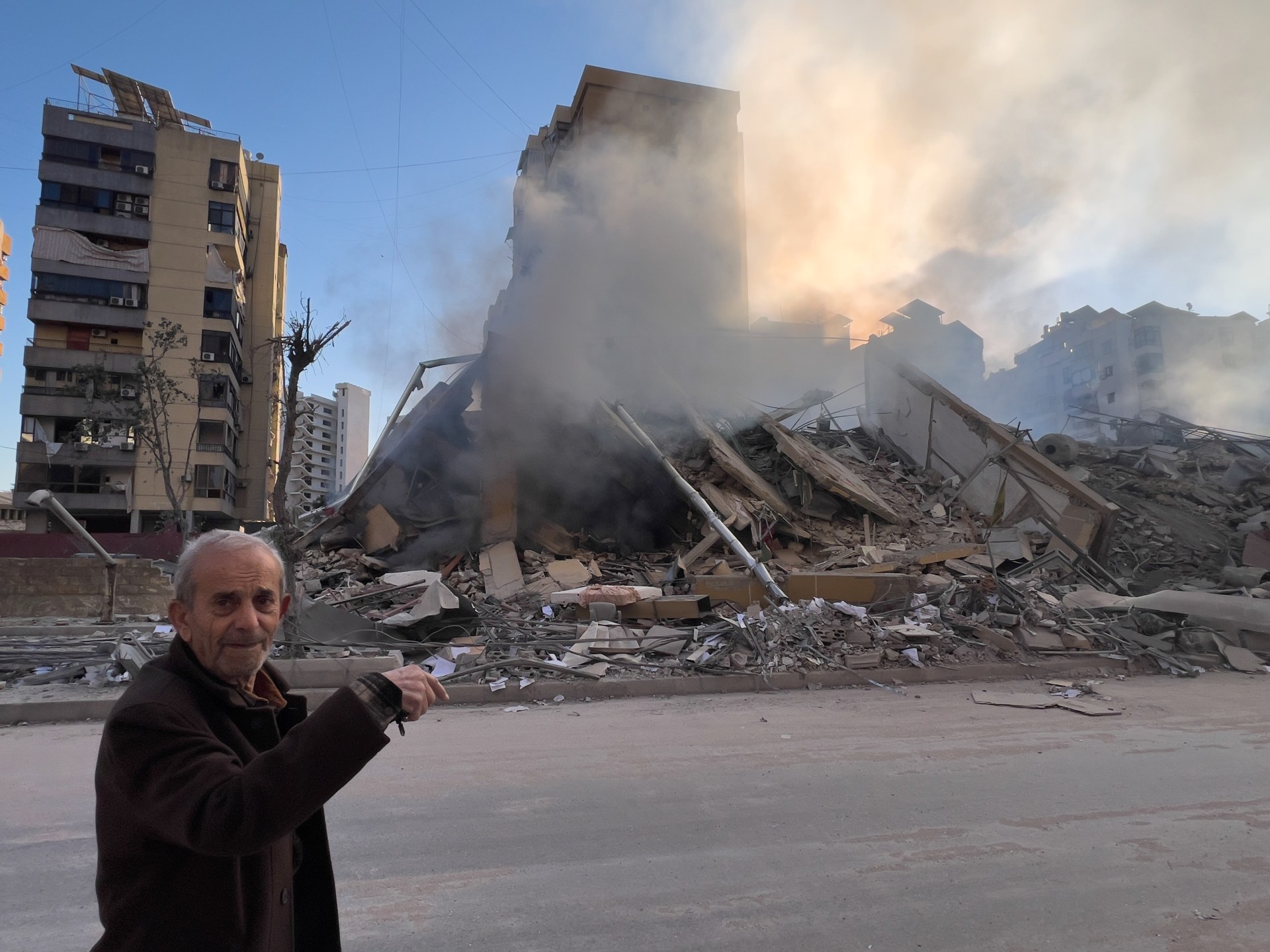
On Monday, Israel targeted a building in Beirut’s southern suburbs that was reportedly a branch of the Hezbollah-affiliated Al-Qard Al-Hassan financial institution, as it intensified attacks against organisations linked to the Lebanese group.

Al-Qard Al-Hassan, a quasi-banking institution that offers interest-free loans to people, is one of the many charity organisations run by Hezbollah, including schools, hospitals and low-price grocery stores.

Recommended Stories

list of 4 itemsend of list

Israel launched renewed attacks on Lebanon on March 2 after Hezbollah responded to the February 28 killing of Iran’s Supreme Leader Ayatollah Ali Khamenei. Hezbollah hadn’t attacked Israel for more than a year, despite Israel’s near-daily violations of the 2024 ceasefire.

Since then, Israel has attacked Lebanon hundreds of times, killing nearly 500 people, including 83 children, and wounding thousands more. Israel claims it is trying to destroy Hezbollah’s capacity to attack its northern area.

So what do we know about Al-Qard Al-Hassan, and Israel is targeting it?

Here’s all you need to know:

What is Al-Qard Al-Hassan?

It is a financial institution that offers microcredit to people in Lebanon. Many people in the country might use it to keep money or to take loans on gold. It differs from a traditional bank in that it doesn’t take banking fees or interest on the loans.

The institution, founded in 1983, is linked to Hezbollah but serves people of all religious communities. It became more prominent in recent years, after Lebanon’s banking system collapsed in 2019.

It mostly deals in smaller loans, often backed by gold deposits, but also offers bank accounts without traditional banking fees. Al-Qard Al-Hassan is not regulated by the Banque du Liban, Lebanon’s central bank, or part of the international banking network.

A local Beirut resident, who said he has used Al-Qard Al-Hassan for 15 years, told Al Jazeera that the organisation has continued to operate despite the Israeli attacks.

Fouad Debs, a lawyer and member of the Depositors Union, which has fought Lebanon’s banking system for depositors’ access to their money blocked during the country’s 2019 financial crisis, said that Al-Qard Al-Hassan provided many who were unbanked with a financial standing or access to loans.

Why is it being targeted?

Israel claims it is trying to destroy Hezbollah and its capacity to operate as an organisation.

Hezbollah was established in response to Israel’s 1982 invasion of Lebanon. It has since evolved into one of the most powerful players in Lebanese politics. Its political ally, the Amal Movement, is a major player in Lebanon’s fractured democratic political system.

The US Treasury Department applied sanctions on Al-Qard Al-Hassan in 2007 after accusing Hezbollah of using it as a cover to hide its financial activities and to gain access to the international financial system. Those sanctions were strengthened in 2021 and again earlier this year.

This is not the first time Israel has attacked Al-Qard Al-Hassan branches. Many branches were targeted during the 2024 escalation. Human Rights Watch called the attacks “war crimes.”

Prior to the last escalation, the institution had around 30 branches.

On October 20, 2024, Israel struck most of those offices in southern Lebanon, the southern suburbs of Beirut, and the Bekaa Valley. Central Beirut also has a couple of offices

“An armed group’s use of a financial institution, association, or bank does not amount to an effective contribution to military action, and therefore it is not a lawful military target under the laws of war,” Human Rights Watch’s report from 2024 said.

“The Israeli military’s repeated strikes on Lebanese financial institutions indicate a deliberate and unlawful attack on Hezbollah’s civilian wing,” Ramzi Kaiss, Lebanon researcher at Human Rights Watch, said in the report from 2024.

“Designating a civilian institution as a military target because of its affiliation rather than its effective contribution to military action puts all commercial operations at risk during wartime.”

Will the strikes have an impact?

Imad Salamey, a Lebanese political scientist, told Al Jazeera that the attacks have little impact on the organisation’s ability to operate.

“Israel’s strikes on Al-Qard Al-Hassan appear largely symbolic and part of a broader campaign of political and psychological warfare against Hezbollah’s institutional network,” Salamey said.

Salamey added that many of the sites “are mainly offices or service branches that hold little actual liquidity, meaning the direct financial impact is likely limited”.

If the attacks have such little impact, then why target the offices at all?

“Issuing warnings before the strikes helps Israel amplify the psychological warfare along media coverages while reinforcing the narrative that it is targeting Hezbollah-linked infrastructure rather than civilians,” Salamey said.

The impact will be minimal on Hezbollah, analysts said, but could hurt Lebanese who keep their valuables at Al-Qard Al-Hassan, particularly the thousands who are working class or unbanked.

The 2019 financial crisis devalued the Lebanese currency by more than 90 percent and thrust much of the country into poverty.

Israel also ordered mass evacuations in the last week of Dahiyeh, in Beirut’s southern suburbs, and the areas south of the Litani River, which runs across south Lebanon. Nearly 700,000 people are displaced.
What are the Ukrainian drone interceptors sent to counter Iranian attacks?

Ukraine has dispatched drone interceptors and military personnel to Jordan as Middle Eastern countries fend off Iranian strikes on infrastructure and United States military assets during the US-Israel war on Tehran.

President Volodymyr Zelenskyy confirmed that a Ukrainian team departed on Friday for Jordan, which has US military assets at its Muwaffaq Salti Air Base.

Recommended Stories

list of 4 itemsend of list

The move followed a request on Thursday from the US, Zelenskyy said, as Washington seeks cheaper technology for intercepting Iranian missiles targeting Israeli and US defence assets as well as other infrastructure across Qatar, Kuwait, Bahrain, Saudi Arabia and the United Arab Emirates.

At the moment, the US is using air defence systems such as Patriot missiles, Terminal High Altitude Area Defense (THAAD) batteries and Airborne Warning and Control System (AWACS) aircraft to intercept Iranian drones and missiles targeting its military assets in the region.

However, these types of systems are expensive, costing millions of dollars for each interceptor missile fired, and there are concerns that supplies of US interceptor missiles could run low.

Iran is deploying its cheap, domestically produced Shahed drones across the Gulf and is believed to have thousands in stock. These are the same drones it has supplied to Russia over the course of Moscow’s war on Ukraine. Kyiv, which has long sought more advanced US defence systems, has developed technology to mass-produce much cheaper interceptor drones to counter drone swarm attacks from Russia.

“Ukrainians have been fighting against ‘shahed’ drones for years now, and everyone recognizes that no other country in the world has this kind of experience. We are ready to help,” Zelenskyy wrote on X on Thursday, adding that Ukraine has asked for advanced US defence systems, such as the Patriot system, in exchange.

In a Monday post on X, Zelenskyy confirmed that 11 countries, including the US, Gulf and European countries, had requested Kyiv’s help and some requests “have already been met with concrete decisions and specific support”.

Here’s what we know about the Ukrainian drones the US and Gulf countries want to deploy:

Ukraine interceptors
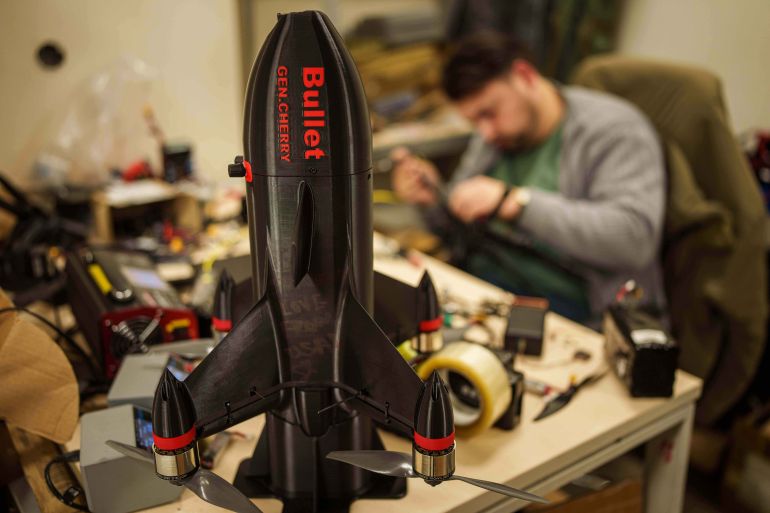
An engineer assembles an interceptor drone for the General Cherry company at a workshop in Ukraine on December 4, 2025 [File: Evgeniy Maloletka/AP]

What do we know about the Ukrainian interceptors being requested?

Ukraine has been building thousands of low-cost interceptor drones to counter Iranian Shahed-type drones over the course of the Russia-Ukraine war.

After failing to receive enough high-end weaponry from its allies, such as US Patriot missile defence systems, Kyiv was forced to innovate in 2025. Now, it has become one of the world’s leading manufacturers of the “Shahed Killers”.

The cheap but powerful drones are designed to shoot down Russian attack drones before they reach their targets. They are operated by pilots tracking them on a monitor or wearing first-person-view (FPV) goggles. Each one is priced at about $1,000 to $2,000 – a fraction of the several million dollars it costs to manufacture, transport and fire a high-tech US interceptor.

Ukrainian manufacturers are producing thousands of them per month.

Analysts said the drones can counter a range of attacks but cannot intercept ballistic missiles. So far, they also require trained pilots positioned close to their area of engagement although manufacturers are now developing automated models.

There are several models that have been developed in Ukraine:

  • The Sting: This quadcopter is shaped like a bullet and is about the size of a large thermos. It is the fastest of the interceptors, reaching speeds of 315 to 343 kilometres per hour (196 to 213 miles per hour), and can cruise at an altitude of 3,000 metres (10,000ft). It relies on thermal imaging cameras to hit targets, and it returns to base if it cannot locate one. Its domed head carries the camera system and an explosive payload. It is manufactured by Ukraine’s Wild Hornets start-up.
  • Bullet: Developed in late 2025 by the Ukrainian weapons manufacturer General Cherry, this high-speed interceptor is driven by a jet engine and four rotors. It can be 3D-printed and uses AI-assisted guidance to locate targets. It can reportedly travel at speeds of 130km/h to 309km/h (81mph to 192mph) and cruise at up to 5,500 metres (3.4 miles).
  • P1-Sun: The 3D-printed craft produced by the weapons company Skyfall can fly at up to 300km/h (186mph). It looks similar to the Sting.
  • Octopus 100: This interceptor is designed in Ukraine but mass-produced in the United Kingdom. Its technical details are unclear.
  • ODIN Win_Hit: Another bullet-shaped drone is built for short-duration, high-intensity missions. It has a maximum speed of 280km/h to 300 km/h (174mph to 186mph) and can fly up to 5,000 metres (3.1 miles) for seven to 10 minutes at a time. It’s developed by the Ukrainian defence company ODIN.

INTERACTIVE - Sting_interceptor_drone-1773155125

How does the Iranian Shahed operate?

Russia has launched thousands of Iranian-designed Shahed drones at Ukraine, resulting in hundreds, if not thousands, of deaths and heavy infrastructure damage. Increasingly, they’ve been countered by Ukraine.

A New York Times analysis found that Russia sent about 5,000 drones into Ukraine in February and Ukraine downed 87 percent of them.

Iran, which has long supplied Moscow with weapons, has used the same models in its strikes on its neighbours as it faces heavy bombardment from the US and Israel. One drone hit Kuwait last week, killing six members of the US military, the Times reported.

Priced at about $20,000 to $33,000 each, the GPS-guided drones are about 3.5 metres (11.5ft) in length. They are loitering munitions and self-destructing vehicles mounted with explosive payloads and automated to blow up upon hitting programmed targets.

Moscow is believed to have incorporated its own elements into the Iranian design and now mass-produces thousands of the “kamikaze” models. Zelenskyy claimed in his X post on Monday that there were “Russian components” in the crashed remains of Shaheds that Iran has used on its Gulf neighbours.

INTERACTIVE - SHAHED 136 drone
(Al Jazeera)

What have the US and Gulf countries been using against Iranian missiles?

The US has been supporting Gulf countries in intercepting Iranian missiles with expensive defence systems, including:

  • Patriot missile systems: The Patriot Advanced Capability-2 (PAC-2) and PAC-3 are advanced surface-to-air missile defence systems built by US defence contractor Lockheed Martin that can intercept aircraft, cruise missiles and short-range ballistic missiles. Ukraine has repeatedly asked the US for more Patriot batteries, which consist of a truck-mounted launching system with eight launchers that can hold up to four missile interceptors each, ground radar, a control station and a generator. Each Patriot missile costs about $4m, and launchers are about $10m. About 90 personnel are required to operate the system. They are in short supply as Lockheed Martin delivered a record 620 PAC-3 MSE interceptors, the most Patriot missiles, in 2025. Zelenskyy said the US and its Middle Eastern partners have already burned through 800 of those, compared with the 600 delivered to Ukraine in four years.
INTERACTIVE-GCC_MILITARY_SEPT18_2025_PATRIOT_SYSTEM-1758287528
(Al Jazeera)
  • THAAD missile defence system: Also developed by Lockheed Martin, the THAAD uses a combination of radar and interceptors to counter short-, medium- and intermediate-range ballistic missiles and can operate at high altitudes. A THAAD battery consists of six truck-mounted launchers, 48 interceptors – eight for each launcher – one radar system, and a fire control and communications component and needs 95 personnel. Each battery costs about $1bn to $1.8bn to produce.
INTERACTIVE_THAAD_GAZA_ISRAEL_IRAN_MISSILE_INTERCEPTOR_FEB25, 2026-1772104791
(Al Jazeera)
  • AWACS aircraft: These aircraft form part of an early-warning radar system designed to detect missiles and long-range projectiles from up to 400km (250 miles) away.

Women’s football team to be welcomed home with open arms, Iran says

The Iranian women’s footballers returning to the country after their Asian Cup campaign in Australia will be welcomed home “with open arms”, Iran’s Ministry of Foreign Affairs has said.

Ministry spokesperson Esmaeil Baghaei urged the players to “come home” on Tuesday, hours after five members of Iran’s squad sought asylum in Australia following their team’s exit from the tournament.

Recommended Stories

list of 3 itemsend of list

“To Iran’s women’s football team: don’t worry – Iran awaits you with open arms,” Baghaei wrote on X.

His post came shortly after the office of Iran’s general prosecutor said the remaining members of the team were invited back to the country “with peace and confidence”.

“These loved ones are invited to return to their homeland with peace and confidence, and in addition to addressing the concerns of their families,” the general prosecutor’s office was quoted as saying by Iran’s Tasnim news agency.

Australia’s decision to provide visas to five players came amid uncertainty and concerns for the team’s safety following their decision to stand in silence during Iran’s anthem before their first match of the tournament on March 3.

The players sang and saluted the anthem in their remaining two matches, on Thursday and Sunday, prompting fears that they could face punishment upon their return home.

Australian Minister for Home Affairs Tony Burke told a news conference on Monday that he had informed the five members “that they are welcome to stay in Australia, that they are safe here, and they should feel at home here”.

He added that he had also offered the other team members the chance to stay in Australia.

The Department of Home Affairs named the five team members as captain Zahra Ghanbari, midfielders Fatemeh Pasandideh, Zahra Sarbali Alishah, Mona Hamoudi, and defender Atefeh Ramezanizadeh.

An undated and unplaced photo released by Australia's Department of Home Affairs shows Home Affairs minister Tony Burke (3/R) with five Iranian women football players who applied for asylum after competing in the Women's Asia Cup tournament being played in Australia. Australia has granted asylum to some of Iran's visiting women's football team over fears they faced persecution at home for not singing the national anthem before a match, Home Affairs Minister Tony Burke said on Tuesday. (Photo by HANDOUT / AUSTRALIAN DEPARTMENT OF HOME AFFAIRS / AFP) / ----EDITORS NOTE ----RESTRICTED TO EDITORIAL USE MANDATORY CREDIT " AFP PHOTO / DEPARTMENT OF HOME AFFAIRS" NO MARKETING NO ADVERTISING CAMPAIGNS - DISTRIBUTED AS A SERVICE TO CLIENTS
An undated and unplaced photo released by Australia’s Department of Home Affairs shows Home Affairs Minister Tony Burke, third left, with five Iranian women football players who applied for asylum [Handout/Australian Department of Home Affairs via AFP]

The players’ decision to stand in silence during Iran’s anthem before their match against South Korea was labelled as the “pinnacle of dishonour” by a commentator on Iran’s IRIB state broadcaster.

The announcement to grant the players visas came after United States President Donald Trump, who is currently waging war on Iran alongside ally Israel, said he had spoken to Australian Prime Minister Anthony Albanese about the “delicate situation” faced by the team, and that Albanese was “on it!”

Iran’s Baghaei dismissed Trump’s statement, questioning the US president’s claims of “saving” the players after new footage of a February 28 attack on an Iranian elementary girls’ school in Minab, which killed 165 students, suggested that the site of the school was likely hit by a Tomahawk missile – a weapon used by the US that Israel and Iran do not possess.

The US had previously accused Iran of the attack.

“They slaughtered more than 165 innocent Iranian schoolgirls in a double-tap Tomahawk attack in the city of Minab, and now they want to take our athletes hostage in the name of ‘saving’ them?” Baghaei said.

Following the Australian government’s decision to grant humanitarian visas to five Iranian players, they were moved to an undisclosed location under police protection, Australian officials were quoted as saying by the Reuters news agency.

Iranian media quoted Farideh Shojaei, vice president for women’s affairs at the Iranian Football Federation, as saying the team had left the hotel through the back door with the police.

“We have contacted the embassy, the football federation, the ‌Foreign Ministry and anywhere possible to see what will happen,” she said.

“We have even spoken with the families of these five players.”

Some of the Iranian players left their hotel in the northeastern city of Gold Coast on Tuesday afternoon on a bus that was surrounded by members of the diaspora protesting against the Iranian government. They flew to Sydney airport on Tuesday evening before being transferred to the international terminal.

It was not clear how many players arrived at the airport or where they were going.

Members of the Iranian community in Australia block the path of a departing bus transporting members of the Iranian Women’s Asia Cup football team to the airport, outside the Royal Pines Resort on the Gold Coast on March 10, 2026. Five players from Iran's visiting women's football team claimed asylum in Australia on March 10, seeking protection after they were branded "traitors" at home for refusing to sing the national anthem. (Photo by Patrick HAMILTON / AFP)
Members of the Iranian community in Australia block the path of a departing bus transporting Iran’s squad to the airport on the Gold Coast [Patrick Hamilton/AFP]

Trump initially posted on social media that Australia was “making a terrible humanitarian mistake” by allowing the team to be sent back home, apparently unaware that Australia had been in secret talks with the women for several days.

Trump said members of the team would “likely be killed” if forced to return to Iran. “The US will take them if you won’t,” he added.

In a later post, Trump said he had spoken to Albanese and that the Australian leader was “doing a very good job having to ⁠do with this rather delicate situation”.

The Iranian general prosecutor’s office said “some members of our country’s women’s football team have, unintentionally and emotionally provoked by the enemy’s conspiracy and mischief, behaved in a way that has caused the delusional excitement of the criminal leaders of the imposed American-Zionist war.”

The US and Israel attacks on Iran have killed 1,255 people in the country and left 1,200 injured after 11 days.

How will soaring oil prices caused by Iran war impact food prices?

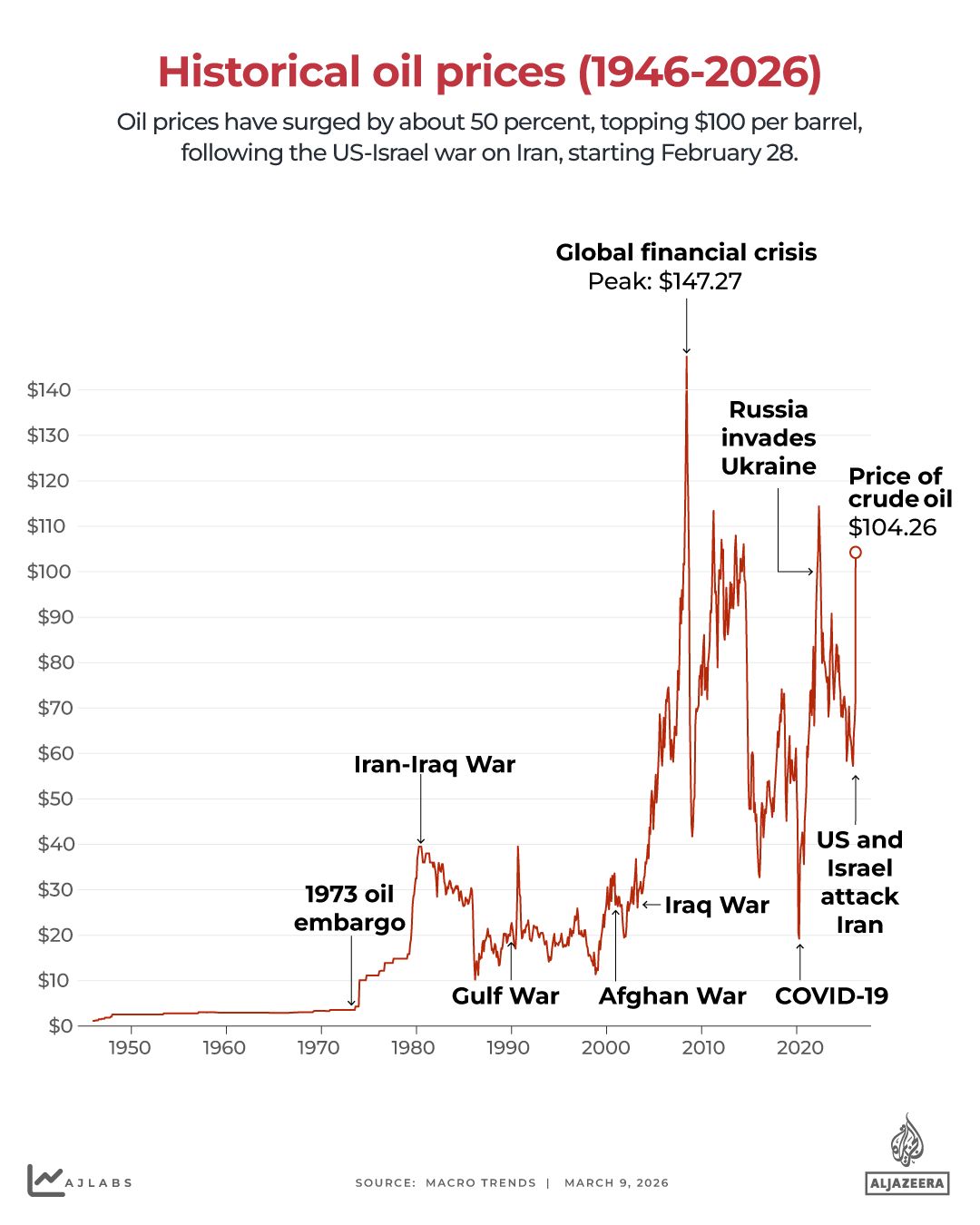
For the first time since Russia’s 2022 invasion of Ukraine, the price of oil skyrocketed past $100 per barrel this week, driven by ongoing energy uncertainty after the United States and Israel’s war on Iran began on February 28.

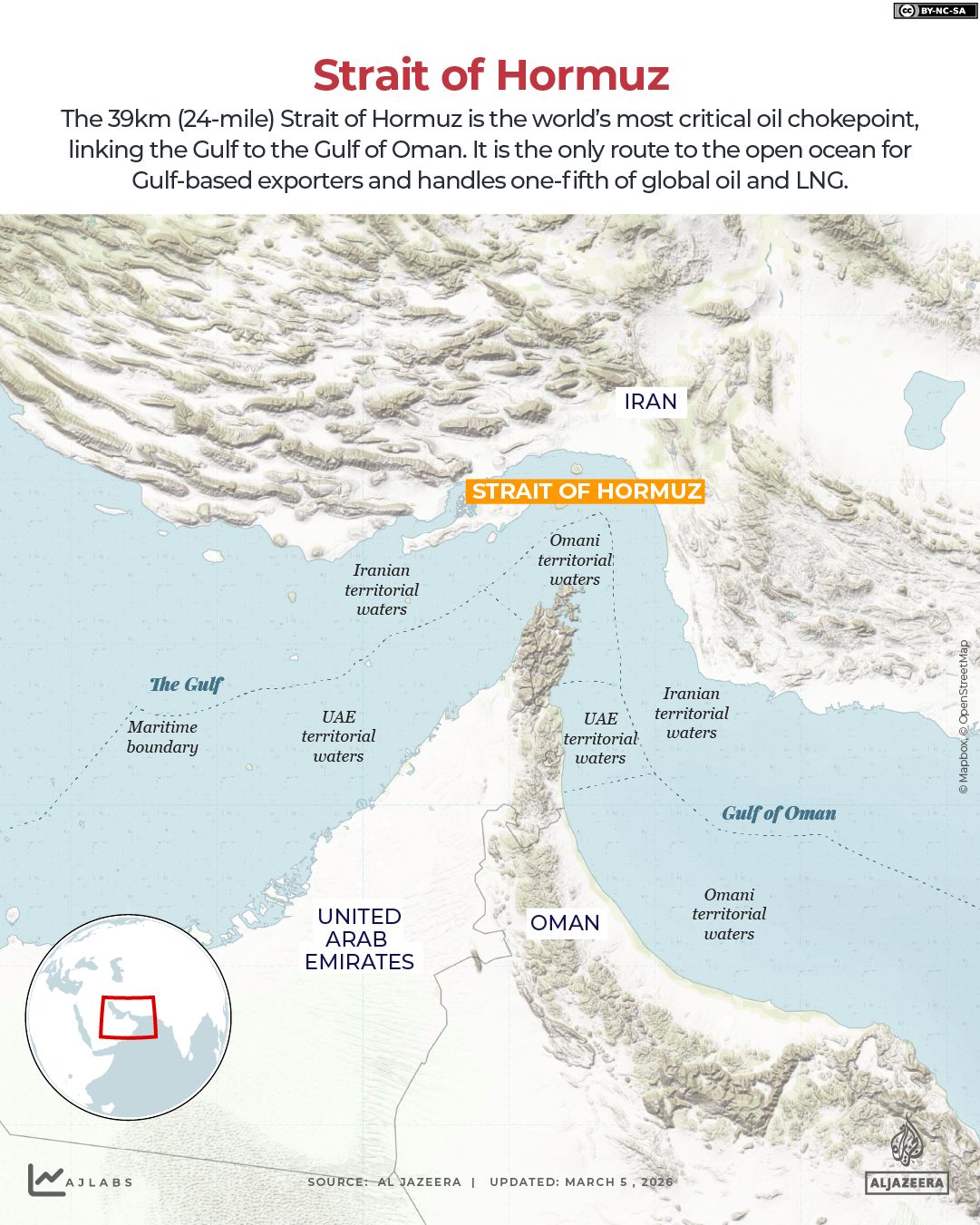
About 20 percent of the world’s oil comes from the Gulf region, and most of it is shipped on massive tankers through the Strait of Hormuz. This narrow waterway, located between Iran and Oman, is only 21 nautical miles (39km) wide at its narrowest point.

More than 20 million barrels transit through the strait per day, which is one-fifth of global petroleum consumption and accounts for one-quarter of all oil traded by sea.

According to the US Energy Information Administration (EIA), more than three-quarters of the world’s oil supply (79.8 million barrels per day) travels by sea, funnelled through a handful of critical chokepoints with no easy transit alternatives.

Why are oil prices surging?

Since the Iran war began, marine traffic through the Strait of Hormuz has nearly ground to a halt. Attacks on vessels and interference with navigation equipment have pushed most operators to anchor their ships at the waterway’s edge rather than risk the crossing.

Without the flow of this oil, global supply chains are severely disrupted. With a limited supply and rising demand, prices are likely to increase, putting pressure on consumers and businesses.

While prices briefly dipped on Monday after US President Donald Trump said, “The war is very complete, pretty much,” analysts warned that high prices could persist if no agreement is reached between Washington, Tel Aviv and Tehran to stop the war.

“It’s all about risk,” Ismayil Jabiyev, supply chain analyst at CarbonChain, told Al Jazeera.

“Think about the Strait of Hormuz and cheap drones. It’s not a physical blockage – Iran hasn’t built a wall across the sea. Cheap drones will always pose a risk, even if all the launch sites are destroyed because hidden drone launches could continue for months. As long as hostilities continue, the disruption is likely to persist. I don’t see any real progress or resolution on the horizon,” Jabiyev added.

Which countries rely most on Middle Eastern oil?

About 89 percent of the oil that flows through the Strait of Hormuz is bound for Asian markets with China, India, Japan and South Korea the top buyers.

If traffic remains restricted, Gulf exporters will be forced to seek alternative routes, but options are limited with Saudi Aramco’s East-West Crude Oil Pipeline and the United Arab Emirates’s Abu Dhabi Crude Oil Pipeline (Habshan-Fujairah pipeline) offering a capacity of about 4.7 million barrels per day (bpd).

The Saudi pipeline runs from eastern oilfields to the port of Yanbu on the Red Sea, one of the few arteries that bypasses the strait entirely. However, of the 7.2 million bpd that Saudi Arabia exported in February, 6.38 million bpd relied on passage through the strait, according to Kpler, a global trade data and analytics firm.

Gavekal Research, an independent macroeconomic research firm, estimated that Gulf exporters, including Iran, could reroute at most an additional 3.5 million bpd to terminals outside the strait. But as long as the bulk of tanker traffic remains suspended, the world would still be facing a sudden supply shortfall of about 15 million bpd.

“I’m somewhat sceptical about those alternatives. Yes, the East-West pipeline and the Fujairah pipeline exist, but capacity-wise, they don’t come close to the main route.” Jabiyev told Al Jazeera.

“There’s also the Kirkuk-Ceyhan pipeline from Iraq’s northern provinces to Turkiye, but that’s limited to northern field production. The major Iraqi output comes from the southern fields, so again, it’s a partial replacement, not a full one.”

What is the highest oil price ever recorded?

Oil prices rose to their highest levels during the global financial crisis. On July 11, 2008, Brent crude, the European benchmark, hit $147.50 per barrel while West Texas intermediate crude, the US benchmark, hit a peak of $147.27. That spike was driven by a mix of a weakening US dollar and a massive influx of speculative money rather than a physical disruption to supply.

Throughout history, there have been a handful of energy market shocks when oil supplies were actually threatened, most notably the 1973 oil embargo, the Iran-Iraq War in the 1980s, the 1990-1991 Gulf War, the 2003 US-led invasion of Iraq and the 2022 Russian invasion of Ukraine.

INTERACTIVE - Oil soars past $100 a barrel - March 9 , 2025-1773125106
(Al Jazeera)

“I think the Gulf War of 1990-91 is the most instructive comparison. Iraq and Kuwait together represented two major producers, and the disruption was serious and prolonged – lasting roughly half a year or more, even though the military phase was fairly brief,” Jabiyev told Al Jazeera.

“The world experienced high crude oil prices for an extended period and eventually faced some economic slowdown as a result. That makes it most analogous to our current situation: a likely long-term disruption, sustained high prices and a meaningful risk of economic slowdown. The key variable, as in 1990, was how quickly the affected countries could restore their production infrastructure and bring supply back online.”

How does crude oil become petrol?

Crude oil is a yellowish-black fossil fuel pumped from the ground and refined into fuels like petrol, diesel and jet fuel. The refining process also produces numerous household items.

Oil is graded by thickness and sulphur content. Light, sweet crude is low in sulphur and easy to refine and thus more valuable. After extraction, crude oil is sent to refineries where heat separates it into products. Lighter fuels form at lower temperatures while heavier products, such as asphalt, require much higher heat.

A barrel contains 159 litres, or 42 gallons, of crude oil. Once refined, a barrel typically produces about 73 litres, or 19.35 gallons, of petrol to power cars and trucks.

INTERACTIVE-CRUDE OIL-USED-MARCH 9-2026 copy-1773138978
(Al Jazeera)

What products are made from oil and gas?

Oil and gas are used for far more than just fuel. They are raw materials for thousands of everyday products.

Plastics, including water bottles, food packaging, phone casings and medical syringes, are all derived from crude oil.

Crude oil is also the hidden ingredient in synthetic fabrics, such as polyester, nylon and acrylic, which is in everything from sportswear to carpets. It also underpins the cosmetics industry in products that include petroleum jelly, lipsticks and concealers.

Household items also rely on oil-based ingredients with laundry detergents, dishwashing liquids and paints all derived from petroleum products.

The global food supply is essentially built on natural gas in the form of fertilisers, used to enhance crop yields and ensure that food production can meet demand.

INTERACTIVE-CRUDE OIL-USED-MARCH 9-2026-1773138980
(Al Jazeera)

How high oil costs drive up the price of food

Oil prices and food prices move in lockstep with energy prices affecting every stage of the food supply chain from the fertilisers used in the fields to the trucks that carry food from the fields to supermarket shelves.

Rising oil prices directly affect shipping and the cost of transportation.

“The lifeblood of the global economy is transport,” economist David McWilliams told Al Jazeera. “It’s getting stuff from A to B. It’s a logistics problem, a supply chain problem, and ultimately, transportation is the energy of the global economy.”

Fears of stagflation – rising inflation and rising unemployment, which major oil shocks have historically summoned – are rising. Economists pointed to the crises of 1973, 1978 and 2008 as evidence that every significant spike in oil prices has been followed, in some form, by a global recession.

In lower-income countries, where populations spend a far greater share of their income on food and import large quantities of grain and fertiliser, rising oil prices could rapidly translate into food shortages.

Could Trump ‘take over’ the Strait of Hormuz as oil prices rise?

United States President Donald Trump has said he is “thinking about taking over” the Strait of Hormuz so that it remains open. The strait links the Gulf to the Gulf of Oman. It is the only route to the open ocean for oil producers in the Gulf.

The war in Iran entered its 11th day on Tuesday, as attacks continue on Iran as well as on Israel and US assets in the Middle East, including in Bahrain, Kuwait, the United Arab Emirates and Saudi Arabia.

The war has sent oil prices soaring. As well as attacking US military assets and infrastructure in Middle East countries in retaliation against the US-Israeli campaign, Iran has threatened to attack ships traversing through the Strait of Hormuz, putting the route at severe risk for about one-fifth of the world’s oil supply.

Why has the price of oil soared?

One major reason is the closure of the Strait of Hormuz.

Ebrahim Jabari, a senior adviser to the commander-in-chief of Iran’s Revolutionary Guard Corps (IRGC), said on March 2: “The strait is closed. If anyone tries to pass, the heroes of the Revolutionary Guard and the regular navy will set those ships ablaze.

“We will also attack oil pipelines and will not allow a single drop of oil to leave the region. Oil price will reach $200 in the coming days,” Jabari wrote in a post on the IRGC’s Telegram channel.

As a result, oil prices had shot up by more than 30 percent by Sunday, when the international benchmark Brent crude at one point topped $119 a barrel. The price of crude has since seen a decline, but remains above the price it was before the war began on February 28. On Tuesday, it was hovering around $93 a barrel.

Placing further pressure on fuel prices, Qatar’s state-run energy firm and the world’s largest producer of LNG, QatarEnergy, halted LNG production last week following Iranian attacks on its operational facilities in Ras Laffan and Mesaieed in Qatar.

Saudi Arabia shut down operations at the Ras Tanura plant, its largest domestic oil refinery, which is operated by Saudi Aramco, after a fire broke out at the facility, which officials said was caused by debris from the interception of two Iranian drones.

Iranian officials have publicly denied attacking QatarEnergy or Aramco.

The volatility in energy markets caused by the war on Iran will worsen over time, members of the industry have warned.

“There would be catastrophic consequences for the world’s oil markets, and the longer the disruption goes on, the more drastic the consequences for the global economy,” Aramco CEO Amin Nasser told reporters on Tuesday.

INTERACTIVE - Strait of Hormuz - March 2, 2026-1772714221
(Al Jazeera)

What has Trump said about the Strait of Hormuz?

During an interview with CBS News on Monday, Trump said he was “thinking about taking over” the Strait of Hormuz to ensure it remains open.

Trump also threatened to increase attacks on Iran if it disrupts the flow of oil in the Hormuz Strait.

“If Iran does anything that stops the flow of Oil within the Strait of Hormuz, they will be hit by the United States of America TWENTY TIMES HARDER than they have been hit thus far,” Trump said during a news conference in Florida on Monday.

“I will not allow a terrorist regime to hold the world hostage and attempt to stop the globe’s oil supply. And if Iran does anything to do that, they’ll get hit at a much, much harder level.”

Trump also said he expects the war to be over in a short amount of time.

Earlier on Monday, Trump told Republicans at his golf club in Doral, Florida: “We took a little excursion because we felt we had to do that to get rid of some people. We’ve already won in many ways, but we haven’t won enough.”

Earlier, Trump said that the war, which began on February 28, could last “four to five weeks” and that the US military had the “capability to go far longer than that”.

Can the US occupy the Strait of Hormuz?

During his CBS interview, Trump did not explain what the US plans for “taking over” the Strait would be. Technically, the US cannot “occupy” the strait, however.

Alexander Freeman, a partner in the shipping team at UK-based law firm Hill Dickinson, said: “The United States has no jurisdiction over the Strait of Hormuz, which are not international waters under UNCLOS [the United Nations Convention on the Law of the Sea]. Without the consent of Iran and Oman – whose sovereign territorial waters cover the Strait – the US taking over the Strait would likely amount to an incursion on Iran and Oman’s jurisdiction – even where it is aimed to protect the safe passage of vessels.”

In the absence of a ceasefire and the reopening of the strait, however, it is possible that ships could be escorted through the strait by US or international navies.

During an interview last week, Trump said the US Navy would escort ships in the waterway “if necessary… as soon as possible”.

In Florida, on Monday, Trump reiterated this, saying: “We’ll perhaps go alongside them for protection.”

Speaking in Cyprus on Monday, French President Emmanuel Macron said France and its allies are also preparing a “purely defensive” mission to escort vessels through the Strait of Hormuz once the “most intense phase” of the US-Israeli war on Iran ends.

Macron did not provide further details, but he said the “purely escort mission” must be prepared by both European and non-European countries.

How has Iran responded, and what is its strategy?

Iranian leaders have not shown any signs of backing down over the war or the closure of the Strait of Hormuz.

The country’s Foreign Minister Abbas Araghchi said on Tuesday that Iran would keep fighting for as long as necessary.

In an interview with CNN, Kamal Kharazi, foreign policy adviser to the office of the supreme leader, ruled out diplomacy and said the war would continue.

“I don’t see any room for diplomacy any more. Because Donald Trump had been deceiving others and not keeping with his promises, and we experienced this in two times of negotiations – that while we were engaged in negotiation, they struck us,” Kharazi said.

He suggested that Gulf and other countries need to place economic pressure on the US and Israel to end the war in Iran for diplomacy to be back on the table.

Rob Geist Pinfold, a lecturer in international security at King’s College London, told Al Jazeera that Iran has been engaging in a “completely different approach to war fighting” than in the past, when it seemed to opt for slow and steady escalation.

Pinfold said Iran’s claim that it is attacking only US assets in the Gulf “has to be taken with far more than a pinch of salt”. Iran’s targets are primarily large-scale infrastructure and civilian ones, he added.

“What they’re doing now is trying to unleash as much chaos as possible to destabilise the region and global markets, hurt the economy, hurt the GCC states, in order that the US will at some point decide that this conflict is no longer worth its while any more and will push for a ceasefire.”

What could happen next?

Scott Lucas, a professor of US and international politics at University College Dublin, told Al Jazeera that if the domestic situation worsens for Trump, there may be an opening for the Gulf states to ask for a pullback.

Lucas added that this would be “especially true” if there is another surge in the price of oil in the coming days.