US Representative Ilhan Omar of Minnesota was sprayed with an unknown substance by an assailant during a public meeting in Minneapolis, where she called for immigration agency ICE to be abolished. She was unharmed, and police arrested the man on third-degree assault charges.
Madrid, Spain – After losing his left arm in a farming accident, Joel Caceda struggles to work delivering packages.
His tough job is typical of many that migrants are forced to take when they arrive in Spain without any legal papers.
Recommended Stories
list of 4 itemsend of list
So, the 30-year-old Peruvian welcomed the news that Spain plans to regularise about 500,000 undocumented migrants, in a break with harsh policies on immigration elsewhere in Europe, in countries like Denmark, Germany and Austria, and in the United States.
“This is good for me and many others. It will mean the chance to become legal after six years working here without any official papers,” he told Al Jazeera from his home in Barcelona.
“It will give me the chance to get a flat with my partner and her daughter and live a better life.”
His story is typical of tens of thousands of migrants who work in what is known as the “black economy” in Spain, where they fight bureaucracy for years to win legal status.
An African migrant sits on top of a border fence covered in razor wire between Morocco and Spain’s north African enclave of Melilla, during a latest attempt to cross into Spanish territory [File: Jesus Blasco de Avellaneda/Reuters]
Spanish Migration Minister Elma Saiz told a news conference on Tuesday that the beneficiaries would be able to work “in any sector, in any part of the country” and pointed to “the positive impact” of migration.
“We are talking about estimations, probably more or less the figures may be around half a million people,” she added, saying the government was “recognising” and giving dignity to people already in Spain.
Socialist Prime Minister Pedro Sanchez has said Spain needs migration to fill workforce gaps and counteract an ageing population that puts a strain on pensions and the welfare state.
Laetitia Van der Vennet, of the Platform for Undocumented Immigrants, an NGO, said the Spanish policy was a welcome contrast to the anti-migrant wave in Europe and the US.
“At a time when a hostile environment against migrants is spreading on both sides of the Atlantic, this move shows both humanity and common sense,” she said.
‘Good for whole society’
Ousman Umar knows only too well the struggle of countless migrants who head to Spain hoping to forge a new life in Europe.
The son of a witch doctor from Ghana, he spent five years trying to reach the “promised land” of Europe after leaving his remote village in the west African country.
At one stage, he was abandoned by smugglers in the Sahara and thought he would die. He only survived by drinking his urine.
After making it to Spain, he lived on the streets before he was adopted by a family. He attended one of the top business schools in Europe and founded NASCO Feeding Minds, an NGO which gives children in Ghana the chance to choose their own future by providing training and computers.
“This is not only going to be good for migrants but the whole society. It will mean that these people can start working legally, pay taxes and social security,” Umar told Al Jazeera.
“This will mean that all these people pay into the pension system in a country where the birthrate is low and there is a growing number of older people.”
Lamine Sar, who arrived in Spain from Senegal 18 years ago, works with the Top Manta fashion label, which celebrates the work many migrants are forced to do, selling fake football shirts or handbags on sheets – known as mantas – in the streets.
“This is a huge step forward, not just for migrants in Spain but for everyone. It will mean these people contribute to society instead of being used in a kind of slavery in the black economy,” he told Al Jazeera.
The measure will apply to those living in Spain for at least five months and who had applied for international protection before December 31, 2025.
The regularisation will also include children of the applicants who already live in Spain. Applications start in April and run until June.
Spain’s government passed a decree that will not need to be passed in parliament, where the Socialist-led coalition lacks a majority and might have met with staunch opposition from the opposition conservative People’s Party and the far-right Vox party.
“The invasion kills. The arrival of half a million migrants will be a call to another half million migrants and put under strain on our health system, social security and security,” wrote Santiago Abascal, leader of Vox, in a message posted online.
Sanaa, Yemen — Until a few years ago, Mehdi Galeb Nasr earned a living pushing an ice cream cart through the streets of the Yemeni capital, Sanaa, moving between neighbourhoods to support his family.
His livelihood became impossible after his eyesight began to deteriorate rapidly. “Selling ice cream was my main source of income,” Nasr told Al Jazeera. “I pushed my cart, selling ice cream to children across the capital. Blindness in one of my eyes began to take its toll on me.”
Recommended Stories
list of 4 itemsend of list
As his vision worsened, he would get lost and was unable to find his way at night. “I couldn’t see. Sometimes I had to sleep outside until the sun came up so I could see my way home.”
Now 52, Nasr lives with his wife and five daughters in Sanaa. With no steady employment and limited options due to a catastrophic humanitarian crisis in one of the world’s most impoverished and conflict-ridden nations, he has no choice but to find other ways to make ends meet.
His plight, and worse, is shared by many in Yemen.
The country is entering a perilous new phase of food shortages with more than half the population – about 18 million people – expected to face worsening hunger in early 2026, according to the International Rescue Committee (IRC).
The warning follows new projections under the Integrated Food Security Phase Classification hunger-monitoring system that were released earlier this month and show an additional million people at risk of life-threatening hunger.
It also comes as Yemen is experiencing its latest internal conflict with external regional actors involved in fighting in the nation’s south. Years of war and mass displacement have shattered livelihoods and limited access to basic health and nutrition services. Declining humanitarian funding, unpaid salaries, inflation and international sanctions on Yemen have exacerbated the crisis.
Yemen has been a source of heightened tensions in recent months between Saudi Arabia and the United Arab Emirates.
The main southern Yemeni separatist group, the Southern Transitional Council (STC) – which Saudi Arabia says is backed by the UAE – gained control of areas across southern and eastern Yemen in December, advancing to within reach of the Saudi border, which the kingdom considered a threat to its national security, prompting it to carry out air strikes there.
Saudi-backed fighters in Yemen have since largely retaken those areas.
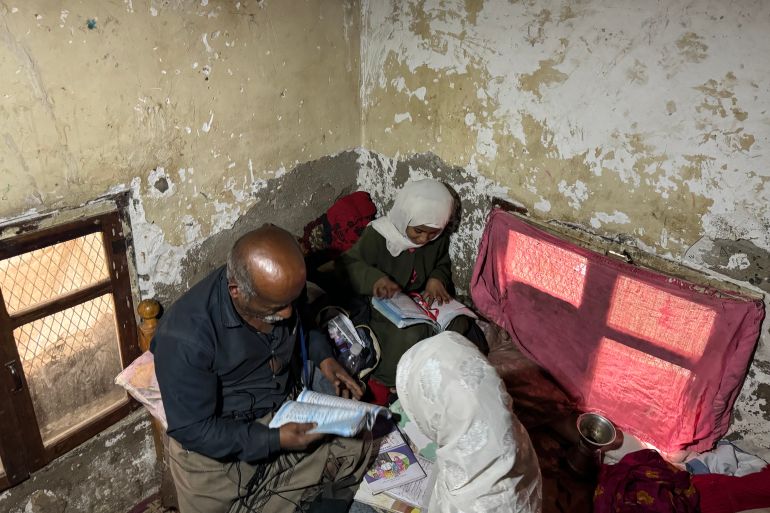
Mehdi Galeb sits with his family in the Yemeni capital, Sanaa, who often go to bed hungry, amid the country’s alarming food shortage crisis on January 27, 2026 [Yousef Mawry/Al Jazeera]
Going to bed hungry
Nasr now collects plastic bottles in the streets where he once sold ice cream. His wife and children accompany him so he does not get lost.
His work now is a last resort of informal labour that brings in a small amount of money, barely enough to cover a basic meal for a family of seven. On the day he spoke to Al Jazeera, Nasr said he earned just 600 Yemeni riyals — a little more than $1. “It’s not enough to cover what we need to eat for dinner before we go to bed,” Mehdi added.
Despite this, such work has become the only option for many Yemenis these days, as they struggle to ensure a daily food supply.
For Nasr and his family, putting food on the table has become a daily struggle. “Currently, we do not even have gas to cook anything,” he said.
“When we have gas, the only thing we can afford to cook is rice.” Even that is not always possible.
“Last night, me, my wife and five daughters went to bed without eating dinner,” he added.
Nasr links his family’s dire situation to the wider conflict and economic collapse that have shaped life in Yemen.
“Due to the foreign aggression against us that began back in 2015, life became more difficult for all Yemenis,” he said.
Informal work, reducing meals, and enduring nights without food will continue to be the reality for half the population.
New Delhi, India — Just moments before, they were both navigating the busiest traffic hours at an intersection in Noida, a satellite city of Delhi, delivering groceries at the doorstep. The next thing he knew, Himanshu Pal, 21, stood there, helpless, looking over the body of his colleague, rammed by a car.
His friend, Ankush, was “just 18, and just out of high school,” Pal told Al Jazeera. It was Ankush’s first day in a metropolitan city, after he came from his village in eastern Bihar, more than 1,000km (600 miles) away; he rented a cheap electric bike and signed up with Swiggy, one of India’s quick commerce giants.
Ankush packed his first order and tried to figure out how to reach the location – mandatorily within 10 minutes – when Pal held his hand and showed him the way around the app. “He was trying his best: looking at the phone, then on the road, a customer calling back; then on the phone, a traffic light, and then on the road again,” Pal recalled, from October last year.
“That was all. A car hit and left him dead at the signal.” Pal and his colleagues crowdfunded for an ambulance to take the body back to his village.
Quick delivery, quick death
India’s rapid delivery services are a marvel to the rest of the world, competing to deliver everything from food to groceries and medicines to cigarettes to the country’s 430 million-strong middle class. Swiggy, where Ankush worked, and Zomato have been the dominant quick commerce platforms for more than a decade. But others have joined, too, including Zepto and Flipkart Minutes. In December 2024, Amazon entered the market with a 15-minute delivery service called Tez — which means “fast” in Hindi and Urdu.
As competition tightened, some, like Zomato’s Blinkit service, explicitly promised 10-minute deliveries, while others like Swiggy’s Instamart tried to get riders to deliver in most cases in about 10 minutes.
[Screen grab]
But for riders trying to beat traffic-congested and potholed roads in India’s metropolises, these top-down delivery deadlines have often served as a death trap. Riders and unions have repeatedly pointed out road accidents that often lead to deaths but are not reported as workplace fatalities. And the dangers extend well beyond crashes. Workers ride long hours outdoors in extreme heat, alongside deadly exposure to toxic air in cities like Delhi and Bengaluru. Payouts are influenced by a star-based rating system, which means that riders can’t push back against misbehaving customers.
In early January, the Indian government intervened and asked all quick commerce platforms to stop promising “10-minute deliveries” after a nationwide strike by the gig workers over dangerous working conditions.
But experts and workers toiling within India’s mammoth quick commerce engine say that the reality remains largely unchanged — the intense competition for speedy deliveries means that with or without a formal 10-minute promise, riders are under pressure to do whatever it takes to get packages to customers as fast as possible.
“The Indian middle class is literally riding on the back of the poor,” said Vandana Vasudevan, the author of OTP Please!, a 2025 book on the lives of gig workers. “They sit at home, and are extremely pampered by this rather innovative tech model,” she told Al Jazeera, “but all these privileges are coming at the cost of workers.”
Delivery workers of Zomato, an Indian food-delivery startup, check their phones as they wait to collect orders outside a restaurant in Kolkata, India, on July 13, 2021 [Rupak De Chowduri/Reuters]
Rise of 10-minute delivery
After the COVID-19 pandemic, which paved the path for digitising grocery services in India, quick commerce platforms have leveraged small “dark stores” — a warehouse exclusively meant to store goods for online shopping — in neighbourhoods to deliver thousands of products, from groceries and skincare to the latest iPhone.
As companies like Walmart’s Flipkart, Swiggy, or IPO-bound Zepto raced for even faster deliveries, they also redefined how urban India bought into the psychological appeal of instant gratification. Where many Indians previously planned and purchased, a study last year found that quick commerce had turned several of them into more impulsive buyers.
India’s gig economy, a $11.5bn market, has been ballooning: gig workers are projected to rise from 7.7 million in 2021 to 23.5 million by 2030, according to Niti Aayog, a government think tank.
In the last financial year, quick commerce platforms had a record-high year, with gross orders worth $7bn, more than double the previous year. The sector has been an investment darling, recording a staggering 142 percent compound annual growth rate from 2022.
But driving this apparent success story are two darker demographic factors, say experts. Middle-class neighbourhoods in Indian cities, while crammed together, are often segregated communities, making it easier for companies to rent a cheap warehouse near a posh locality. Meanwhile, the gap between the rich and the poor has reached a historic high, visible in everything from stagnant wages to the concentration of vast wealth. This allows companies to keep hundreds of riders idle, at every single store, waiting in line to pick the next order and race to deliver, without providing social security or minimum wages.
After the direction from officials of India’s labour ministry, quick commerce companies appear to have replaced the marketing promise of instant delivery within 10 minutes with other features like the availability of products.
But experts say that won’t change much – for the companies, or their workers.
The removal of the 10-minute delivery catchline is largely “optics-driven rather than business-altering,” Karan Taurani, executive vice president at securities firm Elara Capital, told Al Jazeera, adding that the proposition of quick commerce continues to be anchored in speed and convenience that remains structurally superior to horizontal e-commerce timelines.
A week after the government direction, platforms were often still showing a delivery time of less than 10 minutes, when Al Jazeera checked in three different cities in the national capital region, which also includes New Delhi.
A bird flies over a hoarding featuring an advertisement of the SoftBank-funded Blinkit, an Indian company which is offering 10-minute deliveries for groceries, in New Delhi, India, on January 20, 2022 [Anushree Fadnavis/Reuters]
‘The inherent design problem’
Quick commerce companies maintain that the new direction would have no material impact on their business model.
Delivery riders agree.
“We deliver groceries to doorsteps, keeping our lives on [the] line every single time,” said Pal, waiting outside a dark store near a wealthy neighbourhood in Noida, just outside New Delhi, for his next order. “This instant delivery idea is so rubbish; what could one possibly need within 10 minutes?”
The riders say the problem is inherent in the design. “The system works on simple maths for us: the more orders you deliver, the more you earn,” added Pankaj Kumar, another delivery rider, hovering over Pal’s shoulder.
“If we want to earn money on these platforms, we need to ride faster – all the while, flying my bike on the wrong side [of the road] and jumping signals,” Kumar said.
However, Vasudevan, the author, said that “the government’s intervention is a welcome step that has come as a relief to some workers.”
“The 10-minute problem comes with customer expectations; once you do away with the promise, the act of speed becomes at least voluntary,” she said.
“The architecture of a faster delivery is not a wrong thing in itself,” argued Vasudevan. “But a tight deadline is an architectural imposition on the riders that became the norm, unfortunately.”
And India’s quick commerce model has little regard for its workers’ welfare, Vasudevan added.
The Indian government is also introducing new labour laws that formally recognise gig workers for the first time, propose social security benefits, including pensions and accident insurance, and plans to establish a social security fund, partly funded by companies.
But for now, those plans exist just on paper – and workers say that they learned that there’s only one way for them to be heard: through collective action.
Swiggy gig workers assist another worker as he parks an electric three-wheeler delivery scooter during a promotional event in Mumbai, India, on October 14, 2024 [Francis Mascarenhas/Reuters]
You snooze, you lose
In the face of worsening working conditions and fluctuating wages, several workers’ groups coordinated a strike on New Year’s Eve.
Shaik Salauddin, national general secretary of the Indian Federation of App-Based Transport Workers (IFAT) that led the stoppage, told Al Jazeera that their demands from the platform companies were met with “corporate flexing power muscles, from PR games to intimidating riders”.
Salauddin, who is also part of a committee interacting with the Indian government on regulations, said that the demands included making companies’ algorithms, which dictate payouts, transparent and reliable. The workers are also asking for an end to “arbitrary blocking of workers’ IDs” and the right to organise protests.
Delivery riders say platforms use automated algorithms to deactivate a worker’s account, essentially firing them without notice, for a range of reasons, including lower ratings, frequent order cancellations, or customer complaints. The riders involved in protests have also faced police investigations in some cases.
In a statement on the strike, which sparked a fierce debate in the country on workers’ working conditions, one of the quick commerce leaders, Deepinder Goyal, who until recently headed Eternal, Zomato’s parent company, called the complaining workers “miscreants” who caused law and order problems.
The government appeared to disagree.
Welcoming the government’s intervention, Salauddin said, “Our collective voice reached the CEOs and the government; it is a win for those unionising.
“Thousands of riders logged off during peak hours in a protest for the right to life and dignity at the workplace,” said Salauddin.
But, “if the companies cheat us, then we will not sit silently,” he said, referring to the issue that the platforms are still delivering orders within 10 minutes after the government’s intervention.
Kumar, the delivery rider in Noida, said none of the riders were informed of any change by the platforms.
After the government intervention, Kumar said, the onus of riding quickly lies with them, now.
He fractured his right shoulder while delivering an order last year. Kumar said he was not provided with financial assistance in his treatment. Three days later, with a plaster on, he returned to the store, willing to ride with one hand. The manager had no problem, he said.
“If we lose a streak – of say hours in a day, days in a week – then we lose incentives,” said Kumar, standing dejected outside the dark store.
“What are we for the company? Just robots on bikes, delivering orders,” he added. “What’s for them to lose if one bike goes off the street?”
A delivery worker of Zomato, an Indian food-delivery startup, rides her bicycle along a road in Kolkata, India, on July 13, 2021 [Rupak De Chowduri/Reuters]
A plane crash has killed the deputy chief minister of India’s Maharashtra state, Ajit Pawar, the country’s aviation regulator has said.
The plane, which took off from Mumbai on Wednesday, crash-landed at the airport in Pawar’s constituency of Baramati, according to the Directorate General of Civil Aviation.
Two members of the prominent politician’s staff and two crew were also reported to have been killed.
The cause of the crash has not yet been officially confirmed.
FlightRadar, an online flight tracking service, said the aircraft was attempting a second approach to Baramati Airport when it crashed.
The Times of India quoted aviation regulator officials as saying the aircraft, a Learjet 45 operated by a company called VSR, crashed at about 8:45am local time (03:15 GMT).
The newspaper said Pawar, the nephew of veteran politician Sharad Pawar, who founded the Nationalist Congress Party (NCP), was on his way to attend a public rally for the Zilla Parishad elections.
A witness quoted by the newspaper said the aircraft exploded moments after hitting the ground.
“When we rushed to the spot, the aircraft was on fire. There were four to five more explosions. People tried to pull the passengers out, but the fire was too intense,” said the witness.
Prime Minister Narendra Modi said on X that Pawar’s “untimely demise” was “very shocking and saddening”.
He was “widely respected as a hardworking personality”, the prime minister said.
“He had profound knowledge of administrative matters. His passion for the empowerment of the poor and the deprived was particularly noteworthy.”
Elena Rybakina and Jessica Pegula will clash in the semifinals of the Australian Open after knocking out pre-tournament favourites Iga Swiatek and Amanda Anisimova, respectively.
Reigning Wimbledon champion and second-seeded Swiatek, who was seeking a career Grand Slam with a win at Melbourne Park, was stunned by Rybakina in straight sets on Wednesday.
Recommended Stories
list of 3 itemsend of list
The 7-5, 6-2 win for the 2022 Wimbledon champion gives her a chance to win her second Grand Slam, while crushing Swiatek’s dreams of lifting the one Slam trophy that has eluded her despite six major titles.
Rybakina has made the Melbourne final once before, in 2023, when she lost in three tough sets to Aryna Sabalenka.
The 26-year-old fifth seed took her latest victory in her stride, saying a calmer mindset helped in the heat of battle.
“In the beginning, when it’s the first final and you go so far in a tournament, of course you are more emotional,” said Rybakina.
“Now I feel like I’m just doing my job, trying to improve each day. So it’s kind of another day, another match.”
Rybakina fired 11 aces and 26 winners at Rod Laver Arena, winning eight of the last nine games to underline her authority.
“Really pleased with the win,” said Rybakina. “We know each other pretty well and I was just trying to stay aggressive.”
Swiatek struggled with her serve throughout the contest, and the world number two said that was something she needed to improve on in the coming months.
“I didn’t serve as well as in Cincinnati, for example, against Elena. My serve was kind of normal and sometimes it could have given me a bit more,” Swiatek told reporters.
“There’s some stuff on the serve that I want to change and I already changed that in the preseason. But then matches come and you don’t have that much time to think about this.
“You don’t want to think about these details when you play. So then it comes back to the old patterns… There’s some stuff that I can change to play better, and I’ll try to do that.”
Iga Swiatek’s bid for a career Grand Slam is over for another year [Izhar Khan/AFP]
Pegula revels in ‘awesome win’ over Anisimova
Meanwhile, Pegula – fresh off her win over last year’s champion Madison Keys – emerged victorious in an all-American quarterfinal against Anisimova with a 6-2, 7-6 (7-1) scoreline.
Pegula is yet to drop a set this year in Melbourne and is arrowing in on her first major crown at the age of 31.
“It’s awesome,” Pegula said of reaching her first Australian Open semifinal.
“I’ve been able to go deeper in the US Open in the last couple of years, but here was the first Slam that I broke through at.
“I feel like I play some good tennis here, I like the conditions and even matches I’ve lost here I’ve played well in, so I’ve been waiting for the time when I could break through.”
The sixth seed was helped by an error-riddled display from fourth seed Anisimova, who racked up 44 unforced errors to Pegula’s 21.
Anisimova’s frustrations boiled over at the end as her hopes of reaching a third major title in a row melted away in a blur of mistakes.
Sixth seed Pegula and Rybakina have shared three wins each in their six matches so far.
Two-time champion Sabalenka faces Ukrainian 12th seed Elina Svitolina in the other semifinal.
Amanda Anisimova was left frustrated after committing a flurry of errors [Izhar Khan/AFP]