Why has Burkina Faso banned political parties, and what’s next?

After several years of suspension, political parties in Burkina Faso have been formally dissolved by the military government, which has also seized all their assets in a move analysts say is a major blow for democracy in the West African nation.

In a decree issued on Thursday, the government, led by Captain Ibrahim Traore, scrapped all laws which established and regulated political parties, accusing them of failing to comply with guidelines.

Recommended Stories

list of 4 itemsend of list

The troubled West African nation is struggling with violence from armed groups linked to ISIL (ISIS) and al-Qaeda. It is one of a growing number of West and Central African nations to have undergone coups in recent years.

Traore seized power in September 2022, eight months after an earlier military coup had already overthrown the democratically elected President Roch Marc Kabore.

Despite strong criticism by rights groups and opposition politicians of his authoritarian approach, 37-year-old Traore has successfully built up an online cult-like following among pan-Africanists, with many likening him to the late Burkinabe revolutionary leader, Thomas Sankara.

Traore’s anti-colonial and anti-imperial pronouncements are often shown in high-definition, AI-generated videos that have gained him widespread admiration across the internet.

But the decision to ban political parties does not sit well for democracy, Dakar-based analyst Beverly Ochieng of the Control Risks intelligence firm, told Al Jazeera.

“The military government will [remain] highly influential, especially after a recent decree appointing Traore in a supervisory capacity in the judiciary,” Ochieng said, referring to a December 2023 constitutional change which placed courts directly under government control.

Going forward, “there will be very limited division of powers or autonomy across the civic and political space,” Ochieng said, adding that the military government will likely keep extending its stay in power.

Ouaga
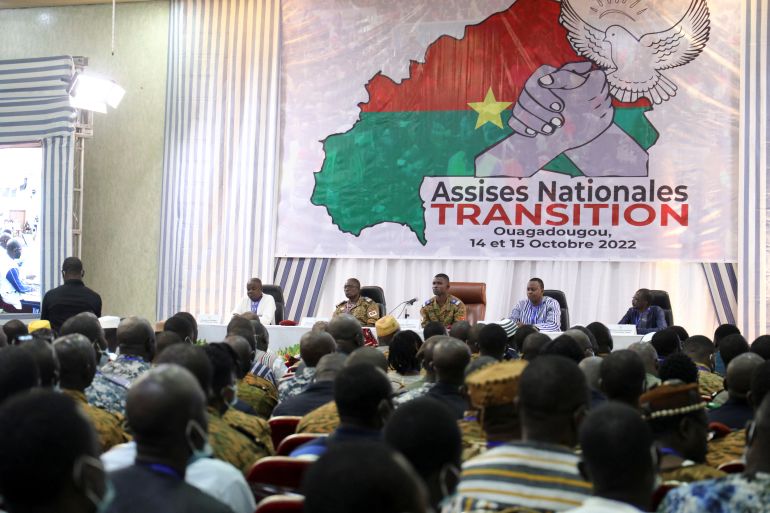
People attend the beginning of two days of national talks to adopt a transitional charter and designate an interim president to lead the country after September’s coup in Ouagadougou, Burkina Faso, on October 14, 2022 [Vincent Bado/Reuters]

Why have political parties been banned?

The Burkinabe government claims the existing political parties were not following the codes which established them.

In a televised statement following a Council of Ministers meeting on Thursday, when the new decree was approved, Interior Minister Emile Zerbo said the decision was part of a broader effort to “rebuild the state” after alleged widespread abuses and dysfunction in the country’s multiparty system.

A government review, he said, had found that the multiplication of political parties had fuelled divisions and weakened social cohesion in the country.

“The government believes that the proliferation of political parties has led to excesses, fostering division among citizens and weakening the social fabric,” Zerbo said.

He did not give details of the political parties’ alleged excesses.

How did political parties operate in the past?

Before the 2022 coup, which brought the current military leadership to power, Burkina Faso had more than 100 registered political parties, with 15 represented in parliament after the 2020 general elections.

The largest was the ruling People’s Movement for Progress (MPP), which had 56 of 127 seats in parliament. It was followed by the Congress for Democracy and Progress, with 20 seats, and the New Era for Democracy with 13 seats.

But the civilian government faced months of protests as thousands took to the streets to demonstrate against growing insecurity from armed groups in large parts of the country.

In 2022, Traore took power, promising to put an end to violence by armed groups. He also promised the regional Economic Community of West African States (ECOWAS) bloc that his government would hold elections by 2024.

But political parties were banned from holding rallies after the 2022 coup and, a month before the 2024 deadline, Traore’s government postponed elections to 2029 after holding a national conference, which was boycotted by several political parties.

Burkina Faso, along with Mali and Niger, withdrew from ECOWAS to form the Alliance of Sahel States, a new economic and military alliance in January last year. They also withdrew from the International Criminal Court (ICC).

In July 2025, Traore’s government dissolved the Independent National Electoral Commission, saying the agency was too expensive.

Traore
Burkina Faso’s President Captain Ibrahim Traore, second left, walks alongside Mali’s President General Assimi Goita during the Alliance of Sahel States (AES) second summit on security and development in Bamako, Mali, on December 23, 2025 [Mali Government Information Center via AP]

Has insecurity worsened under Traore?

Landlocked Burkina Faso is currently grappling with several armed groups which have seized control of land in the country’s north, south and west, amounting to about 60 percent of the country, according to the Africa Center for Strategic Studies (ACSS).

The most active groups are the al-Qaeda-backed Jama’at Nusrat al-Islam wal-Muslimin (JNIM) and Islamic State Sahel Province (ISSP), which also operate in neighbouring Mali and Niger.

The groups want to rule over territory according to strict Islamic laws and are opposed to secularism.

Supporters of Capt. Ibrahim Traore parade wave a Russian flag in the streets of Ouagadougou, Burkina Faso, Oct. 2, 2022.
Supporters of Captain Ibrahim Traore parade with a Russian flag in the streets of Ouagadougou, Burkina Faso, on October 2, 2022 [File: Sophie Garcia/AP]

By December 2024, all three Alliance of Sahel States countries had cut ties with former colonial power France and instead turned to Russian fighters for security support after accusing Paris of overly meddling in their countries.

Between them, they expelled more than 5,000 French soldiers who had previously provided support in the fight against armed groups. A smaller contingent of about 2,000 Russian security personnel is now stationed across the three countries.

But violence in Burkina Faso and the larger Sahel region has worsened.

Fatalities have tripled in the three years since Traore took power to reach 17,775 – mostly civilians – by last May, compared with the three years prior, when combined recorded deaths were 6,630, the ACSS recorded.

In September, Human Rights Watch accused JNIM and ISSP of massacring civilians in northern Djibo, Gorom Gorom and other towns, and of causing the displacement of tens of thousands since 2016.

HRW has also similarly accused the Burkinabe military and an allied militia group, Volunteers for the Defense of the Homeland, of atrocities against civilians suspected of cooperating with armed groups. In attacks on northern Nondin and Soro villages in early 2024, the military killed 223 civilians, including 56 babies and children, HRW said in an April 2024 report.

Mali and Niger have similarly recorded attacks by the armed groups. Malian capital Bamako has been sealed off from fuel supplies by JNIM fighters for months.

On Wednesday night, the Nigerien military held off heavy attacks on the airport in the capital city, Niamey. No armed group has yet claimed responsibility.

Is the civic space shrinking in Burkina Faso?

Since it took power, the government in Ouagadougou has been accused by rights groups of cracking down on dissent and restricting press and civic freedoms.

All political activities were first suspended immediately after the coup.

In April 2024, the government also took aim at the media, ordering internet service providers to suspend access to the websites and other digital platforms of the BBC, Voice of America and HRW.

Meanwhile, authorities have forced dozens of government critics into military service and sent them to fight against armed groups. Several prominent journalists and judges have been arrested after speaking out against increasingly restrictive rules on press and judiciary freedom.

Abdoul Gafarou Nacro, a deputy prosecutor at the country’s High Court, was one of at least five senior members of the judiciary to be forcibly conscripted and sent to fight armed groups in August 2024 after speaking out against the military government. Nacro’s whereabouts are currently unknown.

In April 2025, three abducted journalists resurfaced in a social media video 10 days after they went missing, in one example. All three – Guezouma Sanogo, Boukari Ouoba, and Luc Pagbelguem – were wearing military fatigues in an apparent forced conscription. They have all since been released.
Djokovic beats Sinner as history and Alcaraz await in Australian Open final

Novak ‍Djokovic ‍channelled his halcyon days in a five-set classic to dethrone Jannik Sinner and become ⁠the oldest man to reach ​the Australian Open final ‍in the professional era at a rocking Rod Laver Arena.

Four months before his ‍39th ⁠birthday, Djokovic showed he remains unbeatable on his day as he sent the double defending champion packing with a 3-6 6-3 4-6 6-4 ​6-4 win in a 1:32am finish early on Saturday in Melbourne (14:32 GMT on Friday).

Recommended Stories

list of 4 itemsend of list

“It feels surreal to be honest playing over four hours,” Djokovic said on ​court.

“I was reminiscing in 2012 when I played Rafa (Nadal) in the final, that was six ‍hours almost.

“The level of intensity and quality was high (against Sinner) and that was the only way to have a chance to win.

“He won the last five matches against me, he had my mobile number, so I had to change my ‍number tonight.

“Jokes aside I ⁠said at the net: ‘Thanks for allowing me at least one’. Tremendous respect, an incredible player. He pushed me to the limit, so he deserves applause for his performance.”

Novak Djokovic of Serbia in the Men's Singles Semifinal against Jannik Sinner of Italy
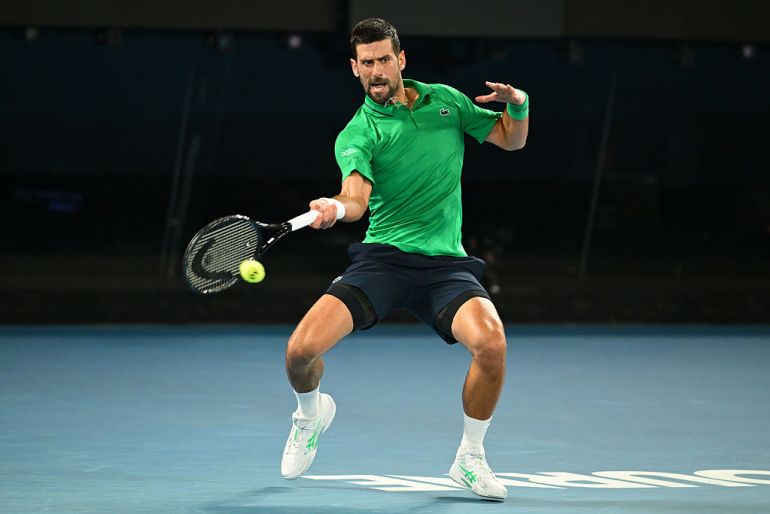
Novak Djokovic of Serbia plays a forehand against Jannik Sinner of Italy [Quinn Rooney/Getty Images]

Djokovic will meet world number one Carlos Alcaraz in Sunday’s decider, the Spaniard having fought off Alexander Zverev in the longest Australian Open semi-final.

Eighteen years after his first Melbourne crown, Djokovic will strive for a record-extending 11th against Alcaraz and the unprecedented 25th Grand Slam title that has eluded him.

Djokovic needed incredible ​fortune to reach the semi-finals, with his quarter-final opponent Lorenzo Musetti retiring injured ‌after taking the first two sets.

The Serb enjoyed a walkover in the fourth round as well, when Jakub Mensik pulled out.

But it was hard work and mental toughness that got Djokovic over the line against Sinner, a player who had beaten him in ‌their previous five matches.

Jannik Sinner in defeat to Novak Djokovic at the Australian Open tennis
Jannik Sinner of Italy plays a forehand in the Men’s Singles semifinal at Melbourne Park[Phil Walter/Getty Images]

Victory came grudgingly.

He had to save a slew of break points in the decisive set before finally getting a look at Sinner’s ‌serve at 3-3.

Flooring the Italian in three punishing rallies, the Serb ⁠broke him to lead 4-3, raised one fist and threw an icy stare at his player’s box.

Djokovic had to save another three break points in the next service game but sent Serbian fans into delirium when he survived them all and held with an ‌ace.

Serving for the match at 5-4, Djokovic summoned the grit and champion spirit of 20 years at the top, setting up two match points with a forehand winner down the line.

Trump nominates Kevin Warsh to replace Powell as fed chair

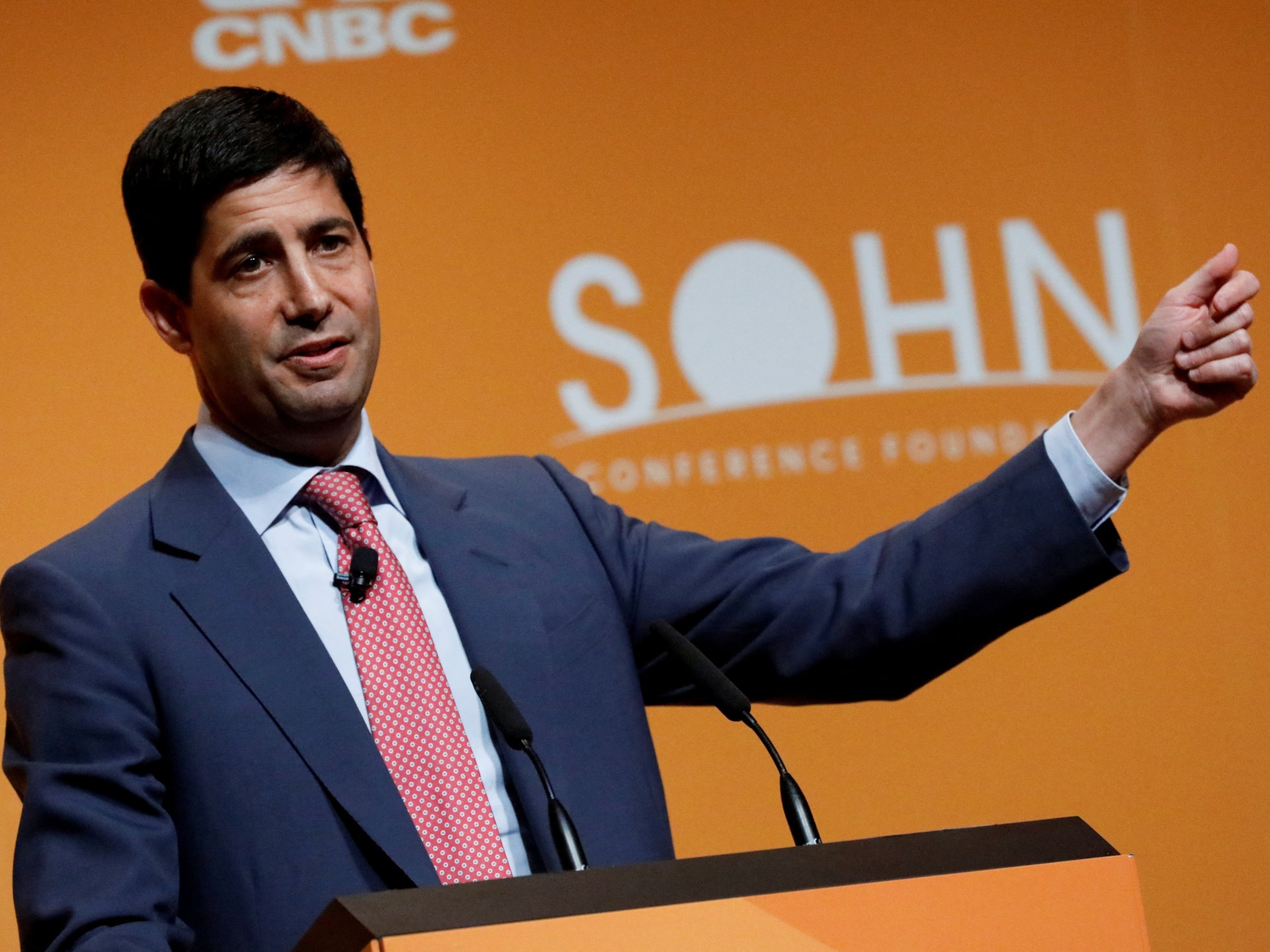
United States President Donald Trump has nominated former Federal Reserve Governor Kevin Warsh to head the US central bank when current Federal Reserve Chair Jerome Powell’s term ends in May.

The announcement on Friday caps a months-long, highly publicised search for a new chair of the Federal Reserve, widely regarded as one of the most influential economic officials in the world.

Recommended Stories

list of 3 itemsend of list

It comes amid Trump’s public pressure campaign on Powell, whom he appointed during his first term but has repeatedly condemned for not cutting interest rates at the pace the president would like.

“I have known Kevin for a long period of time, and have no doubt that he will go down as one of the GREAT Fed Chairmen, maybe the best,” Trump posted on his Truth Social site. “On top of everything else, he is ‘central casting,’ and he will never let you down.”

The statement referenced the apparent compromise Warsh represents. The 55-year-old is known to be in Trump’s orbit and has recently called for lower interest rates, although he is expected to stop short of the more aggressive easing associated with some other potential candidates for the job.

Still, he is expected to face a punishing Senate confirmation hearing, with US lawmakers likely to be particularly critical given Trump’s public comments and the Department of Justice’s decision earlier this month to open a criminal probe into Powell.

Critics, including Powell, have said Trump’s actions seek to undermine the Federal Reserve’s independence and pressure the agency to set monetary policy aligned with the president’s wishes.

What does the Federal Reserve do?

The Federal Reserve has long been seen as a stabilising force in global financial markets, due in part to its perceived independence from politics.

It is tasked with combating inflation in the US while also supporting maximum employment. It is also the nation’s top banking regulator.

The agency’s rate decisions over time influence borrowing costs throughout the economy, including for mortgages, car loans and credit cards.

In a statement, Senator Elizabeth Warren, the top Democrat on the US Senate Banking Committee, said, “This nomination is the latest step in Trump’s attempt to seize control of the Fed.”

She pointed to the investigation into Powell, as well as Trump’s effort to push out Fed Governor Lisa Cook, which is currently being challenged before the US Supreme Court.

“No Republican purporting to care about Fed independence should agree to move forward with this nomination until Trump drops his witch-hunt,” Warren said.

Republican Senator Thom Tillis, meanwhile, said he would not vote to confirm any nominee until the Department of Justice probe into Powell is ended.

“Protecting the independence of the Federal Reserve from political interference or legal intimidation is non-negotiable,” he said in a statement.

Still, some Republicans welcomed the nomination.

“No one is better suited to steer the Fed and refocus our central bank on its core statutory mandate,” Republican Senator Bill Hagerty said in a statement.

If Warsh is confirmed, it remains unclear whether Powell would immediately step down or finish out his term. Traditionally, Federal Reserve chairs step aside as soon as their replacement is appointed, but the political situation has led to speculation Powell could stay on as long as possible.

Who is Warsh?

Warsh is currently a fellow at the right-leaning Hoover Institution and a lecturer at the Stanford Graduate School of Business.

He was a member of the Federal Reserve’s board from 2006 to 2011 and became the youngest Federal Reserve governor in history when he was appointed at age 35.

He was an economic aide in George W Bush’s Republican administration and was an investment banker at Morgan Stanley. His father-in-law is Ronald Lauder, heir to the Estee Lauder cosmetics fortune and a longtime donor and confidant of Trump’s.

Warsh has historically supported higher interest rates to control inflation, but has more recently argued for lower rates.

He has been a vocal critic of current Federal Reserve leadership, calling for “regime change” and criticising Powell for engaging on issues like climate change, which Warsh has said are outside the role’s mandate.

Reporting from Washington, DC, Al Jazeera’s Kimberly Halkett said Warsh’s experience means his appointment will likely be well received by the markets.

“The consensus is that in the short term, yes, this is a nominee who will do what the president has asked,” she said.

“But what he could do long term as chair of the board is very similar, ironically, to what Jerome Powell, the current board chair, is doing right now,” she said.

US-Iran tensions: The diplomatic scramble to prevent a war

Amid rising tensions and growing fears of a military clash between Iran and the United States, a series of nations – especially in Iran’s extended neighbourhood – are engaged in hectic diplomacy aimed at avoiding an all-out war.

We look at the various diplomatic efforts taking place, and whether they could succeed in defusing tensions.

What is happening between Iran and the US?

On Wednesday, US President Donald Trump renewed threats of US military intervention in Iran if it does not reach a deal to curb its nuclear programme and ballistic missile capacity.

“A massive Armada is heading to Iran,” Trump wrote in a post on his Truth Social platform. The US fleet of warships includes the nuclear-powered aircraft carrier USS Abraham Lincoln.

US Central Command (CENTCOM) confirmed in a post on X on Monday that the USS Abraham Lincoln had been sent to the Middle East to “promote regional security and stability”.

The vessel, which departed its home port of San Diego, California in November and had been operating in the South China Sea until last week, is one of the US Navy’s largest warships.

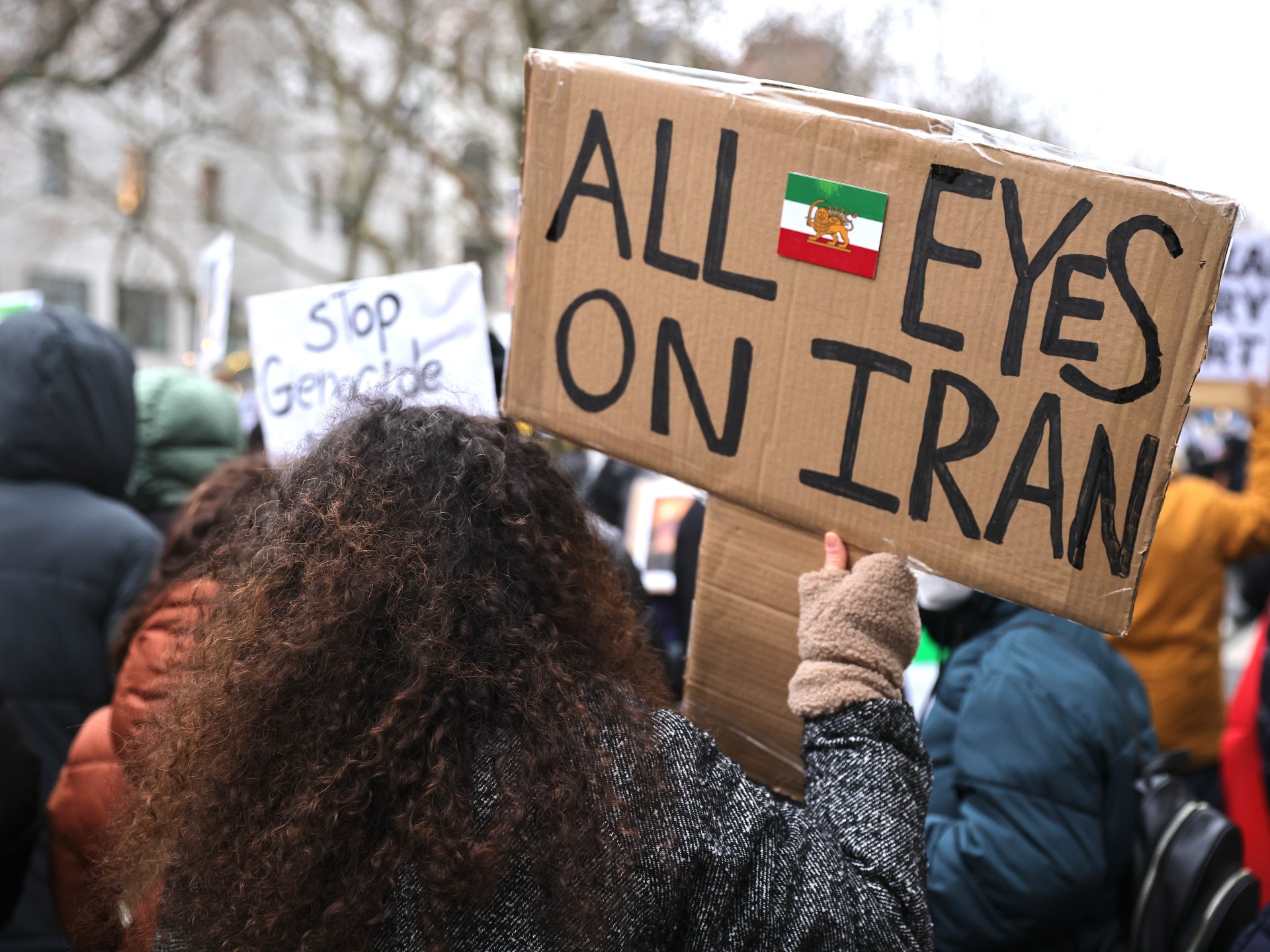
Trump first issued a threat to militarily intervene in Iran earlier this month during protests against the country’s government. The protests had begun in late December 2025 over the country’s worsening economic conditions. They escalated into a broader challenge to the country’s clerical leadership, which has been in power since the 1979 Islamic revolution.

Trump initially backed down from his threat to attack Iran after receiving assurances that protesters would not be executed, he said. But he has since renewed them.

Tehran has stated that it is not willing to negotiate under the threat of attack and has signalled its readiness to defend Iran.

“Tehran’s priority is currently not to negotiate with the US, but to have 200 percent readiness to defend our country,” Kazem Gharibabadi, a senior member of the Iranian negotiating team, told Iranian state media on Wednesday.

He said messages had been passed to the US through intermediaries, but stated that even if conditions became suitable for talks, Iran would remain fully prepared to defend itself. He pointed out that the US launched an assault on its nuclear facilities in June last year – just as negotiations were about to begin to end its 12-day war with Israel.

During that conflict, there were few Israeli casualties, but Iranian missiles did manage to breach Israel’s much-vaunted “Iron Dome” defence system, causing alarm in Tel Aviv and Washington.

On Thursday, the Iranian army announced it had added 1,000 new “strategic” drones to its forces, including one-way attack drones and combat, reconnaissance and cyber-capable systems designed to strike fixed or mobile targets on land, in the air and at sea.

“Proportionate to the threats facing us, the agenda of the army includes maintaining and improving strategic advantages for fast combat and a decisive response to any aggression,” army commander Amir Hamati said in a short statement.

At the same time, however, Iran is pursuing diplomatic channels in a bid to de-escalate the situation.

What diplomatic efforts are taking place?

Turkiye

Iran’s foreign minister, Abbas Araghchi, arrived in Istanbul to hold high-level talks with Turkish Foreign Minister Hakan Fidan and President Recep Tayyip Erdogan on Friday.

While announcing Araghchi’s meetings with the Turkish leaders, Esmaeil Baghaei, Iranian Ministry of Foreign Affairs spokesperson, said that Tehran aims to “constantly strengthen ties with neighbours based on shared interests”.

While the exact agenda for these discussions has not been revealed, the talks come amid Trump’s threats of military intervention in Iran.

Araghchi’s meeting will take place while similar discussions between Iran’s leadership and representatives of other countries continue.

Pakistan

On Thursday, Araghchi spoke with Pakistani Foreign Minister Ishaq Dar on a phone call.

According to a news release by the Iranian government, Dar reiterated Islamabad’s position on respecting state sovereignty, rejecting interference in other countries’ internal affairs and condemning “terrorism”.

On the same day, Pakistani Prime Minister Shehbaz Sharif spoke to Iranian President Masoud Pezeshkian. Sharif wrote in an X post that the two leaders reaffirmed their commitment to further strengthening ties between Pakistan and Iran.

Egypt

Egypt’s Ministry of Foreign Affairs said on Wednesday that its top diplomat, Badr Abdelatty, had spoken with Araghchi and US Special Envoy to the Middle East Steve Witkoff separately in a bid to “work toward achieving calm, in order to avoid the region slipping into new cycles of instability”.

Saudi Arabia and Gulf nations

On Tuesday, Saudi Arabia’s Crown Prince Mohammed bin Salman held a call with Iran’s President Pezeshkian and said the kingdom would “not allow its airspace or territory to be used for any military actions against Iran or for any attacks from any party, regardless of their origin”.

The United Arab Emirates (UAE) has made similar pledges not to allow a US strike on Iran from its territories or airspace.

India

On Wednesday, India’s deputy national security adviser, Pavan Kapoor, travelled to Tehran for meetings with Iran’s Supreme National Security Council Secretary Ali Larijani and Deputy for International Affairs Ali Bagheri Kani.

Last week, India voted against a United Nations Human Rights Council (UNHRC) resolution condemning Iran for its crackdown on protesters.

Twenty-five members of the council voted in favour of the resolution, while 14 abstained. Seven, including India, China, Vietnam and Cuba, opposed it.

China

Besides also voting against the UNHRC resolution last week, China made a show of support for Iran at the UN on Wednesday this week.

Fu Cong, China’s permanent representative to the United Nations, told an open debate on the Middle East: “The use of force cannot solve problems. Any acts of military adventurism will only push the region into an abyss of unpredictability.” He urged all countries to abide by the United Nations Charter and to oppose interference in the internal affairs of other countries.

“China hopes that the United States and other relevant parties will heed the call of the international community and regional countries, do more things that are conducive to peace and stability in the Middle East, and avoid exacerbating tensions and adding fuel to the fire,” he said.

Russia

On Thursday, Russia said there was room for negotiation between the US and Iran.

“We continue to call on all parties to exercise restraint and to renounce any use of force to resolve issues. Clearly, the potential for negotiations is far from exhausted … We must focus primarily on negotiating mechanisms,” Kremlin spokesperson Dmitry Peskov told reporters.

“Any forceful actions can only create chaos in the region and lead to very dangerous consequences in terms of destabilising the security system throughout the region.”

What about the West?

Western leaders have largely focused on condemning Iran’s crackdown on protesters this month and have mostly held back from making any major pronouncements on an impending war between Iran and the US.

On January 25, French armed forces minister Alice Rufo told local media that while France wants to support the Iranian people, “a military intervention is not the preferred option.”

She added that it was “up to the Iranian people to rid themselves of this regime”.

But that was perhaps the closest a European nation has come to opposing Trump’s military plans. Instead, while Iranian authorities were engaged in diplomatic outreach with regional neighbours on Thursday, the European Council adopted new sanctions against 15 Iranian individuals and six entities.

The Council said in a statement that these restrictions had been imposed in response to “serious human rights violations in Iran, following the violent repression of peaceful protests, including the use of violence, arbitrary detention, and intimidation tactics by security forces against demonstrators”.

The European Union also designated Iran’s Islamic Revolutionary Guard Corps (IRGC) a “terrorist organisation”.

The US, Canada and Australia also listed the IRGC as a terrorist organisation in 2019, 2024 and 2025, respectively.

Kaja Kallas, vice president of the European Commission, wrote in an X post on Thursday: “Any regime that kills thousands of its own people is working toward its own demise.”

On Wednesday, French Foreign Minister Jean-Noel Barrot wrote in an X post that “France will support the designation of the Islamic Revolutionary Guard Corps on the European Union’s list of terrorist organisations.”

This marked a policy reversal from Paris, which had previously argued that legal and procedural obstacles prevented the EU from designating the IRGC as a terrorist organisation.

The Iranian leadership strongly criticised the EU decisions.

“Putting aside the blatant hypocrisy of its selective outrage – taking zero action in response to Israel’s Genocide in Gaza and yet rushing to ‘defend human rights’ in Iran – Europe’s PR stunt mainly seeks to cloak that it is an actor in severe decline,” Araghchi wrote on social media.

As Trump renewed his threats of military intervention in Iran on Wednesday, German Chancellor Friedrich Merz said that the Iranian government’s “days are numbered”.

“A regime that can only hold onto power through sheer violence and terror against its own population: its days are numbered,” Merz said at a news conference with Romanian Prime Minister Ilie Bolojan.

“It could be a matter of weeks, but this regime has no legitimacy to govern the country”.

Could diplomacy work?

Experts say diplomacy will likely have only a limited impact when it comes to defusing military tensions between the US and Iran.

Adnan Hayajneh, a professor of international relations at Qatar University, said the calls for de-escalation from regional actors were unlikely to play a major role in influencing US decisions on whether it would strike Iran.

Zverev slams Alcaraz timeout after loss in longest Australian Open semi

Alexander Zverev condemned officials for allowing Carlos Alcaraz a medical timeout for a leg problem after ‍falling in an epic five-setter ‍to the Spaniard in the Australian Open’s longest semifinal.

World number one Alcaraz was struggling to move at 4-4 in the third set on Friday and was allowed treatment on his right thigh at the change of ends, leaving the German incensed.

Recommended Stories

list of 4 itemsend of list

While Alcaraz said post-match that he worried he may have ⁠strained an adductor muscle, Zverev was adamant the Spaniard’s problem was cramp, which is out of bounds for medical timeouts.

Alcaraz dropped ​the next two sets but was back running at full pelt in the fifth to close ‍out an epic 6-4 7-6(5) 6-7(3) 6-7(4) 7-5 win in five hours and 27 minutes.

“Yeah, I mean, he was cramping, so normally you can’t take a medical timeout for cramping,” third seed Zverev said at his post-match news conference.

“What can I do? It’s not my ‍decision. I didn’t ⁠like it, but it’s not my decision.”

On court, Zverev lashed out at a match supervisor in profanity-laden German as Alcaraz underwent treatment.

“I just said it was b******t, basically,” he said later of the exchange, noting that Alcaraz finished full of running.

“He took like an hour and a half off where he wasn’t moving almost at all.

“So again, maybe I should have used that better in a way. Maybe I should have won the games and won the sets a bit quicker. Then moving into the fifth, maybe he ​wouldn’t have had so much time to recover. But the fifth set, the way ‌he was moving, was incredible again.”

Alexander Zverev of Germany in the Men's Singles Semifinal match against Carlos Alcaraz of Spain
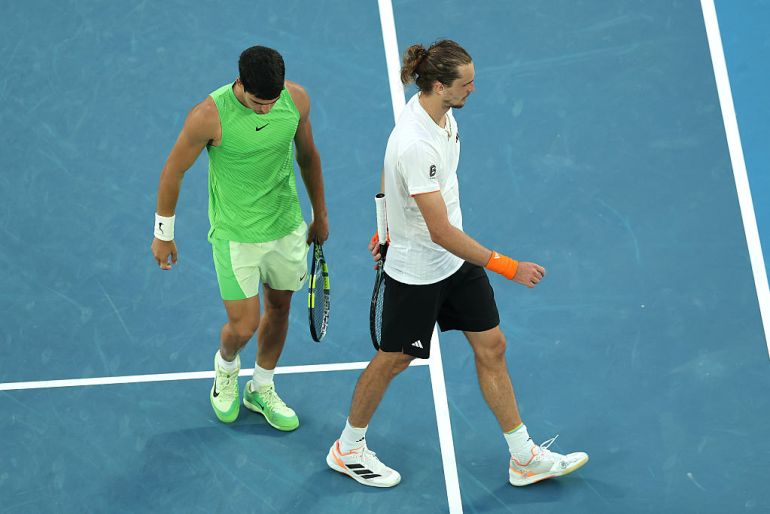
Carlos Alcaraz, left, of Spain, and Alexander Zverev, right, of Germany, react after the former’s victory in the Men’s Singles semifinal [Clive Brunskill/Getty Images]

Alcaraz admits his body could be better ahead of Australian Open final

When asked whether he was injured, Alcaraz equivocated.

“Well, obviously I feel tired. You know, obviously my body could be better, to be honest, but I think that’s normal after five hours and a half.”

Runner-up to Jannik Sinner last ‌year, Zverev was serving for the match at 5-4 in the fifth set of Friday’s semifinal but Alcaraz won the next three games to leave the German with ‌another near-miss at the Grand Slams.

Still chasing an elusive first major title, ⁠Zverev said he had more regrets about dropping the second set than his surrender in the fifth.

“I was hanging on for dear life, to be honest. I was exhausted,” he said, rating the match as probably the toughest physically of his career.

“I think we both went to our absolute ‌limits, so somewhat I’m also proud of myself, the way I was hanging on and came back from two sets to love.

Ukrainian President Zelenskyy invites Putin to Kyiv for talks

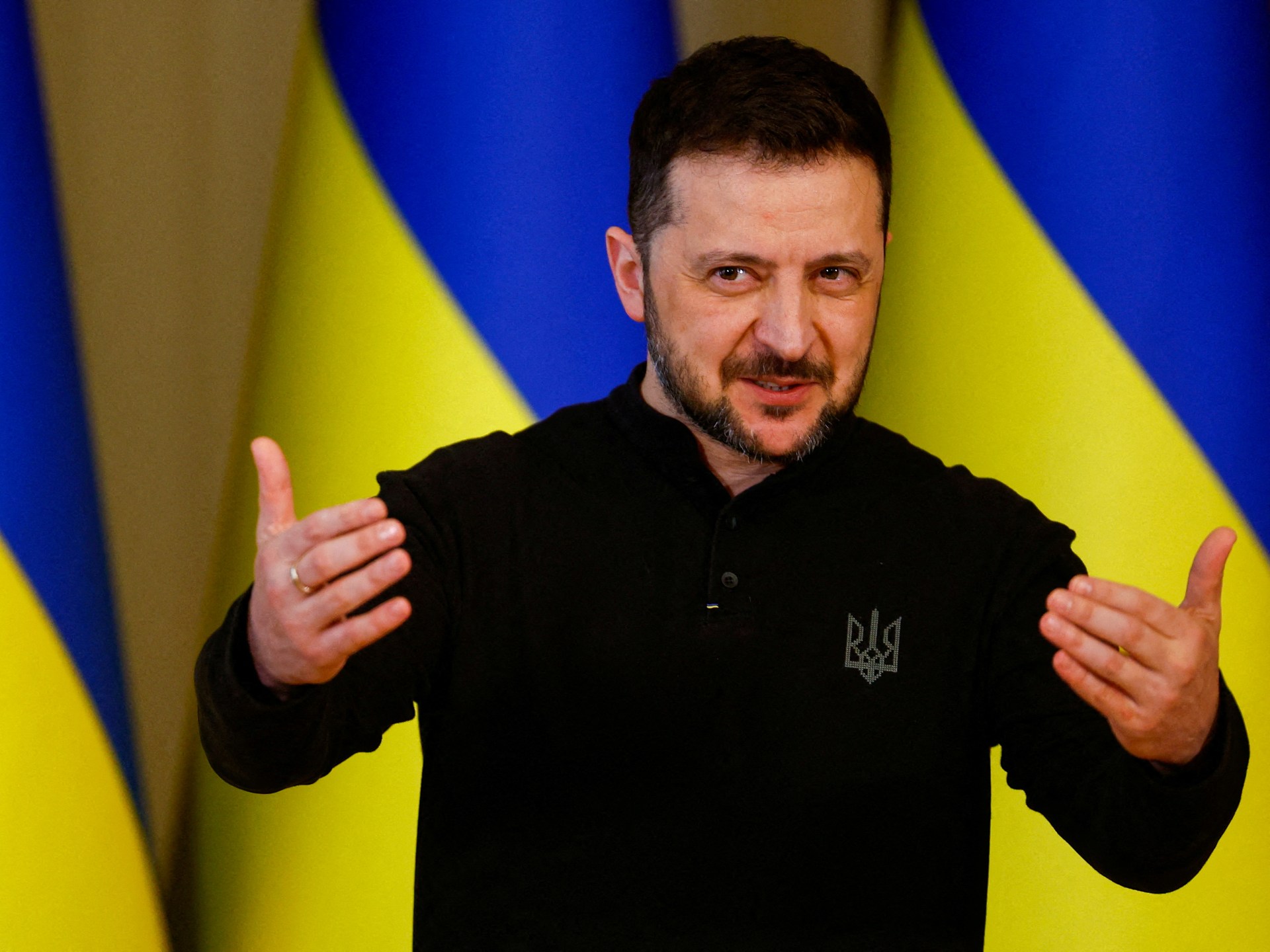
Ukraine’s President Volodymyr Zelenskyy has invited Russian President Vladimir Putin to Kyiv for talks, “if he dares”, as the United States continues to press the warring sides into negotiations on ending the war.

He told reporters on Friday that he was ready for any format for the meeting, but would not go to Moscow or Belarus, following an invitation from the Kremlin.

Recommended Stories

list of 3 itemsend of list

Zelenskyy said it was “impossible” for him to meet Putin in Moscow, news agency RBC-Ukraine reports. “It’s the same as meeting with Putin in Kyiv. I can also invite him to Kyiv, let him come. I publicly invite him, if he dares, of course.”

He added that Russia was an aggressor waging war against Ukraine, and Belarus was a “partner in these actions”.

The Kremlin on Thursday said Russia had again invited the Ukrainian leader to Moscow for talks but had not received a response.

Trilateral talks

US-mediated negotiations between the two countries took place in Abu Dhabi last week and a second round is scheduled for Sunday. However, the Reuters news agency reports that Zelenskyy said the date and location could change, due to the “situation between the United States and Iran”.

He noted that it was “very important for us that everyone we agreed with be present at the meeting”.

US President Donald Trump announced on Thursday that Putin had agreed to his request not to attack Ukraine’s energy infrastructure for a week amid extreme cold weather, which he said was “very nice”.

The Kremlin confirmed on Friday that Putin had received the request, with spokesperson Dmitry Peskov telling Sky News the Russian leader had “of course” agreed to the proposal.

Zelenskyy wrote on X that the issue of a ceasefire on energy infrastructure attacks had been discussed during the talks, and that he expected the agreements to be implemented. “De-escalation steps contribute to real progress toward ending the war,” he added.

On Friday, the Ukrainian leader confirmed in his nightly address that neither Moscow nor Kyiv had conducted strikes ⁠on energy targets from Thursday night onwards.

However, he added that Russia was engaged in a “reorientation” of its military activity by attacking logistics targets, like rail junctions.

Ukrainian ‍Prime ‍Minister Yulia Svyrydenko wrote on X on Friday evening that Russian ⁠forces had launched ​seven attacks on ‍Ukrainian rail infrastructure over the previous ‍24 hours.

“Russia ⁠is deliberately striking Ukraine’s logistics routes. This is intentional terror aimed at ​people ‌and civilian transport,” she wrote.

Before the next round of US-mediated talks, Trump told reporters in the Oval Office on Friday that he believes “we are getting close” to a deal to end the war.

However, several sticking points remain, including Russia’s demand for Ukrainian forces to withdraw from about one-fifth of the Donetsk region, and the potential deployment of international peacekeepers in Ukraine after the war.