Trump nominates Kevin Warsh to replace Powell as fed chair

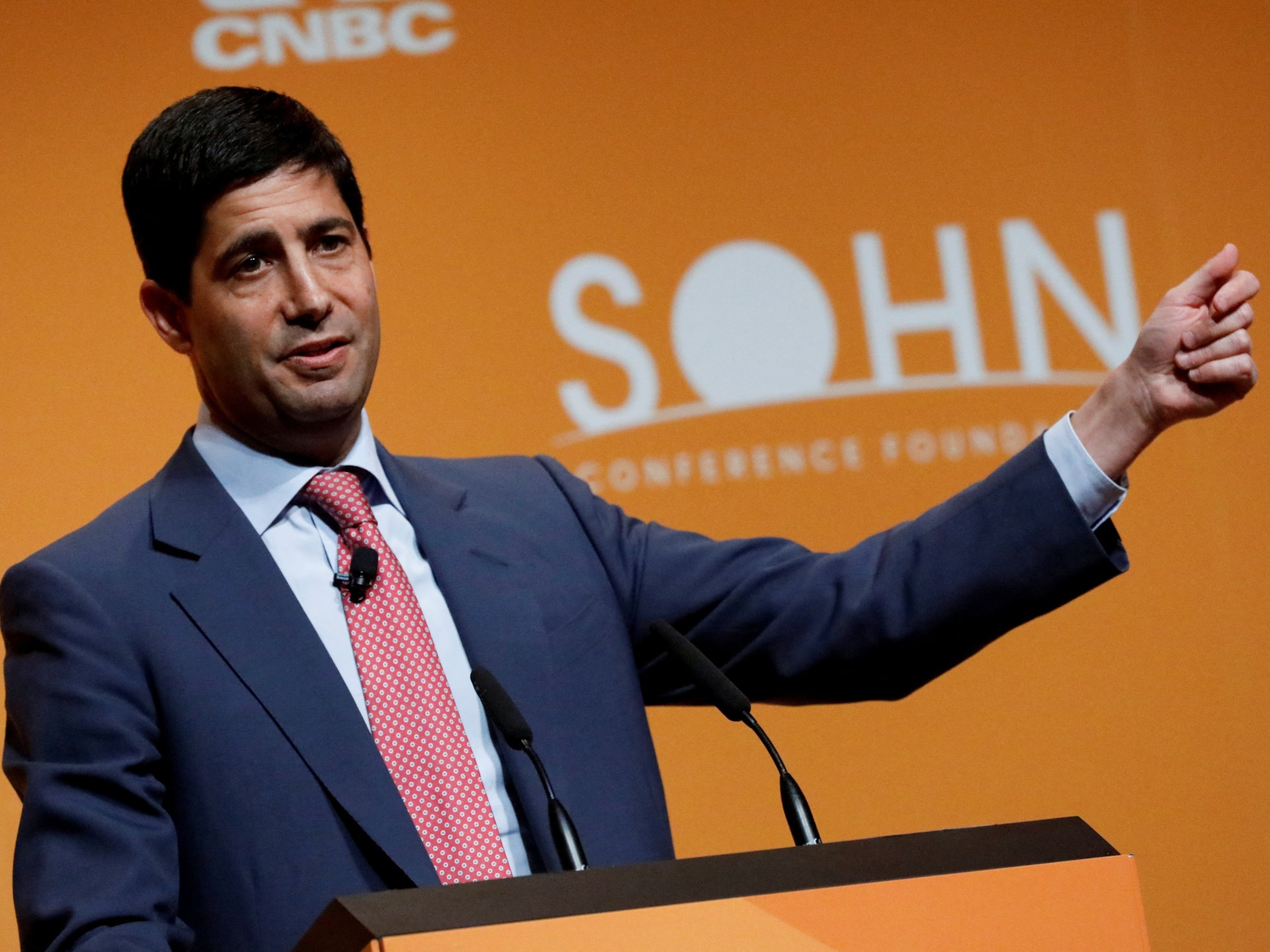
United States President Donald Trump has nominated former Federal Reserve Governor Kevin Warsh to head the US central bank when current Federal Reserve Chair Jerome Powell’s term ends in May.

The announcement on Friday caps a months-long, highly publicised search for a new chair of the Federal Reserve, widely regarded as one of the most influential economic officials in the world.

Recommended Stories

list of 3 itemsend of list

It comes amid Trump’s public pressure campaign on Powell, whom he appointed during his first term but has repeatedly condemned for not cutting interest rates at the pace the president would like.

“I have known Kevin for a long period of time, and have no doubt that he will go down as one of the GREAT Fed Chairmen, maybe the best,” Trump posted on his Truth Social site. “On top of everything else, he is ‘central casting,’ and he will never let you down.”

The statement referenced the apparent compromise Warsh represents. The 55-year-old is known to be in Trump’s orbit and has recently called for lower interest rates, although he is expected to stop short of the more aggressive easing associated with some other potential candidates for the job.

Still, he is expected to face a punishing Senate confirmation hearing, with US lawmakers likely to be particularly critical given Trump’s public comments and the Department of Justice’s decision earlier this month to open a criminal probe into Powell.

Critics, including Powell, have said Trump’s actions seek to undermine the Federal Reserve’s independence and pressure the agency to set monetary policy aligned with the president’s wishes.

What does the Federal Reserve do?

The Federal Reserve has long been seen as a stabilising force in global financial markets, due in part to its perceived independence from politics.

It is tasked with combating inflation in the US while also supporting maximum employment. It is also the nation’s top banking regulator.

The agency’s rate decisions over time influence borrowing costs throughout the economy, including for mortgages, car loans and credit cards.

In a statement, Senator Elizabeth Warren, the top Democrat on the US Senate Banking Committee, said, “This nomination is the latest step in Trump’s attempt to seize control of the Fed.”

She pointed to the investigation into Powell, as well as Trump’s effort to push out Fed Governor Lisa Cook, which is currently being challenged before the US Supreme Court.

“No Republican purporting to care about Fed independence should agree to move forward with this nomination until Trump drops his witch-hunt,” Warren said.

Republican Senator Thom Tillis, meanwhile, said he would not vote to confirm any nominee until the Department of Justice probe into Powell is ended.

“Protecting the independence of the Federal Reserve from political interference or legal intimidation is non-negotiable,” he said in a statement.

Still, some Republicans welcomed the nomination.

“No one is better suited to steer the Fed and refocus our central bank on its core statutory mandate,” Republican Senator Bill Hagerty said in a statement.

If Warsh is confirmed, it remains unclear whether Powell would immediately step down or finish out his term. Traditionally, Federal Reserve chairs step aside as soon as their replacement is appointed, but the political situation has led to speculation Powell could stay on as long as possible.

Who is Warsh?

Warsh is currently a fellow at the right-leaning Hoover Institution and a lecturer at the Stanford Graduate School of Business.

He was a member of the Federal Reserve’s board from 2006 to 2011 and became the youngest Federal Reserve governor in history when he was appointed at age 35.

He was an economic aide in George W Bush’s Republican administration and was an investment banker at Morgan Stanley. His father-in-law is Ronald Lauder, heir to the Estee Lauder cosmetics fortune and a longtime donor and confidant of Trump’s.

Warsh has historically supported higher interest rates to control inflation, but has more recently argued for lower rates.

He has been a vocal critic of current Federal Reserve leadership, calling for “regime change” and criticising Powell for engaging on issues like climate change, which Warsh has said are outside the role’s mandate.

Reporting from Washington, DC, Al Jazeera’s Kimberly Halkett said Warsh’s experience means his appointment will likely be well received by the markets.

“The consensus is that in the short term, yes, this is a nominee who will do what the president has asked,” she said.

“But what he could do long term as chair of the board is very similar, ironically, to what Jerome Powell, the current board chair, is doing right now,” she said.

US-Iran tensions: The diplomatic scramble to prevent a war

Amid rising tensions and growing fears of a military clash between Iran and the United States, a series of nations – especially in Iran’s extended neighbourhood – are engaged in hectic diplomacy aimed at avoiding an all-out war.

We look at the various diplomatic efforts taking place, and whether they could succeed in defusing tensions.

What is happening between Iran and the US?

On Wednesday, US President Donald Trump renewed threats of US military intervention in Iran if it does not reach a deal to curb its nuclear programme and ballistic missile capacity.

“A massive Armada is heading to Iran,” Trump wrote in a post on his Truth Social platform. The US fleet of warships includes the nuclear-powered aircraft carrier USS Abraham Lincoln.

US Central Command (CENTCOM) confirmed in a post on X on Monday that the USS Abraham Lincoln had been sent to the Middle East to “promote regional security and stability”.

The vessel, which departed its home port of San Diego, California in November and had been operating in the South China Sea until last week, is one of the US Navy’s largest warships.

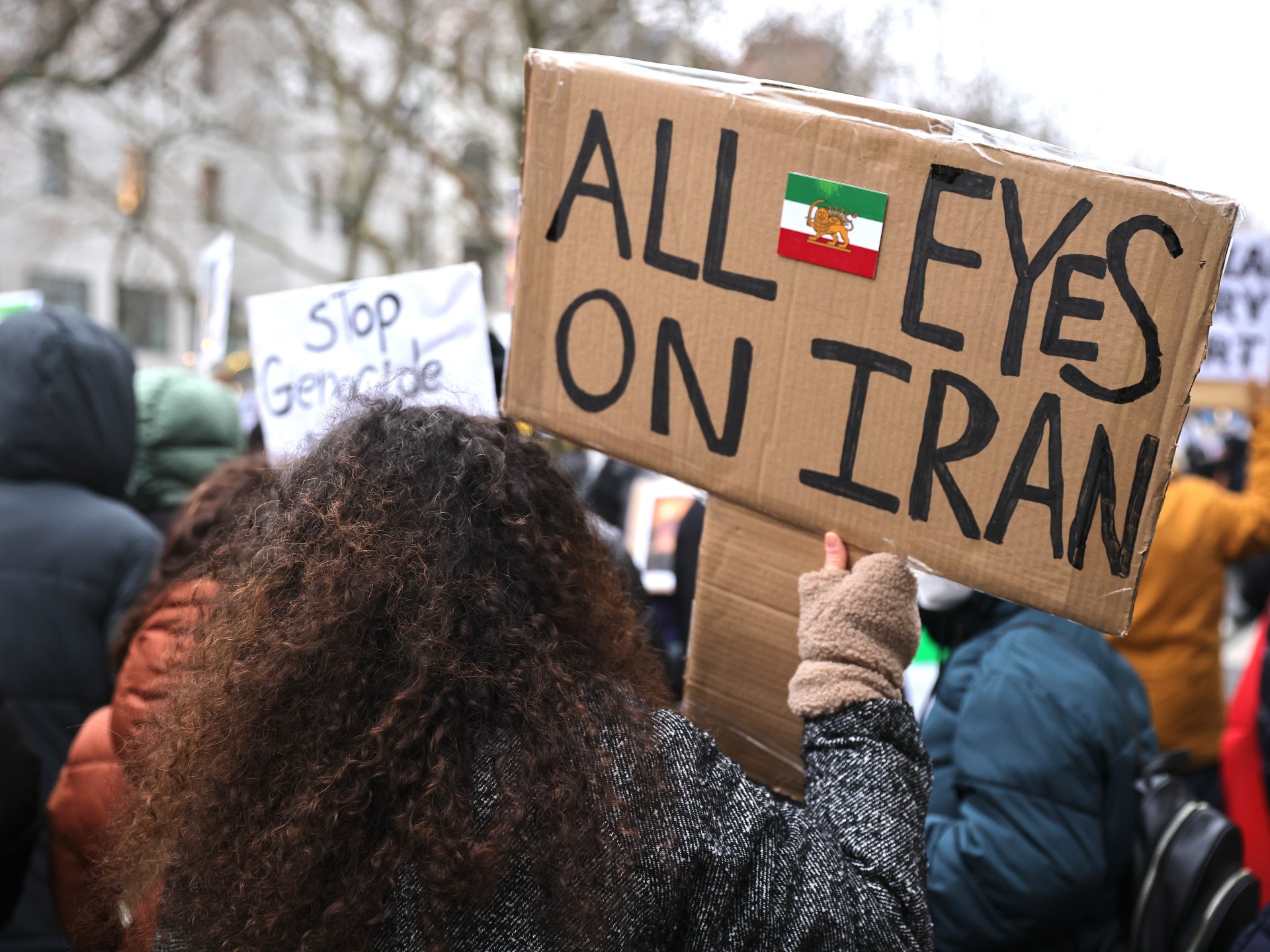
Trump first issued a threat to militarily intervene in Iran earlier this month during protests against the country’s government. The protests had begun in late December 2025 over the country’s worsening economic conditions. They escalated into a broader challenge to the country’s clerical leadership, which has been in power since the 1979 Islamic revolution.

Trump initially backed down from his threat to attack Iran after receiving assurances that protesters would not be executed, he said. But he has since renewed them.

Tehran has stated that it is not willing to negotiate under the threat of attack and has signalled its readiness to defend Iran.

“Tehran’s priority is currently not to negotiate with the US, but to have 200 percent readiness to defend our country,” Kazem Gharibabadi, a senior member of the Iranian negotiating team, told Iranian state media on Wednesday.

He said messages had been passed to the US through intermediaries, but stated that even if conditions became suitable for talks, Iran would remain fully prepared to defend itself. He pointed out that the US launched an assault on its nuclear facilities in June last year – just as negotiations were about to begin to end its 12-day war with Israel.

During that conflict, there were few Israeli casualties, but Iranian missiles did manage to breach Israel’s much-vaunted “Iron Dome” defence system, causing alarm in Tel Aviv and Washington.

On Thursday, the Iranian army announced it had added 1,000 new “strategic” drones to its forces, including one-way attack drones and combat, reconnaissance and cyber-capable systems designed to strike fixed or mobile targets on land, in the air and at sea.

“Proportionate to the threats facing us, the agenda of the army includes maintaining and improving strategic advantages for fast combat and a decisive response to any aggression,” army commander Amir Hamati said in a short statement.

At the same time, however, Iran is pursuing diplomatic channels in a bid to de-escalate the situation.

What diplomatic efforts are taking place?

Turkiye

Iran’s foreign minister, Abbas Araghchi, arrived in Istanbul to hold high-level talks with Turkish Foreign Minister Hakan Fidan and President Recep Tayyip Erdogan on Friday.

While announcing Araghchi’s meetings with the Turkish leaders, Esmaeil Baghaei, Iranian Ministry of Foreign Affairs spokesperson, said that Tehran aims to “constantly strengthen ties with neighbours based on shared interests”.

While the exact agenda for these discussions has not been revealed, the talks come amid Trump’s threats of military intervention in Iran.

Araghchi’s meeting will take place while similar discussions between Iran’s leadership and representatives of other countries continue.

Pakistan

On Thursday, Araghchi spoke with Pakistani Foreign Minister Ishaq Dar on a phone call.

According to a news release by the Iranian government, Dar reiterated Islamabad’s position on respecting state sovereignty, rejecting interference in other countries’ internal affairs and condemning “terrorism”.

On the same day, Pakistani Prime Minister Shehbaz Sharif spoke to Iranian President Masoud Pezeshkian. Sharif wrote in an X post that the two leaders reaffirmed their commitment to further strengthening ties between Pakistan and Iran.

Egypt

Egypt’s Ministry of Foreign Affairs said on Wednesday that its top diplomat, Badr Abdelatty, had spoken with Araghchi and US Special Envoy to the Middle East Steve Witkoff separately in a bid to “work toward achieving calm, in order to avoid the region slipping into new cycles of instability”.

Saudi Arabia and Gulf nations

On Tuesday, Saudi Arabia’s Crown Prince Mohammed bin Salman held a call with Iran’s President Pezeshkian and said the kingdom would “not allow its airspace or territory to be used for any military actions against Iran or for any attacks from any party, regardless of their origin”.

The United Arab Emirates (UAE) has made similar pledges not to allow a US strike on Iran from its territories or airspace.

India

On Wednesday, India’s deputy national security adviser, Pavan Kapoor, travelled to Tehran for meetings with Iran’s Supreme National Security Council Secretary Ali Larijani and Deputy for International Affairs Ali Bagheri Kani.

Last week, India voted against a United Nations Human Rights Council (UNHRC) resolution condemning Iran for its crackdown on protesters.

Twenty-five members of the council voted in favour of the resolution, while 14 abstained. Seven, including India, China, Vietnam and Cuba, opposed it.

China

Besides also voting against the UNHRC resolution last week, China made a show of support for Iran at the UN on Wednesday this week.

Fu Cong, China’s permanent representative to the United Nations, told an open debate on the Middle East: “The use of force cannot solve problems. Any acts of military adventurism will only push the region into an abyss of unpredictability.” He urged all countries to abide by the United Nations Charter and to oppose interference in the internal affairs of other countries.

“China hopes that the United States and other relevant parties will heed the call of the international community and regional countries, do more things that are conducive to peace and stability in the Middle East, and avoid exacerbating tensions and adding fuel to the fire,” he said.

Russia

On Thursday, Russia said there was room for negotiation between the US and Iran.

“We continue to call on all parties to exercise restraint and to renounce any use of force to resolve issues. Clearly, the potential for negotiations is far from exhausted … We must focus primarily on negotiating mechanisms,” Kremlin spokesperson Dmitry Peskov told reporters.

“Any forceful actions can only create chaos in the region and lead to very dangerous consequences in terms of destabilising the security system throughout the region.”

What about the West?

Western leaders have largely focused on condemning Iran’s crackdown on protesters this month and have mostly held back from making any major pronouncements on an impending war between Iran and the US.

On January 25, French armed forces minister Alice Rufo told local media that while France wants to support the Iranian people, “a military intervention is not the preferred option.”

She added that it was “up to the Iranian people to rid themselves of this regime”.

But that was perhaps the closest a European nation has come to opposing Trump’s military plans. Instead, while Iranian authorities were engaged in diplomatic outreach with regional neighbours on Thursday, the European Council adopted new sanctions against 15 Iranian individuals and six entities.

The Council said in a statement that these restrictions had been imposed in response to “serious human rights violations in Iran, following the violent repression of peaceful protests, including the use of violence, arbitrary detention, and intimidation tactics by security forces against demonstrators”.

The European Union also designated Iran’s Islamic Revolutionary Guard Corps (IRGC) a “terrorist organisation”.

The US, Canada and Australia also listed the IRGC as a terrorist organisation in 2019, 2024 and 2025, respectively.

Kaja Kallas, vice president of the European Commission, wrote in an X post on Thursday: “Any regime that kills thousands of its own people is working toward its own demise.”

On Wednesday, French Foreign Minister Jean-Noel Barrot wrote in an X post that “France will support the designation of the Islamic Revolutionary Guard Corps on the European Union’s list of terrorist organisations.”

This marked a policy reversal from Paris, which had previously argued that legal and procedural obstacles prevented the EU from designating the IRGC as a terrorist organisation.

The Iranian leadership strongly criticised the EU decisions.

“Putting aside the blatant hypocrisy of its selective outrage – taking zero action in response to Israel’s Genocide in Gaza and yet rushing to ‘defend human rights’ in Iran – Europe’s PR stunt mainly seeks to cloak that it is an actor in severe decline,” Araghchi wrote on social media.

As Trump renewed his threats of military intervention in Iran on Wednesday, German Chancellor Friedrich Merz said that the Iranian government’s “days are numbered”.

“A regime that can only hold onto power through sheer violence and terror against its own population: its days are numbered,” Merz said at a news conference with Romanian Prime Minister Ilie Bolojan.

“It could be a matter of weeks, but this regime has no legitimacy to govern the country”.

Could diplomacy work?

Experts say diplomacy will likely have only a limited impact when it comes to defusing military tensions between the US and Iran.

Adnan Hayajneh, a professor of international relations at Qatar University, said the calls for de-escalation from regional actors were unlikely to play a major role in influencing US decisions on whether it would strike Iran.
Zverev slams Alcaraz timeout after loss in longest Australian Open semi

Alexander Zverev condemned officials for allowing Carlos Alcaraz a medical timeout for a leg problem after ‍falling in an epic five-setter ‍to the Spaniard in the Australian Open’s longest semifinal.

World number one Alcaraz was struggling to move at 4-4 in the third set on Friday and was allowed treatment on his right thigh at the change of ends, leaving the German incensed.

Recommended Stories

list of 4 itemsend of list

While Alcaraz said post-match that he worried he may have ⁠strained an adductor muscle, Zverev was adamant the Spaniard’s problem was cramp, which is out of bounds for medical timeouts.

Alcaraz dropped ​the next two sets but was back running at full pelt in the fifth to close ‍out an epic 6-4 7-6(5) 6-7(3) 6-7(4) 7-5 win in five hours and 27 minutes.

“Yeah, I mean, he was cramping, so normally you can’t take a medical timeout for cramping,” third seed Zverev said at his post-match news conference.

“What can I do? It’s not my ‍decision. I didn’t ⁠like it, but it’s not my decision.”

On court, Zverev lashed out at a match supervisor in profanity-laden German as Alcaraz underwent treatment.

“I just said it was b******t, basically,” he said later of the exchange, noting that Alcaraz finished full of running.

“He took like an hour and a half off where he wasn’t moving almost at all.

“So again, maybe I should have used that better in a way. Maybe I should have won the games and won the sets a bit quicker. Then moving into the fifth, maybe he ​wouldn’t have had so much time to recover. But the fifth set, the way ‌he was moving, was incredible again.”

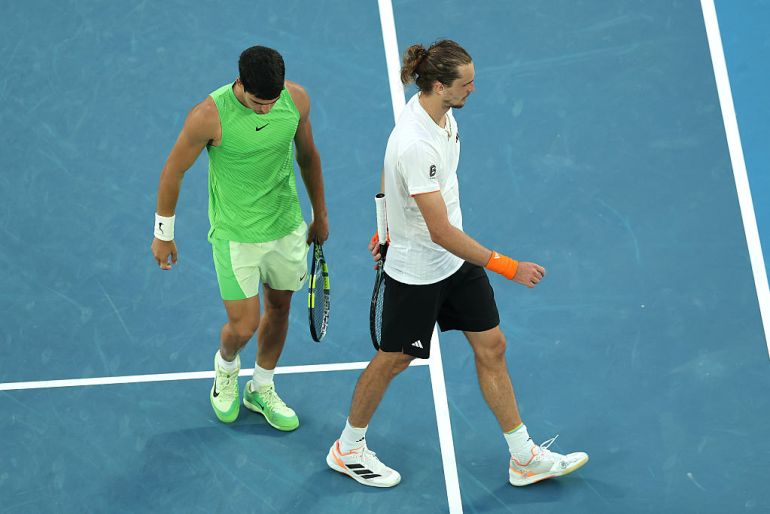
Alexander Zverev of Germany in the Men's Singles Semifinal match against Carlos Alcaraz of Spain
Carlos Alcaraz, left, of Spain, and Alexander Zverev, right, of Germany, react after the former’s victory in the Men’s Singles semifinal [Clive Brunskill/Getty Images]

Alcaraz admits his body could be better ahead of Australian Open final

When asked whether he was injured, Alcaraz equivocated.

“Well, obviously I feel tired. You know, obviously my body could be better, to be honest, but I think that’s normal after five hours and a half.”

Runner-up to Jannik Sinner last ‌year, Zverev was serving for the match at 5-4 in the fifth set of Friday’s semifinal but Alcaraz won the next three games to leave the German with ‌another near-miss at the Grand Slams.

Still chasing an elusive first major title, ⁠Zverev said he had more regrets about dropping the second set than his surrender in the fifth.

“I was hanging on for dear life, to be honest. I was exhausted,” he said, rating the match as probably the toughest physically of his career.

“I think we both went to our absolute ‌limits, so somewhat I’m also proud of myself, the way I was hanging on and came back from two sets to love.

Ukrainian President Zelenskyy invites Putin to Kyiv for talks

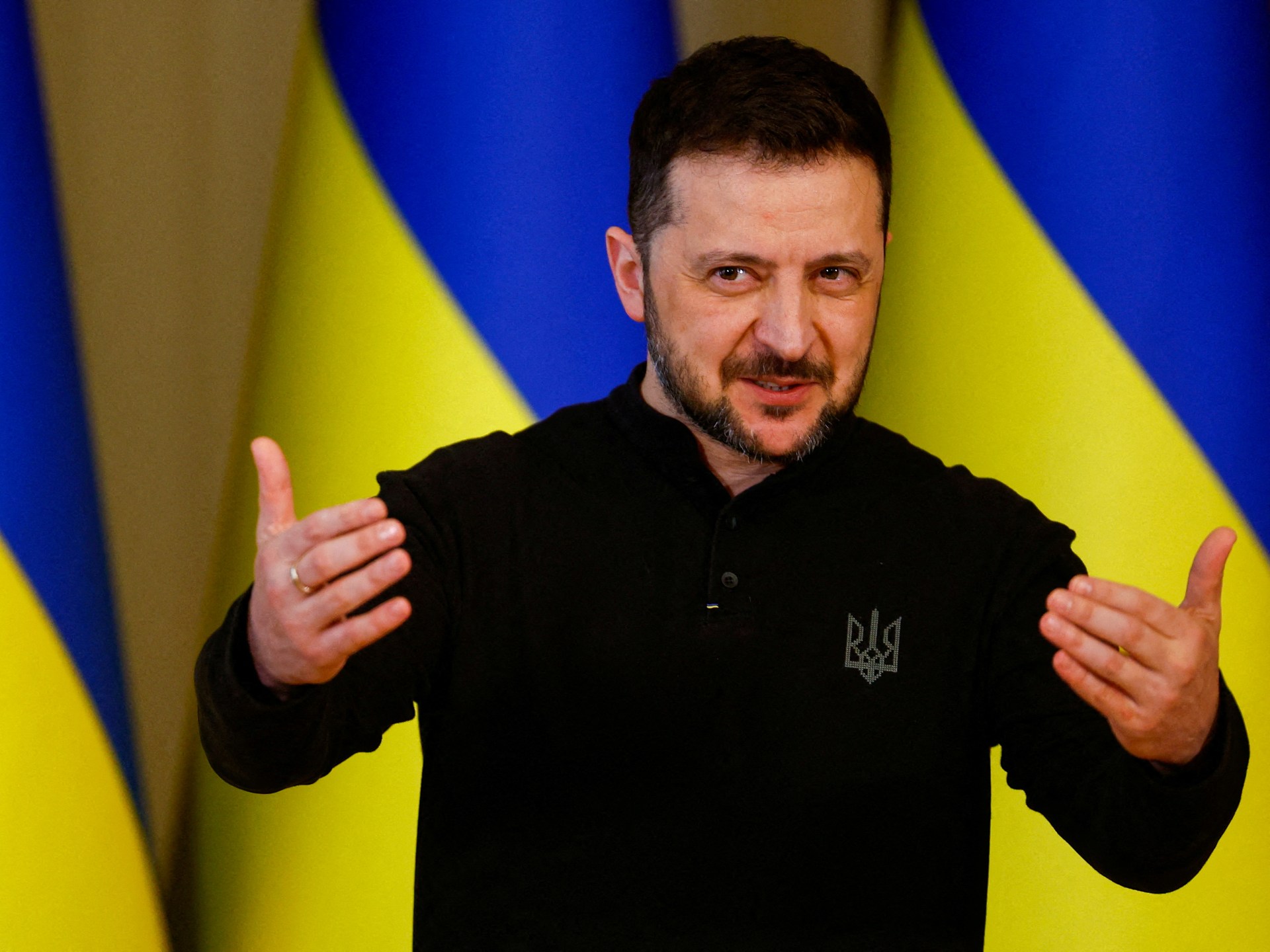
Ukraine’s President Volodymyr Zelenskyy has invited Russian President Vladimir Putin to Kyiv for talks, “if he dares”, as the United States continues to press the warring sides into negotiations on ending the war.

He told reporters on Friday that he was ready for any format for the meeting, but would not go to Moscow or Belarus, following an invitation from the Kremlin.

Recommended Stories

list of 3 itemsend of list

Zelenskyy said it was “impossible” for him to meet Putin in Moscow, news agency RBC-Ukraine reports. “It’s the same as meeting with Putin in Kyiv. I can also invite him to Kyiv, let him come. I publicly invite him, if he dares, of course.”

He added that Russia was an aggressor waging war against Ukraine, and Belarus was a “partner in these actions”.

The Kremlin on Thursday said Russia had again invited the Ukrainian leader to Moscow for talks but had not received a response.

Trilateral talks

US-mediated negotiations between the two countries took place in Abu Dhabi last week and a second round is scheduled for Sunday. However, the Reuters news agency reports that Zelenskyy said the date and location could change, due to the “situation between the United States and Iran”.

He noted that it was “very important for us that everyone we agreed with be present at the meeting”.

US President Donald Trump announced on Thursday that Putin had agreed to his request not to attack Ukraine’s energy infrastructure for a week amid extreme cold weather, which he said was “very nice”.

The Kremlin confirmed on Friday that Putin had received the request, with spokesperson Dmitry Peskov telling Sky News the Russian leader had “of course” agreed to the proposal.

Zelenskyy wrote on X that the issue of a ceasefire on energy infrastructure attacks had been discussed during the talks, and that he expected the agreements to be implemented. “De-escalation steps contribute to real progress toward ending the war,” he added.

On Friday, the Ukrainian leader confirmed in his nightly address that neither Moscow nor Kyiv had conducted strikes ⁠on energy targets from Thursday night onwards.

However, he added that Russia was engaged in a “reorientation” of its military activity by attacking logistics targets, like rail junctions.

Ukrainian ‍Prime ‍Minister Yulia Svyrydenko wrote on X on Friday evening that Russian ⁠forces had launched ​seven attacks on ‍Ukrainian rail infrastructure over the previous ‍24 hours.

“Russia ⁠is deliberately striking Ukraine’s logistics routes. This is intentional terror aimed at ​people ‌and civilian transport,” she wrote.

Before the next round of US-mediated talks, Trump told reporters in the Oval Office on Friday that he believes “we are getting close” to a deal to end the war.

However, several sticking points remain, including Russia’s demand for Ukrainian forces to withdraw from about one-fifth of the Donetsk region, and the potential deployment of international peacekeepers in Ukraine after the war.

Is Israel’s current path setting it on course for collapse?

Israel will find itself diminished and no longer the secure regional hegemon if it maintains its current path, analysts and observers from within Israel and its diaspora have warned.

All signs, they say, from the ratcheting levels of political polarisation within the country, the loss of investor confidence at both home and abroad and the fundamentals of demographic change, make the collapse of the current iteration of the Israeli state almost inevitable in the coming decades.

Recommended Stories

list of 3 itemsend of list

“When we say that the Israeli state will stop existing, it’s more of a starting point,” political economist Shir Hever explained. “What we’re really talking about is whether it will continue as the same entity as it is now. For instance, the way apartheid South Africa was no longer the same entity after 1994, or that East Germany was the same entity after unification [in 1990].”

The argument is that Israel, as it stands now, is unsustainable. And it is not so much about the way Israel treats Palestinians, but about division within Israel. Many secular Israelis are leaving the country – including entrepreneurs who have made Israel’s tech industry one of the best in the world. At the same time, the religious Zionist and ultra-Orthodox segment of society is growing rapidly, even as it comparatively brings in less money to the economy.

The loss of Israelis leaving the country will therefore potentially take much of the revenue and investment needed to sustain the expansionist aims of a hard-right government, while subsidising a benefits-reliant community of ultra-Orthodox adherents.

One of the major push factors for secular Israelis is the country’s deep political polarisation, exacerbated by war, the attempted weakening of the judiciary, and the endless machinations of Prime Minister Benjamin Netanyahu.

Hever isn’t alone in his diagnosis. Perhaps most notable was the 2024 pronouncement from Eugene Kandel, the former head of Israel’s National Economic Council and an ally of Netanyahu, and Ron Tzur, the director of Israel’s Strategic Futures Institute, that Israel was unlikely to reach the centenary of its 1948 establishment if it continues on the same path.

The two based their conclusion on the divisions within Israeli society, outlining three groupings: a liberal Jewish secular group, a group that wants a religious Jewish state, and a group that advocates for a state with equal rights for Jews and Palestinians.

Kandel and Tzur see the main divide as being between the first two groups. “A war over the home, over everyone’s identity and values against everyone else, creates an existential threat to the country, because such a war cannot be stopped without a dramatic change in the feelings of all parties,” the two wrote.

For others, such as American political scientist Ian Lustick, that end has already been reached.

“[Israel] is no longer a ‘Jewish state’ in the sense that most Israeli Jews mean it, namely a state that privileges Jews over non-Jews but successfully fronts itself as a liberal democracy,” he told Al Jazeera. “Israel is now an apartheidist state which includes all the people living between the [Jordan] river and the [Mediterranean] sea.”

According to Hever, Israel cannot afford what he referred to as “the luxury of decline”. That is, to remain as it is, Israel must maintain its core workforce of educated middle-class innovators, such as those currently responsible for driving its technology sector, or maintaining its medical system.

Likewise, to fuel its continued expansion into Palestinian territory, Israel must maintain the industrial, infrastructure and technology to maintain its military strength, and a standard of living to prevent its people from leaving.

At present, none of those indicators are in good shape, analysts say.

Emigration

Israel’s leaders have long regarded population growth as a strategic priority. From the moment the state was formed following the expulsion of some 750,000 Palestinians in 1948, maintaining a clear demographic advantage over Palestinians was seen as vital to the Zionist project, as well as to the ability of the new state to field enough soldiers to secure its borders.

However, according to analysts, the period of political polarisation that preceded Israel’s genocidal war on Gaza has already resulted in the departure of many of the young graduate class that Israel needs to safeguard its future, even before Netanyahu’s government introduced reforms that would weaken the independence of the judiciary in early 2023.

At the time, Netanyahu’s plan to rob the country’s Supreme Court of much of its powers of government oversight divided Israel to a degree that its later genocide in Gaza failed to match. Protesting what they saw as the government’s power grab, more than 200,000 – roughly 2 percent of the country’s population – took to the streets in protest.

The outcome has been stark. While government laws blurring legal and physical residency make accurate numbers hard to gauge, the Israeli parliament’s own figures and those of think tanks show that increased emigration, particularly among secular Israelis, has significantly slowed the growth of Israel’s population. In all, driven by war and an increasingly polarised society, more than 150,000 people have left Israel in the past two years, and more than 200,000 since the current government took office in December 2022.

“The educated upper-class are also more able to leave,” Hever said. “They’re educated, so they can find jobs, and they speak English. They’re also more exposed to international, rather than Hebrew, media, so they have a better idea of what’s going on and how Israel is perceived. However, increasingly, we’re seeing families with children leave, suggesting this is a more fundamental shift.”

“[Israeli economist] Dan Ben-David estimates that Israel relies on around 300,000 members of a core elite to sustain it,” Hever added. “So if a significant number leave, it stops being a developed economy and becomes a developing economy … which it can’t really afford. It just doesn’t have the luxury of losing its economic power or its standard of living. For a colonial state to exist, it relies on occupying land – and that costs money.”

Economic burden

Investor confidence has also been damaged as a result of both the judicial reforms and war, undermining the economic growth that Israel relies upon to support its military spending, expansion and increasing numbers of ultra-Orthodox citizens who often rely on state benefits to support their religious studies.

In 2018, according to Kandel and Tzur, the average Israeli family paid about 20,000 shekels ($6,450)  to support Israel’s ultra-Orthodox community. However, according to demographers, the size of that community is expected to triple by 2065, pushing the burden on non-Orthodox Israeli households to the equivalent of 60,000 shekels ($19,370) a year.

Add to that an increase in defence spending if Israel continues on its current war posture, and analysts warn that the strain on Israel’s main tax-paying sector could become unsustainable, while investors are also moving money out of the country.

“Even before the judicial reforms, institutional investors were moving money out of the country, and had been doing so since the 2008 financial crisis,” Hever said. “Around 50 percent of internal investment is now abroad.”

“Foreign investment is also down. Israel’s typical target for investment was its tech sector, but that sector is primarily military: Elbit, for instance, which is now under pressure from BDS [the Boycott, Divest and Sanctions movement],” Hever added. “There’s also been a sharp reduction since the 2023 judicial overhaul, with investors unsure whether conflicts over, for example, copyright or tax will now be ruled upon by a nationalist or extremist government-appointed judge.”

What future?

At present, Israel remains relatively secure.

Though its renewal remains uncertain, the 10-year, $38bn arms deal signed by the United States in 2016 continues to underpin much of the country’s arms and tech industry. Its economy continues to grow, and some of its more optimistic forecasters are now looking forward to the first full year with no external shocks since the COVID pandemic of 2019.

However, few can avoid the fact that, while its economy may be growing, it is doing so at a reduced rate compared with other developed countries.

Likewise, with the US threatening war against regional nemesis Iran, political deadlock over the recruitment of the ultra-Orthodox at home, and the far-right apparently ascendant, predictions that the economy may get through 2026 unscathed may be wishful thinking.

Meanwhile, the long, slow exodus of the young and the talented continues and, with it, the prospect of a secure future withers.

Some observers, such as Chatham House’s Yossi Mekelberg, were philosophical over the future of the country, or if it might collapse, saying: “When dictatorships come to an end, they break into pieces. Democracies are chipped away bit by bit until they change beyond recognition.”