‘False narrative’: Families challenge Trump’s 75-country US visa suspension

Washington, DC – A group of United States citizens and immigrant rights groups has launched a lawsuit seeking to challenge the sweeping suspension of immigrant visa processing for 75 countries by the administration of United States President Donald Trump.

The lawsuit filed on Monday argues that the Trump administration has relied on a false narrative to justify the visa processing suspension, one of the most substantial restrictions on legal immigration in the country’s history.

Recommended Stories

list of 3 itemsend of list

The lawsuit charges the policy “constitutes an unlawful nationality-based ban on legal immigration and a new set of discriminatory, unlawful public charge rules that strips families and working people of the process guaranteed by law”, according to a case overview by the National Immigration Law Center, which is among the groups supporting the legal challenge.

The sprawling 106-page complaint further alleges that the administration relies “on an unsupported and demonstrably false claim that nationals of the covered countries migrate to the United States to improperly rely on cash welfare and are likely to become ‘public charges’”.

The State Department has described the action, announced in mid-January, as a “pause” on immigrant visa processing on “countries whose migrants take welfare from the American people at unacceptable rates”.

The department has not revealed the criteria it used to determine which countries were added to the list, which comes amid a wider effort to constrict legal immigration pathways into the US and to deport undocumented citizens from the country.

The affected countries include Afghanistan, Bangladesh, Mongolia, Brazil, Colombia, Cambodia, the Democratic Republic of Congo, Ethiopia, Nigeria, Senegal, Ghana, Somalia and Russia.

The list also includes Kuwait, Jordan, Lebanon, Tunisia, Iraq, Syria, and Yemen, as well as several Caribbean, Pacific Island, and Eastern European countries.

Non-immigrant visas, including business and tourist visas, remain exempt.

“The freeze will remain active until the US can ensure that new immigrants will not extract wealth from the American people,” the State Department said in January.

‘Arbitrary, unlawful, and deeply harmful’

More than a dozen organisations and individuals named as plaintiffs in Monday’s lawsuit, as well as the seven legal organisations supporting them, argue the administration’s policy misuses the so-called “public charge” ground for inadmissibility laid out in the Immigration and Nationality Act (INA).

The provision, they argue, is meant to be a determination made on an “individualised” basis that a person risks becoming “primarily and permanently dependent on government for subsistence” if they are granted immigration status.

In turn, they said the administration is violating another provision of the INA, which says “no person shall receive any preference or priority or be discriminated against in the issuance of an immigrant visa because of the person’s race, sex, nationality, place of birth, or place of residence”.

It further argues that the administration has adopted an overly broad interpretation of what constitutes a “public charge”.

The plaintiffs include US citizens who had petitioned and been approved for their family members, including children and spouses, to join them in the US, a process known as “family unification”. Other plaintiffs included foreign nationals approved for immigrant visas through their specialised employment.

Hasan Shafiqullah, immigration supervising attorney at The Legal Aid Society, called the State Department policy “arbitrary, unlawful, and deeply harmful to families who have followed the rules and are simply seeking to reunite with their loved ones”.

Other lawyers supporting the case underscored that the policy disproportionately affects people from Africa, the Middle East, South and Central Asia and Eastern Europe.

Baher Azmy, the legal director of the Center for Constitutional Rights, accused the administration of relying on “obviously pretextual tropes about nonwhite families undeservedly taking benefits”.

“Congress and the Constitution prohibit white supremacy as grounds for immigration policy.”

The lawsuit further points to “arbitrary and disparaging” statements made by Trump and administration officials about immigrants being likely to receive public benefits.

It notes that most immigrants are ineligible for most government assistance programmes, yet are required to pay local, state, and federal taxes.

The State Department did not reply to a request for comment on the new legislation from Al Jazeera. US agencies typically do not comment on pending litigation.

Chances of success

The odds of success for the new lawsuit, which comes amid a deluge of legal challenges, remained unclear.

Plaintiffs have won at least temporary pauses on several key immigration issues, particularly related to Trump’s use of the Alien Enemies Act of 1798 to swiftly deport alleged gang members and his effort to end birthright citizenship, as lawsuits make their way through the legal system.

Many more long-term decisions remain elusive.

Meanwhile, in 2018, a 5-4 ruling by the conservative-dominated US Supreme Court upheld Trump’s visa-processing ban on several Muslim-majority countries, including Iran, Syria, Yemen, Libya and Somalia.

In the 2018 ruling, most justices ruled that the president had broad discretion to limit the entry of individuals into the US.


UN welcomes reopening of Gaza’s Rafah border with Egypt

NewsFeed

Spokesperson Stephane Dujarric says the United Nations welcomes the reopening of Gaza’s Rafah border crossing with Egypt after Israel closed it for nearly two years. Only five patients among thousands of sick and wounded Palestinians have been able to leave for urgent medical care so far.

Pakistan fans endorse boycott of T20 World Cup match against India

NewsFeed

Pakistan says it will boycott its T20 World Cup match against India on Feb 15 in Sri Lanka, risking a points forfeit. The move follows Bangladesh’s expulsion from the tournament and renewed accusations of double standards at the International Cricket Council.

Trump to slash US tariffs on India from 50 percent to 18 percent

United States President Donald Trump has agreed to slash US tariffs on Indian goods to 18 percent from 50 percent in exchange for India lowering trade barriers as well as stopping its purchases of Russian oil and buying oil instead from the US and potentially Venezuela.

“Out of friendship and respect for Prime Minister Modi and, as per his request, effective immediately, we agreed to a Trade Deal between the United States and India, whereby the United States will charge a reduced Reciprocal Tariff, lowering it from 25% to 18%,” Trump said in a social media post following a call with Indian Prime Minister Narendra Modi.

Recommended Stories

list of 4 itemsend of list

A White House official told the Reuters news agency that the US was rescinding a punitive, 25 percent duty on all imports from India over its purchases of Russian oil that had stacked on top of a 25 percent “reciprocal” tariff rate.

Modi also committed to buying more than $500bn worth of US energy, technology, agricultural and other products, Trump added.

“Wonderful to speak with my dear friend President Trump today. Delighted that Made in India products will now have a reduced tariff of 18%,” Modi said in a social media post on X. “Big thanks to President Trump on behalf of the 1.4 billion people of India for this wonderful announcement.”

“The deal has definitely been some time in coming,” said Rachel Ziemba, adjunct senior fellow at the Center for a New American Society. “Eighteen percent puts it near the level for Southeast Asian goods into the US.”

But experts also cautioned that it may be too soon to say if this was a trade deal or a tariff deal.

“Prime Minister Modi welcomed the news, but didn’t reassert President Trump’s claim that India was lowering tariffs on US goods,” pointed out Vina Nadjibulla, vice president of research and strategy at the Asia Pacific Foundation of Canada. “It looks like for now a deal around tariffs and de-escalation of tariffs…. It’s still an important breakthrough.”

Tense trade

The deal comes after months of tense trade negotiations between the world’s two largest democracies.

Last August, Trump doubled duties on imports from India to 50 percent to pressure New Delhi to stop buying Russian oil, and earlier this month said the rate could rise again if it did not curb its purchases.

Purchases of Venezuelan oil would help replace some of the Russian oil bought by India, the world’s third-biggest oil importer.

India has been a buyer of Venezuelan oil over the years and as recently as a year ago, Ziemba told Al Jazeera. “The question will be under what terms and at what price?”

India relies heavily on oil imports, covering around 90 percent of its needs, and importing cheaper Russian oil has helped lower its import costs since Moscow invaded Ukraine in 2022 and since Western nations slapped sanctions on Russian energy exports.

Recently, India has begun to slow its oil purchases from Russia. In January, they were around 1.2 million barrels per day (bpd), and they are projected to decline to about 1 million bpd in February and 800,000 bpd in March, according to a Reuters report.

Indian markets have been battered since the tariffs were levied by Washington, making it the worst-performing market among emerging nations in 2025, with record outflows of foreign investors.

Despite the tariff relief, “India will continue to de-risk and diversify”, a process it had begun in the wake of punishing US tariffs and a deteriorating and unpredictable relationship with Washington, said Nadjibulla.

As EU tightens borders, Spain legalizes 500,000 migrants

Spain will provide a legal pathway for residency for migrants already living in the country.

Spain’s government will grant legal status to undocumented migrants currently living in the country. The decree, passed after years of grassroots campaigning, will potentially impact about 500,000 migrants and comes in stark contrast to the anti-immigration sentiment in other EU countries. Why has the Spanish government decided to embrace its migrant population now?

In this episode:

  • Marcos Bartolomé, Producer, Al Jazeera

Episode credits:

This episode was produced by Melanie Marich, with Phillip Lanos, Spencer Cline, Chloe K. Li, Tuleen Barakat, Alexandra Locke, Marcos Bartolomé, Tamara Khandaker, and our guest host, Kevin Hirten. It was edited by Kylene Kiang and Tamara Khandakher. 

The Take production team is Marcos Bartolomé, Sonia Bhagat, Spencer Cline, Sarí el-Khalili, Sarí el-Khalili, Tamara Khandaker, Kylene Kiang, Phillip Lanos, Chloe K. Li, Melanie Marich, Haleema Shah, and Noor Wazwaz. Our editorial interns are Tuleen Barakat and Maya Hamadah. Our guest host is Kevin Hirten. 

Our engagement producers are Adam Abou-Gad and Vienna Maglio. Andrew Greiner is lead of audience engagement.

Our sound designer is Alex Roldan. Our video editors are Hisham Abu Salah and Mohannad al-Melhem. Alexandra Locke is The Take’s executive producer. Ney Alvarez is Al Jazeera’s head of audio. 

Connect with us:

Democrats win special elections in Texas. How significant is it for Trump?

Democrats in the United States are rejoicing over a Texas State Senate special election victory they say reflects growing discontent with President Donald Trump’s policies, months before the US midterm elections.

Some commentators are describing the Democratic upset win in Texas as a “political earthquake”, but Trump has dismissed the contest as a “local” race.

Recommended Stories

list of 3 itemsend of list

Union leader Taylor Rehmet, a Democrat, defeated Trump-backed conservative activist Leigh Wambsganss in Saturday’s election, receiving 57 percent of the votes in a district that the US president won by 17 percentage points in November 2024.

The vote will not have any immediate major consequences. Republicans – who have dominated Texas politics for years – still have a strong majority in the state’s senate.

Still, Saturday’s contest could be an indicator of a broader voting trend in Texas and beyond, signalling a significant shift.

“A huge political earthquake in Texas tonight as Democrats flipped a State Senate seat from red to blue in a district Trump won by 17 points,” Democratic strategist Matt McDermott wrote in a social media post.

“Trump personally waded in — endorsing the Republican and personally urging base turnout — and was dealt a massive loss.”

The election was held to fill the seat of a Republican state senator who had resigned to serve as Texas’s comptroller.

Trump’s endorsement

On the morning of the election, Trump reiterated his endorsement of Wambsganss.

“I am asking all America First Patriots in Texas’ 9th State Senate District to please make a plan to GET OUT AND VOTE on Election Day, Saturday, January 31st, for a phenomenal Candidate, Leigh Wambsganss,” the US president wrote on his Truth Social platform.

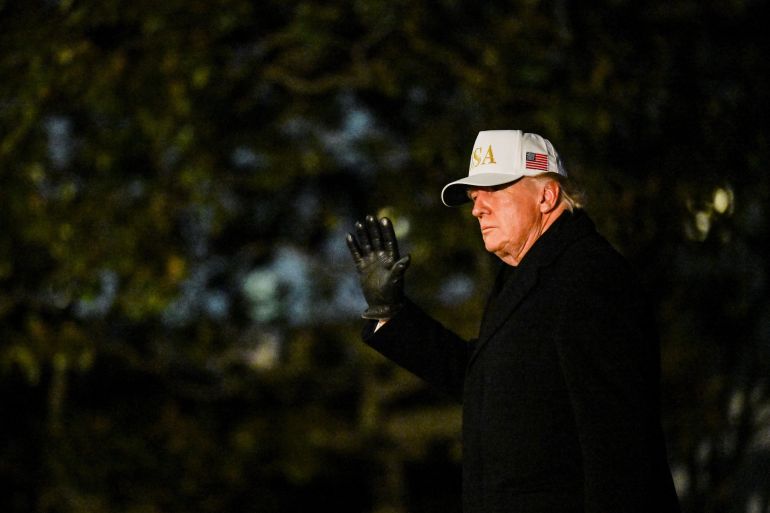
U.S. President Donald Trump waves as he arrives on the South Lawn of the White House in Washington, D.C., U.S., February 1, 2026.
US President Donald Trump arrives on the South Lawn of the White House in Washington. DC, February 1, 2026 [Annabelle Gordon/Reuters]

He called Wambsganss a “warrior” of his Make America Great Again (MAGA) movement. But when the results rolled in, the US president distanced himself from the vote.

“I’m not involved in that. That’s a local Texas race,” he told reporters on Sunday, stressing that he wasn’t on the ballot.

But the US president will not be on the ballot in the November midterm vote, either. And that will decide control of Congress.

If Democrats regain control of the US Senate and House of Representatives, they could impede Trump’s agenda and prevent him from passing any legislation.

How much should one read into the Texas result?

Opposition parties, seizing on their base’s anger, generally do well in special elections before the US midterms.

When Democratic Joe Biden was US president in 2021, voters in Virginia – which Democrats had won by 10 percentage points in 2020 – elected a Republican governor.

Similarly, the Democrats won a US Senate seat in deeply conservative Alabama during Trump’s first year in office in 2017.

But the swing in the Texas State Senate race – more than 30 percentage points from the 2024 election – is noteworthy.

The district covers Fort Worth near Dallas and other areas of Tarrant County – a traditional Republican stronghold.

Republicans also poured nearly $2.5m into the race, according to local reports, significantly outspending Rehmet and his Democratic allies.

‘Wake-up call’

The election comes at a time when Trump’s popularity is dwindling. His approval rating has dropped to 37 percent, according to a recent Pew Research Center survey, amid immigration enforcement chaos and an economy that is starting to show signs of stagnation.

Rehmet dedicated his win to working people. “We have to continue to have our energy. We have a lot more work to do,” he said after the results came out.

Ken Martin, chair of the Democratic National Committee, also invoked working people in a statement celebrating Rehmet’s victory.

“It’s clear as day that this disastrous Republican agenda is hurting working families in Texas and across the country, which is why voters in red, blue, and purple districts are putting their faith in candidates like Taylor Rehmet,” Martin said.

“This overperformance is a warning sign to Republicans across the country.”

Wambsganss, the losing Republican candidate, also described the result as a “wake-up call” for her party – but she was referring to mobilising voters, not changing policy.

Texas Lieutenant Governor Dan Patrick, an ally of Wambsganss, echoed that assessment. “Our voters cannot take anything for granted,” he wrote on X.

Democrats have been trying for years to make inroads in Texas. The state is the second largest in the US by population. Without its 40 Electoral College votes, it would be difficult for any Republican to win a presidential race.

US Congresswoman Jasmine Crockett, one of the Texas Democrats trying to unseat Republican Senator John Cornyn in November, seized on Rehmet’s win to talk up her own chances.

“Don’t tell us what can’t be done in Texas. When we show up #TexasTough, we change the game,” she wrote in a social media post featuring photos of her and Rehmet.

In essence, the Texas State Senate result represents a red flag for Trump and the Republican Party. At the same time, this result aligns with historical trends where American voters favoured the opposition party in special elections.