Police may investigate an alleged bombing attempt during an Indigenous rights protest in Perth, Western Australia, as a possible “terrorist” incident, following calls from Indigenous leaders and human rights groups for a more robust response from authorities.
The Australian Broadcasting Corporation (ABC) reported on Thursday that the incident was now being investigated by police as a “potential terrorist act”, two days after a 31-year-old man was charged with throwing a “homemade improvised explosive device” at an Invasion Day protest attended by thousands of people on Monday.
Recommended Stories
list of 4 itemsend of list
The device did not explode and there were no injuries, police said.
Police charged the man with throwing the device, which consisted of nails and ball bearings, into a large crowd during a protest on Australia’s national holiday, Australia Day, which is also referred to as Invasion Day, since it commemorates the 1788 arrival of a British fleet in Sydney Harbour.
A search of the suspect’s home was conducted, where it was further alleged that a combination of chemicals and materials consistent with the manufacture of homemade explosives was found, Western Australia Police Force said in a statement.
The suspect was charged with an attempt to cause harm and with making or possessing explosives under suspicious circumstances.
Hannah McGlade, a member of the Indigenous Noongar community, told national broadcaster ABC on Thursday that it appeared police had “heard our concerns” regarding the attack.
“A lot of people have been adding concern that it hasn’t been looked at properly as a hate crime or even possibly as a terror crime,” said McGlade, an associate professor of law at Curtin University in Australia.
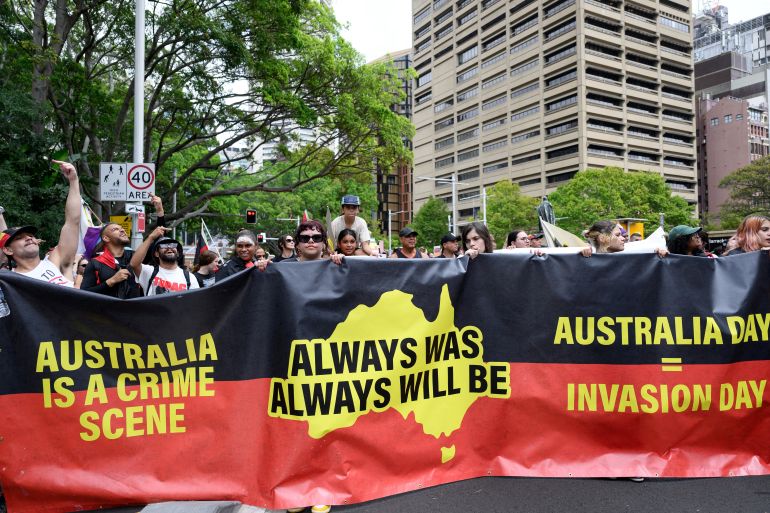
Demonstrators take part in the annual ‘Invasion Day’ rally through the streets of Sydney on Australia Day on January 26, 2026 [Steven Markham/AFP]
Indigenous people felt “absolute horror that so many people could have been injured and killed at an event like this, a peaceful gathering”, McGlade added.
The Human Rights Law Centre also called for “the violent, racist attack on First Nations people” to be “investigated as an act of terrorism or hate crime”.
“Reports by rally organisers and witnesses raise serious questions about [Western Australia] Police’s response and communication with organisers, both before and after the attack,” the legal group said in a statement.
The group also said reports that police failed “to address credible threats received ahead of the rally” should be “fully and independently investigated”.
Police alleged that the suspect removed the device from his bag and threw it from a walkway into a crowd of more than 2,000 people during the Invasion Day protest in Perth on Monday.
Alerted by a member of the public, police took the man into custody and bomb response officers inspected the device, the Western Australia Police Force said in a statement.
Bangladesh’s toppled leader Sheikh Hasina has denounced her country’s election next month after her party was barred from participating in the polls, raising fears of wider political division and possible unrest.
In a message published by The Associated Press news agency on Thursday, Hasina said “a government born of exclusion cannot unite a divided nation.”
Recommended Stories
list of 3 itemsend of list
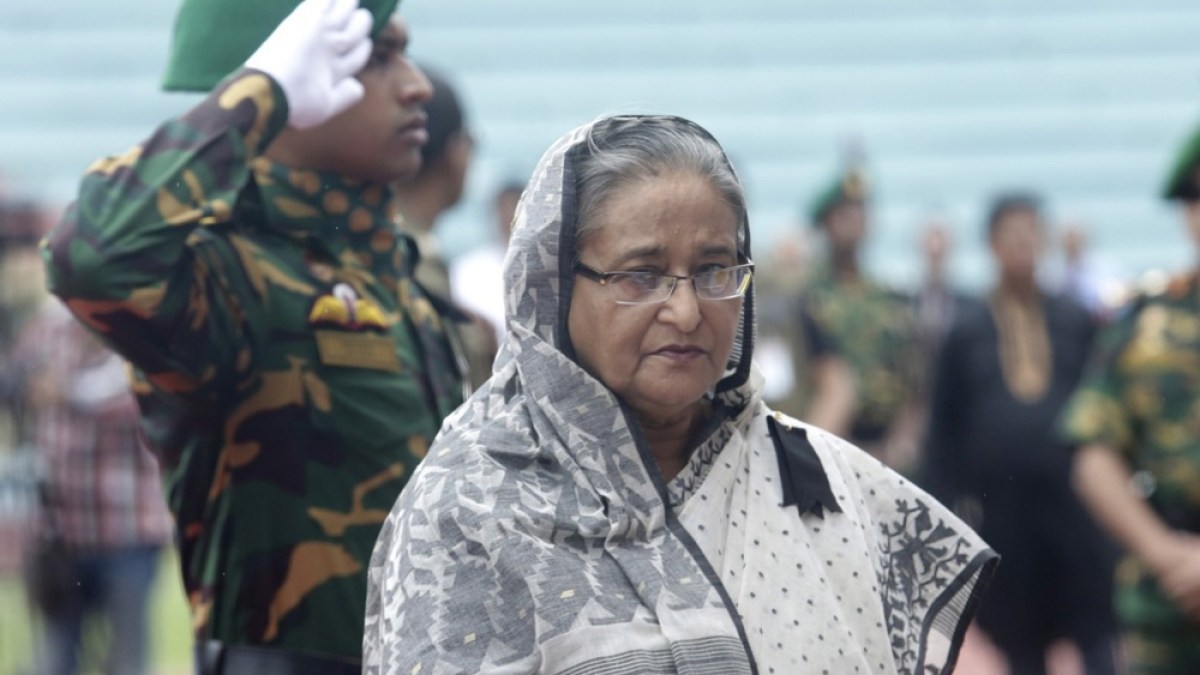
Hasina, who was sentenced to death in absentia for her crackdown on a student uprising in 2024 that killed hundreds of people and led to the fall of her 15-year government, has been sharpening her critique of the interim government of Nobel Peace winner Muhammad Yunus in recent days, as the election that will shape the nation’s next chapter looms.
“Each time political participation is denied to a significant portion of the population, it deepens resentment, delegitimises institutions and creates the conditions for future instability,” the former leader, who is living in exile in India, warned in her email to the AP.
She also claimed that the current Bangladesh government deliberately disenfranchised millions of her supporters by excluding her party – the former governing Awami League – from the election.
More than 127 million people in Bangladesh are eligible to vote in the February 12 election, widely seen as the country’s most consequential in decades and the first since Hasina’s removal from power after the mass uprising.
Yunus’s government is overseeing the process, with voters also weighing a proposed constitutional referendum on sweeping political reforms.
Campaigning started last week, with rallies in the capital, Dhaka, and elsewhere.
Yunus returned to Bangladesh and took over three days after Hasina fled to India on August 5, 2024, following weeks of violent unrest.
He has promised a free and fair election, but critics question whether the process will meet democratic standards and whether it will be genuinely inclusive after the ban on Hasina’s Awami League.
There are also concerns over security and uncertainty surrounding the referendum, which could bring about major changes to the constitution.
Yunus’s office said in a statement to the AP that security forces will ensure an orderly election and will not allow anyone to influence the outcome through coercion or violence. International observers and human rights groups have been invited to monitor the process, the statement added.
Tarique Rahman, the son of former prime minister and Hasina rival, Khaleda Zia, returned to Bangladesh after his mother’s death in December.
Rahman, the acting chairman of Khaleda’s Bangladesh Nationalist Party, is a strong candidate to win the forthcoming election.
On Friday, Hasina made her first public speech since her ouster, telling a packed press club in Delhi that Bangladesh “will never experience free and fair elections” under Yunus’s watch.
Her remarks on Friday were broadcast online and streamed live to more than 100,000 of her supporters.
The statement was criticised by Bangladesh’s Ministry of Foreign Affairs, which issued a statement saying it was “surprised” and “shocked” that India had allowed her to make a public address.
Bangladesh has been asking India to extradite Hasina, but New Delhi has yet to comment on the request.
Goma, Democratic Republic of the Congo – A year after M23 rebels seized control of Goma, the capital of eastern DRC’s strategic North Kivu province, the streets are bustling with foot and car traffic and markets operating almost as normal.
But on roads across the city, some of the most essential buildings remain shut.
Recommended Stories
list of 3 itemsend of list
On one street, the yellow and black logo on Rawbank stands above a bolted door and a shut ATM machine; nearby, the blue and white Ecobank sign stands above doors sealed by big blue shutters; and on another street, the blue and orange Access Bank logo and flags frame more locked doors.
It was early on Monday, January 27, 2025, when M23 rebels made good on their threat from a few days prior and seized Goma, before advancing in DRC’s east and taking other key cities in the weeks and months that followed.
With the deteriorating security situation, all banks in Goma shut, and ATMs stopped operating. The effects on the local population were harsh – and immediate.
Sitting at the door of a pharmacy she runs in central Goma, Sheilla Zawadi watches the traffic on the road go by, recounting the way her business and livelihood have changed in the last year.
She has an account with Access Bank, but lost her bank card just before the city fell to the rebels – and she does not have a mobile banking app to conduct transactions electronically.
Fortunately, she has a Visa card, which allows her to withdraw money – as long as she finds a bank or ATM.
So, like many others in Goma, the 37-year-old mother of three decided to make a plan – crossing from Goma into neighbouring Rwanda to find a bank.
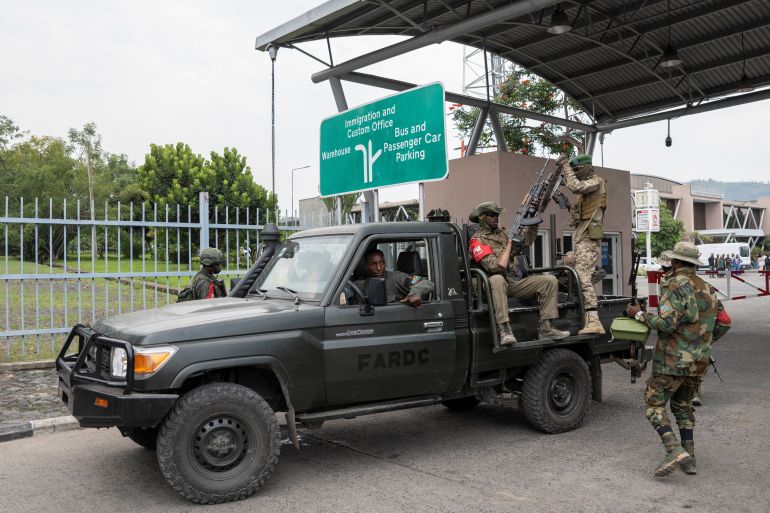
M23 rebels gather around a truck at the Goma-Gisenyi Grande Barrier border crossing, between the DRC and Rwanda, March 1, 2025 [Arlette Bashizi/Reuters]
“I had to cross the border to get to the ATMs in Rwanda,” Zawadi says.
But the workaround came with challenges – and more expense.
“To withdraw the equivalent of $100, I had to pay up to $15 in fees at the ATMs. And in Rwanda, I could only withdraw money in the local currency, which was the Rwandan franc.”
After that, she’d cross over from Rwanda, meeting informal money dealers along the border between Gisenyi and Goma, who would help change the Rwandan francs into dollars and then into Congolese francs. But she loses money with every exchange.
“It’s more expensive to withdraw money in another country. If only the banks would reopen,” she complains.
A year after banks shut, they have not resumed operations even as the security situation has normalised. The government in Kinshasa and M23 officials who now run the city trade blame about who is responsible, while the banks themselves have not said much or referred on occasion to “temporary closure” due to the “security situation”.
The border between Gisenyi and Goma is always busy. People line up in a single file to cross from one side to the other. Every day, dozens flock to ATMs and banks in downtown Gisenyi to withdraw their money the same way Zawadi does. Others also use ATMs installed at the customs office between the DRC and Rwanda.
Meanwhile, in Goma, the economy is cash-based, or, for those who can, run through electronic transfers.
In the city’s main market, traders and buyers say commodity prices have surged, while everyone is struggling to make a decent living.
“Before, we used to buy in bulk at an affordable price. Today, prices have risen sharply and customers hardly buy anything any more,” said trader Esperance Mushashine. “We’re holding on as best as we can, but the situation isn’t improving.”
Residents recover items left in the street following an attack by M23 rebels in Goma on January 28, 2025 [EPA]
Difficult for ‘economy to return to normal’
Before M23 rebels captured Goma a year ago, there were days of fighting.
The group, which is known to be backed by Rwanda, is one of 100 armed groups operating in the east. It claims to be fighting the government for the rights of DRC’s minority Tutsi population.
A couple of days before M23 took Goma, Congolese General Peter Cirimwami, the military governor of North Kivu, was killed on the front lines, reportedly in a rebel assault.
A day later, the rebels announced they would capture Goma and warned the Congolese army, its allied militias called Wazalendo, Southern African Development Community (SADC) troops, Burundian army, European mercenaries and peacekeepers to surrender.
The Sunday night before the siege, at about 10pm local time (20:00 GMT), the rebels entered the city in military clothes amid heavy gunfire and explosions.
By early Monday, they announced they were in control of Goma, while Congolese soldiers and their allied militias fled or surrendered.
The Congolese government later said thousands of people were killed in the M23 advance, while hundreds of thousands were displaced.
Afterwards, the rebels said they had brought peace to the city, as they soon advanced into other parts of DRC’s east, capturing Bukavu, the capital of neighbouring South Kivu province, and other key cities and towns over the months to come.
In Goma, many citizens found relief in the change of leadership, but for others, the challenges were only beginning.
Motorcycle taxi operators wait for customers in front of an Access Bank branch that was closed when M23 rebels took control of Goma [File: Arlette Bashizi/Reuters]
Banking transactions, withdrawals, and transfers have become a marathon – and many say they feel abandoned to their sad fate.
Gustave Katsuva, a resident of Goma, receives his assets through the Kenyan bank Equity BCDC, one of the main banks operating in eastern DRC. Despite the closure of banks in Goma, he says he continues to manage his account as if nothing had changed.
“Those of us who have been lucky enough to request or access online banking can access our money and our salaries via mobile apps, and we have lots of options for withdrawing cash. I can see notifications related to my salary payments,” he said, pointing out that he can also transfer money from his bank account to Mobile Money.
But he says he loses about 3 percent of his money every time he withdraws dollars in the city of Goma.
Economic analysts say the closure of commercial banks is weakening the local economy and has made the dollar scarce in an economy that has been dollarised for decades.
“The closure of banks and microfinance institutions does not facilitate the circulation of capital and currency,” said Deo Bengeya, a university professor in Goma. “Neither does it make it easier for the economy to return to normal.”
According to an economic analyst, who spoke to Al Jazeera on condition of anonymity, “the banks were closed following the loss of control of Goma by the authorities in Kinshasa. Billions of dollars of savers’ money cannot be left to chance in banks in a region held by rebels.” He points out that the authorities in Kinshasa were and are the “only ones responsible” if the money was lost as a result of the war, and they avoided the worst by closing the banks and moving the cash to “secure” locations far from the ”sound of boots”.
Since the fall of Goma, M23 rebel leaders and Congolese authorities have been trading accusations over the closure of banks in Goma and other regions under M23 administration.
The coordinator of the M23-AFC political-military alliance believes that holding the population’s savings against their will may constitute a war crime.
“They ordered the banks not to open. The banks are holding the savings on [President Felix] Tshisekedi’s orders,” said Corneille Nangaa Yobeluo, head of the M23-AFC.
These allegations are false, according to the Congolese authorities, who describe them as “misleading”.
“The banks are not closed by government order. No bank can legally operate under US sanctions,” Congolese Communications Minister Patrick Muyaya Katembwe emphasised during a media briefing last year.
Al Jazeera reached out to the banks to ask about the reasons for continued closure, but most did not respond. Access Bank in eastern DRC said they were “not authorised” to comment. Equity BCDC Bank did not reply, but in a rare statement published in July last year, they informed customers that “branches in Goma and Bukavu have been temporarily closed for several months due to the security situation.”
‘Elusive’ peace
Although economically, there is much to complain about following the closure of the banks and Goma International Airport, the population remains divided over the capture of Goma.
M23 leaders say they have brought peace and basic services to the city, including a stable supply of water and electricity – and many residents agree.
“Since the AFC has been here, we have seen an improvement in the overall security of the population because today, at least, we can sleep peacefully. There are no more targeted killings of motorcyclists and money changers. Peace reigns here in Goma,” says Gentil Mulume, a resident.
According to M23, there were about 50,000 armed men in the city of Goma before they seized it, and it is this over-militarisation that they say was the root cause of instability in North Kivu.
Mulume also said he noted the good faith of the AFC-M23 authorities in resolving the social difficulties of the people of Goma.
“These days, water flows in the city 24 hours a day, there is no longer a water shortage and no untimely power cuts. We are seeing work being done on the road infrastructure.”
A woman sells bananas on the shores of Lake Kivu in Goma, a year after M23 took control of the city [Moses Sawasawa/AP]
Still, other residents do not agree.
“Did they bring electricity to Goma? Did they bring water? Did they find Goma without roads?” asked Dieudonne Muweza, an architect, who believes that the M23-AFC leaders should prove themselves.
“I think the M23 leaders should show us the difference between their mode of governance and that of Kinshasa,” he observed, saying nothing has changed. He hopes for the total withdrawal of the M23-AFC from all areas under their control.
Muweza has been between jobs since M23 took over the city and wants all ongoing peace initiatives to be concluded to enable the Congolese people to enjoy an “endless peace” that seems “elusive” right now.
A year since M23’s rapid advance, peace deals mediated by the United States and Qatar have been signed by the rebels and the DRC’s government, while regional efforts also continue. The rebels recently withdrew from the city of Uvira, on the border between the DRC and Burundi, allowing the “symbolic” return of authorities installed by Kinshasa.
But for Congolese across the east of the country, the future remains uncertain.
“They [M23] have done well on security, but we are very hungry,” said David Linda, a resident of Goma. “Peace is good. People are sleeping well. The guns are silent. But we don’t have food.”
A year after her life and bank account were thrown into disarray, Zawadi, the pharmacy owner – like other businesspeople in Goma – is still finding workarounds to make a living. Most of her customers pay her using internet or mobile banking, depositing into her bank account electronically. After that, she still crosses the border into Rwanda to withdraw foreign currency and change it to US dollars and then back into Congolese francs – losing a percentage with every transaction.
In Dhaka’s political chatter, one word often keeps resurfacing when people debate who really holds the reins of the country: “Kochukhet”.
The neighbourhood that houses key military installations has, in recent public discussions, become shorthand for the cantonment’s influence over civilian matters, including politics.
Bangladesh is weeks away from a national election on February 12, the first since the 2024 uprising that ended then Prime Minister Sheikh Hasina’s long rule and ushered in an interim administration led by Nobel laureate Muhammad Yunus.
The army is not vying for electoral power. But it has become central to the voting climate as the most visible guarantor of public order, with the police still weakened in morale and capacity after the upheaval of 2024, and with the country still reckoning with a “security apparatus” that watchdogs and official inquiries say was used to shape political outcomes under Hasina.
For nearly a year and a half now, soldiers have policed the streets of Bangladesh, operating under an order that grants them magisterial powers in support of law and order. On election duty, the deployment will scale up further: Officials have said as many as 100,000 troops are expected nationwide, and proposed changes to election rules would formally list the armed forces among the poll’s “law-enforcing agencies”.
Bangladesh, a nation of more than 170 million wedged between India and Myanmar, has repeatedly seen political transitions hijacked by coups, counter-coups and military rule, a past that still shapes how Bangladeshis read the present. Analysts say that the army today is not positioned for an overt takeover, but it remains a decisive power centre: an institution embedded across the state, able to narrow civilian choices through its security role, intelligence networks and footprint inside government.
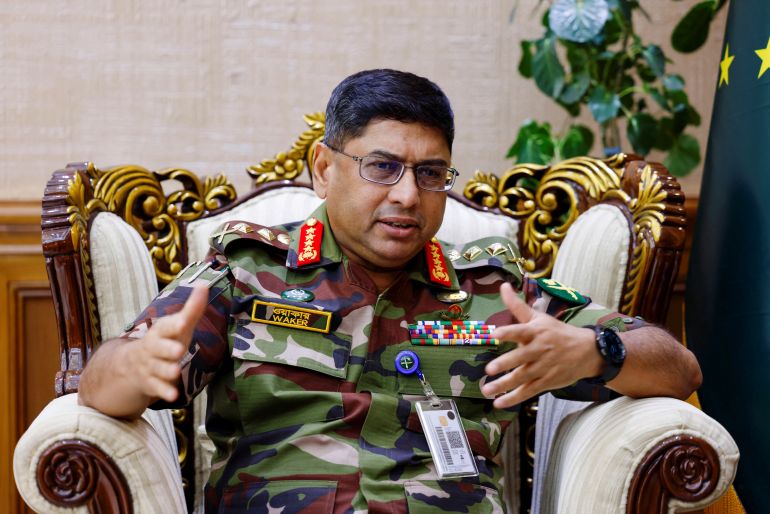
Bangladesh’s Chief of Army Staff General Waker-uz-Zaman, seen here during an interview with Reuters at his office in the Bangladesh Army Headquarters, in Dhaka, Bangladesh, September 23, 2024 [Mohammad Ponir Hossain/ Reuters]
The military’s role now
Thomas Kean, the International Crisis Group’s senior consultant on Bangladesh and Myanmar, said the army has been “backstopping the interim government” not only politically but also “through day-to-day security amid police weakness”.
He said the institution is eager to see a transition to an elected government so the country returns to a firmer constitutional footing and so troops can “return to their barracks”.
“There are different factions and views within the army, but overall I would say that the army wants to see the election take place as smoothly as possible,” Kean told Al Jazeera.
Kean argued that if the army chief, General Waker-uz-Zaman, and the military “had wanted to take power, they could have done so when the political order collapsed on August 5”, the day Hasina fled to India amid a popular student-led revolt. But the military chose not to, he said, in part because it had learned from the fallout of past experiments with its direct political control.
Asif Shahan, a political analyst and professor at Dhaka University, said the military was aware that a takeover would have also jeopardised key interests, including Bangladesh’s United Nations peacekeeping deployments, which carry both financial benefits and reputational weight for the armed forces. Bangladesh has for decades been one of the biggest suppliers to UN peacekeeping missions, and receives between $100m and $500m a year in payouts and equipment reimbursements for these services.
But Shahan argues that the military remains “an important political actor”. Today, he said, its influence is “less about overt intervention than the institutional weight it carries through the security and intelligence apparatus”.
He also pointed to what he called the army’s “corporate” footprint. That footprint spans involvement in major state infrastructure projects, the military’s own business conglomerate, and the presence of serving and retired officers across commercial and state bodies.
Shahan said the last Hasina government “gave them a share of the pie”, leaving “a kind of culture of corruption … ingrained”. He suggested that this could translate into informal pressure on whoever governs next to do the same, and anxieties inside the force over whether “the facilities and privileges” it has accumulated will shrink.
On the election itself, Shahan too said that the possibility of the army trying to gain overt control was “very low” unless there is such a major law and order breakdown that there is public demand for the army to step in as the “only source of stability”,
Others who track the military closely agreed. Rajib Hossain, a former army officer and author of the best-selling book Commando, said he “strongly believes” the army will avoid partisan involvement for its own sake. “The army will play a neutral role during this election,” he said. “What we’ve observed on the ground over the past year and a half, there is no record of the army acting in a partisan way.”
But, he added, pressure on the institution has been intense since 2024. “Internally, there’s an understanding that if the army fails to act neutrally, it could lose even the public credibility it still has,” he said.
Mustafa Kamal Rusho, a retired brigadier general at the Osmani Centre for Peace and Security Studies, also told Al Jazeera that the military does not have “any clear intent” to influence politics, though “it still remains a critical power base”.
That leverage was clearest during the 2024 uprising, Rusho said, when Bangladesh’s political crisis reached a point that many Bangladeshis and international watchdogs viewed the military’s posture as decisive. “If the military did not take the stand that it took, then there would have been more bloodshed,” he said.
With protests escalating, the military refused to fully enforce Hasina’s curfew orders and decided troops would not fire on civilians. It enabled Hasina to flee to India on an air force plane, and the army chief then announced an interim government would be formed.
In an Al Jazeera documentary on the uprising last year, Waker-uz-Zaman, who is related to Hasina and was appointed less than two months before her collapse, also stressed that his forces would not turn their guns on civilians. “We don’t shoot at civilians. It’s not in our culture … So we did not intervene,” he said.
In the same interview, he added: “We believe that the military should not engage in politics … It’s not our cup of tea.”
Bangladesh’s military leader and president, Hussain Muhammad Ershad, meeting British PM Thatcher at Downing St. London on February 16, 1989 [Wendy Schwegmann/ Reuters]
When the military ruled
That hasn’t always been the military’s position.
After the 1975 assassination of Sheikh Mujibur Rahman, Bangladesh’s founding leader and then-president, by a group of military officers, the country entered a period marked by coups, counter-coups and military rule upheavals that reshaped the state and produced political forces that still dominate elections.
One of them was the Bangladesh Nationalist Party (BNP), founded by army general-turned-ruler Ziaur Rahman, who emerged as the country’s most powerful figure in the late 1970s before moving into civilian politics. Rahman was assassinated in 1981 in a failed coup attempt by another group of military officers. The BNP remains a key contender in the February 12 vote, now led by Rahman’s son, Tarique Rahman, who has returned to front-line politics after a long exile.
In 1982, then army chief Hussain Muhammad Ershad seized power and ruled for much of the 1980s. Writer and political historian Mohiuddin Ahmed has described Ershad’s takeover as coming only months after he publicly argued that “the army should be brought in to help run the country”.
Eventually, a pro-democracy movement led by Zia’s wife, Khaleda Zia, and Hasina, also Mujibur Rahman’s daughter, forced him from office. The BNP won a landmark election, and in 1991, Khaleda became the country’s first female prime minister.
Since then, Rusho said, the military’s influence “became more indirect”, though Bangladesh still saw an abortive May 1996 showdown when the then army chief, Lieutenant General Abu Saleh Mohammad Nasim, defied presidential orders, and troops loyal to him moved towards Dhaka. Nasim was arrested and removed from office.
A decade later, in 2007, the military in effect “fully backed” a caretaker government that was formed to replace Khaleda’s second administration, which had ruled between 2001 and 2006. That caretaker government was installed in January 2007 after a breakdown in the election process and escalating political violence. The International Crisis Group described the caretaker administration as “headed by technocrats but controlled by the military”, while then-army chief Moeen U Ahmed argued the political climate “was deteriorating very rapidly” and that the military’s intervention had “quickly ended” street violence.
It was only after 2009, when Hasina came back to power – her Awami League had first ruled between 1996 and 2001 – that the military became “subordinate to the civilian regime”, Rusho said.
Bangladeshi military force soldiers on armored vehicles patrol the streets of Dhaka, Bangladesh, Saturday, July 20, 2024 [Rajib Dhar/ AP Photo]
Blurred lines
But even though the military today insists that it does not want power, it has often drifted into the political terrain.
A major moment arrived just weeks after Hasina’s ouster, in September 2024, when General Zaman told the Reuters news agency he would back Yunus’s interim government “come what may”, while also floating a timeline for elections within 18 months. The interview, which critics described as something unprecedented for a serving army chief, placed the military close to the country’s central political debate.
Hossain, the former army officer and author, criticised the public nature of the intervention. “If he [Zaman] had discussed this after sitting with all the stakeholders … the interim [administration], political parties, protest leaders … and then gone to the media, that would be acceptable,” he said. “But here, he declared it unilaterally and blindsided the government from his position of power. He had no authority to do that.”
“You may say this is an extraordinary, transitional time and the military has a role to play,” Hossain added. “But then, why do we have an administration at all?”
Shahan, the Dhaka University professor, said Zaman “came very close” to crossing the line and explained it as a product of military institutional culture after August 5. “Military organisations … like to follow standing operating procedures, order, stability,” he said. But August 5, he added, was “a political rupture” that forced the army and the nation into uncertainty: about the interim government’s longevity, legitimacy and how it would deal with the military.
Those anxieties, Shahan said, likely pushed Zaman to speak. In principle, he said, it is reasonable for the army chief to say elections are needed for stability. But “when he set a specific timeline – within 18 months – that is beyond his role”, Shahan said. “It then appears as if he is dictating.”
Shahan added that the problem becomes sharper when that kind of specificity appears to respond to a party demand; he was referring to a time when only the Bangladesh Nationalist Party was repeatedly pushing for a vote timetable.
Eight months later, in May 2025, Zaman again weighed in, telling a high-level military gathering, according to local media reports, that his position had not changed and that the next national vote should be held by December 2025. After that, Faiz Ahmad Taiyeb, a special adviser to Yunus, wrote on Facebook that “the army can’t meddle in politics” and argued that the military chief had failed to maintain “jurisdictional correctness” by prescribing an election deadline.
Around the same period, rumours emerged suggesting that Yunus had considered resigning amid political discord.
Military personnel stand in front of a portrait of then Prime Minister Sheikh Hasina in Dhaka, Bangladesh, on July 30, 2024 [Rajib Dhar/ AP Photo]
The shadow Hasina left
Another reason that analysts say the military’s role is being debated so intensely now is because of Bangladesh’s recent wounds.
During Hasina’s 15-year rule, human rights organisations argued Bangladesh’s security apparatus was often used for political control. Human Rights Watch has described enforced disappearances as a “hallmark” of Hasina’s rule since 2009.
When the United States sanctioned the Rapid Action Battalion (RAB) in 2021 over allegations of extrajudicial killings, the US Department of the Treasury said, “These incidents target opposition party members, journalists, and human rights activists.” Critics argue that security institutions became central to governance, and questions about how that machinery was used are now part of the post-Hasina political settlement.
Hossain, the former officer, said the Hasina-era legacy still echoes inside the top brass. “If you look at the leadership, the general, five lieutenant generals, and some major generals and brigadier generals, a lot of them were part of Hasina’s apparatus,” he said, “aside from a handful of professional officers”.
A report by Bangladesh’s Commission of Inquiry on Enforced Disappearances says disappearances were used as a “tool for political repression” and that the practice “reached alarming levels during key political flashpoints”, including in the run-up to elections in 2014, 2018 and 2024. The commission said it verified 1,569 cases of enforced disappearance.
In cases where political affiliation could be confirmed, the Jamaat-e-Islami and its student wing accounted for about 75 percent of victims, while the BNP and its affiliated groups accounted for about 22 percent. Among those “still missing or dead”, the BNP and its allies accounted for about 68 percent, while the Jamaat and its affiliates accounted for about 22 percent, the report said.
The commission also noted that the Directorate General of Forces Intelligence (DGFI), the military-run intelligence agency, had been “accused of manipulating domestic politics and interfering in the 2014 parliamentary elections”, and argued that perceived alignment with the Awami League compromised its neutrality.
Several senior military officers, including 15 in service, are now facing trial in a civilian tribunal on charges of enforced disappearances, murders and custodial tortures.
The proceedings have become a delicate issue in civil-military relations, as cases against serving officers in civilian courts are rare in Bangladesh’s history.
Former army chief Iqbal Karim Bhuiyan wrote on Facebook that local media had reported disagreements over the “trial process” for officers accused of crimes against humanity and that those disagreements had created what he described as a “chasm” between the interim government and the army’s top leadership.
Hossain, the former officer, however, said he disagreed. “These trials are not defaming the army,” Hossain said. “Rather, they are a kind of redemption for the institution to recover from the stigma created by the crimes of some self-serving officers.”
He argued that accountability could motivate younger officers and reduce the risk of the military being politically exploited again. Rusho, the retired brigadier general, also argued that politicisation under Hasina was driven less by formal doctrine than by executive control over careers.
“Promotions, important postings, placements … they were influenced considerably by the executive branch,” he said. “When you influence postings, some people’s loyalty often gets diverted to political masters, [and] it affects … professionalism and capability.”
Kean of the International Crisis Group said the real test for Bangladesh now would be whether it can stop the security state from being reabsorbed into partisan politics.
“The military is going to remain a powerful institution in Bangladesh, with a level of influence in domestic politics,” he said. “One hopes that the lesson of the past 18 months is that the military is better to support civilian administrations rather than be in power directly – that it can be a stabilising force, and one that is ultimately committed to democracy and civilian leadership.”
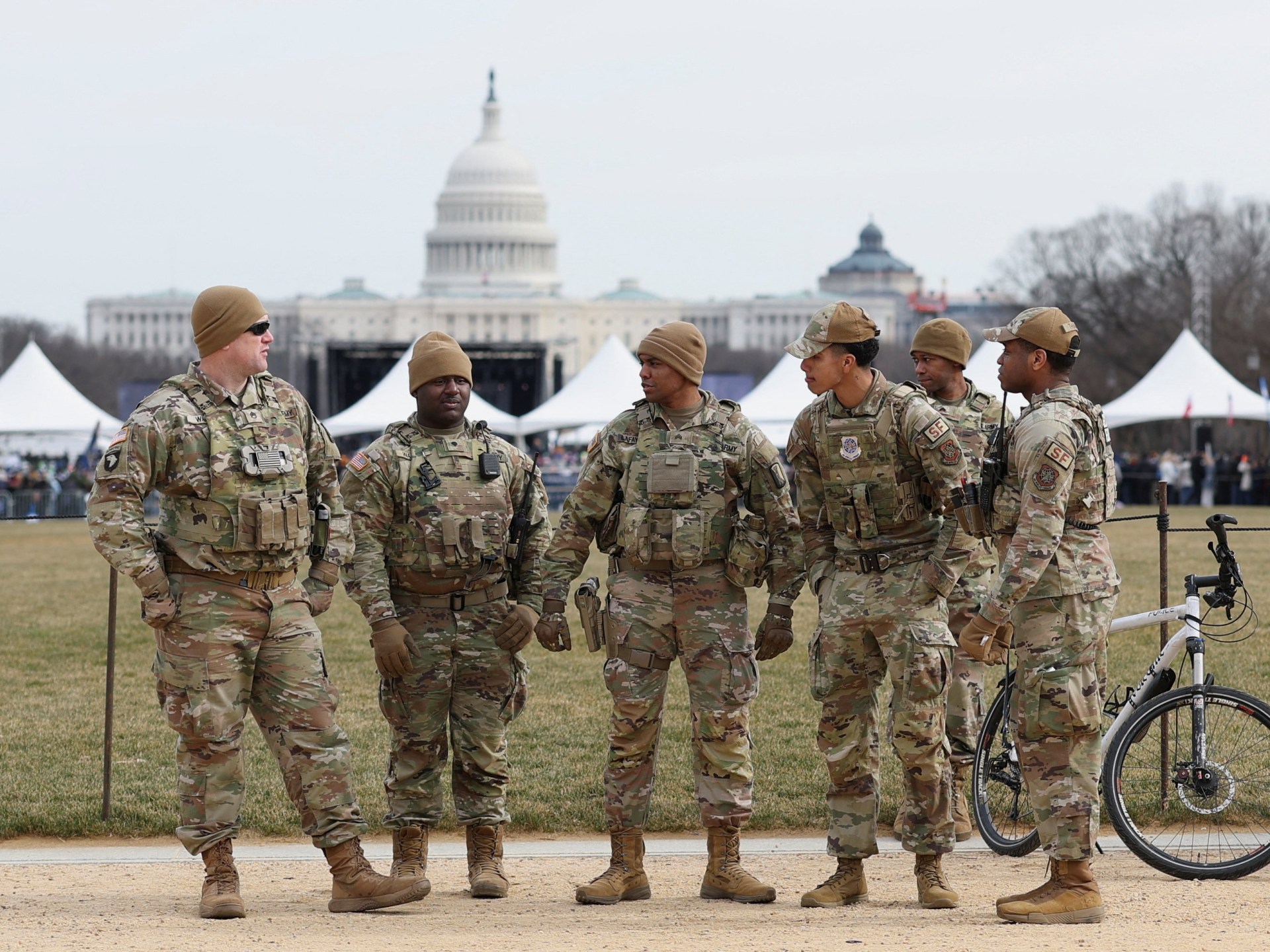
United States President Donald Trump’s deployment of troops in major US cities in 2025 cost nearly $500m, according to the latest estimates from the nonpartisan Congressional Budget Office (CBO).
Trump last year activated more than 10,000 National Guard soldiers and active-duty marines and sent them to Los Angeles, Washington, DC, Memphis, Portland, Chicago and New Orleans in what the president claimed was an effort to deter crime and protect federal immigration enforcement.
Recommended Stories
list of 4 itemsend of list
“Since June 2025, the Administration has deployed National Guard personnel or active-duty Marine Corps personnel to six US cities … [and] cost a total of approximately $496 million through the end of December 2025,” CBO director Phillip Swagel wrote in the report released on Wednesday.
The actual number of troops patrolling US streets fluctuated throughout 2025 due to legal challenges to Trump’s orders from city and state officials, and just over 5,000 remained activated by the end of December.
The CBO estimated that an ongoing deployment at that size will cost $93m a month in 2026.
Operations in Los Angeles, Chicago and Portland have all been suspended since the end of December, but they continue in Washington, DC, Memphis and New Orleans.
If Trump sends troops elsewhere, the CBO estimates that deploying 1,000 National Guards to an average US city in 2026 will cost between $18m and $21m a month in 2026, depending on the cost of living.
“The costs of those or other deployments in the future are highly uncertain, mainly because the scale, length, and location of such deployments are difficult to predict accurately,” the report said.
At $232m, the costliest military operation in 2025 was in Washington, DC, where Trump activated 2,950 troops to patrol the streets of the US capital to address what he maintained was “out of control” crime, according to the CBO.
The CBO estimates that maintaining troops in Washington, DC, will cost the city $55m a month. Trump reportedly plans to keep them in the capital through to the end of 2026.
Los Angeles was the second most costly operation in 2025 at $193m per month.
Starting in June, Trump activated 4,200 National Guard and 700 active-duty marines to patrol the city, although the operation was largely wound down within three months, according to the CBO.
Deployments in Portland and Chicago in 2025 cost $26m and $21m each month, respectively, with 400 and 375 personnel activated for each city at the height of Trump’s enforcement operation last year.
While troops have left Chicago, 200 members of the National Guard remain on standby in the state of Texas, according to the CBO, at $4m a month.
The National Guard deployment in Memphis cost $33m per month last year, and at its height, activated 1,500 personnel. The operation is still under way but local media report that the number of troops remaining is much smaller.
The United States is intensifying a military build-up off Iran that experts say could be an indicator that Washington is planning to strike the country.
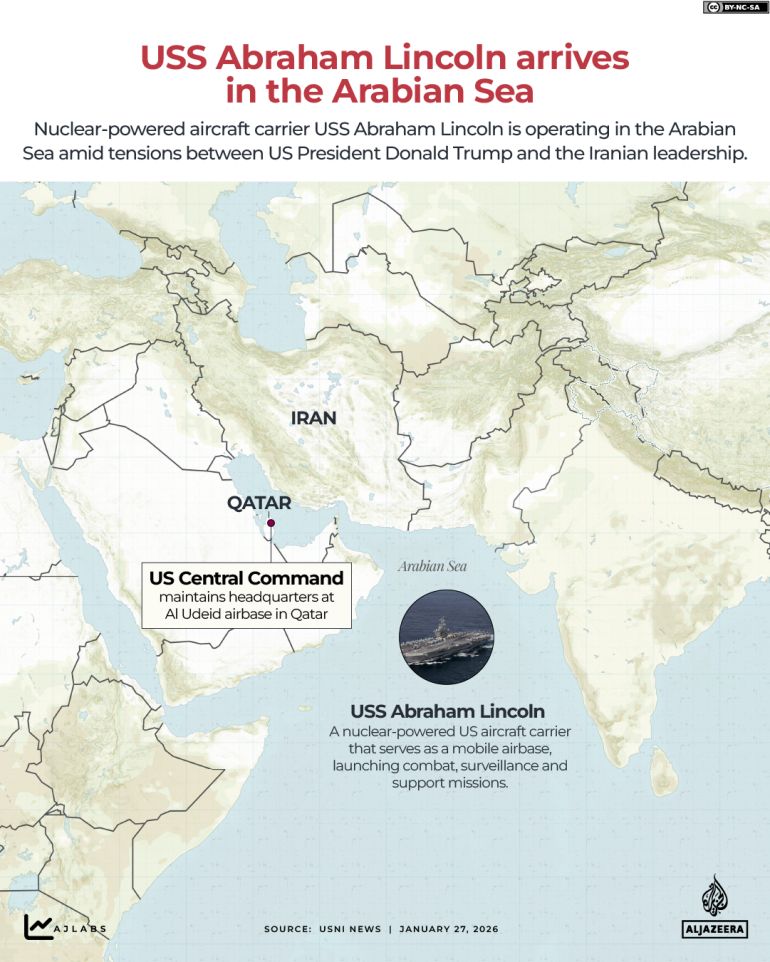
The USS Abraham Lincoln, a nuclear-powered aircraft carrier, is one of several military assets the US has deployed to the Arabian Sea in recent days.
The US also deployed assets from around the world to the region during the 12-day Iran-Israel War in June last year, when Washington sided with its ally Israel and heavily bombed three Iranian nuclear sites.
And later last year, the US stockpiled military assets in the Caribbean just weeks before launching a series of strikes on Venezuelan boats it claimed – without proof – were trafficking drugs to the US. Eventually, the US abducted Venezuelan President Nicolas Maduro from Caracas in a military assault on January 3.
Following mass protests in Iran from late December, when thousands took to the streets first to complain about the country’s failing currency, but later on, demanding government change, Iranian security forces were accused of massacring demonstrators. The United Nations special rapporteur to Iran said at least 5,000 protesters were killed, while thousands have been detained.
US President Donald Trump seized on the opportunity to lambast Iran’s clerical leaders, telling demonstrators that “help is on its way”, and threatening military action if Iran carried out executions of prisoners.
Earlier this month, Trump dialled back his threats when, he said, the Iranian government assured him there would be no executions. And, when protests were finally quashed last week, he claimed planned executions had been halted because of him, although Iran disputes that account.
Nonetheless, Trump’s rhetoric and the unusual deployment of US military assets to the coast of Iran in recent days may indicate that strikes could be imminent, some analysts say.
Speaking to reporters aboard Air Force One on Thursday last week, Trump said military forces and assets had been deployed to the region “just in case”.
“We have a massive fleet heading in that direction, and maybe we won’t have to use it,” he said.
However, he warned, if Iran does execute protesters, US military action on the country would make June’s attack on three Iranian nuclear sites “look like peanuts”.
Here’s what we know about what US assets have been deployed:
What US military assets have arrived in the region?
US Central Command (CENTCOM) confirmed in a post on X on Monday that a nuclear-powered aircraft carrier, USS Abraham Lincoln, has been sent to the Middle East to “promote regional security and stability”.
The vessel, which departed her homeport of San Diego, California in November and had been operating in the South China Sea until last week, is one of the US Navy’s largest warships.
While CENTCOM did not offer more details on why the ship had been deployed, its statement signals a large US naval deployment towards Iran at a time when tensions between Washington and Tehran have soared.
On Tuesday, the US Air Forces Central Command (AFCENT) also announced “multi-day readiness” military drills throughout its “areas of responsibility”, referring to 20-some nations in the Middle East, Asia and Africa that host US military bases.
In a statement, AFCENT said the drills would help to improve its capacity to deploy assets and personnel, strengthen its partnerships with host countries, and prepare for “flexible responses”.
“This is about upholding our commitment to maintaining combat-ready Airmen and the disciplined execution required to keep airpower available when and where it’s needed,” Lieutenant General Derek France, AFCENT commander, said in the statement.
Details regarding the locations and timing of the drills are unknown.
The US maintains a vast military footprint in the Middle East and has been expanding its assets and capabilities there since 2024, as part of its attempt to deter the Iran-backed Houthis in Yemen, who have been targeting Israel-linked commercial vehicles in the Red Sea in solidarity with Palestinians in Gaza.
There were about 40,000 US service members in the region by June 2025, according to the Council on Foreign Relations.
Overall, there are eight permanent US military bases in Bahrain, Egypt, Iraq, Israel, Jordan, Kuwait, Qatar, Saudi Arabia, Syria and the United Arab Emirates.
Other US military installations are situated in Oman and Turkiye.
Iran bombed the Al Udeid US military airbase in Doha, Qatar, on June 23, 2025, in response to Washington’s strikes on Iranian nuclear sites the day before, at the end of the 12-day Iran-Israel war. No deaths or injuries were recorded, and satellite imagery noted that military aircraft had been evacuated in anticipation of the strikes. Iran’s attack was largely seen as a face-saving exercise.
What are the capabilities of the USS Abraham Lincoln and other assets?
The USS Abraham Lincoln (CVN-72) serves as a mobile airfield and the flagship vessel of the US Navy’s Carrier Strike Group 3, an operational formation that includes several thousand personnel – likely between 6,000 and 7,000 sailors and marines.
With an overall length of 333 metres (1,092 feet), the vessel is one of the US Navy’s largest warships. It is part of a 10-member elite class of US aircraft carriers that use nuclear reactors, rather than diesel engines, to power their propeller shafts. They can operate for decades without requiring fuel.
USS Abraham Lincoln, despite its huge size, is designed for exceptional speed over extended periods. It runs at more than 56km/h (35mph), a speed at which it can quickly manoeuvre and evade attacks.
At least three destroyers – smaller, faster warships that flank the bigger vessels as escorts – are also known to be in the formation. They are Arleigh Burke-class guided missile destroyers – all-steel ships capable of launching Tomahawk missiles for land strikes and providing ballistic missile defence. All three belong to the destroyer unit assigned to USS Abraham Lincoln-Destroyer Squadron 21.
The destroyers are:
USS Frank E Petersen Jr, which features highly advanced missile launch systems
USS Spruance, known for its powerful radar and sensor systems. It is similarly armed with multiple missiles, including anti-submarine missiles
USS Michael Murphy, a newer model of the Spruance
Carrier strike formations also usually include a cruiser, an attack submarine and one replenishment ship.
The USS Mobile Bay guided-missile cruiser, used to launch missiles or detect incoming threats, is typically deployed alongside the USS Abraham Lincoln. But it’s unclear if the vessel has arrived with the fleet this time.
The air unit assigned to the USS Abraham Lincoln, Carrier Air Wing 9 or Shoguns as they are nicknamed, were involved in multiple US strikes against Yemen’s Houthis in 2024. The group has between eight and nine squadrons and around 65 fighter aircraft, mainly strike fighters like the F/A-18E Super Hornet – a speedy, single-seat strike fighter used for precision strikes, reconnaissance and refuelling missions.
What happened during the 2025 June attack?
On the night of June 22, 2025, US forces attacked three Iranian nuclear sites simultaneously during an elaborate mission codenamed Operation Midnight Hammer, which involved 4,000 military personnel.
The sites, located in Fordow, Natanz and Isfahan in Iran, were all heavily damaged, with the US assessing that Iran’s nuclear capabilities had been severely hampered.
Fordow, an underground enrichment facility built deep into the mountains, was hit with 12 Massive Ordnance Penetrator (MOPs) or “bunker-buster” bombs delivered from seven B-2 stealth bomber planes. The 13,000kg (28,700lb) GBU-57 MOP is the most powerful bunker-buster bomb, able to penetrate 60m (200 feet) below ground and deliver up to 2,400kg (5,300lb) of explosives, while the bombers are hard to detect due to their specialised shaping and radar-absorbent materials that reduce reflection.
Natanz, Iran’s second-biggest enrichment facility, was also hit with two MOPs.
Isfahan, a research facility, was targeted with more than 24 Tomahawk missiles fired from a US submarine, likely the USS Georgia.
President Trump revealed that F-35 and F-22 fighter jets also breached Iran’s airspace in anticipation of a retaliatory strike by Iran. A total of 125 aircraft were involved in the mission. All successfully withdrew before Iran could respond to the surprise bombing.
It was the first time the US launched strikes on Iranian soil. In January 2020, the US targeted and assassinated Iranian major general Qassem Soleimani in a drone strike, but that was while he was near Baghdad Airport in neighbouring Iraq.
Days before the June 2025 attacks on Iran, media reported that US military assets were moving unusually. On June 21, for example, the US deployed six B-2 stealth bombers towards Guam, but it was later revealed that this had been a decoy mission to maintain an element of surprise.
Two carrier strike groups accompanying the USS Carl Vinson and USS Nimitz had also been positioned in the Arabian Sea ahead of the attack. The USS Thomas Hudner, an Arleigh Burke-class guided-missile destroyer, was meanwhile moved to the eastern Mediterranean.
How ready is the US for another attack on Iran?
Analysts say the new military build-up off Iran could signal an imminent, albeit likely a limited, attack on Iran – one that would probably be aimed at Iran’s government following its brutal crackdown on protesters this month.
Ellie Geranmayeh, from the European Council on Foreign Relations, told Al Jazeera that Trump could justify such an attack – and possibly even a regime change – by arguing that the US wants to protect civilians. But the risks of a military intervention, she added, are significant, and there are no guarantees that Iranians would be better off as a result.
“If America launches significant attacks, possibly with a regime change endgame, Tehran is likely to directly increase the cost to Trump in an election year by targeting American soldiers stationed across the Middle East,” she said.
Iran, Geranmayeh warned, would suffer in a US attack, but it also has the capacity to inflict damage on the US and its allies, particularly by attacking oil facilities and blocking international shipping routes. Iran, she said, could also strike US allies such as Israel.
Although the Iranian government chose not to escalate the conflict following the June 2025 attacks, there is no assurance it will do the same again, the analyst added.
“If its regime stability comes under unprecedented existential threat from ground-up pressure domestically and bombing from the skies, the Islamic Republic is likely to use all its cards before they lose them,” she added.
However, Ali Vaez, from the International Crisis Group, told Al Jazeera that an attack may not happen at all, since a justification on human rights grounds would not be timely.
“It’s hard to imagine that a strike is imminent – the protests have already been crushed,” he said. Besides, he added, military strikes on Iran would be expensive, and the end goal of such a costly intervention for the US is not clear.
Vaez agreed that it would likely be Iran’s 92-million population that would bear the brunt of military action if diplomatic channels fail and the situation escalates.