Israel has killed at least 18 Palestinians in attacks across Gaza – one of the deadliest days since the October “ceasefire” – as the evacuation of Palestinian patients and wounded via the Rafah crossing was suspended for Wednesday.
Israel has killed 529 Palestinians since the US-brokered ceasefire. At least 71,803 Palestinians have been killed in Israeli attacks since the war began on October 7, 2023. Rights groups and a United Nations inquiry dubbed Israeli military actions a genocide. A case of genocide against Israel is under way at the International Court of Justice.
Recommended Stories
list of 4 itemsend of list
Reporting from Khan Younis, Al Jazeera’s Abu Azzoum said the attacks, despite the so-called “ceasefire” supposedly in place, had left Palestinians in Gaza “without any sense of respite”.
“There has been a surge in Israel’s military activities across Gaza in the past few hours,” he said.
“We can hear the … sound of Israeli drones hovering overhead, giving a sign of further potential attacks that might take place.”
Among the casualties were a number of children, medical sources said on Wednesday.
The dead included 14 people killed by Israeli shelling in northern Gaza, an Al Jazeera team on the ground reported.
In further attacks in the south of the Strip, at least four people were killed in Israeli shelling of displaced people’s tents in the Qizan Abu Rashwan area, south of Khan Younis, an Al Jazeera team reported, citing medical sources.
Despite the US-brokered “ceasefire” between Israel and Hamas that came into effect in October, Israel has continued to kill hundreds of Palestinians across the Strip.
Amid the latest attacks, Israel’s military said its armoured units and aircraft had conducted strikes in northern Gaza after a reserve officer came under fire, severely injuring him.
It said the injured officer had been evacuated to hospital after the incident, which took place “during routine operational activity” near the so-called “yellow line” demarcating areas under Israeli military control.
Abu Azzoum said Israel was moving the location of the “yellow line” in eastern Gaza, causing anxiety for residents there.
Rafah crossing evacuation suspended
Amid the uptick in Israeli attacks, the Palestinian Red Crescent said on Wednesday Israel has canceled the coordination for a third batch of Palestinian patients to leave the Gaza Strip through the Rafah crossing.
“Unfortunately, a few minutes ago, we were… informed that the evacuation process of today has been cancelled,” Raed al-Nims, a spokesperson for the Palestinian Red Crescent Society (PRCS), told Al Jazeera from Khan Younis in Gaza. He said that Israel informed the organisation about the move on Wednesday morning.
Al-Nims added that the procedure should have seen sick and wounded people arrive at the Red Cross Society hospital for preliminary medical checkups before being transferred by ambulance to the Rafah crossing, then to Egyptian hospitals or elsewhere.
Only five Palestinian were permitted to leave for Egypt on Monday and only 16 on Tuesday – numbers far below the 50 Palestinians who Israeli officials said would be allowed to leave via the crossing daily.
Israel now says the World Health Organization (WHO), which is responsible for coordinating the arrival of residents from the Gaza Strip to the Rafah Crossing, has not submitted the required coordination details. COGAT, the Israeli defence ministry body overseeing civil affairs in the Palestinian territories, in an X post said that the WHO has not submitted “the required coordination details at this stage for procedural reasons”.
There’s no response from the WHO so far.
Israel agreed to open the key crossing – the Gaza Strip’s only gateway to the outside world – after weeks of delay, but has placed restrictions on the movement of people through the crossing.
Only Palestinians who left Gaza during the war, and have passed strict security vetting from Israeli authorities, are being permitted to return.
Those who have recently returned have described being blindfolded, handcuffed, interrogated and sexually harassed as they made the trip.
More than 18,000 Palestinian patients are also awaiting medical evacuations through the crossing, including about 440 critical cases that need immediate attention, Gaza health officials say.
Al Jazeera’s Tareq Abu Azzoum said Israel was not giving any explanation as to why some Palestinians were being denied permission to leave or return to the Strip.
Palestinian killed in Jericho raid
While the killings have played out in Gaza, Israeli forces have also carried out attacks in the occupied West Bank.
Saeed Na’el al-Sheikh, a 24-year-old Palestinian man, was shot and killed by Israeli forces on Tuesday night during a raid on the city of Jericho, in the east of the occupied West Bank, Wafa news agency reported.
The Health Ministry said three other Palestinians were wounded.
Barcelona ended Albacete’s giant-killing run in the Copa del Rey, winning 2-1 away on Tuesday to become the first side to book a semifinal berth, but only after surviving a late comeback from the second-tier outfit.
Lamine Yamal swept home a 39th-minute strike to open the scoring and captain Ronald Araujo netted from a second-half corner as Barcelona stayed on course to defend the trophy they won last year.
Recommended Stories
list of 4 itemsend of list
Albacete pulled one back through Javier Moreno in the 87th minute and then had an effort cleared off the Barca line in stoppage time as they made a late bid for another high-profile scalp.
Albacete, who sit in 12th spot in the Spanish second division, had upset Celta Vigo and Real Madrid in the previous rounds but went behind in the quarterfinal tie when Marcus Rashford helped steal the ball, passing to Frenkie de Jong, who in turn set up Yamal for a sweeping left-footed finish.
Rashford had squandered an early chance, and Dani Olmo had a volleyed effort deflected for a corner before Yamal broke the deadlock.
Yamal scored his first goal in this season’s Copa del Rey tournament in the 39th minute against Albacete [Manu Fernandez/AP]
Albacete had two quick chances to equalise before the break, but centre forward Antonio Puertas failed to make the most of either opportunity.
Olmo had another shot blocked after Rashford’s run had set him up from close range in the 47th minute, but Barcelona did double the score nine minutes later when Araujo headed home in his first start since taking a mental health break in December.
Journeyman attacker Jefte Betancor, who had scored twice for Albacete against Real last month, could have got his side back into contention, but failed to make an immediate impact off the bench when he shot wide in the 63rd minute and then missed with a free header 10 minutes later.
But Moreno steered home a diving header from a free kick to reduce the deficit in a frenetic finale that then saw Ferran Torres tuck the ball away for what Barca thought was their third goal in the 89th minute, only for it to be ruled offside.
Albacete then laid siege to the La Liga leaders, forcing Gerard Martin to make a dramatic clearance off the line.
Deportivo Alaves host Real Sociedad and Valencia are home to Athletic Bilbao on Wednesday in other Spanish Cup quarterfinals, while Atletico Madrid visit Real Betis on Thursday.
The Cavaliers and Clippers have finalised a trade that sends 11-time All-Star James Harden to Cleveland, with Darius Garland and a second-round pick going to Los Angeles, ESPN and The Athletic both reported late on Tuesday.
Harden, 36, was held out of the Clippers’ lineup the last two games for what the team labelled personal reasons.
Recommended Stories
list of 4 itemsend of list
The former NBA MVP and three-time scoring champ is averaging 25.4 points, 8.1 assists and 4.8 rebounds in 44 games this season, his 17th in the NBA.
Harden could block any trade because he is technically under contract for just this season, which requires his approval for the swap. The second year of his two-year, $81.5m deal is a player option, which is not fully guaranteed.
Garland, 26, has been sidelined since January 14 with a Grade 1 right toe sprain.
The two-time All-Star is averaging 18.0 points and 6.9 assists over 26 games this season. He is in the third year of a five-year, $197.2m contract.
The Cavaliers (30-21) are in contention in the Eastern Conference, one of four teams with either 30 or 31 wins behind first-place Detroit (36-12), which explains the desire to make a big move by acquiring Harden.
The Clippers, 23-26, remain in play-in contention in the West, currently in ninth place.
The NBA trade deadline is Thursday at 3pm ET (20:00 GMT).
Harden, centre, is averaging 25.4 points per game this season, his highest scoring clip since 2020-21 [Bart Young/Getty Images via AFP]
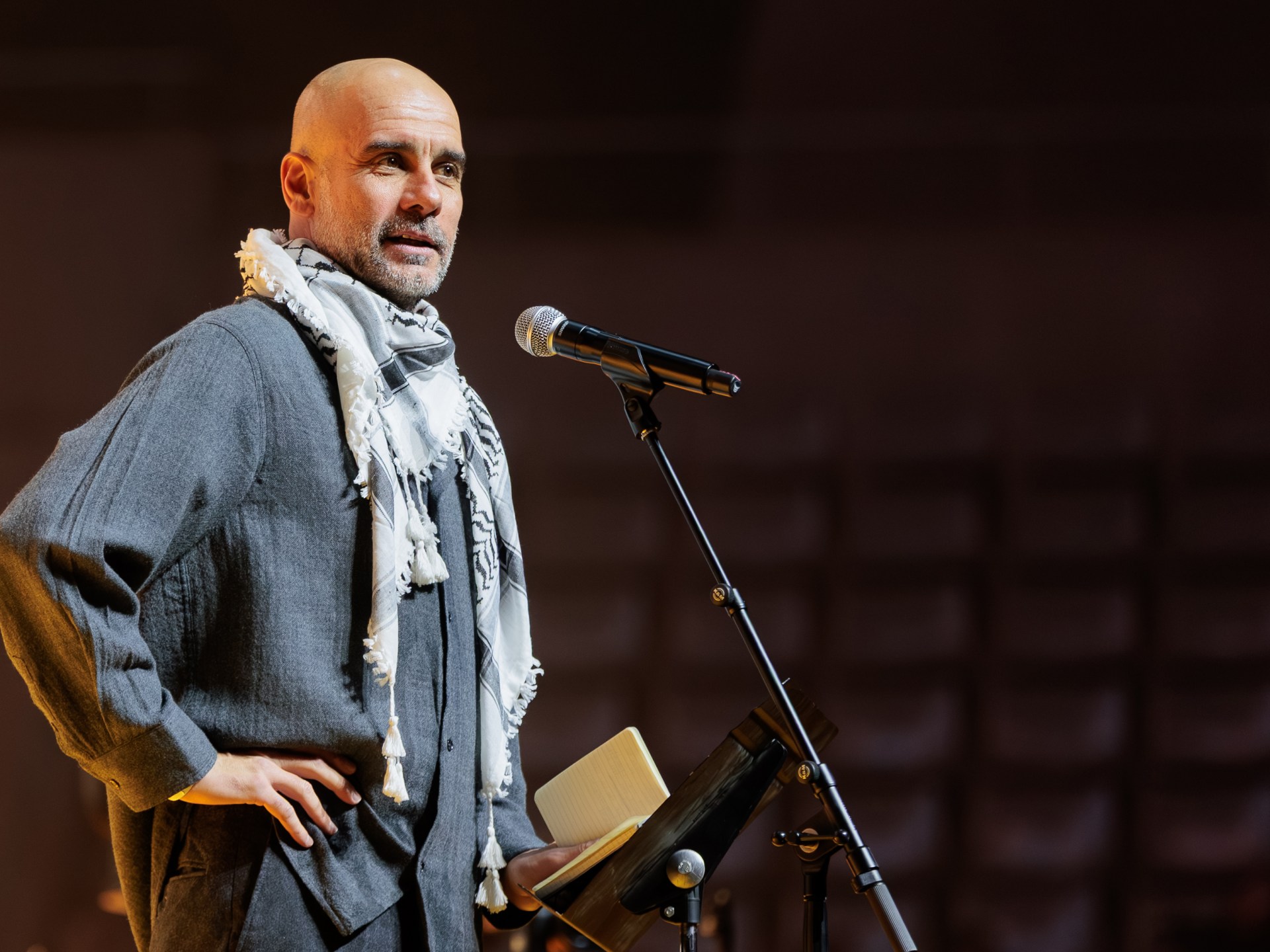
Pep Guardiola has again voiced his support for the people of Palestine, saying he will continue to speak out on Israel’s genocidal war on Gaza to help bring justice and peace.
On Tuesday, the Manchester City manager used the pre-match news conference for his team’s English League Cup match against Tottenham Hotspur as a platform to highlight the plight of people affected by wars across the world, especially in Gaza.
Recommended Stories
list of 4 itemsend of list
“Never, ever in the history of humanity have we had the information in front of our eyes watching more clearly than now,” Guardiola told reporters in Manchester, England.
“The genocide in Palestine, what happened in Ukraine, what happened in Russia, what happened all around the world – in Sudan, everywhere,” he said.
“What happened in front of us? Do you want to see it? It’s our problems as human beings. It’s our problems.”
The 55-year-old voiced his feelings on the images coming out of the war-torn regions, saying they hurt him deeply.
“If it was the opposite side, it would hurt me,” Guardiola said.
“Wanting harm for another country? It hurts me. To completely kill thousands of innocent people, it hurts me. It’s no more complicated than that. No more.
“When you have an idea and you need to defend it, and you have to kill thousands, thousands of people? I’m sorry, I will stand up. Always, I will be there, always.”
The Catalan said the protection of human life was of foremost importance.
“What is happening right now, with the technologies and advances that we have, the humanity is better than ever in terms of possibilities. We can reach the moon; we can do everything.
“But still, right now, we kill each other. For what? When I see the images, I am sorry, it hurts.
“That is why in every position I can help by speaking up to be a better society, I will try and will be there. From my point of view, the justice? You have to talk.”
Israel’s genocidal war on Gaza has killed at least 71,803 people and wounded 171,575 since October 2023. At least 10 people, including a four-year-old girl, were killed by Israeli attacks on Wednesday.
Guardiola has repeatedly voiced his support for the Palestinian people, and it was the second time in five days that he addressed the genocide in Gaza in his public comments.
“We have left them alone, abandoned,” Guardiola, wearing a keffiyeh, said on January 29 as he condemned global silence over the suffering of Palestinian children in Gaza during a charity event in Spain.
The Spanish manager was visibly moved when he was asked why he felt the need to speak about Palestine at the event.
Last year, Guardiola said images of children being killed during Israel’s genocidal war on Gaza left him “deeply troubled”.
He is one of the few prominent sports managers to have repeatedly raised his voice for the Palestinians.
“There is not a perfect society, nowhere is perfect, I am not perfect, we have to work to be better.”
“I have a lot of friends in many, many countries, a lot of friends. When you have an idea and you need to defend [it], and you have to kill thousands, thousands of people, I’m sorry, I will stand up. Always I will be there, always.”
Guardiola also remarked on the two fatal shootings by federal law enforcement officials of American citizens, which have led to a broad backlash against United States President Donald Trump’s crackdown on undocumented immigrants.
“Look what happened in the United States of America, Renee Good and Alex Pretti have been killed,” said Guardiola, who asked what would happen if a nurse like Pretti were shot in the United Kingdom in those circumstances.
“Imagine [someone from] the NHS [National Health Service] — five, six people around him, go on the grass”, and was shot.
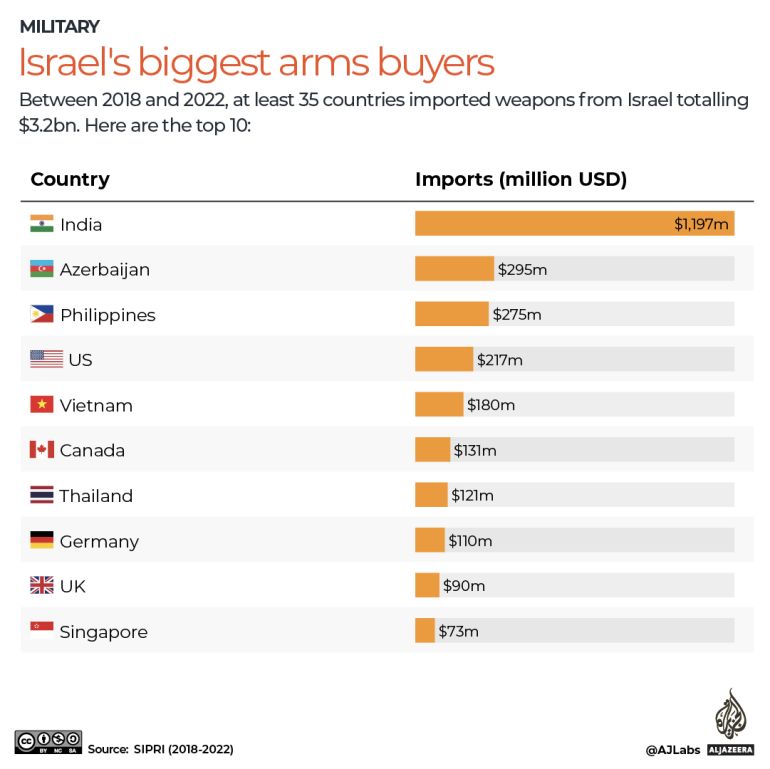
Athens, Greece – Greece is interested in jointly developing weapons with Israel, Greek officials have told Al Jazeera.
“We’re an excellent customer of Israeli systems,” Angelos Syrigos, chairman of the Greek parliament’s Defence Affairs Committee, told Al Jazeera. “The leap in our defence relationship will happen when there’s co-production of defence systems and common planning.”
Recommended Stories
list of 4 itemsend of list
The relationship is strengthening as Israel stands accused of committing genocide against Palestinians in Gaza.
On December 4, Greece’s Defence Affairs Committee approved the purchase of 36 PULS rocket artillery systems at a cost of $760m, the largest Greek acquisition of Israeli weapons to date.
The medium-range air defence system is to form part of Greece’s Shield of Achilles, a 2.8-billion-euro ($3.3bn) layered air defence umbrella announced last year.
Syrigos said that if co-production were on the table, the remainder of that budget could be devoted to Israeli systems.
(Al Jazeera)
Greece is nominally a member of the European Sky Shield Initiative (ESSI) formed by Germany in 2022 as a vehicle to sell mostly German air defence systems such as Iris-T and Skyranger. But Greece is not known to have entered into talks to buy those systems.
In contrast, Greece’s Ministry of National Defence last month formed negotiating committees to buy three additional missile defence systems, Spyder, Barak and David’s Sling, produced by the Israel-owned Rafael and Israeli Aerospace Industries, worth a potential 3.1 billion euros ($3.5bn).
The three systems, comprising short, medium and long-range air defence against airborne threats including ballistic missiles, would complete the Shield of Achilles.
Greece and Israel are discussing a government-to-government deal that bypasses a competitive bid process.
“Otherwise, everyone would come in and tender an offer, which Greece wants to avoid,” Kathimerini newspaper’s foreign and defence affairs reporter Vassilis Nedos told Al Jazeera.
He explained why Greece prefers to award the contracts directly to Israel: “Israel has no problem giving you a qualitative edge. With other suppliers, you have to negotiate it.”
The procurement advisory committees, made up of officers from all four branches of the armed forces, are also discussing a “360 approach” involving unmanned aerial, surface and underwater vehicles with their Israeli counterparts, said Nedos.
“We’ve also discussed ballistic missiles with other countries,” Syrigos said, without specifying which ones.
Greek Defence Minister Nikos Dendias confirmed on January 20 that Greece wants to move towards co-development.
“Israel, until a few decades ago, bought all the weapons it needed for its defence, and today it is at the summit of defence technologies,” Dendias said during a visit from his Israeli counterpart. “Our goal is for Greece to transition from a customer and buyer of defence systems to a co-producer of low-cost, dual-use, innovative products.”
Dealing with Israel amid genocide ‘a problem’
But not everyone agrees that emboldening ties with Israel amid its ongoing deadly assaults on Gaza is a good thing.
“Not dealing with an international human rights issue because you’re putting your strategic relationship first, is a problem,” said Lefteris Papagiannakis, head of the Greek Council for Refugees, a legal aid group for refugees, referring to the ethnic cleansing of Palestinians in Gaza.
“If you don’t want to call it genocide, then don’t, but as a humanitarian country, you have to do more than the bare minimum … It’s as if Greece is copying Israel’s defence model, and becoming the second-most heavily armed state in the east Mediterranean.”
But if Israel and the United States ever have a “rupture in their relationship for whatever reason”, Greece will find itself in a difficult position, he added.
Pro-Palestinian demonstrators throw red paint on mock bodies during a protest as part of a two-day campaign called ‘Target Souda Base for Palestine’, calling for the closure of the naval base in Souda Bay and denouncing Greece’s involvement in the conflict, on the island of Crete, Greece, on October 18, 2025 [Stefanos Rapanis/Reuters]
Last year, the left-wing opposition Syriza party suggested Greece’s national team boycott a friendly basketball match with Israel.
“While famine in Gaza is killing thousands of people, [Israeli Prime Minister] Benjamin Netanyahu is openly declaring that his goal is ethnic cleansing,” said a party announcement, referring to Israel’s efforts to eject two million Palestinians from Gaza into Jordan and Egypt. “More and more countries are denouncing these genocidal policies.”
Shared threat perceptions
Greece and Israel drew closer after 2010, when Israeli-Turkish relations frayed over Turkish aid to the Palestinians following clashes in the Gaza Strip between Palestinian armed groups and the Israeli army.
As Greece and Israel drew closer, they formed a trilateral relationship with Cyprus, initially to discuss common energy projects, but now extending to security and defence.
The three countries share similar threat perceptions from Turkiye, and Ankara has referred to their relationship as an “anti-Turkish” alliance.
Panathinaikos fans raise a banner on the day of their EuroLeague game against Maccabi Tel Aviv at the OAKA Indoor Stadium, in Athens, Greece, on November 12, 2024 [Alkis Konstantinidis/Reuters]
In April 2019, they discussed a radar system based in all three countries to cover the Eastern Mediterranean. In December 2025, they signed a military cooperation work plan.
“Those who dream of dragging the region backward … will encounter a resolute alliance of free, strong nations capable of defending themselves,” Israeli Defence Minister Israel Katz said during his visit to Athens on January 20, in what was widely interpreted as a thinly veiled reference to Turkiye.
The Israeli-Turkish relationship has further deteriorated since December 2024, when forces backed by Ankara seized control of Syria.
Greece and Israel have since begun joint military exercises.
The extent to which Greece now sees its security as bound up with Israel’s was revealed in a recent interview by Greek Deputy Foreign Minister Alexandra Papadopoulou with To Vima newspaper.
“Imagine how Greece could survive on the edge of Europe amidst a completely Muslim region, if Israel should cease to exist,” she said.
Is cooperation possible?
On February 2, the Hellenic Aerospace Industry announced it had taken a step in this direction, by combining its own Centaur anti-drone electronic warfare system with Israel Aerospace Industries’ Barak anti-drone hard-kill rocket system, providing a soft-kill, hard-kill combined weapon.
“We are in conversation with a number of companies, including Israeli companies, to jointly develop systems,” said Hellenic Aerospace Industry CEO Alexandros Diakopoulos. The goal, he told Al Jazeera, was “to have joint development and co-production, with a transfer of knowledge.”
Both HAI and IAI are state-owned, but Greece and Israel have very different corporate and government cultures.
“Israeli state companies are no different to private sector companies. But Hellenic Aerospace Industry unfortunately has so many problems that [I doubt] its administration can go out and borrow $5m, or hire people. The law doesn’t allow it to operate like a private company and hire the people it needs to hire,” Tassos Rozolis, the president of the Greek Association of Defence Industries, told Al Jazeera.
“Greece is a very friendly nation to Israel and presently the cooperation between the two governments is very tight and very intimate,” Israeli former Prime Minister Ehud Olmert told Al Jazeera. “And therefore, I think that on that basis, there is likelihood that many of the products which are produced by the Israeli companies, security defence companies, will be allowed in this kind of relationship to be sold to Greece.”
But can political intimacy make up for legal and administrative sclerosis in Greece?
Cox’s Bazar, Bangladesh – On a Thursday afternoon, 19-year-old Mahmudul Hasan prepared seating on the floor of his bamboo-and-tarpaulin home in Balukhali Rohingya Refugee camp.
Minutes later, 35 young children trooped in. Hasan is still in his teens, but he is their teacher. They greeted him in Rakhine language: “Sayar, Nay Kaung Lar? [Sir, how are you?]” The children are among 80 who study at Hasan’s community-run private school, where he teaches them Burmese, English and maths.
But nearby, a Bangladeshi government official on a motorcycle was trying to educate all those who would listen about something else: He was making announcements about the country’s upcoming February 12 elections.
Between February 9 and February 13, the official yelled out on a microphone, people in the refugee camp should keep their shops shut and not venture outside the camp. And he warned them: Anyone found participating in any political campaign would receive “serious punishment” – they could lose their registration card and a separate document that allows refugees access to subsidised rations.
The camps in Cox’s Bazar are home to more than 1 million Rohingya refugees, who were forced to flee Myanmar in 2017 after a brutal military crackdown. At a time when most countries shunned them, Bangladesh – under then Prime Minister Sheikh Hasina – gave them shelter. But the election season warnings to them were a reminder of how, at the same time, life in Bangladesh is life in limbo: Limited education, health, rations, livelihood options, and freedom of movement.
As Bangladesh’s 127 million voters prepare to elect their next government, Rohingya refugees like Hasan know that they aren’t real stakeholders.
“I don’t have any new expectations,” Hasan told Al Jazeera. “I deserve to live with dignity and human rights. This life [in Bangladesh] is not my choice.”
Still, he conceded, candidates from the two main political fronts in the election – the alliances led by the Bangladesh Nationalist Party and the Jamaat-e-Islami – in the Ukhia and Teknaf regions where the Rohingya camps are based, have spoken of the community’s concerns, as have national leaders from these parties.
That gives him some hope to cling to.
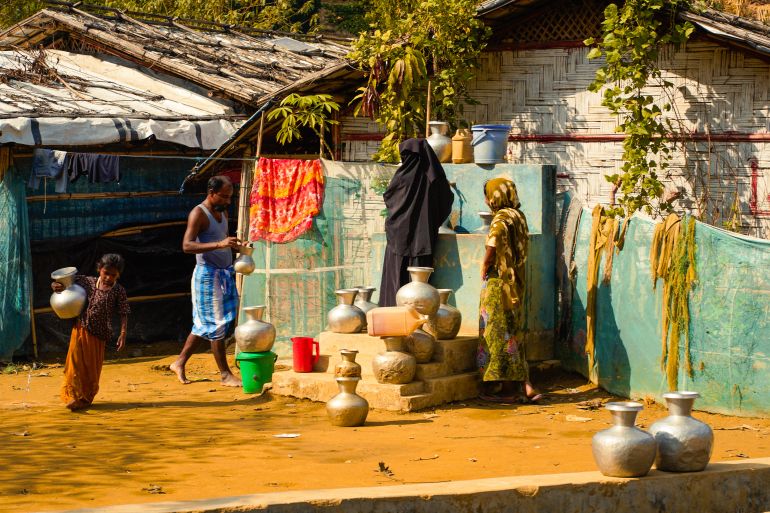
A Rohingya family outside their temporary home in a camp in Cox’s Bazar, Bangladesh [Sahat Zia/Al Jazeera]
‘It’s not sufficient’
Hasan arrived in Bangladesh with his family when he was 10 years old in 2017, with other Rohingya refugees.
The massacre of the Rohingya in Myanmar – where the community’s members are not even considered citizens – is currently being investigated by the International Court of Justice as a possible genocide. Meanwhile, in November 2024, the International Criminal Court issued an arrest warrant against Myanmar’s military chief, Min Aung Hlaing, accusing him of committing crimes against the Rohingya in 2017.
Since then, Bangladesh has been home to the biggest chunk of Rohingya refugees globally.
But Nay San Lwin, a diaspora leader of the Rohingya and a co-chair of the Arakan Rohingya National Council (ARNC), said that while the community was grateful to Bangladesh’s government and people, the country’s policy of “non-integration” of the Rohingya meant that they remained on the peripheries of society. The camps are fenced with barbed wire, and Rohingya children can’t access the formal education system of Bangladesh, for instance.
“The elected government in February should focus on improving living conditions, access to education, healthcare, livelihoods, and fostering greater engagement between refugees and host communities,” he said.
That’s easier said than done, though. The Rohingya camps have run with financial support from the United Nations and global aid agencies – and funding cuts in recent years have hobbled the already limited services available to residents.
“The humanitarian situation continues to deteriorate due to insecurity, funding cuts, lack of education, and uncertainty about the future,” said Sayed Ullah, president of the United Council of the Rohingya, a community organisation.
Hafez Ahmed, a 64-year-old shopkeeper in the camp, said medical facilities there were getting worse. “We only got the basic medicines they provide in the hospital. If any critical illness is detected, hospitals advise us to seek treatment at private hospitals, but we don’t have the money,” he told Al Jazeera. “Rations are getting less; it’s not sufficient.”
And for young Rohingya like the teenage teacher Hasan, life in the camp is one of dashed dreams.
“Living camp life is a trauma; camp life is like prison life,” he said. “I wanted to be a world-class teacher who contributes to world education, but what can I say to myself, a fateless one?”
Growing frustrations with life in Bangladesh have led more and more Rohingya refugees to try to repeat the perilous journeys they once took to get to the country – to go elsewhere this time.
In a joint statement issued in November, the UN refugee agency (UNHCR) and the International Organization for Migration (IOM) said that in 2025, more than 5,300 Rohingya refugees embarked on dangerous maritime journeys. Many left Myanmar, but others were also trying to flee Bangladesh. In all, more than 600 are missing or have been killed.
Bibi Khadija, 23, is among those who tried to leave the refugee camps in Bangladesh. In November, she said, she tried “to go to Malaysia in search of a better life”. But after a human trafficker detained her and her three-year-old son, she escaped with the child. As she tried to make her way back to the camp, she asked locals in a market for help. Instead, she said, they “beat” her. “You are the Rohingya; you always create problems for us,” she recalled the mob telling her. Eventually, another local – a stranger – gave her some money to help her get back home.
Khadija’s story isn’t unique: The Rohingya in Bangladesh today sit at the intersection of a complex narrative, say experts – both treated as victims of a possible genocide, and held responsible for crime and strained social services.
As the country looks for a new start with the upcoming election, many – among both the Rohingya and Bangladeshis concerned about their presence in the nation – are hoping for a new deal for the community.
Camps in Cox’s Bazar, Bangladesh, are home to more than one million Rohingya refugees [Sahat Zia/Al Jazeera]
‘Matter of utmost priority’
In August 2024, then Prime Minister Sheikh Hasina fled to India, seeking exile after a major student-led uprising. She has now been sentenced, in absentia, to death for a brutal crackdown by her security forces against protesters, in which more than 1,400 people were killed.
Since her ouster, Nobel laureate Muhammad Yunus has led an interim administration. Before the February 12 elections that will determine Bangladesh’s next government, the BNP and the Jamaat – the two main forces, with Hasina’s Awami League banned – have both spoken of the Rohingya crisis.
“Rohingya repatriation is a matter of utmost priority for the BNP,” party leader Israfil Khosru told Al Jazeera. Khosru is a special assistant to BNP chairperson Tarique Rahman’s Foreign Advisory Committee. In 1992, during the first term of Rahman’s mother, Khaleda Zia, as the country’s prime minister, Bangladesh successfully repatriated Rohingya refugees to Myanmar. “We believe in safe and dignified repatriation of the Rohingyas. Their right to citizenship [in Myanmar] must be ensured.”
The Jamaat, meanwhile, has launched a platform to seek feedback on potential solutions to the Rohingya crisis from Bangladeshis and the diaspora. “We received a significant number of policy proposals from the people to solve the Rohingya crisis. We will examine those,” Jamaat’s assistant secretary, Ahsanul Mahboob Zubair, said.
“Solving the Rohingya issue is one of our party’s top priorities, to return them to their homeland, Myanmar, with security and dignity,” he added. He said that while previous Bangladeshi governments have focused on seeking a resolution through the UN, “China, India, and other essential stakeholders should play an effective role,” too.
But Tanvir Habib, assistant professor in international relations at Dhaka University, said the Rohingya issue was not a major factor in the election campaign.
“The next government would need to engage global and regional stakeholders to ensure that support continues to reach this vulnerable community,” he said.
Thomas Kean, senior consultant on Bangladesh and Myanmar for the International Crisis Group, said Rohingya refugees would “welcome improvements to their living conditions in the camps” under whichever party wins the election.
But the refugees see “their stay in Bangladesh as temporary, so the focus remains repatriation”.
John Quinley, director at the human rights nonprofit Fortify Rights, cautioned that Bangladeshi parties need to go beyond using “the Rohingya as a political tool during election campaigns”.
“Whoever comes to power in Bangladesh must outline a comprehensive Rohingya strategy that goes beyond repatriation. Repatriation cannot be the sole political agenda for Bangladeshi leaders, as it is not possible at this time,” he argued. “The Myanmar junta continues to commit genocide against the Rohingya.”
Not everyone is as sympathetic to the Rohingya refugees.
Outside the camp in Cox’s Bazar, Mahabub Alam, a 29-year-old student and a resident of Ukhia, described the Rohingya as a “burden”.
“Rohingya are occupying our local labour market at a lower day wage rate, and the job market is decreasing. So the Rohingya issue is a big problem for us,” Alam said.
Alam also blamed the Rohingya in Cox’s Bazar for local crime, including human trafficking.
While Rohingya leaders push back against the community being characterised as responsible for crime and violence in parts of Bangladesh, those concerns extend beyond locals in Cox’s Bazar.
“People are getting impatient with the lingering Rohingya issue in Bangladesh,” Major-General Shahidul Haque, a former diplomat and Bangladeshi defence attache to Myanmar, told Al Jazeera. “It is impacting our law and order situation and our national security. I have attended seminars this week where everybody is worried and wants this solved. They are expecting the next government to solve the issue.”
What that solution will look like is unclear.
But back in the camp in Cox’s Bazar, Ahmed, the Rohingya shopkeeper, knows what he wants from the next government in Bangladesh: Repatriation with rights, to Myanmar.






![A Rohingya family outside their temporary home in a camp in Cox's Bazar, Bangladesh [Sahat Zia/Al Jazeera]](https://i0.wp.com/www.aljazeera.com/wp-content/uploads/2026/02/DSC3080-1770189355.jpeg?w=696&ssl=1)
![Camps in Cox's Bazar, Bangladesh, are home to more than one million Rohingya refugees [Sahat Zia/Al Jazeera]](https://i0.wp.com/www.aljazeera.com/wp-content/uploads/2026/02/DSC6062-1770189395.jpeg?w=696&ssl=1)