Are Trump officials driving Alberta’s separatist movement in Canada?

Canada’s Prime Minister Mark Carney has said that he expects the United States to respect the country’s sovereignty after reports that Alberta separatists have met several times with officials of the Donald Trump administration.

The Financial Times reported that US State Department officials held meetings with the Alberta Prosperity Project (APP), a group calling for a referendum on whether the energy-rich western province should leave Canada.

Recommended Stories

list of 1 itemend of list

Speaking in Ottawa on Thursday, Carney said he has been clear with US President Donald Trump on the issue.

“I expect the US administration to respect Canadian sovereignty,” he said, adding that after raising the issue, he wanted the two sides to focus on areas where they can work together.

Carney is himself an Albertan, raised in Edmonton, the provincial capital. The province has had an independence movement for decades.

Trump has repeatedly threatened to make Canada the “51st state” of the American Union.

Here is what we know:

Leaders of the APP have reportedly met with US State Department officials in Washington at least three times since last April. Trump entered office for a second time in January.

These meetings have prompted concern in Ottawa regarding potential US interference in Canadian domestic politics.

This follows comments by US Treasury Secretary Scott Bessent last week, who described Alberta as “a natural partner for the US” and praised the province’s resource wealth and “independent” character during an interview with the right-wing broadcaster Real America’s Voice.

“Alberta has a wealth of natural resources, but they [the Canadian government] won’t let them build a pipeline to the Pacific,” he said. “I think we should let them come down into the US,” Bessent said during an interview with the right-wing broadcaster.

“There’s a rumour they may have a referendum on whether they want to stay in Canada or not.”

Asked if he knew something about the separation effort, Bessent said, “People are talking. People want sovereignty. They want what the US has got.”

After Bessent’s comments, Jeffrey Rath, a leader of the APP, said that the group was seeking another meeting with US officials next month, where they are expected to ask about a possible $500bn credit line to support Alberta if a future independence referendum – which has not yet been called – were to be held.

The developments come at a sensitive moment in US-Canada relations, with trade tensions still simmering and after a recent speech at the World Economic Forum in Davos where Carney warned that Washington was contributing to a “rupture” in the global order.

Trump has repeatedly threatened to make Canada part of the American Union. His expansionist ambitions have been further underscored by his recent push to acquire Greenland from Denmark, which, like Canada, is a NATO ally. At the start of the year, the US military also abducted Venezuelan President Nicolas Maduro, and has since attempted to take control of the South American nation’s massive oil industry.

How have Canadian leaders reacted to the reports?

Speaking on Thursday, British Columbia Premier David Eby described the reported behind-the-scenes meetings as “treason”.

“To go to a foreign country and to ask for assistance in breaking up Canada, there’s an old-fashioned word for that – and that word is treason,” Eby told reporters.

“It is completely inappropriate to seek to weaken Canada, to go and ask for assistance, to break up this country from a foreign power and – with respect – a president who has not been particularly respectful of Canada’s sovereignty.”

Ontario Premier Doug Ford appealed for Canadian unity on Thursday morning.

“You know, we have a referendum going on out in Alberta. The separatists in Quebec say they’re gonna call a referendum if they get elected. Like, folks, we need to stick together. It’s Team Canada. It’s nothing else,” he said.

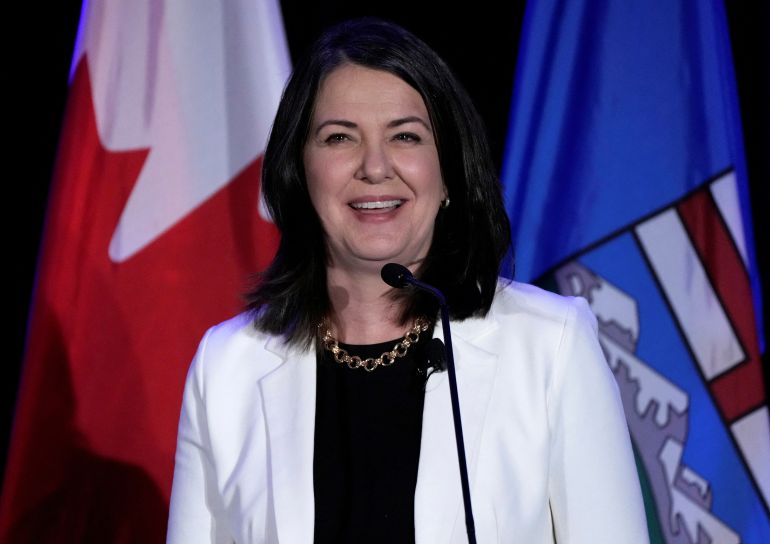
Alberta Premier Danielle Smith, however, said she won’t demonise the Albertans who are open to separation because of “legitimate grievances” with Ottawa and said she did not want to “demonise or marginalise a million of my fellow citizens”.

Smith has long been pro-Trump and visited the US president’s Mar-a-Lago estate in January 2025, at a time when most other Canadian leaders were joining hands to criticise his demand that the country become a part of the United States.

Alberta Premier Danielle Smith speaks at the Calgary Chamber
Alberta Premier Danielle Smith [FILE: Todd Korol/Reuters]

What do we know about a potential referendum in Alberta?

Anger towards Ottawa has been building in Alberta for decades, rooted largely in disputes over how the federal government manages the province’s vast oil and gas resources.

Many Albertans feel federal policies – particularly environmental regulations, carbon pricing and pipeline approvals – limit Alberta’s ability to develop and export its energy.

As a landlocked province, Alberta depends on pipelines and cooperation with other provinces to access global markets, making those federal decisions especially contentious.

Many Albertans believe the province generates significant wealth while having limited influence over national decision-making. In 2024-25, for instance, it contributed 15 percent of Canada’s gross domestic product (GDP), despite being home to only 12 percent of the population.

Alberta consistently produces more than 80 percent of Canada’s oil and 60 percent of the country’s natural gas.

Yet, many Albertans say that the federal government does not give the province its fair share from taxes collected. Canada has a system of equalisation payments, under which the federal government pays poorer provinces extra funds to ensure that they can maintain social services. While Quebec and Manitoba receive the highest payments, Alberta – as well as British Columbia and Saskatchewan – at the moment receive no equalisation payments.

A woman crosses an empty downtown street in Calgary, Alberta
A woman crosses an empty downtown street in Calgary, Alberta [FILE: Andy Clark/Reuters]

Carney recently signed an agreement with Alberta, opening the door for an oil pipeline to the Pacific, though it is opposed by Eby and faces significant hurdles.

Recent Ipsos polling suggests that about three in 10 Albertans would support starting the process of leaving Canada.

But the survey also found that roughly one in five of those supporters viewed a vote to leave as largely symbolic – a way to signal political dissatisfaction rather than a firm desire for independence.

A referendum on Alberta independence could happen later this year if a group of residents can collect the nearly 178,000 signatures required to force a vote on the issue. But even if the referendum passes, Alberta would not be immediately independent.

Under the Clarity Act, the federal government would first have to determine whether the referendum question was clear and whether the result represented a clear majority. Only then would negotiations begin, covering issues such as the division of assets and debt, borders and Indigenous rights.

What is the Alberta Prosperity Project and what does it want?

The APP is a pro-independence group that is campaigning for a referendum on Alberta leaving Canada.

It argues that the province would be better off controlling its own resources, taxes and policies, and has been working to gather signatures under Alberta’s citizen-initiative rules to trigger a vote.

While it describes itself as an educational, non-partisan project, the group has drawn controversy over its claims about the economic viability of an independent Alberta.

On its website, the APP says, “Alberta sovereignty, in the context of its relationship with Canada, refers to the aspiration for Alberta to gain greater autonomy and control over provincial areas of responsibility.”

“However, a combination of economic, political, cultural and human rights factors … has resulted in many Albertans defining ‘Alberta sovereignty’ to mean Alberta becoming an independent country and taking control of all matters that fall within the jurisdiction of an independent nation,” it adds.

What else has Washington said?

White House and State Department officials told the FT that administration officials regularly meet with civil society groups and that no support or commitments were conveyed.

A  report published by Canada’s public broadcaster CBC earlier this year quoted US national security analyst Brandon Weichert as saying that Trump’s talk of Canada becoming the “51st state” was, in reality, aimed at Alberta.

Appearing on a show hosted by former Trump chief strategist Steve Bannon, Weichert suggested that a vote for independence in Alberta would prompt the US to recognise the province and guide it towards becoming a US state.

Has the Trump administration tried this elsewhere?

Yes, in Greenland.

As with Canada, Trump has repeatedly called for Greenland to be incorporated into the US. His threats to annex Greenland have prompted strong opposition from the government of the Arctic island, Denmark — which governs Greenland — and Europe.
Chronicle of a mass kidnapping: The day Nigeria’s Kurmin Wali changed

Kurmin Wali, Nigeria – Like most Sundays in Kurmin Wali, the morning of January 18 began with early preparations for church and, later on, shopping at the weekly market.

But by 9:30am, it became clear to residents of the village in the Kajuru local government area of Nigeria’s Kaduna State that this Sunday would not be a normal one.

Recommended Stories

list of 3 itemsend of list

Gunmen known locally as bandits arrived in the village in numbers, armed with AK47 rifles.

They broke down doors and ordered people out of their homes and the village’s three churches.

They blocked the village exits before taking people and marching dozens into the forest at gunpoint.

Some captives were taken from church, while others were forcibly kidnapped as gunmen moved from house to house.

In one house, more than 30 members of an extended family were abducted.

Jummai Idris, a relative of the family that was taken, remains inconsolable.

She was home the day of the attack and did not go out.

“When I heard shouting, I took two children and we hid behind a house. That was how they [the bandits] missed us,” she told Al Jazeera.

“But I heard every shout, every cry and footstep as they picked up people from our house and surrounding houses,” she added, between sobs.

With tears streaming down her face, Idris recounts how she kept calling out the names of her missing family members – men, women and children.

Her house sits on the edge of the village, close to a bandits’ crossing point.

“I don’t know what they are doing to them now. I don’t know if they’ve eaten or not,” she said.

A total of 177 people were abducted that day. Eleven escaped their captors, but about a quarter of Kurmin Wali’s population remains captive.

Initially, state officials denied the attack had taken place.

In the immediate aftermath, Kaduna’s police commissioner called reports a “falsehood peddled by conflict entrepreneurs”.

Finally, two days later, Nigeria’s national police spokesman, Benjamin Hundeyin, admitted an “abduction” had indeed occurred on Sunday. He said police had launched security operations with the aim of “locating and safely rescuing the victims and restoring calm to the area”.

Uba Sani, Kaduna state’s governor, added that more than just rescuing the abductees, the government was committed to ensuring “that we establish permanent protection for them”.

There has been a police presence in Kurmin Wali since then. But it is not enough to reassure villagers.

Locals say the police are not there to protect the village, but merely to compile the names of victims they for days denied existed.

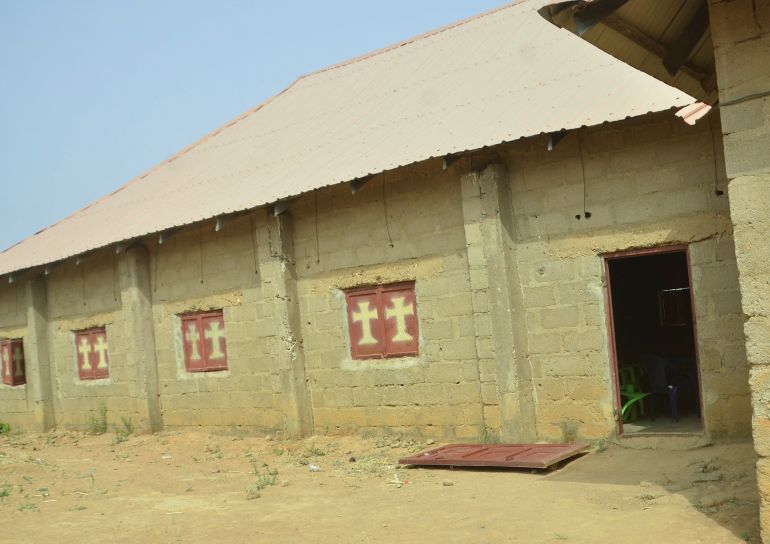
At the premises of Haske Cherubim and Seraphim Movement Church, the largest church in the village, days after the attack, a rust-coloured door lay on the floor, pulled off its hinges. Inside the mud-brick building, the site was chaotic.

Plastic chairs overturned in panic were strewn around the room – just as the kidnappers had left them.

An exterior view of the Haske Cherubim and Seraphim Movement Church, after an attack by gunmen in which worshippers were kidnapped, in Kurmin Wali, Kaduna, Nigeria, January 20, 2026. REUTERS/Nuhu Gwamna
An exterior view of the Haske Cherubim and Seraphim Movement Church, after an attack by gunmen in which worshippers were kidnapped, in Kurmin Wali, Kaduna, Nigeria, January 20, 2026 [Nuhu Gwamna/Reuters]

‘Only the recklessly bold can stay’

The church building was where the captors brought everyone before marching them into the forest surrounding the village.

Residents said the gunmen divided themselves into different groups, targeting homes and churches in the village.

Maigirma Shekarau was among those taken before he managed to escape.

“They tied us, beat us up, before arriving us into the bush. We trekked a long distance before taking a break,” he said of his journey with his captors.

Shekarau, a father of five, was holding his three-year-old daughter when he and others were taken.

“When we reached an abandoned village, I ducked inside a room with my little daughter when the attackers weren’t looking. I closed the door and waited. After what seemed like eternity, and sure they were gone, I opened the door and walked back home, avoiding the bush path,” he said, now back in the village.

But on returning home, his heart sank. He and his three-year-old were the only ones who made it home. The rest of the family is still held by the kidnappers.

Standing in a parched field of long dried grass, Shekarau says the village no longer feels like home.

The village chief was also taken, but managed to escape. He now presides over a community hopeful for the return of the missing – but too scared to stay.

“Everyone is on edge. People are confused and don’t know what to do. Some haven’t eaten. There are entire families that are missing,” said Ishaku Danazumi, the village chief.

Danazumi says the kidnappers regularly visit and loot the village grain stores and the villagers’ possessions, including mobile phones.

Two days after the attack, residents said the bandits rode through their village again.

On that day, the community also received a ransom demand.

“They accused us of taking 10 motorcycles they hid in the bush to evade soldiers who operated here the week before,” Danazumi said. “But we didn’t see those bikes.”

The chief said the captors told him the return of the 10 bikes was a precondition for the return of his people.

But deep inside, he knows, more demands will follow.

In the village, residents wait in their thatch and mud-brick houses, hoping for their loved ones to return.

But because of fear and the tense situation, many are leaving the farming community.

“Anyone thinking about remaining in this village needs to reconsider,” said Panchan Madami, a resident who also survived the attack.

“Only the recklessly bold can stay with the current state of security here.”

Villagers said that before the January 18 attack, 21 people kidnapped by the bandits were returned to them after a ransom was paid. But just two days later, a quarter of the village was taken.

“It will be stupid to stay here, hoping things will be OK,” added Madami.

The government says it will establish a military post to protect the community from further attacks. But that is not comforting enough for Idris, who has also made up her mind to leave.

“I’m not coming back here,” she said, gathering her belongings to leave the village where she grew up and married. “I just hope the rest of my family gets back.”

A drone view of Kurmin Wali, where churches were attacked by gunmen and worshippers were kidnapped, in Kurmin Wali, Kaduna, Nigeria, January 20, 2026. REUTERS/Nuhu Gwamna TPX IMAGES OF THE DAY
A drone view of Kurmin Wali, where churches were attacked by gunmen and people were kidnapped [Nuhu Gwamna/Reuters]

Diplomatic efforts intensify to avert US-Iran war

NewsFeed

Diplomatic efforts are intensifying to avoid a military confrontation between the US and Iran, as Iran’s Foreign Minister Abbas Araghchi travels to Turkiye for high-level talks. Al Jazeera’s Ali Hashem explains how regional leaders are pushing to avert conflict.

Kurdish-led SDF agrees integration with Syrian government forces

Syria’s Kurdish forces have reached a comprehensive agreement with the government to integrate with the Syrian army.

The interim government in Damascus has been fighting an offensive in the north of the country against the Kurdish-led Syrian Democratic Forces (SDF) over recent weeks as it seeks to consolidate control of the country following the overthrow of longtime leader Bashir al-Assad in December 2024.

However, a ceasefire over the past week or so has now resulted in an agreement for a phased integration of the Kurdish military forces into the army, according to an SDF statement issued on Friday.

Shortly afterwards, Syrian state TV confirmed the agreement, reporting that government officials said it would be implemented immediately.

The army has seized swaths of northern and northeastern territory in the last three weeks from the SDF in a rapid turn of events that has consolidated the leadership of President Ahmed al-Sharaa, after months-long talks between the sides failed to merge the fighters and Kurdish political entities into central institutions.

Under ​the new ‌agreement, forces will withdraw from the front lines, ‌government units will ‌deploy to ⁠the centres of the cities of Hasakah and Qamishli, and ‌local security forces will be merged.

The ceasefire between the sides was largely holding, even as they accused each other of violating its terms, as the government pressed its demand for the integration of the remaining Kurdish-run enclaves with the state, while the SDF sought to cling on in the northeastern enclave it held.

Why the UK’s toughest immigration voices are often politicians of colour

When Sajid Javid remarked that he would not allow people like his own parents to enter the United Kingdom today, he was not making an offhand comment. He was articulating a view that has become increasingly central to British immigration politics. The UK’s first ethnic minority home secretary said he opposed admitting unskilled workers and those who do not speak English. By his own criteria, neither his father, who arrived as an unskilled worker, nor his mother, who did not speak English, would have been permitted to settle in the country. Promoting his memoir, The Colour of Time, Javid was unambiguous: immigration must fall, English-language requirements should be tougher, and entry should be limited to skilled workers.

Far from being exceptional, Javid’s position points to a broader and increasingly visible pattern in British politics. Some of the most prominent anti-immigration positions of recent years have been articulated by ethnic minority politicians.

This pattern is most visible at the Home Office, the government department responsible for borders, asylum, detention and deportation. Since 2018, the role of home secretary has repeatedly been held by ethnic minority politicians, including Javid himself, Priti Patel, Suella Braverman and James Cleverly under Conservative governments, followed by Shabana Mahmood under Labour. Each, in turn, has advanced a tougher approach to immigration control.

Under Priti Patel, a points-based immigration system was introduced and the controversial plan to send asylum seekers to Rwanda was developed. Braverman went further still, declaring that seeing deportation flights take off would be her “dream” and her “obsession”. Yet despite the increasingly punitive tone, overall immigration numbers rose during this period. Rhetoric and outcomes diverged. Even so, the political signal from the Home Office was unmistakable: firmness on borders above all else.

The explanation for this phenomenon lies not simply in personal biography or individual conviction. Drawing on my research on ethnic minority representation in Britain, I argue that these appointments reflect a clear political logic. When political parties harden their stance on immigration, they often rely on minority politicians to act as reputational shields, figures who can front restrictive policies while insulating parties from accusations of racism.

Reputational shields matter because immigration control in the UK has long been racialised. From post-war restrictions on Commonwealth migration to the “hostile environment” policies associated with former Prime Minister Theresa May, border control has frequently intersected with race and belonging. When such policies are championed by ethnic minority politicians, criticism can more readily be reframed as ideological disagreement rather than racial exclusion.

Nowhere is this dynamic clearer than at the Home Office. The department effectively demands a hard line on immigration from its secretary, and appointing minority politicians to the role has repeatedly proven politically expedient. This does not mean white politicians are more liberal, as Theresa May’s record makes clear, but it does help explain why parties have been willing to place minority figures at the forefront of border enforcement. Four consecutive Conservative home secretaries were non-white.

This logic now extends beyond the Conservative Party. Labour’s appointment of Shabana Mahmood as home secretary marks a notable shift for a party that has historically sought to signal greater nuance on immigration. Since taking office, Mahmood has announced and is implementing sweeping asylum reforms, which she has described as “the most substantial reform to the UK’s asylum system in a generation”.

That Keir Starmer has placed a minority politician at the forefront of Labour’s tougher turn on immigration suggests an implicit recognition of this reputational logic. Mahmood’s identity does not determine her policy positions, but it does shape how those positions are received, particularly in a media and political environment where immigration debates are routinely filtered through accusations of racism. In this sense, Labour appears to have absorbed a lesson from Conservative governments about how ethnic minority representation can function as political cover when tightening border policy.

Immigration is now cited by about four in 10 Britons as the most important issue facing the country. For Labour, long uneasy talking about borders and enforcement, Mahmood’s stance represents a recalibration. Her measures include tightening the route from asylum to permanent settlement, reforming human rights legislation to facilitate removals, and suspending visas for countries that refuse to accept returned nationals. She has been unapologetic, arguing that the pace and scale of immigration has destabilised communities and fuelled perceptions of unfairness. While Labour backbenchers and the Green Party have accused her of scapegoating migrants, figures on the political right have welcomed her approach.

It would, however, be a mistake to portray minority politicians as mere symbols or cynical mouthpieces. Many articulate their positions through narratives of fairness, legality and contribution. Javid has spoken of his family’s experiences of racism while emphasising that they entered the UK legally and worked hard. Mahmood has similarly argued that constituents who “did things the right way” feel aggrieved by irregular arrivals crossing the Channel in small boats.

These arguments reflect a broader shift in how immigration is discussed: less overtly in racial terms and more through the language of fairness, order and control. Yet this reframing does not escape the UK’s longer history of racialised immigration policy. Instead, ethnic minority politicians increasingly play a visible legitimising role within it.

The prominence of politicians of colour at the forefront of the UK’s immigration crackdown is therefore not a paradox. It is a window into how representation is operationalised in practice. When Sajid Javid says his parents would not be admitted today, he is not disavowing his background but signalling his political credibility. The deeper question is what happens when such credibility is no longer enough to contain the moral and social consequences of a system built on exclusion. Race, borders and political legitimacy, and enduring questions about belonging and citizenship, remain tightly bound together in contemporary British politics.