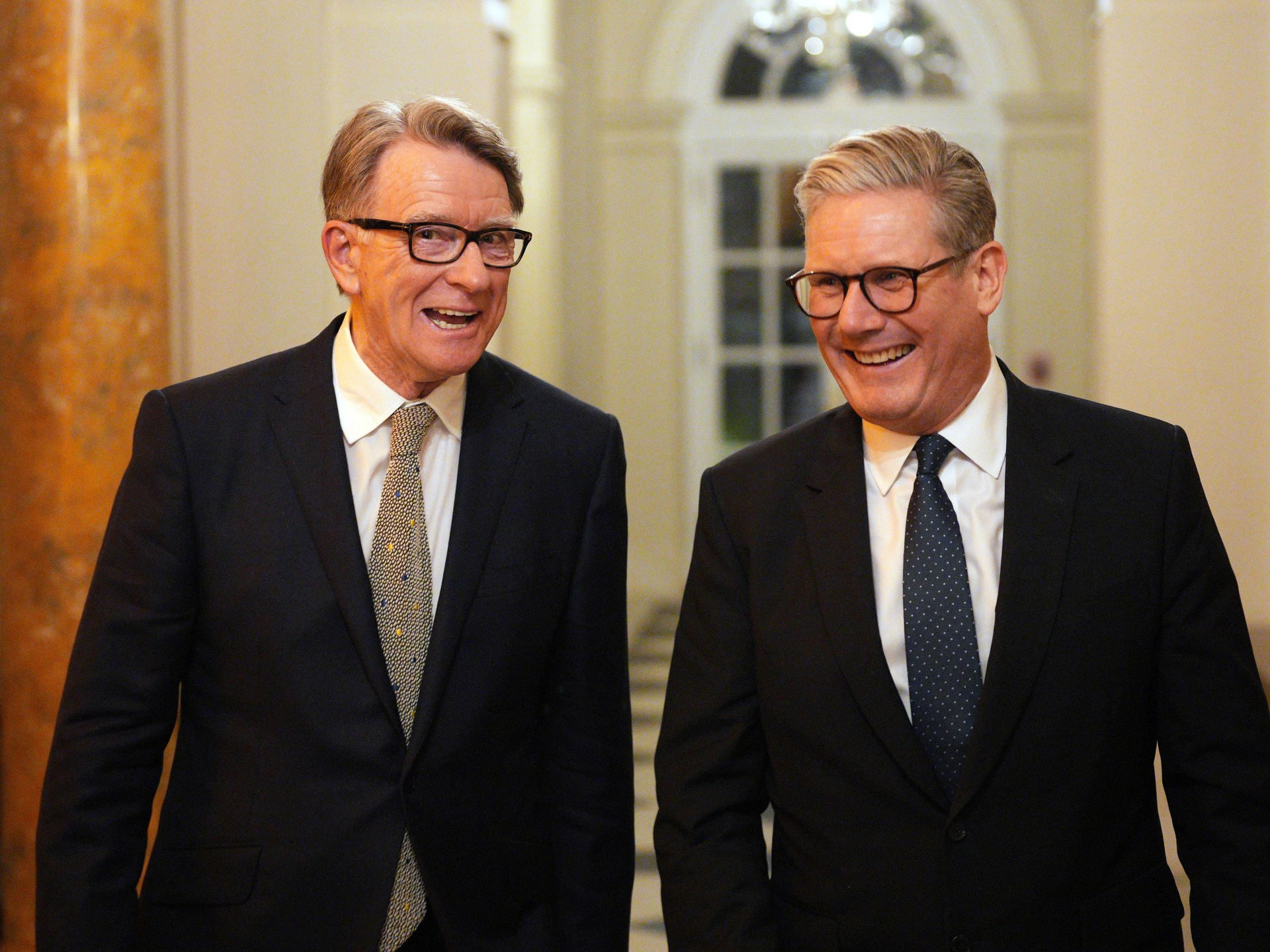
British Prime Minister Keir Starmer has agreed to reveal the vetting process used by the ruling Labour Party to approve Peter Mandelson’s appointment as the United Kingdom’s ambassador to the United States in December 2024 after new revelations from the Jeffrey Epstein files about the relationship between the diplomat and the billionaire sex offender.
For one, the latest release of files relating to the investigation of Epstein by the US Department of Justice showed that Mandelson maintained his relationship with Epstein after Epstein served a sentence for soliciting prostitution from a minor in 2008. But chief among the claims against Mandelson now are the suggestions he received payments from the late financier and may have shared market-sensitive information with him that was of financial interest to Epstein.
Epstein died in prison by suicide in 2019 before his trial stemming from his second prosecution for sex offences, including allegations of trafficking dozens of girls, could take place.
On Thursday, Starmer apologised to victims of Epstein for appointing Mandelson as ambassador to the US despite knowing of his ties to the disgraced financier.
“It had been publicly known for some time that Mandelson knew Epstein, but none of us knew the depth and the darkness of that relationship,” Starmer said.
“I am sorry. Sorry for what was done to you, sorry that so many people with power failed you, sorry for having believed Mandelson’s lies and appointing him.”
Who is Peter Mandelson and what is he accused of?
Since the release on Friday of the latest tranche of Epstein files, including emails between Epstein and Mandelson, UK media have widely reported that the government suspects Mandelson may have illegally shared market-sensitive information with Epstein 15 years ago.
The newly released files include more than 3 million pages of documents and more than 2,000 videos and 180,000 images.
As a life peer, Mandelson, 72, was a member of the House of Lords before he resigned this week. He was a veteran Labour politician who served in the cabinets of Prime Ministers Tony Blair and Gordon Brown from 1997 to 2010. After Labour swept back into power after 14 years in the opposition in 2024, he was appointed ambassador to the US, taking up his post on February 10 last year.
He resigned from the Labour Party on Sunday.
“I have been further linked this weekend to the understandable furore surrounding Jeffrey Epstein and I feel regretful and sorry about this,” Mandelson said in a letter reported by British media.
“While doing this I do not wish to cause further embarrassment to the Labour Party and I am therefore stepping down from membership of the party.”
Alleged leaks of sensitive information by Mandelson took place in 2009 when he was serving as the UK’s business secretary in the wake of the 2008 financial crisis.
This is not the first time that Mandelson has been embarrassed by his friendship with Epstein. On September 11, the UK fired Mandelson as ambassador to the US over emails between the two men, the British Foreign, Commonwealth and Development Office (FCDO) said.
On Tuesday, UK police launched a criminal investigation into Mandelson over suspected misconduct in public office linked to his relationship with Epstein.
Misconduct in public office is punishable in the UK with a maximum sentence of life imprisonment.
Besides his sacking as ambassador, Mandelson has previously been forced to resign from ministerial posts for alleged misconduct on two occasions – in 1998 and 2001.
Who was Jeffrey Epstein?
Epstein was a billionaire financier born and raised in New York who was known for socialising with celebrities and politicians.
Criminal investigations indicated he may have abused hundreds of girls over the course of his high-profile career. He was arrested in 2019 on federal criminal charges relating to alleged exploitation of underage girls dating back two decades. He died in prison before he could come to trial.
He also was previously accused of sexually assaulting a 14-year-old girl in 2005 after her parents made a report to the police. In 2008, Epstein pleaded guilty to charges of soliciting prostitution and soliciting prostitution from a minor in relation to a single victim.
He spent 13 months in prison on a work-release programme, which allowed him to leave jail to go to work during the day and return at night.
The US attorney in Manhattan also prosecuted Epstein’s former girlfriend Ghislaine Maxwell as a coconspirator in his sexual abuse scheme. Maxwell was convicted in 2021 and is currently serving a 20-year prison sentence, which she received in 2022.
What do we know about Mandelson’s relationship with Epstein?
When Mandelson was fired as ambassador to the US in September, the FCDO wrote: “In light of the additional information in emails written by Peter Mandelson, the prime minister has asked the foreign secretary to withdraw him as ambassador.
“The emails show that the depth and extent of Peter Mandelson’s relationship with Jeffrey Epstein is materially different from that known at the time of his appointment.”
These particular emails were obtained and published by the UK’s Sun newspaper in September. In them, Mandelson told Epstein to “fight for early release” shortly before he was sentenced in 2008.
“I think the world of you,” Mandelson told Epstein before his sentence began.
“I can still barely understand it. It just could not happen in Britain,” Mandelson wrote. “You have to be incredibly resilient, fight for early release and be philosophical about it as much as you can.”
It is now clear from the latest tranche of Epstein files that Mandelson continued his friendship with Epstein for some time after the financier had been convicted of sex offences.
What do the new Epstein files reveal?
From 2003 to 2004, bank records indicated that Epstein made three payments totalling $75,000 to accounts connected to Mandelson or his partner Reinaldo Avila da Silva. Mandelson has said he does not recall receiving any such funds and has pledged to examine whether the documents are genuine.
According to these documents, in 2009, Epstein sent da Silva 10,000 pounds ($13,607, or $20,419 today after inflation) to pay for an osteopathy course. This week, Mandelson told The Times of London: “In retrospect, it was clearly a lapse in our collective judgement for Reinaldo to accept this offer.”
Emails revealed in the latest tranche of files from the US Justice Department also shine a light on the close friendship between the two men.
In October 2009, Epstein wrote in an email to Mandelson: “You can marry princess beatrice, the queen would have a queen as a grandson,” referring to the daughter of Andrew Mountbatten-Windsor, the former prince whose royal titles were stripped last year over his own links to Epstein and allegations of the sexual abuse of Virginia Giuffre, who successfully sued Mountbatten-Windsor.
“does that make it incest, how exciting,” Epstein wrote.
In 2010, Lesley Groff, known to have been Epstein’s long-term executive assistant, emailed his boss: “Mandelson’s holiday plans arc still being sorted out. They hope to be in touch soon.”
In 2013, Epstein emailed Mandelson, saying he knew Mandelson was visiting St Petersburg, Russia. Mandelson described the city as “a rave”, to which Epstein asked whether “its for gays”. Mandelson responded, “Er no, tastey [sic] models and dancing.”
But the emails also suggested Mandelson passed sensitive information to the financier.
On May 9, 2010, Mandelson emailed Epstein, saying: “Sources tell me 500 b euro bailout, almost compelte [sic].” The next morning, European governments approved a 500-billion-euro bailout for banks in the wake of the global financial crisis.
Also in May 2010, Mandelson emailed Epstein, saying, “Finally got him to go today.” It is believed that Mandelson was referring to former Labour Prime Minister Brown.
Epstein replied to this email: “I have faith, the value of some chapters in your book should now increase.”
Brown announced his resignation just hours after this email exchange.
What has Starmer said?
Under mounting pressure from opposition politicians and within his own party this week, Starmer agreed to release information about the process through which Mandelson was appointed ambassador in 2024.
At a question and answer session on Wednesday in the House of Commons dominated by the Epstein revelations, Starmer admitted that he knew of Mandelson’s friendship with Epstein but said Mandelson had “lied repeatedly to my team when asked about his relationship with Epstein before and during his tenure as ambassador”.
“Mandelson betrayed our country, our parliament and my party,” Starmer said. “I regret appointing him. If I knew then what I know now, he would never have been anywhere near government.”
Starmer said he would ensure that “all of the material” is published, except for documents that compromise Britain’s national security, international relations or the police investigation into Mandelson’s activities.
On Tuesday, Starmer told his cabinet he was “appalled by the information” regarding Mandelson and was concerned more details could come to light, according to a Downing Street readout of the cabinet meeting.
Starmer also said he had ordered the civil service to conduct an “urgent” review of all of Mandelson’s contacts with Epstein while he was in government.
“The alleged passing on of emails of highly sensitive government business was disgraceful,” Starmer said, adding that he was not yet “reassured that the totality of information had yet emerged”.
How will this affect Starmer?
Members of parliament expressed their dismay and called on him to step down.
Conservative MP Luke Evans said: “At the end of the day, he [Starmer] made the decision to appoint Mandelson to the post of ambassador, so he must explain his decision-making process.”
Alex Burghart, the shadow chancellor of the Duchy of Lancaster, said: “There is no doubt that the prime minister’s judgement is being called sharply into question at this moment. It is becoming harder to see how any of us can rely on his judgement in future.”
Conservative MP Graham Stuart added: “The fact is that he appointed a person who had already broken all the Nolan Principles before his appointment as well as doing so after it. I think that makes the prime minister’s position untenable.”
The Nolan Principles are a set of ethical standards for all public office holders in the UK.
“I would say that today is the crumbling of Starmer. His judgement is poor, and it is ruining this country and the Labour Party,” Conservative MP Esther McVey said.
What do we know about how Mandelson was approved as US ambassador?
Facing questions from Conservative leader Kemi Badenoch in the House of Commons in September, Starmer maintained that “full due process was gone through” for the purposes of Mandelson’s appointment.
Mandelson’s ties to Epstein, who is said to have nicknamed him “Petie”, had been publicly known for years.
But The Times of London reported that Starmer received just a two-page vetting note from the Cabinet Office’s propriety and ethics team about Mandelson’s appointment.
That document suggested that while Epstein was in prison in 2009, Mandelson stayed at Epstein’s townhouse in Manhattan. The report also contained a photograph of Mandelson and Epstein together.