US treasury secretary declines to rule out future Federal Reserve lawsuits

Treasury Secretary Scott Bessent has faced questions from the United States Senate about President Donald Trump’s ongoing campaign to slash interest rates, despite concerns that such a move could turbo-charge inflation.

Bessent appeared on Thursday before the Senate’s Financial Stability Oversight Council.

Recommended Stories

list of 3 itemsend of list

There, he received a grilling from Democrats over rising consumer prices and concerns about Trump’s attempts to influence the Federal Reserve, the US central bank.

One of his early clashes came with Senator Elizabeth Warren, who sought answers about a report in The Wall Street Journal that indicated Trump joked about suing his nominee for the Federal Reserve chair, Kevin Warsh, if he failed to comply with presidential demands.

“Mr Secretary, can you commit right here and now that Trump’s Fed nominee Kevin Warsh will not be sued, will not be investigated by the Department of Justice, if he doesn’t cut interest rates exactly the way that Donald Trump wants?” Warren asked.

Bessent evaded making such a commitment. “That is up to the president,” he replied.

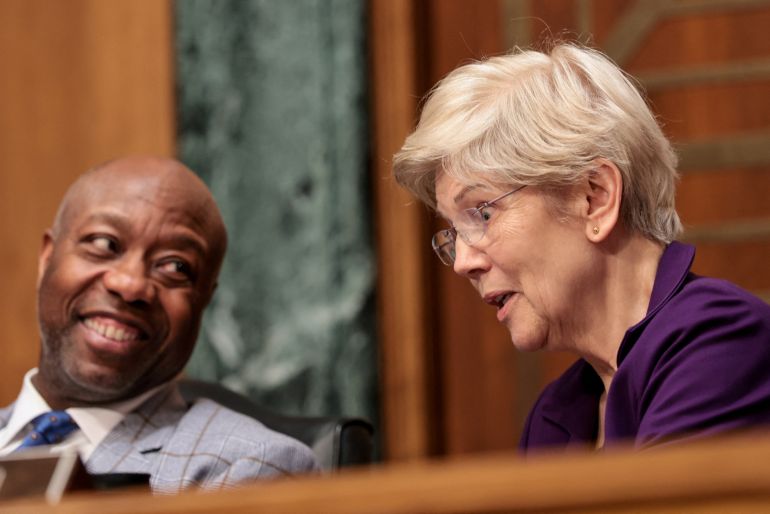
Senators Elizabeth Warren and Tim Scott on a congressional panel
Senators Tim Scott and Elizabeth Warren speak during a hearing on the Financial Stability Oversight Council’s annual report to Congress [Jonathan Ernst/Reuters]

Pressure on Federal Reserve members

Last week, Trump announced Warsh would be his pick to replace the current Federal Reserve chair, Jerome Powell, who has faced bitter criticism over his decision to lower interest rates gradually.

By contrast, Trump has repeatedly demanded that interest rates be chopped as low as possible, as soon as possible.

In December, for instance, he told The Wall Street Journal that he would like to see interest rates at “one percent and maybe lower than that”.

“We should have the lowest rate in the world,” he told the newspaper. Currently, the federal interest rate sits around 3.6 percent.

Experts say a sudden drop in that percentage could trigger a short-term market surge, as loans become cheaper and money floods the economy. But that excess cash could drive down the value of the dollar, leading to higher prices in the long term.

Traditionally, the Federal Reserve has served as an independent government agency, on the premise that monetary decisions for the country should be made without political interference or favour.

But Trump, a Republican, has sought to bring the Federal Reserve under his control, and his critics have accused him of using the threat of legal action to pressure Federal Reserve members to comply with his demands.

In August, for instance, he attempted to fire Federal Reserve Governor Lisa Cook based on allegations of mortgage fraud, which she has denied.

Cook had been appointed to the central bank by Trump’s predecessor and rival, Democrat Joe Biden, and she has accused Trump of seeking her dismissal on political grounds. The Supreme Court is currently hearing the case.

Then, in early January, the Department of Justice opened a criminal investigation into Powell, echoing accusations Trump made, alleging that Powell had mismanaged renovations to the Federal Reserve building.

Powell issued a rare statement in response, accusing Trump of seeking to bully Federal Reserve leaders into compliance with his interest rate policy.

“The threat of criminal charges is a consequence of the Federal Reserve setting interest rates based on our best assessment of what will serve the public, rather than following the preferences of the President,” Powell wrote.

Thom Tillis speaks on a Senate panel
Senator Thom Tillis, a Republican who is not seeking reelection, has been critical of the probe of Federal Reserve Chair Jerome Powell [Jonathan Ernst/Reuters]

Bipartisan scrutiny of Powell probe

Given the string of aggressive actions against Powell and Cook, Trump’s joke about suing Warsh fuelled rumours that the Federal Reserve’s independence could be in peril.

Within hours of making the joke on January 31, Trump himself faced questions about how serious he might have been.

“It’s a roast. It’s a comedy thing,” Trump said of his remarks as he spoke to reporters on Air Force One. “It was all comedy.”

Warren, however, pressed Bessent about Trump’s remarks and chided the Treasury chief for not rejecting them.

“I don’t think the American people are laughing,” Warren told Bessent. “They’re the ones who were struggling with the affordability.”

The prospect of Trump exerting undue influence over the Federal Reserve even earned a measure of bipartisan criticism during Thursday’s council meeting.

Senator Thom Tillis, a Republican from North Carolina, opened his remarks to Bessent with a statement denouncing the probe into Powell, even though he acknowledged he was “disappointed” with the current Fed chair.

Still, Tillis emphasised his belief that Powell committed no crime, and that the investigation would discourage transparency at future Senate hearings.

He imagined future government hearings becoming impeded by legal formalities, for fear of undue prosecution.

“They’re going to be flanked with attorneys, and anytime that they think that they’re in the middle of a perjury trap, they’re probably just going to say, ‘I’ll submit it to the record after consultation with my attorneys,’” Tillis said, sketching out the scenario.

“Is that really the way we want oversight to go in the future?”

For his part, Bessent indicated that he backed the Federal Reserve’s long-term goal to keep interest rates at about 2 percent.

“It is undesirable to completely eliminate inflation,” Bessent said. “What is desirable is to get back to the Fed’s 2 percent target, and for the past three months, we’ve been at 2.1 percent.”

A screen shows Scott Bessent testifying at a Senate committee hearing. A photographer sits on the floor next to the screen.
Treasury Secretary Scott Bessent attends a Senate Banking, Housing and Urban Affairs Committee hearing on the Financial Stability Oversight Council on February 5 [Jonathan Ernst/Reuters]

Scrutinising the lawsuit against the IRS

As Thursday’s hearing continued, Bessent was forced to defend the Trump administration on several fronts, ranging from its sweeping tariff policy to its struggle to lower consumer prices.

But another element of Trump’s agenda took centre stage when Democrat Ruben Gallego of Arizona had his turn at the microphone.

Gallego sought to shine a light on the revelation in January that Trump had filed a lawsuit against the Internal Revenue Service (IRS) — part of his own executive branch.

Trump is seeking $10bn in damages for the leak of his tax returns during his first term as president. The IRS itself was not the source of the leak, but rather a former government contractor named Charles Littlejohn, who was sentenced to five years in prison.

Bessent was not named as a defendant in the lawsuit, though he currently serves both as the Treasury secretary and the acting commissioner of the Internal Revenue Service.

Critics have argued that Trump’s lawsuit amounts to self-dealing: He holds significant sway over the Justice Department, which would defend the federal government against such lawsuits, and he could therefore green-light his own settlement package.

In Thursday’s exchange with Gallego, Bessent acknowledged that any damages paid to Trump would come from taxpayer funds.

“ Where would that $10bn come from?” Gallego asked.

“ It would come from Treasury,” Bessent replied. He then underscored that Trump has indicated any money would go to charity and that the Treasury itself would not make the decision to award damages.

Still, Gallego pressed Bessent, pointing out that the Treasury would ultimately have to disburse the funds — and that Bessent would be in charge of that decision.

That circumstance, Gallego argued, creates a conflict of interest, since Bessent is Trump’s political appointee and can be fired by the president.

“Have you recused yourself from any decisions about paying the president on these claims?” Gallego asked.


Germany’s Merz warns of potential escalation as US, Iran prepare for talks

German Chancellor Friedrich Merz has warned of the threat of a military escalation in the Middle East before talks between Iran and the United States in Oman on Friday.

Speaking in Doha on Thursday, Merz said that fears of a new conflict had characterised his talks during his trip to the Gulf region.

Recommended Stories

list of 3 itemsend of list

“In all my conversations yesterday and today, great concern has been expressed about a further escalation in the conflict with Iran,” he said during a news conference.

Merz also urged Iran to end what he called aggression and enter into talks, saying Germany would do everything it could to de-escalate the situation and work towards regional stability.

The warning came in the run-up to a crucial scheduled meeting between officials from Tehran and Washington in Muscat.

Mediators from Qatar, Turkiye and Egypt have presented Iran and the US with a framework of key principles to be discussed in the talks, including a commitment by Iran to significantly limit its uranium enrichment, two sources familiar with the negotiations have told Al Jazeera.

Before the talks, both sides appear to be struggling to find common ground on a number of issues, including what topics will be up for discussion.

Iran says the talks must be confined to its long-running nuclear dispute with Western powers, rejecting a US demand to also discuss Tehran’s ballistic missiles, and warning that pushing issues beyond the nuclear programme could jeopardise the talks.

Reporting from Washington, DC, Al Jazeera’s Kimberly Halkett said the US is eager for the talks to follow what they see as an agreed-upon format.

“That agreed-upon format includes issues broader than what the US understands Iran is willing to discuss in this initial set of talks,” she explained.

US Secretary of State Marco Rubio said on Wednesday that talks would have to include the range of Iran’s ballistic missiles, its support for armed groups around the Middle East and its treatment of its own people, in addition to its nuclear programme.

A White House official has told Al Jazeera that Jared Kushner, US President Donald Trump’s son-in-law and a key figure in his Middle East policy negotiations, and Steve Witkoff, Trump’s special envoy, have arrived in the Qatari capital, Doha, in advance of the talks.

Halkett said that Qatar is playing an instrumental role in trying to facilitate these talks, along with other regional US partners, including Egypt.

“We understand, according to a White House official, that this is perhaps part of the reason for the visit – to try and work with Qatar in an effort to try and get Iran to expand and build upon the format of these talks.”

Pressure on Iran

The talks come as the region braces for a potential US attack on Iran after US President Donald Trump ordered forces to amass in the Arabian Sea following a violent crackdown by Iran on protesters last month.

Washington has sent thousands of troops to the Middle East, as well as an aircraft carrier, other warships, fighter jets, spy planes and air refuelling tankers.

Trump has warned that “bad things” would probably happen if a deal could not be reached, ratcheting up pressure on Iran.

This is not the first time Iranian and US officials have met in a bid to revive diplomacy between the two nations, which have not had official diplomatic relations since 1980.

How the US left Ukraine exposed to Russia’s winter war

As Ukrainians face the coldest winter in a decade, trilateral talks take place in Abu Dhabi.

Russia is exploiting Ukraine’s coldest winter yet since it escalated the war four years ago. As negotiations between Ukraine, Russia and the United States continue to stall, will this winter freeze become Ukraine’s breaking point?

In this episode: 

  • Oleksiy Sorokin (@mrsorokaa) Deputy Chief Editor, Kyiv Independent

Episode credits:

This episode was produced by Chloe K. Li, Marcos Bartolomé, and Melanie Marich, with Phillip Lanos, Spencer Cline, Maya Hamadeh, Tuleen Barakat, and our guest host, Kevin Hirten. It was edited by Tamara Khandaker. 

Our sound designer is Alex Roldan. Our video editors are Hisham Abu Salah and Mohannad al-Melhemm. Alexandra Locke is The Take’s executive producer. Ney Alvarez is Al Jazeera’s head of audio. 

Connect with us:

Starvation by design: How Israel turned food into a weapon of war in Gaza

In the first three months of Israel’s genocidal war on Gaza in 2023, only four deaths were officially attributed to starvation by health officials in Gaza. By 2024, that number rose to 49.  But it was in 2025 – the year the siege reached its suffocating zenith – that the death toll exploded, reaching 422 deaths in a single year.

This represents a staggering 760 percent increase in starvation deaths in just 12 months.

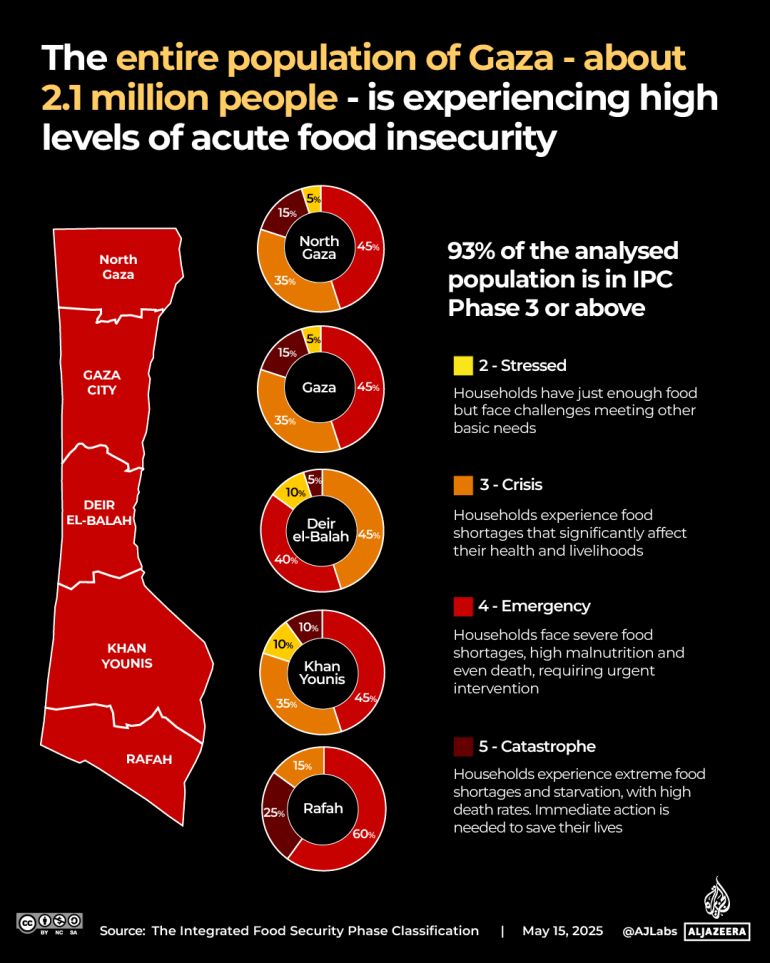
UN Special Rapporteur on the Right to Food Michael Fakhri told Al Jazeera in August 2025 that the global standard for famine analysis, known as the Integrated Food Security Phase Classification (IPC), tends to be “conservative”.

“The reality on the ground was unequivocal. We raised the alarm when we started seeing the first children dying,” Fakhri explained, noting that the crisis met the strict technical criteria for famine.

The Health Ministry in Gaza gave the breakdown of the victims: 40.63 percent were elderly (over 60), and 34.74 percent were children. In 2025 alone, cases among children under five spiked from 2,754 in January to 14,383 in August.

Legal experts said that what occurred in Gaza wasn’t just “food insecurity”; it met the strict technical criteria for famine, a designation often delayed by political bureaucracy.

“In the human rights community, we don’t wait as long … we don’t have to focus on measuring pain, suffering, and death,” Fakhri explained. “We raised the alarm when we started seeing the first children dying … because when a parent is holding their child in their arms, and that child is wasting away, that means an entire community is under attack.”

Interactive_Gaza_food_IPC_report_May13_2025 starvation hunger famine

Anatomy of a strategy

Palestinians in the Gaza Strip and other parts of the occupied Palestinian territory have accused consecutive Israeli governments of a decades-old policy to use food and aid as a weapon of war.

Suleiman Basharat, a Palestinian commentator and researcher on Israeli affairs, traces this strategy to the blockade of Gaza imposed by Israel in 2007.

“It was based on the idea of starvation and narrowing daily life,” Basharat noted. This doctrine was infamously summarised in 2006 by Dov Weisglass, an adviser to the Israeli prime minister, who said the goal was “to put the Palestinians on a diet, but not to make them die of hunger”, adding that the war marked a shift from “management” to “elimination”.

Senior Israeli ministers made their intentions clear at the very start of the genocidal war on Gaza. Former Israeli Defence Minister Yoav Gallant had declared a complete siege against “human animals“.  His remarks were quickly reinforced by far-right Finance Minister Bezalel Smotrich, who argued that blocking aid to Gaza was “justified and moral“, even if it meant starving millions.

Israel’s moves to ramp up this policy were thorough. Before the war on Gaza began in 2023, the United Nations said 500 trucks carrying aid and food were needed to keep the people in Gaza sustained.

But during the war, an average of 19 trucks a day were allowed in the Strip – a 96 percent reduction – which some Israeli media have referred to as the “calorie collapse”.

  • The Calorie Collapse: Before the war, 500 trucks sustained Gaza daily. During the conflict, this dropped to an average of 19 trucks a day – a 96 percent reduction.
  • The Thirst War: Water availability plummeted from 84 litres per person to just 3 litres during the siege.
  • Scorched Earth: Israel systematically destroyed infrastructure for agricultural production. By August 2025, 90 percent of agricultural land was razed, 2,500 chicken farms were destroyed (killing 36 million birds), and the fishing port was obliterated.

“If Israel wanted to do it, every child in Gaza could have breakfast tomorrow,” de Waal observed. “All they need to do is to open the gates”.

Interactive_WorldFoodDay_October16_2025-01-1760613556
[Al Jazeera]

In addition to food, people in Gaza witnessed a sharp decrease in water releases from Israel. Rights group Oxfam said that, 100 days into the “ceasefire”, Gaza is still deliberately deprived of water as aid groups are forced to scavenge under an illegal blockade.

Israel also employed a “scorched earth” policy, systematically destroying the infrastructure for agricultural production.

By August 2025, estimates suggest that the Israeli army had destroyed 90 percent of agricultural land and 2,500 chicken farms. The army focused its campaign on areas near the security barrier in the north, south and east of the Gaza Strip.

The spokesperson for Gaza’s Ministry of Agriculture, Mohammed Abu Odeh, has warned that the Israeli army’s destruction and control of the farmland will affect the chain of food and supply of vegetables for nearly two million people in the Strip.

The illusion of aid

Palestinian officials and analysts suggest Israel has had a strategy of blocking aid and, at times, manipulating how it is delivered.

Political analyst Abdullah Aqrabawi told Al Jazeera Arabic that Israel and the US have tried to create their own aid-delivering system, such as the Gaza Humanitarian Foundation (GHF), but failed. Hundreds of Palestinians were killed at GHF sites trying to access food.

“The United States came with a pier and contracted companies … and failed,” Aqrabawi said. He noted that these initiatives were attempts to “support criminal pockets” or specific families to distribute aid, “thereby isolating Hamas – the resistance”.

Re-engineering society

Analysts say that the starvation tactics were used, not just for military leverage, but also to create an “anti-resistance” sentiment in Gaza.

“The goal is to break the Palestinian resistance by affecting the social base that embraces it,” Basharat explained. He argues that Israel aimed to “re-engineer the Palestinian human” into a being whose sole cognitive focus is basic survival, rendering them incapable of political thought.

Analysts described a host of policies adopted by Israeli officials to push Palestinians out of Gaza, cloaking them in misleading terms, such as encouraging “voluntary migration“.

Israeli affairs expert Mohannad Mustafa said this was a cynical euphemism for forced displacement. “You starve the people, destroy the infrastructure … and in the end, you ask them: ‘Do you want to emigrate?’” Mustafa told Al Jazeera Arabic Channel. “This is forced displacement, not voluntary migration.”

Israeli rights activists have repeatedly pointed out the policies of Israeli Prime Minister Benjamin Netanyahu to pressure people in Gaza and the occupied West Bank to leave.

Alice Rothchild, a member of Jewish Voice for Peace, described the policies as “humiliating mechanics”. She detailed how the system forced starving civilians to walk miles to feeding centres, “herding them into cages” to receive aid. “It’s all part of this attempt to destroy Gaza,” she said.

Future defined by hunger

Today, despite the ongoing Gaza “ceasefire” – which continues despite Israel’s regular attacks – the destruction of Gaza’s agricultural backbone means the Strip remains entirely dependent on external aid, giving Israel permanent control.

The 475 officially recorded deaths are merely the tip of the iceberg.

For many Palestinians, the war may be “paused” in theory, but for a generation of Palestinians, the man-made hunger, physical and political scars could take decades to heal.

UK ex-envoy’s ties to Epstein spark political storm

NewsFeed

UK PM Keir Starmer says he regrets appointing Peter Mandelson as ambassador to the US after documents showed Mandelson maintained a close relationship with Jeffrey Epstein, shared sensitive information, and received payments linked to Epstein. Police are investigating.

New Trump administration rule makes it easier to fire career civil servants

The administration of United States President Donald Trump has finalised its overhaul of the US government’s civil service system, according to a government statement, giving the president the power to hire and fire an estimated 50,000 career federal employees.

The US Office of Personnel Management (OPM) on Thursday is set to create a new category for high-ranking career employees involved in carrying out administration policies, the Wall Street Journal reported. Personnel in that category would be exempted from longstanding civil service protections that make federal workers difficult to fire.

Recommended Stories

list of 4 itemsend of list

OPM officials said the rule is aimed in part at “disciplining” federal workers who stand in the way of Trump’s policies, the paper reported. It added that the new category applies to senior positions that are policy-determining, policy-making or policy-advocating in nature.

“People can’t be conscientious objectors in the workforce in a way where it interferes with their ability to carry out their mission,” OPM’s director Scott Kupor said in an interview with the WSJ.

“These positions will remain career jobs filled on a non-partisan basis. Yet they will be at-will positions excepted from adverse action procedures or appeals. This will allow agencies to quickly remove employees from critical positions who engage in misconduct, perform poorly, or obstruct the democratic process by intentionally subverting Presidential directives,” the more than 250-page directive from OPM claimed.

The federal government has long been seen as a stable employer, with staff commonly spending decades working at US agencies. Trump and his team sought to change that at the start of his second term, as he argued that the federal government was bloated and inefficient.

In 2025, the White House made aggressive cuts to the federal workforce, with more than 300,000 people leaving the nation’s largest employer.