Campaign to boycott Israel looks to future after Gaza ‘ceasefire’

Israel’s genocidal war on Gaza has pushed the plight of the Palestinian people to the forefront of global attention. For more than two years, the world has witnessed the mass killing, disease and starvation imposed upon the enclave by Israel.

Faced with a sense of helplessness, calls have grown for boycotts of Israeli goods, for companies profiting from Israel or its settlements in the occupied West Bank to divest, and for politicians to expand sanctions that some have already imposed on Israeli ministers.

Recommended Stories

list of 4 itemsend of list

However, with other world events, such as the war in Ukraine and the United States’s face-off with Iran now dominating much of the world’s headlines, the Boycott, Divestment, Sanctions (BDS) movement faces a challenge to keep attention on Gaza and Israel’s illegal occupation of Palestine.

Gains made

The war on Gaza has led to Israel facing unprecedented condemnation from around the world.

Israel has moved closer to pariah status for its attacks not just in Gaza – killing more than 70,000 Palestinians – but in Lebanon and elsewhere in the Middle East.

The country’s Prime Minister Benjamin Netanyahu, as well as former Defence Minister Yoav Gallant now find themselves facing International Criminal Court arrest warrants for war crimes.

At home, at least two of Israel’s far-right government ministers, Finance Minister Bezalel Smotrich and National Security Minister Itamar Ben-Gvir, have also been sanctioned by governments worldwide.

And on top of that hangs the judgement of the International Court of Justice in January 2024, that the state of Israel may plausibly be engaged in genocide, in an ongoing case brought by South Africa.

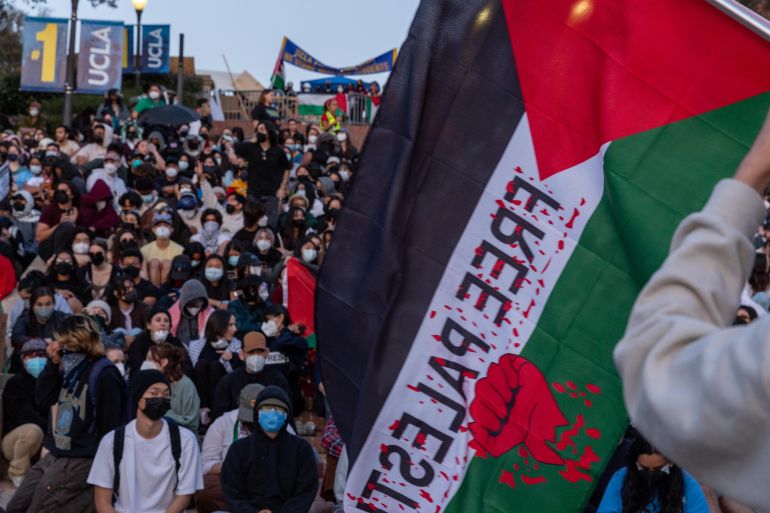
LOS ANGELES, UNITED STATES - MAY 01: Pro-Palestinian students at UCLA campus set up encampment in support of Gaza and protest the Israeli attacks in Los Angeles, California, United States on May 01, 2024. ( Grace Yoon - Anadolu Agency )
Pro-Palestinian students at the UCLA campus set up an encampment in support of Gaza in protest against Israel’s attacks on the enclave, in Los Angeles, California [Grace Yoon/Anadolu Agency]

Criticism of Israel has also entered the mainstream culturally in Western countries, particularly among young people horrified by the death rained upon Gaza.

And importantly, there have been economic consequences for Israel and some of those doing business in it – echoing the boycott movement against apartheid South Africa in the 1980s.

Companies such as the French supermarket chain Carrefour were forced to close a number of outlets in the Middle East amid public anger over its links to Israeli firms operating in illegal settlements in the occupied West Bank.

Other companies associated with Israel’s actions, including Airbnb – which allows Israelis in illegal settlements to rent their properties – and Microsoft, whose Azure cloud services have supported the Israeli military, have all faced internal dissent and reputational damage because of their ties to the Israeli government.

As a consequence of public pressure, pension funds from around the world, including Spain, Norway, Denmark, France and Ireland, have divested from Israeli assets linked to settlements, or withdrawn investments from companies tied to Israel.

“BDS and boycotts have changed Israel’s global trade landscape,” Avi Balashnikov, chairman of the Israel Export Institute, conceded in September 2024.

“We fight every day, hour by hour, for Israeli industry abroad,” he added. “Economic boycotts and BDS organisations present major challenges, and in some countries, we are forced to operate under the radar.”

Moving spotlight

Despite a US-brokered “ceasefire“, Israeli attacks on Gaza have killed more than 500 people since the agreement was reached in October, including at least 31 on Saturday. The fact that Israel has continued to kill Palestinians, while much of the world looks away, highlights the difficulty now facing the BDS movement and whether it can maintain the energy it has gained.

“It is not uncommon for the observance of a boycott to rise and fall according to the prominence of an issue and success of specific campaigns to raise awareness or promote adherence to the boycott,” Nick Cull, a historian and authority on cultural boycotts at the University of Southern California, told Al Jazeera.

bds
A protester holds a placard reading, ‘This Company Supports Israeli Genocide, Join The Boycott’, for lunchtime shoppers to see during a demonstration outside Coca-Cola-owned Costa Coffee [Martin Pope/SOPA Images/LightRocket via Getty Images]

“I think that the power of a boycott is cumulative,” Cull continued. “Just as advertising associates a brand with good feelings and positive experiences – think how over many decades Coca-Cola link their drink to ideas of friendship – as part of the ‘buy-me’ message, so a boycott’s ‘don’t buy’ message becomes a negative branding associating a product and its place of origin with negative feelings: training a revulsion impulse rather than a logical inner debate over the merits of a particular case.”

“Since the ceasefire, a less-visible form of genocide has been unfolding,” Saleh Hijazi, Policy Coordinator with the BDS movement, told Al Jazeera, pointing to the mounting death toll in Gaza from Israeli attacks and the restrictions that Israel was imposing on access to food and medicine.

“Israel and the US, a full partner in this genocide, have used the so-called ceasefire as an attempt to rescue apartheid Israel from a downward spiral, to launder its global image and muffle international outrage. It’s meant to push Palestinians out of the headlines, weaken calls for boycotts and sanctions, and make our struggle seem less urgent,” Hijazi said.

Protesters hold a banner and Palestinian flags during the "Stop Israel" demonstration, against Israel's participation in the Eurovision Song Contest due to its ongoing offensive in Gaza against Hamas, in Malmo, Sweden
Protesters hold a banner and Palestinian flags during the ‘Stop Israel’ demonstration against Israel’s participation in the Eurovision Song Contest due to its ongoing offensive in Gaza, in Malmo, Sweden [Johan Nilsson/TT News Agency via Reuters]

Lasting damage

However, while the media spotlight may have broadened from its formerly sharp focus on Gaza, the reputational damage inflicted on companies trading with Israel as a result of its genocide, as well as new initiatives to culturally isolate it, are gaining ground.

“I still feel odd about brands demonised during [South Africa’s] apartheid and artists who violated the boycott,” Cull added, emphasising the lasting reputational damage of boycotts. “This training of people into a negative reflex is what makes boycotts so powerful.”

More initiatives are now taking hold, attempting to build on the sense of cultural isolation many in Israel feel.

One, Game Over Israel, led by political strategist Ashish Prashar, aims to remove Israel from European football.

“We launched our campaign to kick Israel out of football with a huge billboard in Times Square on September 16, the same day the UN’s [Commission of Inquiry] report on genocide came out,” Prashar said.

“The idea is to appeal to what they call the ‘integrity of the game,’” he said, explaining that the campaign would continue despite the “ceasefire”. “We’re running a campaign the same way we would an election strategy. Our next target is to go after [European football’s governing body] UEFA in Switzerland.”

A billboard in Times Square displays the message "Soccer Federations: Boycott Israel" as part of the campaign by Game Over Israel calling for a boycott of Israel by national soccer federations over the war in Gaza, in New York City, U.S
A billboard in Times Square displays the message ‘Soccer Federations: Boycott Israel’ as part of the campaign by Game Over Israel calling for a boycott of Israel by national football federations over the war in Gaza, in New York City, United States [Jeenah Moon/Reuters]

“Ninety percent of Israel’s games are played through UEFA,” Prashar said. “Suspending them would probably help lots of the clubs, their towns and the fans. Just the cost of policing an Israeli game … costs a fortune. Most councils can’t afford that. Other stadiums are closed off, which means that fans can’t go and clubs lose the ticket money, or they’re moved, which means no one makes any money.”

“It’s not about football,” he said. “It’s about not accepting the normalisation of Israel. It’s the institutional resistance to this that’s frightening. This shouldn’t be on people or small groups of activists. This should be on governments.”
Volkanovski wins featherweight title defence against Lopes at UFC 325

In front of a deafening Sydney crowd, Ultimate Fighting Championship featherweight ‌champion Alexander Volkanovski survived a fifth-round rally attempt from Diego Lopes to win yet another unanimous decision (49-46, 49-46, 50-45) in their ‍rematch at UFC 325.

Just ‍like their first meeting last April at UFC 314, Lopes (27-8 MMA, or mixed martial arts, 6-3 UFC) would not let Volkanovski (28-4 MMA, 15-3 UFC) coast easily, as the first three rounds on Sunday saw Lopes take Volkanovski’s best shots and deliver some of his own. But Volkanovski retaliated with adjustments throughout, utilising the clinch to cut Lopes’s cage room off.

Recommended Stories

list of 4 itemsend of list

Volkanovski’s win was his first title defence ⁠during his second reign, ushering in a reinvigorated era at featherweight moving forward.

But for Volkanovski, winning his first fight in his home country ​in nearly three years with the full backing of the Australian crowd felt different.

“I didn’t want to stand [with Lopes] ‍for 25 minutes, but we got the job done,” Volkanovski said.

Volkanovski said he was excited to get back in the Octagon soon, saying he would “see what’s next” with his team.

Lopes was humble in defeat, although he had a visible reaction to the one judge who ruled all five rounds in Volkanovski’s favour.

“I think ‍Volkanovski is one of ⁠the best in the division and has been for this long,” the Brazilian competitor said.

Lopes called this part of the journey “step-by-step” as he prepares for an uncertain next fight after his second failed championship match against the future Hall of Fame member.

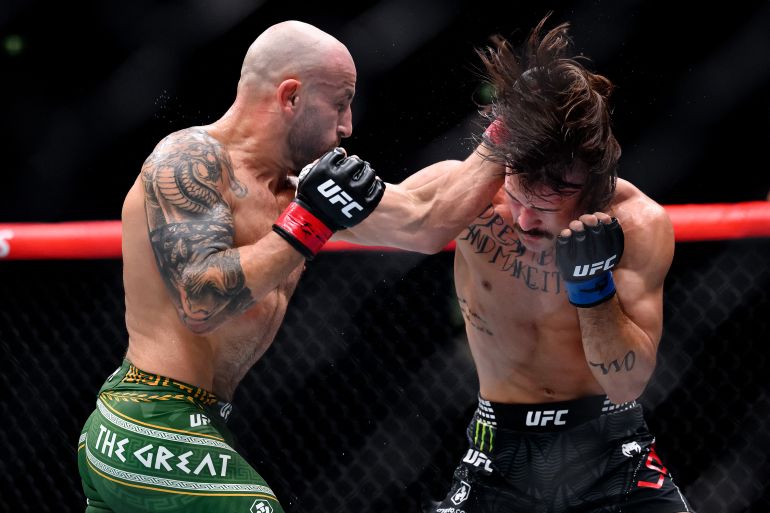
Alexander Volkanovski and Diego Lopes in action.
Volkanovski strikes Diego Lopes, right, during their UFC 325 featherweight title fight [Steven Markham/AFP]

Saint-Denis overpowers Hooker

Meanwhile, lightweight Benoit Saint-Denis of France effortlessly defeated New Zealand’s Dan Hooker by second-round technical knockout (TKO) in the night’s co-main event with punches from the mount position.

Saint-Denis (17-3 MMA, 9-3 UFC) has put himself in a firm position to remain in title contention this year with four straight wins, while Hooker (24-14 MMA, 14-10 UFC) has dropped back-to-back fights and will continue to go back to the drawing board.

A ​devastating right hand from lightweight Mauricio Ruffy of Brazil marked the beginning of the end of a ‌high-stakes featured bout opposite Rafael Fiziev of Azerbaijan. Ruffy (13-2 MMA, 4-1 UFC) secured a TKO victory with 30 seconds left in the second round, bouncing back from a loss to Saint-Denis for his eighth win in the last nine fights.

As for Fiziev (13-5 MMA, 7-5 UFC), he has lost four of his last five outings since ‌his six-match win streak was snapped in March 2023.

‘Trauma does not define us’: Living with loss in wartime Ukraine

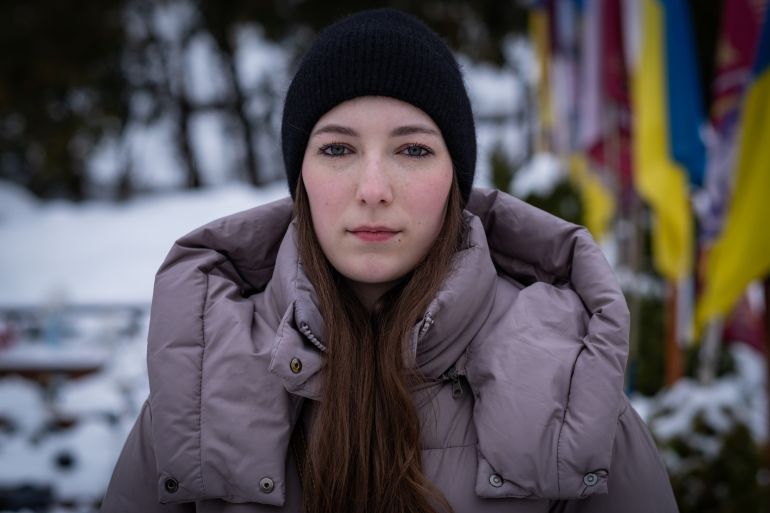
Lviv, Ukraine – Anastasiya Buchkouska, a 20-year-old student from western Ukraine, gently brushes away layers of snow and ice from her father’s grave.

She pauses, looking up at the photograph fixed to the gravestone. His face bears a striking resemblance to hers.

Recommended Stories

list of 4 itemsend of list

When her father was younger, he had served in the military. When Russia launched its full-scale invasion of Ukraine on February 24, 2022, he was called up almost immediately and sent to the front line.

Contact with the family was sporadic at best. They clung to brief messages and fleeting signs of life until one day in September 2022, everything fell silent.

For seven months, he was officially listed as missing. Buchkouska said she held on to hope, though deep down she feared the worst.

When confirmation of his death finally came, grief hit hard, but amid the demands of war, she said she had little choice but to “deal with it”.

Ukraine
Anastasiya Buchkouska in Lviv, Ukraine, January 26, 2026 [Nils Adler/Al Jazeera]

Her uncle was killed around the same time.

She focused on caring for her grandmother, who was often inconsolable, inventing topics of conversation and small activities to distract her.

In quieter moments, Buchkouska broke down into tears but tried to remind herself not to “overthink things”. This was war, she thought, and it would do her no good to wallow in grief.

The human toll

At Lychakiv Cemetery in the western city of Lviv, where Buchkouska’s father is buried, the surge in deaths in early 2022 forced authorities to allocate additional space beyond the cemetery’s walls – an area that is now itself running out of room.

Exact figures for how many people have been killed in the Russia-Ukraine war are difficult to verify. The United Nations Human Rights Monitoring Mission in Ukraine (HRMMU) confirmed that conflict-related violence killed 2,514 civilians and injured 12,142 others in the country in 2025 alone.

Nadia Zvonok in Nikita’s room. ‘I felt complete emptiness,’ says Nikolay, recalling the moment he saw the body of Olesya, his wife who went missing on March 11
Nadia Zvonok wipes away tears as she recalls how her granddaughter went missing during Russia’s occupation of Bucha in 2022 [File: Nils Adler/Al Jazeera]

According to a report by the Center for Strategic and International Studies, a  Washington, DC-based think tank, nearly two million Ukrainian and Russian soldiers are estimated to have been killed, wounded, or gone missing since the start of Russia’s full-scale invasion.

Russia alone is estimated to have suffered almost 1.2 million casualties, including at least 325,000 deaths.

The report says Russia’s losses exceed those endured by any major power since World War II, while Ukraine’s military casualties are estimated at between 500,000 and 600,000.

Al Jazeera is unable to verify the figures independently.

‘Everybody who lives in Ukraine has some mental health issue’

For many Ukrainians, loss is coupled with a sense of anxiety about what comes next.

“No one can predict how we will live after the war,” Kseniia Voznitsyna, a neurologist and founder of the first mental health rehabilitation centre for veterans in Ukraine, told Al Jazeera.

The human toll is already visible.

“Many people have been killed, many people live with amputations and psychological trauma,” Voznitsyna said.

A photo of Oleksandr Bugeruk looking on as his mother's body is placed on the ground.
Oleksandr Bugeruk looks on as his mother’s body is exhumed after Russian forces retreated from an area of central Ukraine in 2022 [File: Nils Adler/Al Jazeera]

“How the economy will hold up” remains uncertain, she said. “Whether people will have jobs with decent pay – these are open questions.”

For Oleksandra Matviichuk of the Center for Civil Liberties, a Kyiv-based human rights group and Nobel Peace Prize winner, the psychological weight of war is felt most sharply in everyday life.

“Living during a war means living in complete uncertainty,” Matviichuk said, adding, “We cannot plan not only our day, but also the next few hours.”

The constant fear for loved ones has become a defining feature of daily existence.

“There is no safe place in Ukraine where you can hide from Russian missiles,” said Matviichuk.

In late 2025, the UN Women’s representative in Ukraine, Sabine Freizer Gune, said “pretty much everybody” in the country “has some mental health issue”.

Oleksandra Matviichuk
Oleksandra Matviichuk [File: Nils Adler/Al Jazeera]

People, especially in eastern Ukraine or big cities such as Kyiv, Kharkiv in the northeast, or Odesa in the south, are regularly woken up to mass strikes by Russia.

In winter months, Russian forces often target infrastructure, leaving millions without electricity, heat or a reliable water supply.

As Buchkouska stood at her father’s grave, her words were stoic, but her eyes had the faint sign of tears.

If the war ends, “we will all be happy”, she said matter-of-factly, “but we cannot do anything about the people who died, we cannot make them come back to life”.

She pointed to a resilience forged under pressure.

‘Deeply insecure’: Why Bangladeshi minorities are scared ahead of elections

Dhaka, Bangladesh — Sukumar Pramanik, a Hindu teacher in Rajshahi city – about 250km (155 miles) from Bangladesh’s capital, Dhaka – says the country’s upcoming national election could be his final test of trust in politics.

Electoral periods in Bangladesh have seen spikes in communal and political violence throughout the country’s history, with religious minorities often bearing the brunt amid intense political competition and social tension.

Recommended Stories

list of 4 itemsend of list

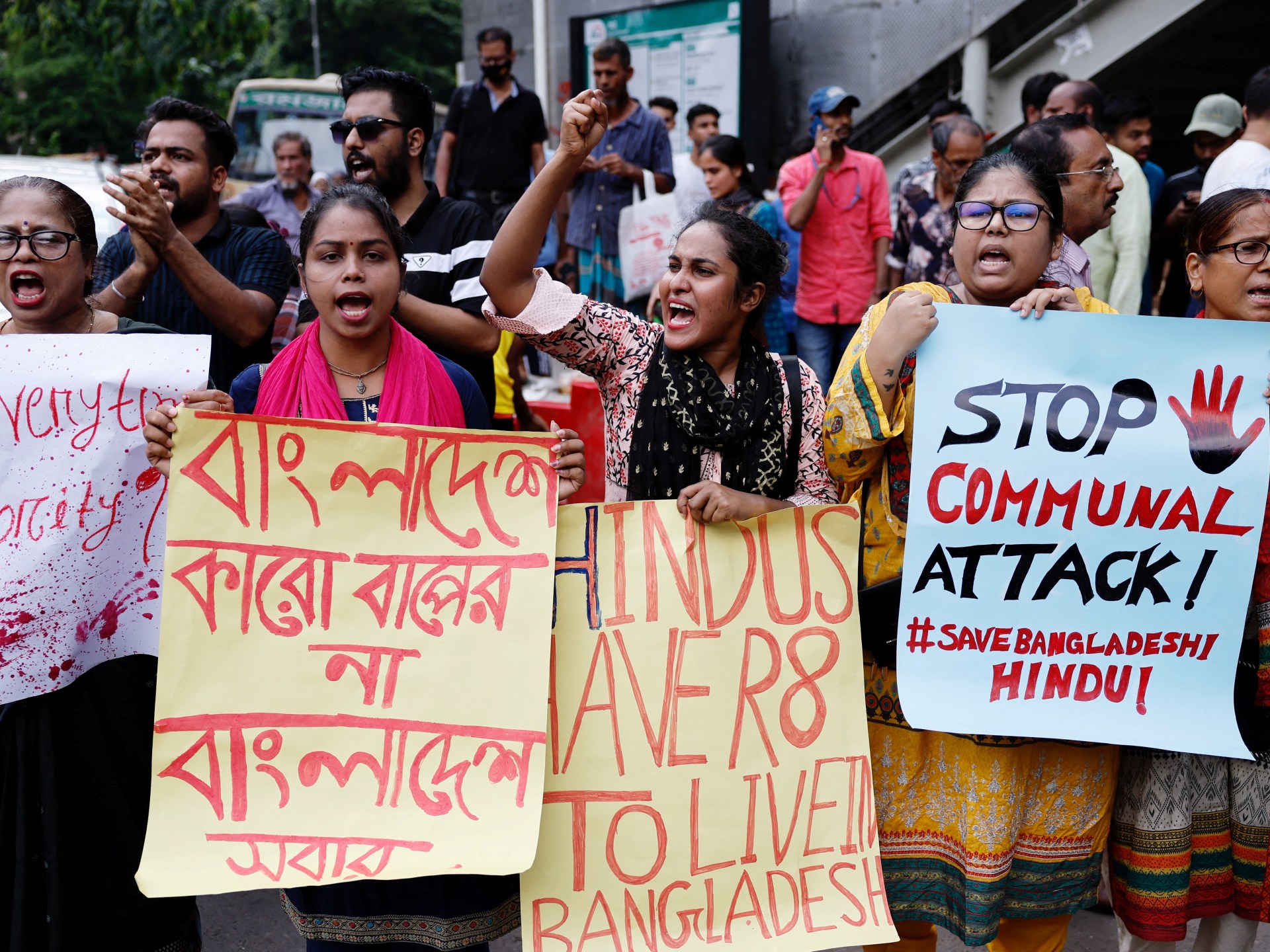
But since August 2024, and the end of former Prime Minister Sheikh Hasina’s rule, minorities in Bangladesh have felt under siege, with reports of attacks, killings and arson against their property, even though the government insists that most incidents were not motivated by religious hate.

That backdrop has intensified fears ahead of the February 12 election, despite efforts by leading political parties to reach out to minority communities. “The leaders of major parties have assured us that we will be safe before and after the vote,” Pramanik said, but faith in politicians runs low in his community at the moment.

After the August 2024 uprising that led to Hasina’s ouster, mobs in several parts of the country targeted the Hindu community, many of whose members had historically voted for Hasina’s Awami League, which has long tried to claim a “secular” mantle — even though critics have accused the party of failing to prevent attacks on minorities during its long years in power, and indulging in scaremongering.

Pramanik said a mob from his village attacked the Hindu community in Rajshahi’s Bidyadharpur, beating him and breaking his hand. He required surgery and spent days in hospital. “I stood in front of the mob believing they knew me and would not attack me,” he said. “They broke my hand – but more than that, they broke my heart and my trust. I had never experienced anything like this before.”

‘No proper justice’

Hindus form about 8 percent of the population in Muslim-majority Bangladesh, with Christians, Buddhists and other minorities present in much smaller numbers.

Through Bangladesh’s history, say experts and minority leaders, political actors and their supporters have at times exploited religious identities to intimidate voters or settle local disputes, leading to targeted attacks on minority homes, places of worship and individuals.

“If you look at elections in the past – even during the Awami League’s tenure – oppression and persecution of minorities never truly stopped,” Manindra Kumar Nath, acting general secretary of the Bangladesh Hindu Buddhist Christian Unity Council (BHBCUC), an umbrella group representing these minority communities, told Al Jazeera. “It happened before elections and after elections.” But what made things worse, he said, was that “there has been no proper justice”.

Not after Hindus were attacked following the 2001 election that former Prime Minister Khaleda Zia and her Bangladesh Nationalist Party (BNP) won, and not after later attacks against Hindus in subsequent years.

Now, sporadic attacks in recent months ahead of the election have revived those fears. According to the BHBCUC, at least 522 communal attacks were recorded in 2025, including 61 killings. The group says 2,184 incidents took place in 2024 following Hasina’s removal in August that year.

Minorities are now “deeply insecure” ahead of the election, Nath said. “There is fear among everyone,” he added.

The Bangladesh government disputes claims of widespread communal violence. According to official data, in 2025, authorities recorded 645 incidents involving members of minority communities. Of these, the government says, only 71 had “communal elements”, while the remainder were classified as general criminal acts. Officials argue the figures show that most incidents involving minorities were not driven by religious hostility, stressing the need to distinguish communal violence from broader law-and-order crimes.

At a national level, Bangladesh faces persistent law-and-order challenges, with an average of 3,000 to 3,500 violent crime deaths each year, according to official figures.

The government has also suggested that the issue has been politicised internationally, particularly by the Indian media and officials, since the fall of Hasina’s government.

Rights groups, however, present different data. Ain o Salish Kendra, a prominent human rights organisation, documented 221 incidents of communal violence in 2025, including one death and 17 injuries — lower than the BHBCUC’s count, but higher than the government’s data.

And the differing numbers notwithstanding, interviews with minority communities point to deep anxiety shaped by recent lived experience.

‘Not another mental trauma’

Shefali Sarkar, a homemaker in Bidyadharpur in Rajshahi, saw her life turn upside down on the afternoon of August 5, 2024 — the day Hasina fled, seeking exile in India.

As fears of an attack spread, most men in the community fled, leaving the women behind in their homes. Mobs primarily targeted men in the aftermath of Hasina’s ouster.

“They started vandalising our house. I thought this was it – that we were going to die,” Shefali said, still visibly shaken when recalling the day. “It left a deep scar in my mind, and I have needed mental health treatment after this.”

With elections approaching, Shefali said her anxiety has returned, fearing that any fresh unrest could once again make her community a target. “I cannot go through another mental trauma,” she said.

Her husband, Narayan Sarkar, said the area has remained calm since the attack and that local Muslim residents and political leaders have assured them of protection. “But the fear always remains – peace can be taken away at any time,” he said.

‘Unrest might spread’

Not everyone is as worried.

Shaymol Karmokar, from central Bangladesh’s Faridpur district, is the secretary of the local Durga Puja celebration committee. Durga Puja is a major Hindu Bengali festival, celebrated in Bangladesh and the Indian state of West Bengal.

“We have traditionally maintained strong communal harmony here over the years,” Karmokar said. “Many areas reported attacks during the uprising, but nothing happened in our locality.”

He added that political leaders had actively sought minority votes and promised to ensure their safety. “We will vote and expect a peaceful election,” he said.

Indeed, BNP leader Tarique Rahman — former PM Khaleda Zia’s son — has spoken of his desire to build an inclusive Bangladesh where all communities, irrespective of faith, feel safe and secure.

And the Jamaat-e-Islami, the BNP’s principal challenger in the elections, has for the first time nominated a Hindu candidate, from the city of Khulna, as part of its outreach to the community.

Still, in Gopalganj, where about a quarter of voters are Hindu, worries about election violence are high.

In one heavily Hindu-populated constituency of the district — which is also Hasina’s birthplace — Govinda Pramanik, secretary-general of the Bangladesh Jatiya Hindu Mohajote [Bangladesh National Hindu Grand Alliance] and an independent candidate, said he was scared that “unrest might spread around this election”, he said.

BHBCUC’s Nath said the government and election authorities could have done more to assuage concerns of minorities. “Even now, as the Election Commission operates, it has not once asked religious minorities what problems they are facing or what support they need,” he said.

Shafiqul Alam, press secretary to Muhammad Yunus, head of Bangladesh’s interim government, however, said authorities have taken steps to protect minorities and ensure a safe election. “We have taken adequate measures so that people of all communities – minorities and majorities, followers of all faiths and identities – can vote in a festive atmosphere,” Alam told Al Jazeera. “They could not vote freely under Sheikh Hasina over the last 15 years, as the elections were rigged.”

“Our priority is to ensure that everyone can vote this time,” he added, insisting that the government had consulted minority communities and addressed their concerns.

A vote for continuity? What to know for Costa Rica’s presidential election

The ruling party of Costa Rica is hoping to extend its control of the presidency for another four years in the country’s upcoming election, as voters express apathy about their options and opposition parties struggle to mobilise support.

On Sunday, millions of Costa Ricans will head to the polls to vote. But while the forecast looks promising for the centre-right populist movement championed by outgoing President Rodrigo Chaves, the election conceals a wild card: a large number of undecided voters.

Recommended Stories

list of 3 itemsend of list

As many as a third of Costa Ricans have yet to settle on a presidential candidate.

Still, Chaves’s movement appears on track to secure enough votes to avoid a run-off. Its prospects have been bolstered by a splintered opposition and waning support for centre-left groups like the National Liberation Party and Citizens’ Action, both of which held the presidency before Chaves.

Just as voter support has shifted, so too have voter priorities: Polls show more Costa Ricans are concerned with security than the economy in the upcoming election.

“Costa Rica is moving towards a political realignment,” said Ronald Alfaro, the coordinator of the Public Opinion and Political Culture Unit at the University of Costa Rica.

Who are the candidates? Which issues are top of mind for voters? We answer these questions and more in this brief explainer.

When is the election?

Voting is scheduled to take place over a 12-hour period on February 1, with the presidency, the two vice presidential positions and all 57 seats of the country’s legislature up for grabs.

What happens if no candidate wins the first round outright?

If no presidential hopeful crosses the 40 percent threshold necessary to avoid a run-off, the two top candidates will face off in another round of voting on April 5.

Is voting mandatory in Costa Rica?

While Costa Rica’s constitution states that voting is a “compulsory civic function”, there are no penalties for those who don’t participate.

More than 3.7 million Costa Ricans are eligible to vote. But many have expressed indifference to this year’s election cycle.

A January 21 poll from the University of Costa Rica’s Centre for Political Research and Studies (CIEP) found that nearly 79 percent of respondents said they felt little or no enthusiasm about the campaigns.

But the respondents had a range of responses when asked about their willingness to actually cast a ballot. More than 57 percent answered they felt motivated to vote. Only 19.5 percent said they had no desire to participate in the election.

A photo that shows five Costa Rican presidential candidates.
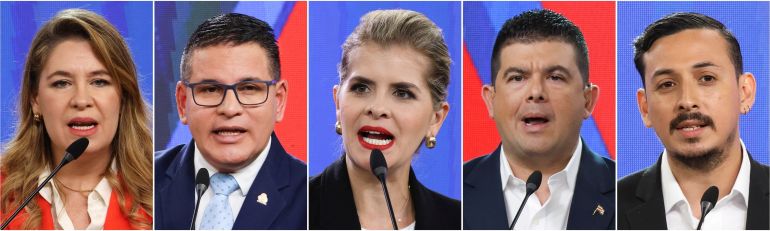
Candidates include, from left, Claudia Dobles, Fabricio Alvarado, Laura Fernandez, Alvaro Ramos and Ariel Robles [Mayela Lopez/Reuters]

Who are the candidates?

Former government minister Laura Fernandez is running with the Sovereign People Party (PPSO) to succeed President Chaves, promising continuity with his leadership.

Chaves remains popular in Costa Rica and has built a reputation for railing against what he defines as a corrupt status quo.

But presidents are restricted from running for back-to-back terms, and Fernandez has campaigned on her work within Chaves’s government, including as his chief of staff and minister for national planning and economic policy.

She has also pledged to appoint Chaves to her cabinet if elected as president.

The opposition to Chaves, meanwhile, has yet to consolidate around a single candidate.

Alvaro Ramos, an economist and the administrator of Costa Rica’s healthcare and pension systems, is running as the candidate for the centre-left National Liberation Party, a once-dominant force in the country’s politics.

But he faces competition on the left from former First Lady Claudia Dobles, whose husband Carlos Alvarado Quesada served as president from 2018 to 2022.

An urban planner, Dobles will be representing the Citizen Agenda Coalition (CAC), a group made up of two left-wing forces: the Citizens’ Action Party and the National Democratic Agenda.

Further splitting the opposition vote is 34-year-old legislator Ariel Robles of the left-leaning Broad Front Party (FA). He hopes to galvanise dissatisfaction with the status quo from the left.

Where do the candidates rank in the polls?

The latest poll from CIEP, published on January 28, found that about 43.8 percent of respondents expect to vote for Fernandez. That level of support would be enough to avoid a runoff.

Ramos polls in a distant second with 9.2 percent, and Dobles is close behind with 8.6 percent. Robles, meanwhile, is in fourth place with 3.8 percent support.

About 26 percent of respondents said they had not decided on who they would vote for, down from 32 percent the week before.

Fernandez appears well-positioned to secure a first-round win, something uncommon in the country’s recent history. But analysts say that another candidate could still outperform expectations, given the collapse of traditional political blocs and the large number of undecided voters.

Upsets are not uncommon in Costa Rica’s presidential elections. A poll before the 2022 race found Chaves drawing only 7 percent support, but he still went on to win the presidency.

“In the last three elections, we have seen an underdog who nobody was thinking about see a big jump,” said Alfaro. “Are there conditions for that? Perhaps, in the past, they were higher, but there is still a chance.”

Laura Fernandez
Costa Rican presidential candidate Laura Fernandez has promised continuity with the outgoing president [File: Mayela Lopez/Reuters]

What issues are front and centre?

National security has been a top issue in this year’s election cycle, with nearly all candidates embracing tough policies to combat crime.

Fernandez, for instance, has proposed in her platform to complete the maximum-security mega-prison that Chaves started to build in August.

The completed prison, under Fernandez’s plan, would “isolate leaders of organised crime”, cutting them off from the outside world. She has also advocated for mandatory prison labour and stricter criminal sentencing.

While Costa Rica was once known for its relative stability, homicides and organised crime have risen in the country.

Preliminary government figures for 2025 show that 873 homicides were reported in the country, down slightly from a high of 907 in 2023 and on par with 2024.

Right-wing candidates have successfully capitalised on similar concerns in other Latin American countries such as El Salvador, Ecuador and Chile.

In the final weeks before Sunday’s vote, Chaves invited El Salvador’s President Nayib Bukele – known for “mano dura” or “iron-fisted” approach to security – to tour the new mega-prison site. His government also accused a human rights activist of seeking his assassination.

The activist has denied the allegations, calling them politically motivated. But experts say such accusations can help heighten voter fears ahead of a pivotal vote.

Rodrigo Chaves and Nayib Bukele wave from the construction site of a prison
President Rodrigo Chaves Robles poses with El Salvador’s leader Nayib Bukele at the site of a future mega-prison in Alajuela, Costa Rica, on January 14 [Mayela Lopez/Reuters]

What role is President Chaves playing?

More than any particular policy issue, Alfaro says that the current election is a referendum on the Chaves presidency and dissatisfaction with the traditional opposition parties.

The current president is not on the ballot, but he has also played an outsized role in the lead-up to the election.

Chaves has also faced numerous allegations of illegal campaign interference, and the head of the Supreme Electoral Tribunal (TSE) has accused him of “threatening the peace and political stability of the country”.

Analysts say that his efforts to influence the race are unusual in Costa Rica and have alarmed observers who see it as evidence of his personalistic style of politics.