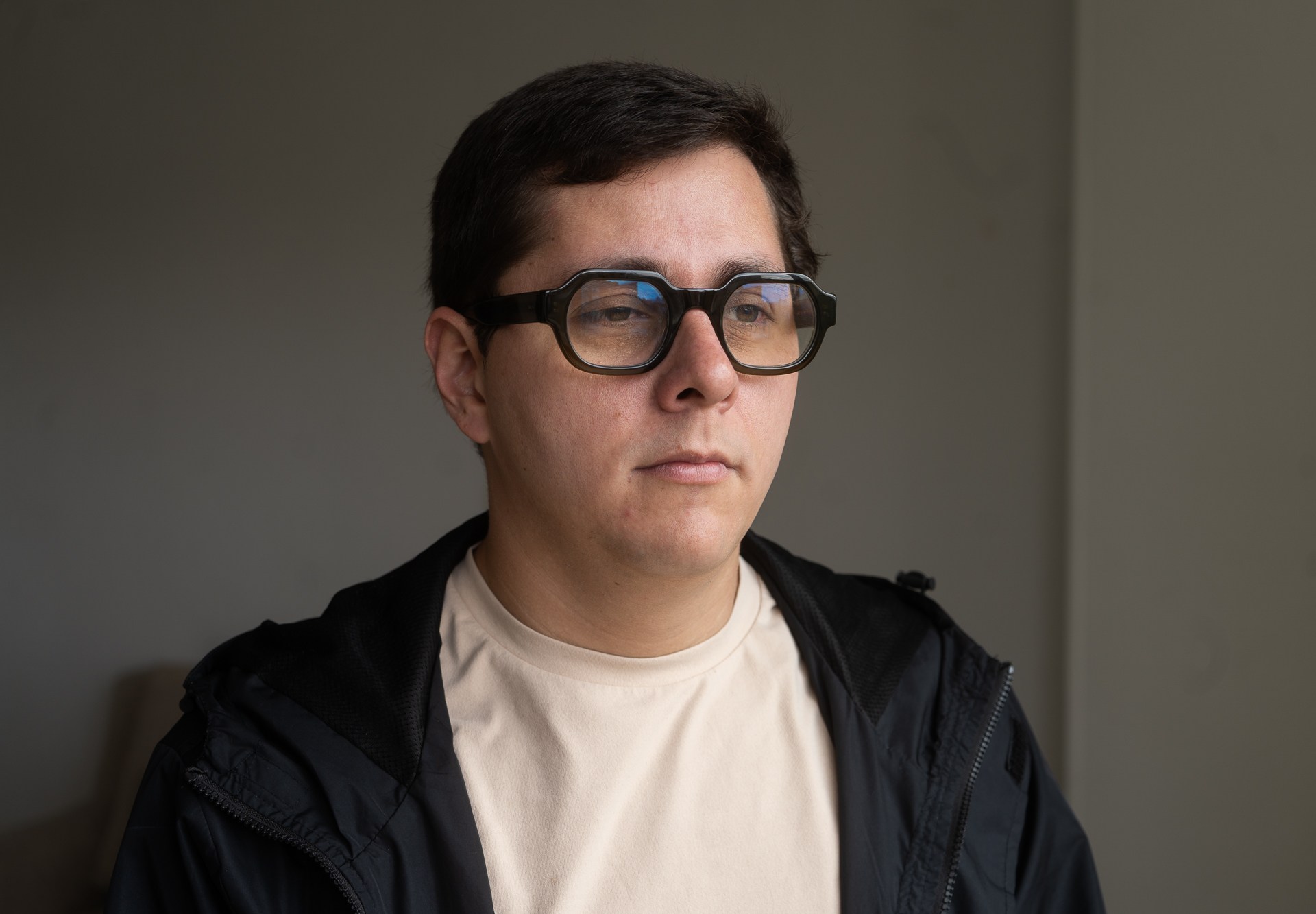
This longing is shared by Angelica Angel, a 24-year-old student activist in exile.
She had grown up with tear gas and police beatings in Venezuela. After all, she had started protesting at age 15.
“They’ve pointed their guns at me, beaten me and almost arrested me. That’s when you realise that these people have no limits: They target the elderly, women and even young girls,” Angel said.
But the increasing political repression ultimately made her life in Merida, a college town in western Venezuela, untenable.
After 2024’s disputed presidential election, Angel decided to voice her outrage on social media.
Maduro had claimed a third term in office, despite evidence that he had lost in a landslide. The opposition coalition obtained copies of more than 80 percent of the country’s voter tallies, showing that its candidate, Edmundo Gonzalez, had won the race.
Protests again broke out, and again, Maduro’s government responded with force.
Military and security officers detained nearly 2,000 people, including opposition leaders, journalists and human rights lawyers.
When Angel denounced the arbitrary detentions on TikTok, she began receiving daily threats.
By day, anonymous phone calls warned her of her impending arrest. By night, she heard pro-government gangs on motorcycles circling her home.
Fearing detention, she fled to Colombia in August 2024, leaving her family and friends behind.
But living outside Venezuela gave her a new perspective. She came to realise that the threats, persecution and violence she had learned to live with were not normal in a democratic country.
“When you leave, you realise that it isn’t normal to be afraid of the police, of unknown phone calls,” said Angel, her voice trembling. “I’m afraid to go back to my country and to be in that reality again.”
For exiled Venezuelans to return safely, Angel believes certain benchmarks must be met. The interim government must end arbitrary detention and allow opposition members, many of whom fled Venezuela, to return.
Only then, she explained, will Venezuela have moved past Maduro’s legacy.
The United States House of Representatives has approved a $1.2 trillion spending package to end a partial government shutdown.
The bipartisan legislation, passed on Tuesday, restores lapsed funding for key federal programmes, including those within the Departments of Labor and Education. The bill passed with 217 voting for it and 214 voting against in the Republican-controlled House.
Recommended Stories
list of 4 itemsend of list
Twenty-one Republicans voted against the bill, while 21 Democrats ended up voting for the legislation, which is now headed to President Donald Trump’s desk, where he will sign it into law.
Immigration was a major point of contention. The bill temporarily extends funding to the Department of Homeland Security (DHS) but leaves room for lawmakers to negotiate changes and reforms to immigration enforcement in the wake of federal agents killing two US citizens, Renee Good and Alex Pretti, last month.
The spending package only funds DHS for two weeks, through February 13. Otherwise, Congress wrapped up 11 annual appropriations bills that fund government agencies and programmes through September 30.
Democrats are also demanding new restraints for the Immigration and Customs Enforcement (ICE) agency.
“Democrats are united in our commitment to compel substantial reform at the Department of Homeland Security. Dramatic changes such as a mask ban, judicial warrant requirement, independent investigations when agents break the law, use of force protocols, mandatory body cameras and an end to the targeting of sensitive locations like houses of worship, schools and hospitals must be part of any full-year appropriations bill,” Democratic leader Hakeem Jeffries said in a statement after the vote.
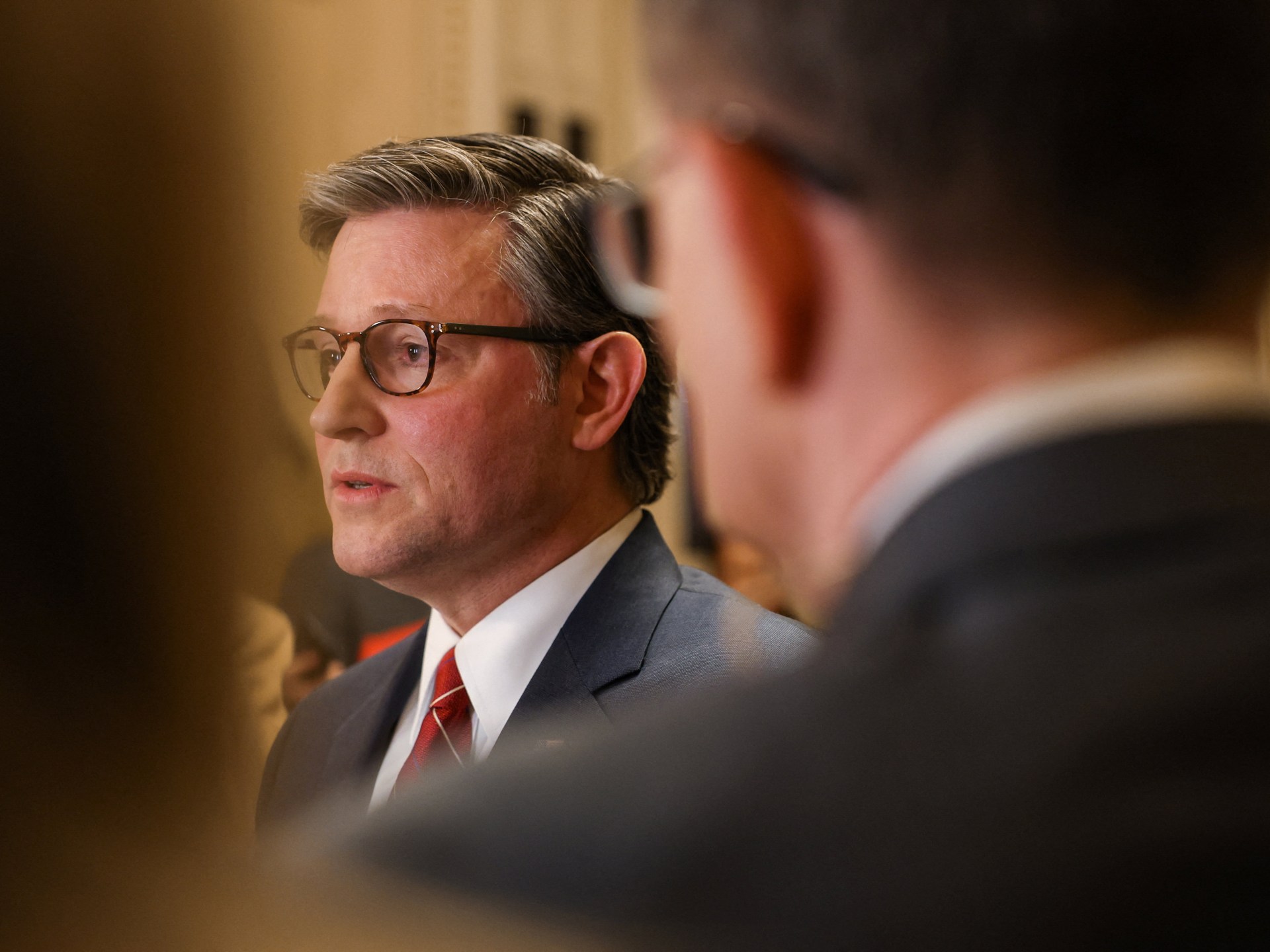
Speaker Mike Johnson said he expects the two sides will be able to reach an agreement by the deadline.
“This is no time to play games with that funding. We hope that they will operate in good faith over the next 10 days as we negotiate this,” said Johnson. “The president, again, has reached out.”
Some Republicans on the party’s right flank had sought, unsuccessfully, to modify the bill to include a provision that would tighten voting requirements.
House Republicans have only a 218-214 majority, which means they can lose only one Republican vote in the face of united Democratic opposition.
Saif al-Islam Gaddafi, the most prominent son of slain Libyan leader Muammar Gaddafi, has been killed in the country’s western city of Zintan.
Saif al-Islam, who was 53 when he was killed, was Gaddafi’s second son and had been based in Zintan since 2011 – first in prison, and then, after 2017, as a free man, plotting a return to politics.
Recommended Stories
list of 3 itemsend of list
Figures close to him, including his political adviser, Abdullah Othman, and his lawyer, Khaled el-Zaydi, confirmed his death on Tuesday, although the exact circumstances are still unclear.
Saif al-Islam had been seen by many before the 2011 uprising as his father’s heir-apparent and the second-most powerful man in Libya.
He remained prominent throughout the violence that gripped Libya in the wake of the Arab Spring protests, which led to a civil war. There were numerous allegations against him of torture and extreme violence against opponents of his father’s rule. By February 2011, he was on a United Nations sanctions list and was banned from travelling.
In March 2011, NATO began bombing Libya after the UN authorised “all necessary measures” to protect civilians from Gaddafi’s forces in the civil war.
In June 2011, Saif al-Islam announced that his father was willing to hold elections and to step down if he did not win them. However, NATO rejected the offer, and the bombardment of Libya continued.
By the end of June, the International Criminal Court (ICC) had issued an arrest warrant against Saif al-Islam, but he remained at large until after the death of his father and his brother, Mutassim, in Sirte, on October 20, 2011.
Prison
Following long negotiations with the ICC, which had been calling for his extradition, Libyan officials were granted the authority to try Saif al-Islam in Libya for war crimes committed during the 2011 uprising.
At the time, Saif al-Islam’s defence lawyers feared that a trial in Libya would not be motivated by justice, but a desire for revenge. The UN estimated that up to 15,000 people were killed in the conflict, while Libya’s National Transitional Council placed the figure as high as 30,000.
In 2014, Saif al-Islam appeared via videolink in the Tripoli court where his trial was held, as he was imprisoned in Zintan at the time. In July 2015, the Tripoli court sentenced him to death in absentia.
However, in 2017, he was released by the Abu Bakr as-Siddiq Battalion, a militia that controlled Zintan, as part of an amnesty issued by Libya’s eastern authorities, which are not recognised internationally.
But he did not re-emerge publicly for years, and continued to be wanted by the ICC. In July 2021, Saif al-Islam gave a rare interview to The New York Times, in which he accused authorities in Libya of being “afraid of … elections”.
Explaining his underground persona, he said he had “been away from the Libyan people for 10 years”.
“You need to come back slowly, slowly. Like a striptease,” he added.
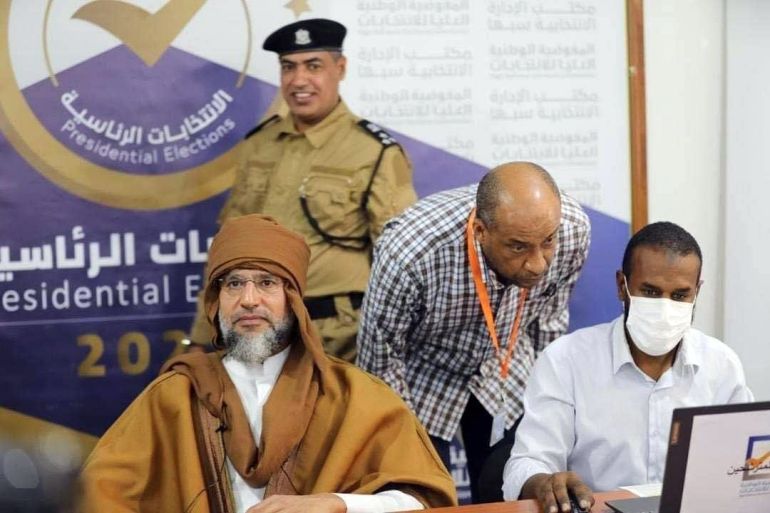
He went on to make his first public appearance in years in November 2021, in the city of Sebha, where he filed to run for the Libyan presidency in an attempt to resurrect the ambitions of his father’s former supporters.
Initially banned from taking part, he was later reinstated, but the election did not take place as a result of Libya’s tumultuous political situation, with two rival administrations vying for power.
‘Progressive’ face
A Western-educated and well-spoken man, Saif al-Islam presented a progressive face to the oppressive Libyan government. He received a PhD from the London School of Economics in 2008. His dissertation dealt with the role of civil society in reforming global governance.
He was prominent in his calls for political reform, and was extremely visible and active in the drive to repair Libya’s relations with the West between the year 2000 and the start of the 2011 uprising.
The London School of Economics was later condemned for having sought a relationship with the Libyan regime, namely for accepting Saif al-Islam as a student, who had signed an agreement for a $2.4m gift from the Gaddafi International Charity and Development Foundation on the day of his doctorate ceremony.
As an internationally prominent negotiator and influencer, Saif al-Islam could claim a number of victories and prominent roles. He played a pivotal role in the nuclear negotiations with Western powers, including the United States and the UK.
He was also prominent when negotiating compensation for families of victims of the Lockerbie bombing, the Berlin nightclub attack, and the UTA Flight 772, which detonated over the Sahara Desert.
And he mediated the release of six medics – five of whom were Bulgarian – who were accused of infecting children with HIV in Libya in the late 1990s. The medics were imprisoned for eight years in 1999 and, upon their release, announced that they had been tortured while in detention.
Sudanese military officials say they’ve broken through a siege by the Rapid Support Forces (RSF) paramilitary group of the South Kordofan capital of Kadugli. It’s the military’s second major advance in the Kordofan region in less than a week.
Tehran, Iran – Several of Iran’s former leaders, including some who are currently imprisoned or under house arrest, have released damning statements over the killing of thousands during nationwide protests, garnering threats from hardliners.
The Iranian government claims that 3,117 people were killed during the antiestablishment protests. The government has rejected claims by the United Nations and international human rights organisations that state forces were behind the killings, which were mostly carried out on the nights of January 8 and 9.
Recommended Stories
list of 3 itemsend of list
The United States-based Human Rights Activists News Agency (HRANA) says it has verified 6,854 deaths and is investigating 11,280 other cases.
“After years of ever-escalating repression, this is a catastrophe that will be remembered for decades, if not for centuries,” wrote Mir Hossein Mousavi, a former reformist presidential candidate who has been under house arrest since the aftermath of the Green Movement of 2009.
“How many ways must people say that they do not want this system and do not believe your lies? Enough. The game is over.”
Mousavi told state forces to “put down your guns and step aside from power so that the nation itself can bring this land to freedom and prosperity”, and stressed that this must be done without foreign intervention amid the shadow of another war with the US and Israel.
He said that Iran is need of a constitutional referendum and a peaceful, democratic transition of power.
A group of 400 activists, including figures from inside and outside the country, backed Mousavi’s statement.
Mostafa Tajzadeh, a prominent jailed former reformist politician, said that he wants Iran to “move beyond the wretched conditions that the guardianship of Islamic jurists and the failed rule of the clergy have imposed on the Iranian nation”.
In a short statement from prison last week, he said this would be contingent upon the “resistance, wisdom, and responsible action of all citizens and political actors” and called for an independent fact-finding mission to uncover the true aspects of “atrocities” committed against protesters last month.
‘Major reforms’
Other former heavyweights have heavily criticised Iran’s current course, but have avoided calling for the effective removal of the Islamic Republic from power.
Former President Hassan Rouhani, who many believe is eyeing a potential future return to power, last week gathered his ex-ministers and insiders for a recorded speech, and called for “major reforms, not small reforms”.
He acknowledged that Iranians have been protesting for a variety of reasons over the past four decades, and insisted the state must listen to them if it wants to survive, but did not mention the internet blackout and killing of protesters during his tenure in November 2019.
Rouhani added that the establishment must hold public votes on major topics, including foreign policy and the ailing economy, in order to avoid further nationwide protests and prevent the population from looking to foreign powers for help.
Mohammad Khatami, the reformist cleric who was president from 1997 to 2005, adopted a softer tone and said violence derailed protests that could have helped “expand dialogue to improve the country’s affairs”.
He wrote in a statement that Iran must “return to a forgotten republicanism, and an Islamism that embraces republicanism in all its dimensions and requirements, placing development together with justice at the core of both foreign and domestic policy”.
Mehdi Karroubi, another senior reformist cleric who had his house arrest lifted less than a year ago after 15 years, called the protest killings “a crime whose dimensions language and pen are incapable of conveying” and said the establishment is responsible.
“The wretched state of Iran today is the direct result of Mr. Khamenei’s destructive domestic and international interventions and policies,” he wrote, in reference to Supreme Leader Ayatollah Ali Khamenei, who has been in absolute power for nearly 37 years.
Karroubi noted one prominent example as the 86-year-old leader’s “insistence on the costly and futile nuclear project and the heavy consequences of sanctions over the past two decades for the country and its people”.
Former Iranian President Hassan Rouhani in 2013 [File: Frank Franklin II/AP Photo]
Political prisoners rearrested
Three prominent Iranian former political prisoners were arrested and taken to prison by security forces once again last week.
The Fars news agency, affiliated with the Islamic Revolutionary Guard Corps (IRGC), said the reason for the arrests of Mehdi Mahmoudian, Abdollah Momeni, and Vida Rabbani was that they had sneaked out Mir Hossein Mousavi’s statement from his house arrest.
Mahmoudian is a journalist and activist, and co-writer of the Oscar-nominated political drama movie, It Was Just an Accident, which won the Palme d’Or at the 2025 Cannes Film Festival. Momeni and Rabani are also political activists who have previously been arrested by the Iranian establishment multiple times.
The three were among 17 human rights defenders, filmmakers and civil society activists, including Nobel Peace Prize laureate Narges Mohammadi and internationally recognised lawyer Nasrin Sotoudeh, who co-signed a statement last week that put the blame for the protest killings on the supreme leader and the theocratic establishment.
“The mass killing of justice seekers who courageously protested this illegitimate system was an organised state crime against humanity,” they wrote, condemning the firing on civilians, the attacks on the wounded, and the denial of medical care as “acts against Iran’s security and betrayal of the homeland”.
The activists called for holding a referendum and constituent assembly to allow Iranians to democratically decide their political future.
Hardliners incensed
In hardline-dominated circles and among their affiliated media, the mood has been entirely different.
On Sunday, lawmakers in parliament donned the uniforms of the IRGC, which was last week designated a “terrorist” organisation by the European Union.
They chanted “Death to America” and promised they would seek out European military attaches working at embassies in Tehran to expel them as “terrorists”.
Nasrollah Pejmanfar, a cleric who represents northeast Mashhad in the parliament, told a public session of parliament on Sunday that former President Rouhani must be hanged for favouring engagement with the West, echoing a demand also made by other hardline peers in recent years.
“Today is the time for the ‘major reform’, which is arresting and executing you,” he said, addressing Rouhani.
Amirhossein Sabeti, another firebrand lawmaker, condemned the government of President Masoud Pezeshkian – but not Khamenei or the establishment – for proceeding with mediated talks with the US.
Norway’s Crown Princess Mette-Marit’s son has pleaded not guilty to four rape charges as his trial opens in Oslo. Marius Borg Hoiby faces 38 counts, including assault and domestic violence, in a case that has shaken Norway’s royal family.