Polls open in Thailand with three main parties vying for power

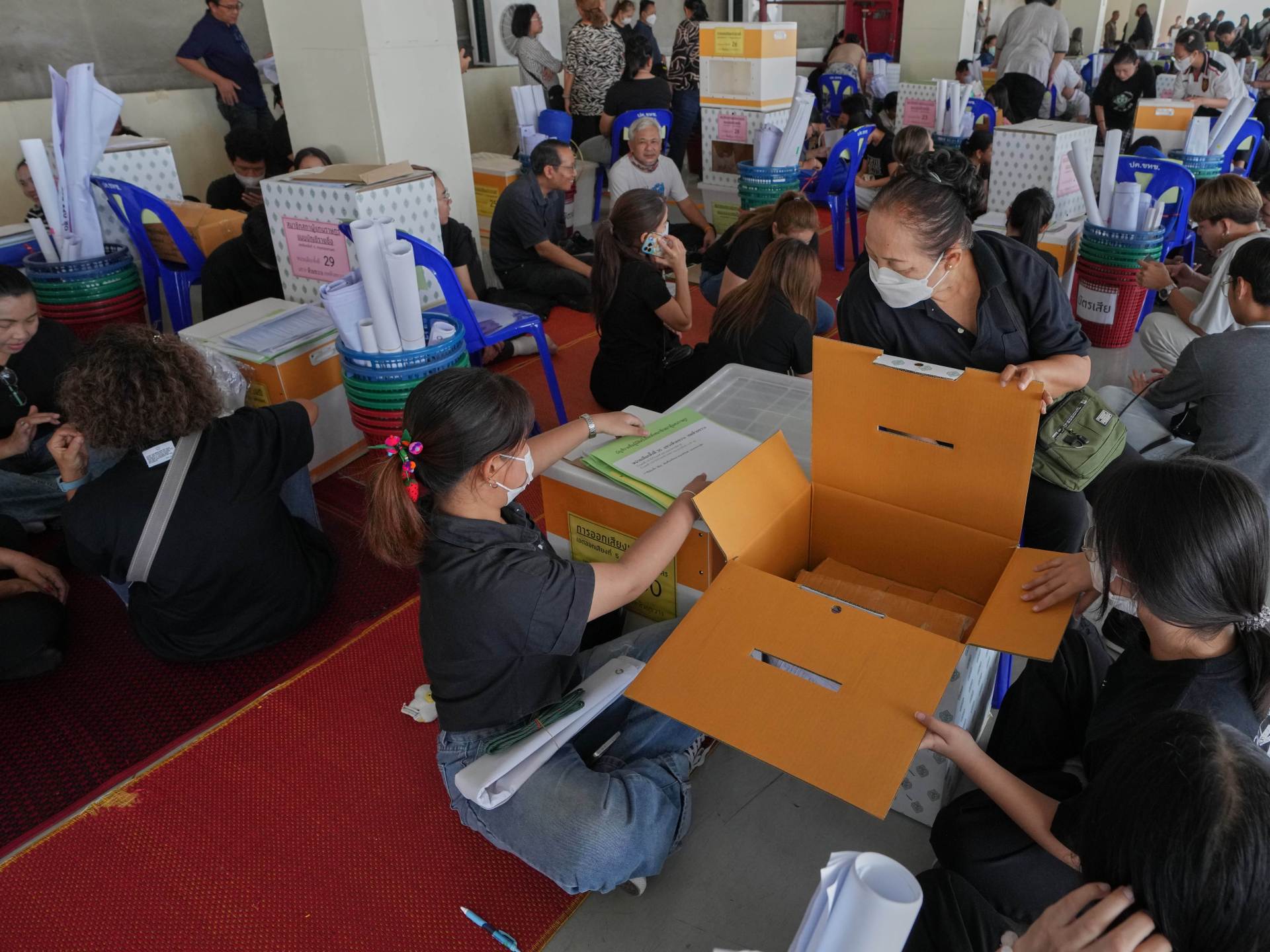
Polls have opened in Thailand in a closely watched general election, with progressive reformers, military-backed conservatives and populist forces vying for control.

Polling stations opened at 8am local time (01:00 GMT) on Sunday and were set to close at 5pm (10:00 GMT).

Recommended Stories

list of 4 itemsend of list

More than 2.2 million voters had already cast ballots during an early voting period that began on February 1, according to the Election Commission.

The battle for support from Thailand’s 53 million registered voters comes against a backdrop of slow economic growth and heightened nationalist sentiment.

While more than 50 parties are contesting the polls, only three – the People’s Party, Bhumjaithai, and Pheu Thai – have the nationwide organisation and popularity to gain a winning mandate.

With 500 parliamentary seats at stake and surveys consistently showing no party likely to win an outright majority, coalition negotiations appear inevitable. A simple majority of elected lawmakers will select the next prime minister.

The progressive People’s Party, led by Natthaphong Ruengpanyawut, is favoured to win the most seats. But the party’s reformist platform, which includes promises to curb the influence of the military and the courts, as well as breaking up economic polices, remains unpalatable to its rivals, who may freeze it out by joining forces to form a government.

The party is the successor to the Move Forward Party, which won the most seats in the House of Representatives in 2023, but was blocked from power by a military appointed Senate and later dissolved by the Constitutional Court over its call to reform Thailand’s strict royal insult laws.

The Bhumjaithai, headed by caretaker Prime Minister Anutin Charnvirakul, is seen as the main defender and preferred choice of the royalist-military establishment.

Anutin has only been the prime minister since last September, after serving in the Cabinet of former Prime Minister Paetongtarn Shinawatra, who was forced out of office for an ethics violation regarding the mishandling of relations with Cambodia. Anutin dissolved parliament in December to call a new election after he was threatened with a no-confidence vote.

He has centred his campaign on economic stimulus and national security, tapping into nationalist fervour stoked by deadly border clashes with neighbouring Cambodia.

The third major contender, Pheu Thai, represents the latest incarnation of political movements backed by jailed former Prime Minister Thaksin Shinawatra, and trades on the populist policies of the Thai Rak Thai party, which held power from 2001 until 2006, when it was ousted by a military coup.

The party has campaigned on economic revival and populist pledges like cash handouts, nominating Thaksin’s nephew, Yodchanan Wongsawat, as its lead candidate for prime minister.

Sunday’s voting also includes a referendum asking voters whether Thailand should replace its 2017 military-drafted constitution.

Japan heads to polls as Takaichi seeks mandate for conservative agenda

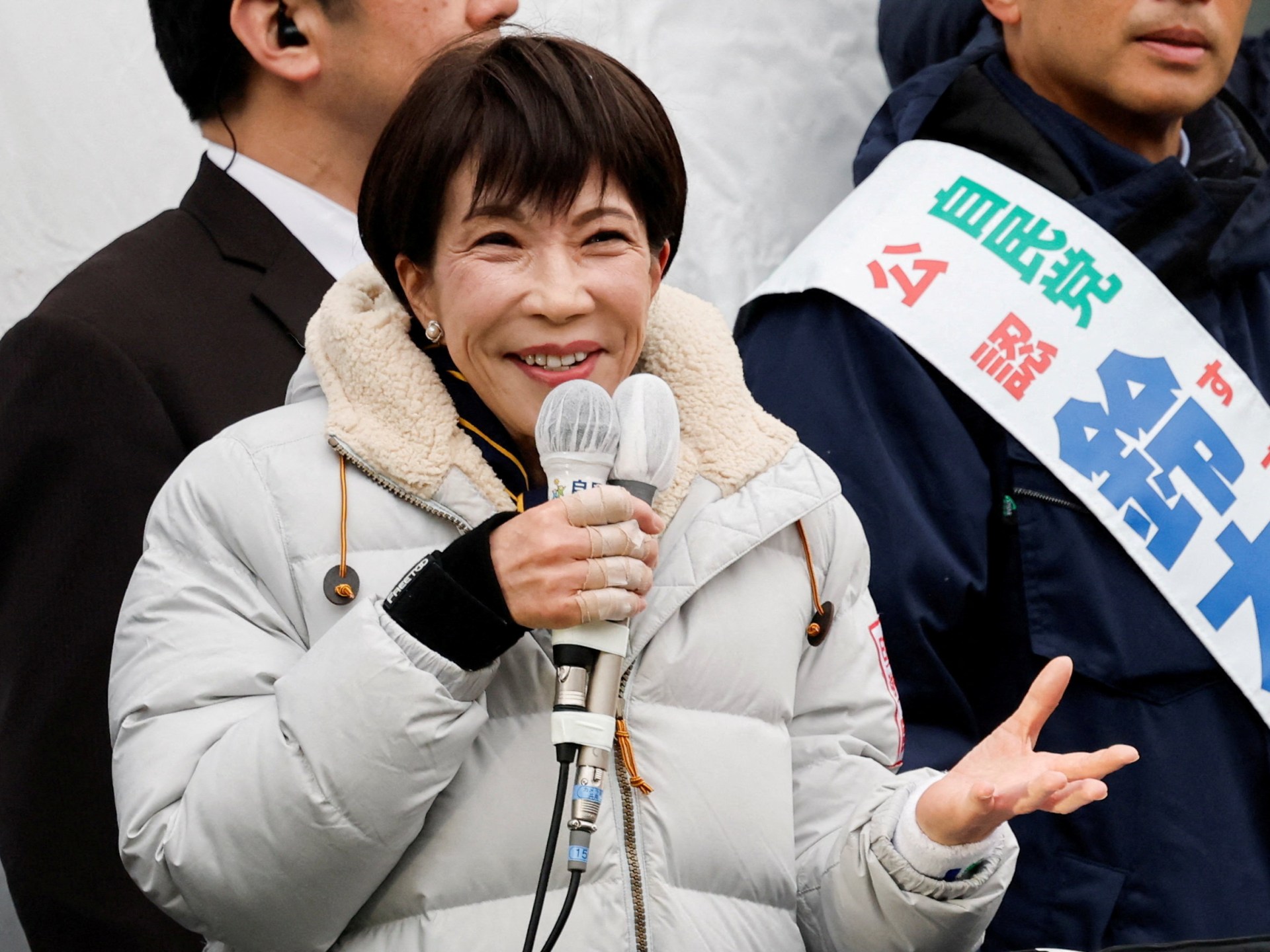
Voters in Japan are casting their ballots in a parliamentary election expected to deliver a resounding victory for Prime Minister Sanae Takaichi’s conservative coalition.

The snap vote on Sunday comes as Takaichi seeks a new mandate to push through an ambitious agenda, including increased defence spending and tougher immigration measures.

Recommended Stories

list of 4 itemsend of list

The coalition of Takaichi’s Liberal Democratic Party (LDP) and the Japan Innovation Party, known as Ishin, could win more than 300 of the 465 seats in the lower house of parliament, according to multiple opinion polls.

The figure would mark a substantial gain from ⁠the 233 it is defending.

The opposition, despite the formation of a new centrist alliance and a rising far-right, is seen as too splintered to be a real challenger.

Takaichi, 64, is Japan’s first female prime minister and took office in October after being selected as the LDP’s leader. The ultraconservative politician has pledged to “work, work, work” and her style – seen as both playful and tough – has resonated with younger voters.

She has said she will step down if the LDP fails to win a majority.

Takaichi has put the rising cost of living at the centre of her campaign. The issue is voters’ main concern, with prices rising while real wage growth lags behind inflation, leaving households worse off. Japan also faces longstanding problems with sluggish economic growth. The economy expanded just 1.1 percent last year and is on track to grow by only 0.7 percent in 2026, according to the International Monetary Fund.

Takaichi has promised to suspend the 8 percent sales tax on food for two years to help households cope with rising prices.

The pledge follows the approval last year of Japan’s largest stimulus package since the COVID-19 pandemic, a 21.3 trillion yen ($136bn) injection into the economy heavily focused on cost-of-living relief measures, including energy bill subsidies, cash handouts and food vouchers.

Takaichi has also pledged to revise security and defence policies by December to bolster Japan’s offensive military capabilities, lifting a ban on weapons exports and moving further away from the country’s post-war pacifist principles.

Al Jazeera’s Patrick Fok, reporting from Tokyo, said Takaichi, who is popular with young voters, is hoping to capitalise on her “tremendous popularity” and secure a landslide victory for her coalition.

“That result – if indeed that’s how it turns out – will mark a remarkable turnaround really for the LDP. Months ago, it was a party in disarray. It had lost its parliamentary majority and was embroiled in a slush fund scandal. So, this turnaround has very much been engineered by Takaichi and what some describe as an almost cult-like popularity,” Fok said.

Sunday’s vote comes amid record snowfall in parts of the country. With up to 70cm (27.5 inches) of snow forecast in northern and eastern regions, some voters will have to battle blizzards to cast their ballots. The vote is only the third post-war election held in February, with polls typically called during milder months.

Fok said the heavy snowfall could affect voter turnout, but “there’s no suggestion that’s going to impact the outcome of the election”.

Is Nigeria’s security situation worsening, or is there progress?

More than 200 people have been killed in attacks, but the abducted Christians have been freed.

Armed groups in Nigeria have killed more than 200 people in several attacks in recent days.

Meanwhile, all the Christian worshippers abducted from churches last month have been released.

How serious is Nigeria’s security situation – and what progress is being made?

Presenter: Adrian Finighan

Guests:

James Barnett – non-resident research fellow at the Hudson Institute, specialising in armed groups in Nigeria

Oluwole Ojewale – regional coordinator for West and Central Africa at the Institute for Security Studies

‘Non-negotiable’: Iran says missiles off the table in talks with the US

Iranian Foreign Minister Abbas Araghchi says he hopes talks with the United States will resume soon, while US President Donald Trump pledged another round of negotiations next week following mediated discussions in Oman.

Araghchi told Al Jazeera on Saturday that Iran’s missile programme was “never negotiable” in Friday’s talks, and warned Tehran would target US military bases in the Middle East if the US attacks Iranian territory.

Recommended Stories

list of 4 itemsend of list

He added that despite the negotiations in Muscat being indirect, “an opportunity arose to shake hands with the American delegation”. The talks were “a good start“, but he insisted “there is a long way to go to build trust”.

Iranians in the capital, Tehran, however, seemed less positive.

“In my opinion, like previous times, negotiations will end without results because both sides are sticking to their own positions and not willing to back down,” a woman who asked to remain anonymous told Al Jazeera.

Abdullah al-Shayji, a US foreign policy expert at Kuwait University, said he hopes for a new deal between the two foes but is not feeling optimistic.

“There is a strong position” from the US and “being provoked by” Israel to “clamp down on the Iranians because they feel that Iran is at its weakest point” so that it will be easy to extract concessions from it, especially after last month’s antigovernment demonstrations, al-Shayji said from the Al Jazeera Forum in Qatar’s capital Doha.

‘Inalienable right’

Despite calling the talks “very good” on Friday, Trump signed an executive order effective from Saturday that called for the “imposition of tariffs” on countries still doing business with Iran.

The US also announced new sanctions against numerous shipping entities and vessels aimed at curbing Iran’s oil exports.

More than one-quarter of Iran’s trade is with China, including $18bn in imports and $14.5bn in exports in 2024, according to World Trade Organization data.

Nuclear enrichment is Iran’s “inalienable right and must continue”, Araghchi said, adding, “We are ready to reach a reassuring agreement on enrichment. The Iranian nuclear case will only be resolved through negotiations.”

Iran’s missile programme is non-negotiable because it relates to a “defence issue”, he said.

Washington has sought to address Iran’s ballistic missile programme and its support for armed groups in the region – issues that Israel has pushed to include in the talks, according to media reports.

Tehran has repeatedly rejected expanding the scope of the negotiations beyond the nuclear issue.

“The Iranians are vehemently opposed to any concessions,” said al-Shayji, as is the US, which makes it extremely hard for countries leading mediation efforts to “get them closer together”.

Friday’s negotiations were the first since nuclear talks between Iran and the US collapsed last year following Israel’s unprecedented bombing campaign against Iran, which triggered a 12-day war.

Following widespread antigovernment protests in Iran last month, Trump ramped up threats against the country, deploying the USS Abraham Lincoln to the Middle East.

(FILES) This January 19, 2012 image provided by the US Navy, shows the Nimitz-class aircraft carrier USS Abraham Lincoln transiting the Arabian Sea.
The Nimitz-class aircraft carrier USS Abraham Lincoln transiting the Arabian Sea in 2012 [File: AFP]

‘Peace through strength’

Trump’s lead negotiators in Oman, special envoy Steve Witkoff and presidential adviser Jared Kushner, visited the aircraft carrier stationed in the Arabian Sea on Saturday.

In a social media post, Witkoff said the aircraft carrier and its strike group are “keeping us safe and upholding President Trump’s message of peace through strength.”

Witkoff said he spoke with the pilot who downed an Iranian drone that approached the carrier “without clear intent” on Tuesday.

“Proud to stand with the men and women who defend our interests, deter our adversaries, and show the world what American readiness and resolve look like, on watch every day,” said Witkoff.

While Trump has sought to use the aircraft carrier’s deployment as a means to exert pressure on Iran, al-Shayji said this cannot be a long-term strategy.

“He [Trump] can’t keep his forces at alert stage for too long. This would really discredit Trump’s administration regarding being very harsh and hard-liners on Iran,” he said.

Israeli Prime Minister Benjamin Netanyahu is set to meet Trump on Wednesday to discuss the Iran talks, his office said in a statement.

Netanyahu “believes any negotiations must include limitations on ballistic missiles and a halting of the support for the Iranian axis”, it said, referring to Iran’s allies in the region.

During the 12-day war, US warplanes bombed Iranian nuclear sites.

Chris Hedges on decline of the American empire

Journalist Chris Hedges speaks to Marc Lamont Hill on Trump’s first year and the future of US democracy.

One year into Donald Trump’s return to office, a wave of hardline actions – from volatile ICE raids to growing concern over political pressure on the media – has raised alarm about the expansion of the president’s power.

Then with US midterms approaching, attention is turning to whether there is any meaningful challenge to Republican grip on Congress.

So what happens next?

Suryakumar rescues India as United States threaten T20 World Cup upset

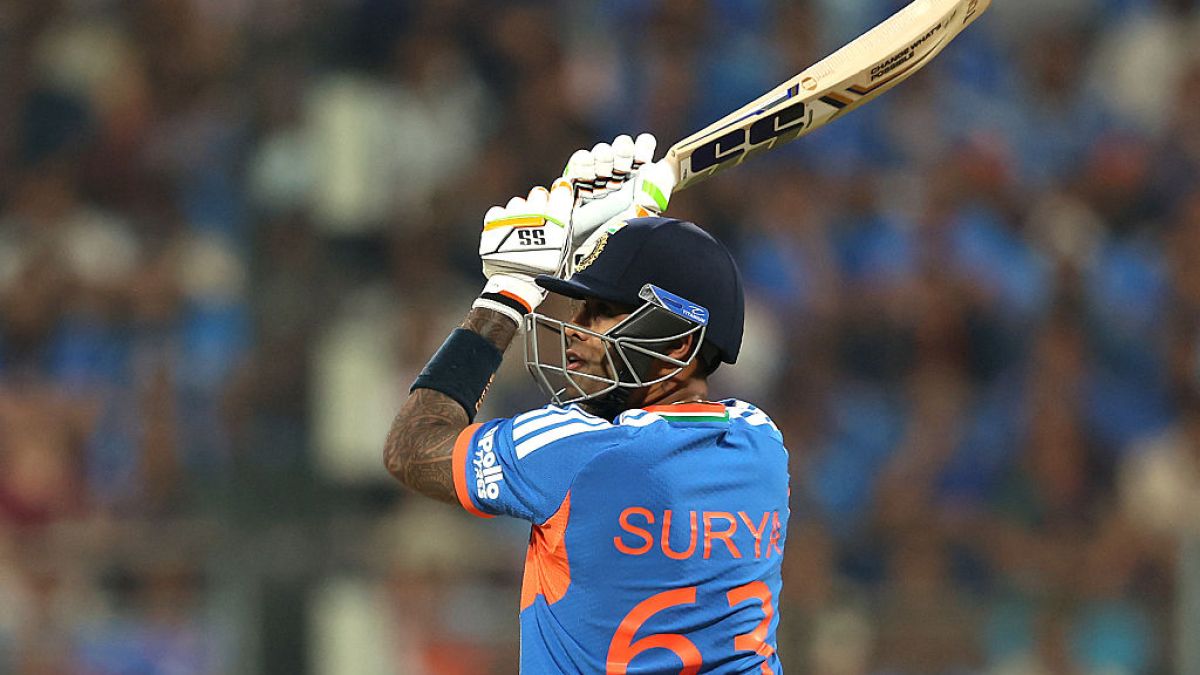
India captain Suryakumar Yadav led ‌by example as the tournament co-hosts began their Twenty20 World Cup title defence with a 29-run victory against the United States in a group A contest on Saturday.

India recovered from a dire 77-6 to post a decent 161-9 with Suryakumar hitting a scintillating 84 not out off 49 balls.

Recommended Stories

list of 4 itemsend of list

The US managed 132-8 in reply, putting up a decent fight but never really coming ⁠close to chasing down the target.

Earlier, the predominantly Indian fans at the Wankhede Stadium probably expected sixes and fours to rain down after US captain Monank Patel elected to field.

Instead, it was a long procession of India’s top-order batters returning to the pavilion after a spectacular meltdown of the world’s top-ranked T20 team.

Opener Abhishek Sharma, currently the world’s number one T20 batter, fell for a first-ball duck in perhaps an inkling of what was in ⁠store for the home side.

The real nightmare unfolded in the final Powerplay over when Shadley van Schalkwyk claimed three wickets in five deliveries to leave India reeling on 46-4.

Ishan Kishan (20) and Tilak Varma (25) could not convert their starts, while Shivam Dube departed with a golden duck against his name in that eventful over from van Schalkwyk.

It could easily have been worse, but bowler Shubham Ranjane could not hold onto a return catch from Suryakumar when the batter was on 15.

Wickets kept tumbling at the other end though.

Rinku Singh, Hardik Pandya and ‌Axar Patel perished trying to swing their way out of trouble.

Suryakumar responded to the crisis with a captain’s knock as he raced to a 36-ball fifty before plundering 21 runs from the final over from Saurabh Netravalkar.

India’s pace spearhead Jasprit Bumrah missed ‌the match due to illness, and they were also forced into replacing Harshit Rana, who was ruled out of the tournament barely 24 hours before ‌their opening match with a thigh injury.

Mohammed Siraj (3-29) vindicated his last-minute ⁠inclusion as Rana’s replacement with a two-wicket burst, while Arshdeep Singh also tasted success as they reduced the US to 31-3 in the six Powerplay overs.

Sanjay Krishnamurthi (37) and Milind Kumar (34) defied India for a while with a 58-run stand, but once the partnership ‌ended, India were firmly in charge.

In Colombo, the Netherlands nearly pulled off a major upset before Faheem Ashraf’s breezy cameo secured Pakistan’s nervy three-wicket win with three balls to spare in another group A contest.