Searching for Amani: A boy investigates his father’s death in Kenya

A 13-year-old aspiring journalist investigates his father’s death in one of Kenya’s largest wildlife conservation parks.

Simon Ali, 13, finds himself in a world of mystery when his father, a respected conservation guide, is found dead under suspicious circumstances. Armed with his video camera and an unwavering desire for truth, Simon and his best friend Haron embark on a perilous journey to uncover the secrets behind his father’s death.

They unravel a complex web of regional conflict, lingering shadows of colonialism and the devastating impact of the global climate crisis hitting close to home.

Are Israel, Hamas entering the second phase of the ceasefire?

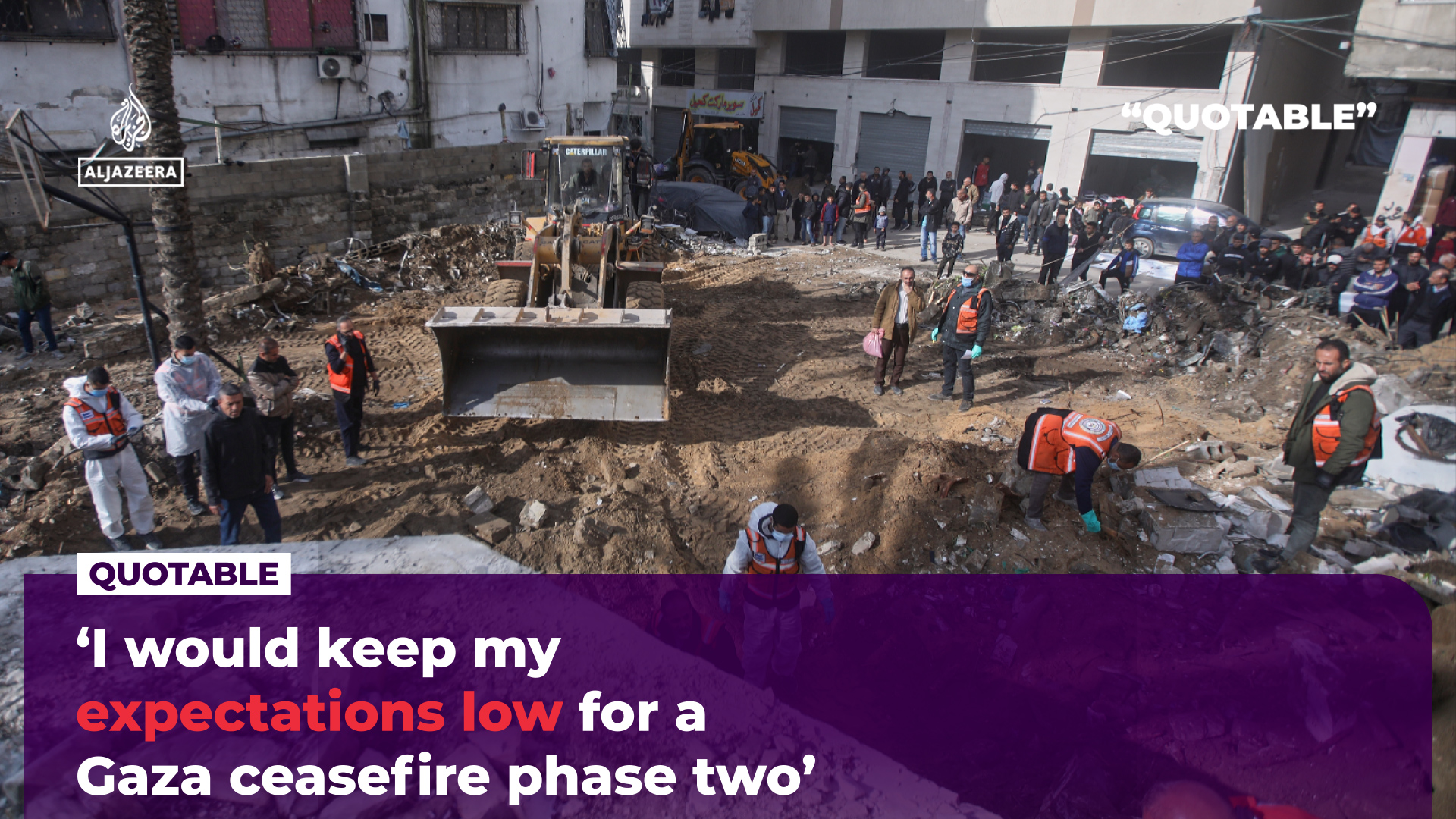
Hamas is expected to hand over the body of the last Israeli captive held in Gaza in the coming days and has commented that it would be open to discussing “freezing” its weapons to facilitate entering the second phase of the ceasefire.

Meanwhile, Israeli Prime Minister Benjamin Netanyahu said on Sunday that the second phase would be challenging to achieve but that it could begin as soon as this month.

Recommended Stories

list of 4 itemsend of list

However, Israel has been attacking Gaza throughout the first phase, killing at least 360 Palestinians, and still restricts the entry of aid, with quantities allowed in far below what was agreed.

So, how has phase one of the ceasefire gone? And what are the chances of it continuing into phase two?

Here’s what we know.

Has Israel observed the ceasefire?

No.

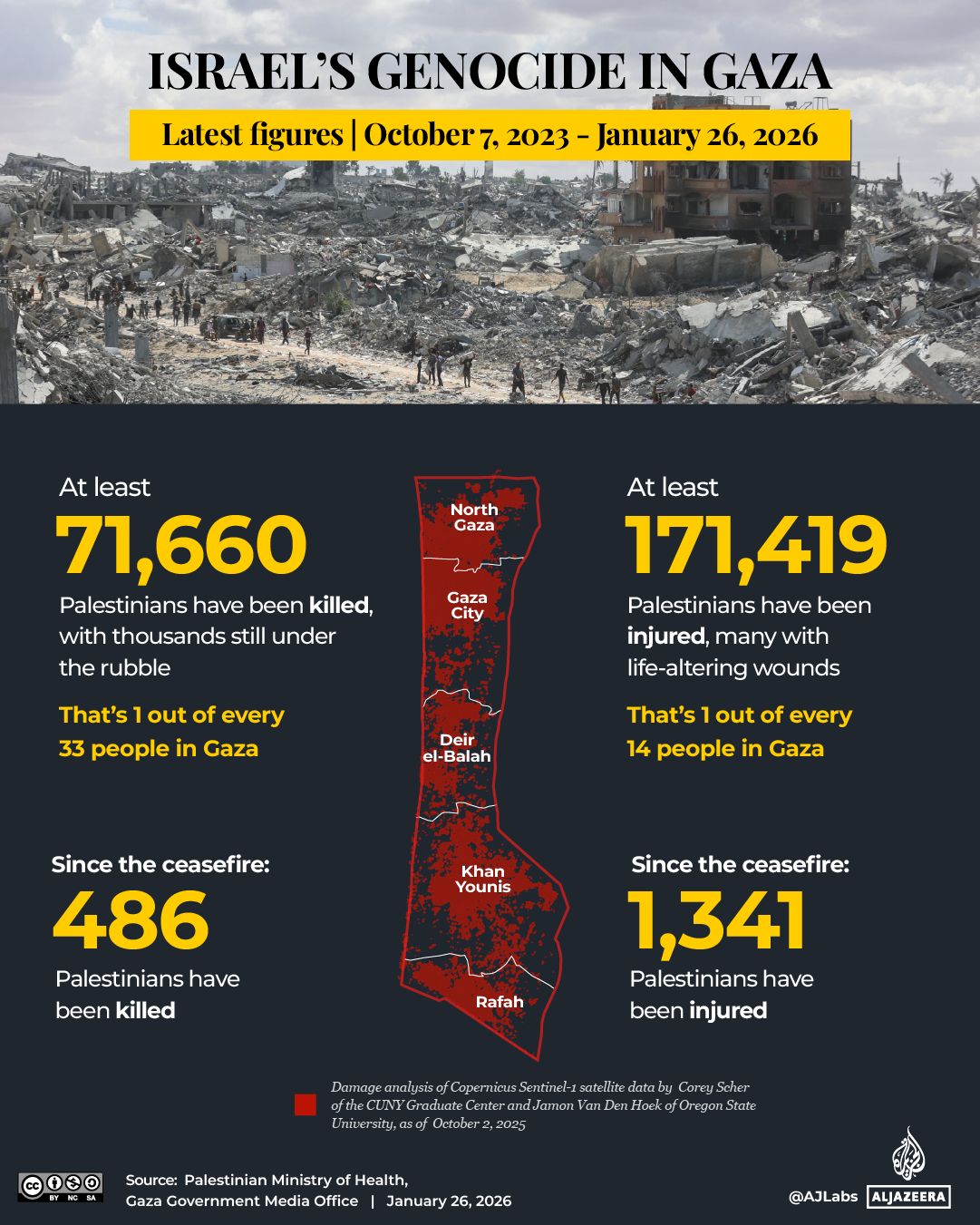
Since the ceasefire began on October 10, Israel has broken it more than 590 times, killing at least 360 Palestinians, and sending the total death toll in Gaza from two years of attacks above 70,000.

Under the first phase – based on US President Donald Trump’s 20-point peace plan – Israel was required to halt its genocidal war on Gaza, pull back its troops, allow aid in, and exchange hundreds of Palestinian detainees for the remaining captives still held in Gaza.

Speaking a month after agreeing to the ceasefire, Israeli Prime Minister Benjamin Netanyahu said Israel’s war on Gaza “has not ended” and that Hamas “will be disarmed”.

Throughout Israel’s genocidal war on Gaza, Israeli officials have been pledging to “destroy” Hamas and claiming that Israeli bombardment, which has killed mostly civilians according to Israel’s own tally, was to achieve that.

Palestinians in Gaza remain in limbo and suffering daily attacks.

Has Israel withdrawn its troops?

Under the terms of the agreement, Israel initially pulled its troops back behind what it called the “yellow line”.

Running around the land edges of the Strip, the poorly demarcated yellow line separates the areas of Gaza controlled by the Israeli army and those controlled by Hamas.

Hamas accuses Israel of pushing the yellow line further into Gaza “daily”, displacing those who find themselves on the wrong side and killing Palestinians, including children, approaching the unclear boundary.

Has Israel allowed aid in?

A full Israeli blockade on Gaza this year led to an engineered famine that was recognised by the UN-backed Integrated Food Security Phase Classification (IPC) in Gaza City in August.

Since the ceasefire, Israel has allowed slightly more aid in, although far less than Gaza’s needs and what the agreement stipulated.

Aid agencies are reporting that the situation remains desperate, despite cases of malnutrition starting to slow.

UNICEF and partners in October identified nearly 9,300 children less than five with acute malnutrition, five times the level reported during a previous ceasefire in February.

“A big portion of the goods coming in is commercial [not humanitarian] – meaning that big aid agencies, including UNRWA, aren’t getting there,” said Tamara Alrifai, the director of external relations for Gaza’s principal aid agency, UNRWA.

Is Israel really committed to this ceasefire?

Considering Israel’s past actions – including unilaterally breaking a ceasefire earlier this year and Netanyahu saying the war isn’t over – it is uncertain.

According to many Netanyahu critics, much of the genocide Israel unleashed on Gaza has been shaped by his own political circumstances.

But that makes him more reliant on the Trump administration, which supports the ceasefire, to protect him.

“Israel has never had a leader in a weaker position, so the US will never have a better chance of pushing their deal through,” Yossi Mekelberg, a senior consulting fellow at Chatham House, said, listing the threats to the PM that Trump’s support might save him from.

Netanyahu has petitioned Israel’s President Isaac Herzog to grant him a pardon in his ongoing corruption trial. Trump has also asked Herzog to pardon Netanyahu.

Netanyahu can also use Trump as an excuse if his far-right government members are angered by an end to the war on Gaza.

“Netanyahu can always shrug and say, ‘it’s not me, it’s Trump,’” Mekelberg said.

What’s planned for phase two?

Phase two of the deal concerns Gaza’s post-war governance. The most detailed framework so far has been the US-backed plan, now endorsed in part by the UNSC.

The plan sets out a transitional phase in which Palestinian technocrats – not political factions – would run day-to-day governance.

Their work would be overseen by a multinational “Board of Peace”, and supported by an International Stabilisation Force tasked with security and demilitarisation. This is meant to allow for the reconstruction of Gaza and stop a return to armed conflict.

But Hamas and other Palestinian groups have rejected the idea of foreign guardianship over Gaza.

They were also opposed to the UNSC resolution, saying it “paves the way for field arrangements imposed outside the Palestinian national will”.

So, could a final deal be likely?

Other than the still escalating death toll in Gaza, nothing is certain.

Netanyahu, according to his critics, is an opportunist to his core, who is still balancing several competing threats at home.

Meanwhile, Trump and his inexperienced political negotiators drawn from outside of the US’s diplomatic core find themselves negotiating a settlement to both the genocide in Gaza and the war in Ukraine.

And, whatever deal is agreed upon, Israel is almost certain to continue to attack Gaza whenever it likes, much as it does in the occupied West Bank, Lebanon, Syria, and elsewhere in the region.

A Palestinian state also does not look any closer to fruition.

Mekelberg points out that with so many potentially shifting factors, including Israel’s domestic politics, it is hard to know if a final deal is achievable.

“It’s Netanyahu,” Mekelberg said.

“His corruption cuts through everything, from his legitimisation of the far-right at home to the way he’s approached the conscription of the ultra-Orthodox [Jews in the Israeli military]. It’s too messy. There are no lines through.

‘Stop killing us’: Huge crowds rally in Brazil, decrying rise in femicide

Tens of thousands of women have marched in cities across Brazil, denouncing femicide and gender-based violence, after a series of high-profile cases that shocked the country.

Women of all ages and some men took to the streets in Rio de Janeiro, Sao Paulo and other cities on Sunday, calling for an end to femicide, rape and misogyny.

Recommended Stories

list of 4 itemsend of list

In Rio, the protesters put out dozens of black crosses, while others bore stickers with messages such as “machismo kills”. And in Sao Paulo, the demonstrators chanted, “Stop killing us”, and held placards that read, “Enough of femicide”.

The protesters in Rio’s Copacabana included Alline de Souza Pedrotti, whose sister was killed on November 28 by a male colleague. Pedrotti said the person who killed her sister, an administrative employee at a school, did not accept having female bosses.

“I’m devastated,” she told The Associated Press news agency. “But I’m fighting through the pain, and I won’t stop. I want changes in the legislation and new protocols to prevent this kind of crime from happening again.”

The protesters also denounced other shocking cases that took place last month in Sao Paulo and in the southern city of Florianopolis. In Sao Paulo on November 28, Taynara Souza Santos was run over by her ex-boyfriend and trapped by the car, which dragged her over concrete for one kilometre (0.6 mile).

The 31-year-old’s injuries were so severe, her legs were amputated.

Video footage of the incident went viral.

And in Florianopolis on November 21, English teacher Catarina Kasten was raped and strangled to death on a trail next to a beach on her way to a swimming lesson.

These recent cases were “the final straw”, said Isabela Pontes, who was on Sao Paulo’s Paulista Avenue. “I have suffered many forms of abuses, and today, I am here to show our voice.”

A decade ago, Brazil passed a law recognising the crime of femicide, defined as the death of a woman in the domestic sphere or as resulting from contempt for women.

Last year, 1,492 women were victims of femicide, the highest number since the law was introduced in 2015, according to the Brazilian Forum on Public Safety.

“We’re seeing an increase in numbers, but also in the intensity and cruelty of violence,” said Juliana Martins, an expert in gender-based violence and institutional relations manager at the Brazilian Forum on Public Safety.

More women are speaking out against violence targeting them, and have gained visibility in the public sphere, Martins said.

“Social transformations seeking equality of rights and representation generate violent responses aimed at reaffirming women’s subordination,” she said.

In Rio, Lizete de Paula, 79, said men who hate women had felt empowered during the term of former President Jair Bolsonaro, who dismantled public policies aimed at strengthening women’s rights.

“Women are increasingly entering new spaces and macho men can’t stand this,” the former architect said.

Joao Pedro Cordao, a 45-year-old father of three daughters, said men have a duty to stand with women by calling out misogyny, not only at protests but in day-to-day life.

Nigeria secures release of 100 kidnapped children, reports say

Nigerian authorities have secured the release of 100 children who were among hundreds kidnapped from a Catholic school in northern Nigeria last month, officials and local media have reported.

The 100 children arrived in Nigeria’s capital, Abuja, and are set to be handed over to local government officials in Niger State on Monday, an unnamed United Nations source told the AFP news agency.

Recommended Stories

list of 4 itemsend of list

“They are going to be handed over to Niger State government tomorrow,” the source told the AFP news agency.

Nigeria’s The Guardian newspaper reported on Sunday that the rescued children were receiving medical evaluations and would be reunited with their families after a debriefing.

Presidential spokesman Sunday Dare also confirmed reports to the AFP that 100 children were being freed.

Armed gunmen kidnapped 303 students and 12 teachers from St Mary’s School in the Papiri community of Niger State’s Agwara district on November 21.

They included both male and female students aged between 10 to 18 years, according to the Christian Association of Nigeria (CAN).

Fifty of the students escaped captivity in the days after they were kidnapped, returning home to their families. Following the release of 100 students on Sunday, 153 students and 12 teachers are believed to remain in captivity.

Days earlier, gunmen abducted 25 schoolgirls from the Government Girls Comprehensive Secondary School in the neighbouring Kebbi State’s Maga town,170km (106 miles) away.

“We have been praying and waiting for their return. If it is true, then it is a cheering news,” said Daniel Atori, spokesman for Bishop Bulus Yohanna of the Kontagora diocese, which runs the school.

“However, we are not officially aware and have not been duly notified by the federal government.”

The latest abductions are the worst seen in Nigeria since more than 270 girls from Chibok town were snatched from their school in 2014.

In total, more than 1,400 Nigerian students have been kidnapped since 2014, in almost a dozen separate incidents.

The most recent kidnappings came soon after United States President Donald Trump said that Nigeria’s Christians are facing genocide, a claim that has been questioned by local officials and Christian groups, who say that people from different faiths have been caught up in ongoing violence in parts of the country.

Kimiebi Imomotimi Ebienfa, a spokesman for Nigeria’s Ministry of Foreign Affairs, told Al Jazeera last month that people of all faiths have been affected by the ongoing violence.

“We’ve continuously made our point clear that we acknowledge the fact that there are killings that have taken place in Nigeria, but those killings were not restricted to Christians alone. Muslims are being killed. Traditional worshippers are being killed,” Ebienfa said.

“The majority is not the Christian population.”

Trump has threatened military intervention in Nigeria, alleging that the country is failing to protect Christians from persecution. He has also threatened to cut aid to Nigeria.

Nigeria, a country of more than 200 million people, is divided between the largely Muslim north and mostly Christian south.

According to Pew Research Center estimates, Muslims make up 56 percent of Nigeria’s population, while Christians make up just more than 43 percent.

US lawmakers urge release of video of double-tap boat strike in Caribbean

Lawmakers in the United States have urged the release of a video of a controversial double-tap strike on a vessel in the Caribbean amid growing scrutiny of the legality of Washington’s militarised anti-drug trafficking campaign.

The bipartisan calls on Sunday came amid mounting controversy over revelations that military officials ordered a follow-up strike in the September 2 operation targeting a suspected drug-smuggling vessel, killing two survivors of the initial attack.

Recommended Stories

list of 4 itemsend of list

Democratic and Republican lawmakers watched footage of the strikes last week in a closed-door briefing with military officials, but emerged from the screening with substantially different accounts of what happened.

Reactions to the footage split along partisan lines, with Democrats expressing deep concerns about the legality of the strikes and Republicans insisting they were justified.

Adam Smith, the top Democrat on the House of Representatives’s armed services committee, said the targeted vessel had been “clearly incapacitated” in the initial strike, and the survivors were unarmed and without any means of communication.

“They ought to release the video. If they release the video, then everything that the Republicans are saying will clearly be portrayed to be completely false, and people will get a look at it, and they will see,” Smith said in an interview with the ABC News programme This Week with George Stephanopoulos.

“It seems pretty clear they don’t want to release this video because they don’t want people to see it because it’s very, very difficult to justify,” Smith added.

Jim Himes, who leads the Democrats on the House’s intelligence committee, said the American public should have the chance to judge the video for themselves.

“Look, there’s a certain amount of sympathy out there for going after drug runners, but I think it’s really important that people see what it looks like when the full force the United States military is turned on two guys who are clinging to a piece of wood and about to go under just so that they have sort of a visceral feel for what it is that we’re doing,” Himes told CBS News’s Face the Nation with Margaret Brennan.

Several Republicans said they would support the release of the video, even as they defended the strikes.

Senator Tom Cotton, whose account of the survivors trying to “flip” the boat and continue their voyage has been disputed by Democrats, said he would not object to the video’s release, but would defer to the judgement of Secretary of Defense Pete Hegseth and the Pentagon.

“I didn’t find it distressing or disturbing. It looks like any number of dozens of strikes we’ve seen on Jeeps and pickup trucks in the Middle East over the years,” Cotton, who chairs the intelligence committee in the Senate, told NBC News’s Meet the Press.

John Curtis, a Republican senator from Utah, also suggested that he would support the video’s release, saying officials should “err on the side of transparency”.

“The American people, they like to make decisions too based on facts, not just on what we tell them,” Curtis told CNN’s State of the Union.

President Donald Trump, whose administration has carried out at least 22 strikes against alleged drug traffickers in the Caribbean Sea and Eastern Pacific, said last week he would have “no problem” with releasing the footage.

Hegseth on Saturday struck a more cautious note during an appearance at a defence forum in California, telling a Q&A that officials were reviewing the possibility, but needed to make a “responsible” decision.

Scrutiny of the strikes has mounted since The Washington Post reported last month that US military officials carried out a second attack on two people clinging to the vessel’s wreckage after Hegseth directed commanders to leave no survivors.

Hegseth has repeatedly denied the report, which cited two unnamed sources, labelling it “fake news”, “fabricated” and “inflammatory”.

Legal scholars have argued that both the double-tap strike and the Trump administration’s military campaign against suspected drug traffickers more generally are illegal.

“The United States is not currently operating in a context of armed conflict in its strikes in the Caribbean. For that reason, this is not a context in which war crimes apply,” Tom Dannenbaum, an expert in the laws of war at Stanford University, told Al Jazeera.

“Instead, all of the strikes qualify as murder in violation of domestic criminal law, and extrajudicial killings in violation of international human rights law.”

At least 87 people have been killed in the strikes, which the Trump administration began in September.