Gaza’s collapsing economy drives youth to create unconventional solutions

Gaza City – For many Palestinians in Gaza, earning a living has become a daily struggle amid Israel’s continuing blockade, repeated ceasefire violations, and the near-total collapse of the local economy.

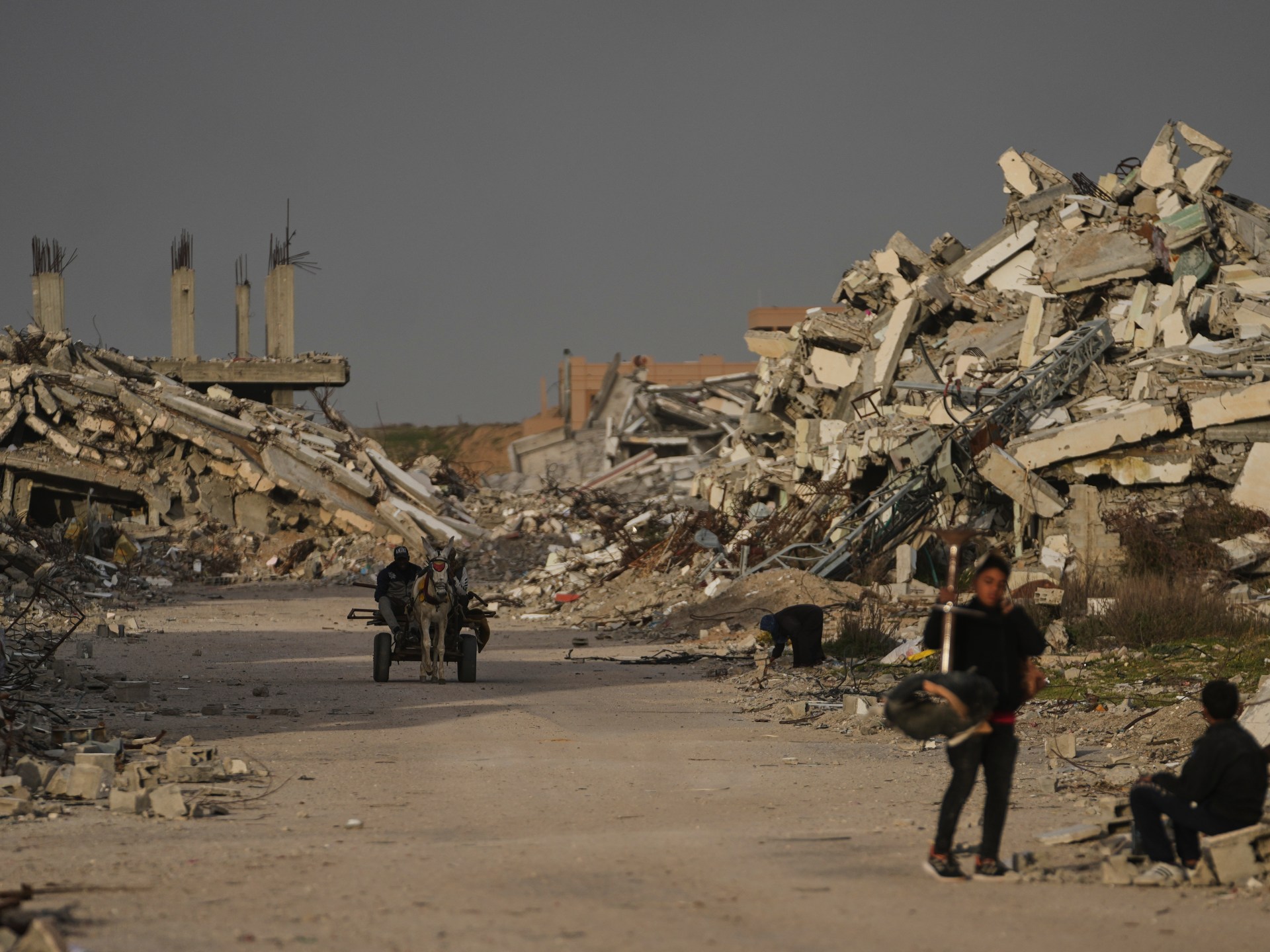
With infrastructure destroyed and productive sectors paralysed as a result of Israel’s genocidal war on Gaza, traditional employment opportunities have all but disappeared, forcing residents to seek alternative, often precarious, ways to survive.

Recommended Stories

list of 3 itemsend of list

Hala Mohammed al-Maghrabi, 24, is one of many young professionals whose education no longer provides a path to stability. After graduating as a nurse in 2023, she spent two years volunteering in the healthcare sector, hoping the experience would eventually lead to paid employment. That opportunity never came.

“Volunteering doesn’t pay the bills,” al-Maghrabi said. “With prices constantly rising and no stable income, it became impossible to rely on this work to meet even my basic needs.”

With limited prospects in Gaza’s overstretched healthcare system, she made a difficult decision to leave her field entirely.

Al-Maghrabi instead shifted into social media marketing and e-commerce, working online to generate a modest income.

As al-Maghrabi recounted, she graduated as a nurse and began training in the hospital. During that training, she also took several design courses and tried to find work in that field, but she was unable to reach clients and earn an income. She then decided to take marketing courses instead of waiting for someone else to promote her work, allowing her to market herself effectively. After gaining experience in marketing, she began working in e-commerce and digital marketing.

“This isn’t what I studied or planned for,” she said. “But even though the income is limited, it helps me cover my daily expenses and survive under these conditions.”

Economic crisis

Al-Maghrabi’s experience reflects a broader phenomenon in Gaza, where years of compounded crises have pushed unemployment to unprecedented levels. According to the Palestinian Central Bureau of Statistics’ 2024 figures, the overall unemployment rate in Gaza is 69 percent, rising to approximately 80 percent among 15- to 29-year-olds.

The population under 30 accounts for approximately 70 percent of Gaza’s residents, meaning the majority of the community faces severe economic challenges, with a significant portion of young people holding university degrees but unable to find suitable employment.

Gaza’s GDP has also contracted by more than 82 percent due to Israel’s ongoing war and destruction of economic infrastructure, and around 80 percent of the population relies on international aid due to food insecurity and loss of income sources.

The economic collapse has not only affected employees, but business owners as well. Mohammed al-Hajj, who previously worked in general trade and food supplies, saw his entire business model unravel after the war.

“My warehouses and goods were destroyed, and I could no longer afford import costs or the required licences,” al-Hajj said. “Everything I had built over the years was suddenly gone.”

Faced with few options, al-Hajj searched for an alternative way to earn an income. Because his neighbourhood had not been heavily damaged, and he still had intermittent internet access, he converted part of his property into a small workspace equipped with an internet connection.

“I created this place after running out of options,” he said. “Students and engineers needed somewhere stable to take exams or work online, and this became a solution for them – and for me.”

Innovating to survive

As traditional employment structures collapse, innovation has become less a choice than a necessity. For some Palestinians in Gaza, finding unconventional solutions to personal crises has opened new paths not only for survival, but for rebuilding economic activity.

Ahmed Fares Abu Zayed, CEO of Abu Zayed General Trading, described how his company’s operations came to a halt when the war began.

“We started the company before the war as a very small electricity generation business with limited resources, aimed only at supplying specific energy needs,” said Abu Zayed. “But when the war broke out, our operations stopped immediately due to fuel shortages for the generators. The situation was extremely difficult.”

Rather than shutting down entirely, Abu Zayed began searching for alternatives. The result was an innovative approach to energy production that relied on available materials rather than scarce fuel.

“We thought about how to turn surrounding waste into energy,” he said. “That’s how we started producing electricity systems using plastic scraps as fuel. It was a difficult experience, but it was driven by creativity and necessity.”

His story illustrates how innovation in Gaza often emerges directly from crisis, as individuals attempt to solve immediate problems with limited resources.

Project manager and business management specialist Maram al-Qarra explained that such efforts play a critical role in Gaza’s labour market.

“The problem in Gaza isn’t a lack of talent, but the absence of an economic environment capable of absorbing it,” al-Qarra said. “Even small projects can stimulate the market by creating direct jobs and indirect service and production chains.”

She emphasised that innovation is now essential. “When traditional jobs are absent, innovation becomes a means to create opportunities instead of waiting for them,” she said.

On the broader labour market, al-Qarra concluded, “The blockade and the war destroyed traditional work structures, pushing many young people to seek alternatives outside conventional employment.”

Exploitation and opportunity

Across Gaza, many educated young people – doctors, engineers, nurses, and graduates – now sell bottled water, vegetables, or second-hand clothes on the streets. These efforts are not entrepreneurial ambitions, but survival strategies in a place where choice has all but disappeared.

As one young resident put it, “We don’t have the luxury of choice; all we can do is try to survive.”

While innovation has opened new paths for some, desperation has also created space for exploitation. Mahmoud, a young man from Gaza, described how the lack of jobs and social protection has pushed people towards shady or dangerous businesses.

“With no government support and no safety nets, securing a steady income has become almost impossible,” Mahmoud said. “Some people are turning to illegal or exploitative methods just to survive.”

He explained that money lending, currency trading, and exploitative financial transfers have become increasingly common.

“People are sometimes forced to receive their remittances in cash at a discount of more than 50 percent,” he said. “This is clear exploitation of people’s urgent needs, and it shows how desperation is being abused.”

Yet even amid these negative outcomes, examples of innovation that benefit the wider community persist. Abu Zayed noted that his electricity project did more than solve his own problem.

“The most important part is that it didn’t just provide energy,” he said. “It created jobs for dozens of young people in manufacturing, installation, and maintenance, and gave them skills they couldn’t gain in the traditional job market.”
Israeli forces kill 12 Palestinians across Gaza, attacks reported in Rafah

At least 12 Palestinians, half of them children, have been killed in the Gaza Strip since dawn, a day before the Rafah crossing is due to reopen.

An Israeli air strike on Saturday on a tent sheltering displaced people in the al-Mawasi area to the northwest of Khan Younis city killed at least seven Palestinians, including three children, medical sources told Al Jazeera.

Recommended Stories

list of 4 itemsend of list

Their bodies were taken to the Nasser Medical Complex in Khan Younis.

In Gaza City, emergency services reported that at least five Palestinians, including three children, were killed in an Israeli air strike on an apartment building in the Remal neighbourhood to the west of the city.

Eight Palestinians were also injured in an Israeli bombing of an apartment building in the Daraj neighbourhood of Gaza City.

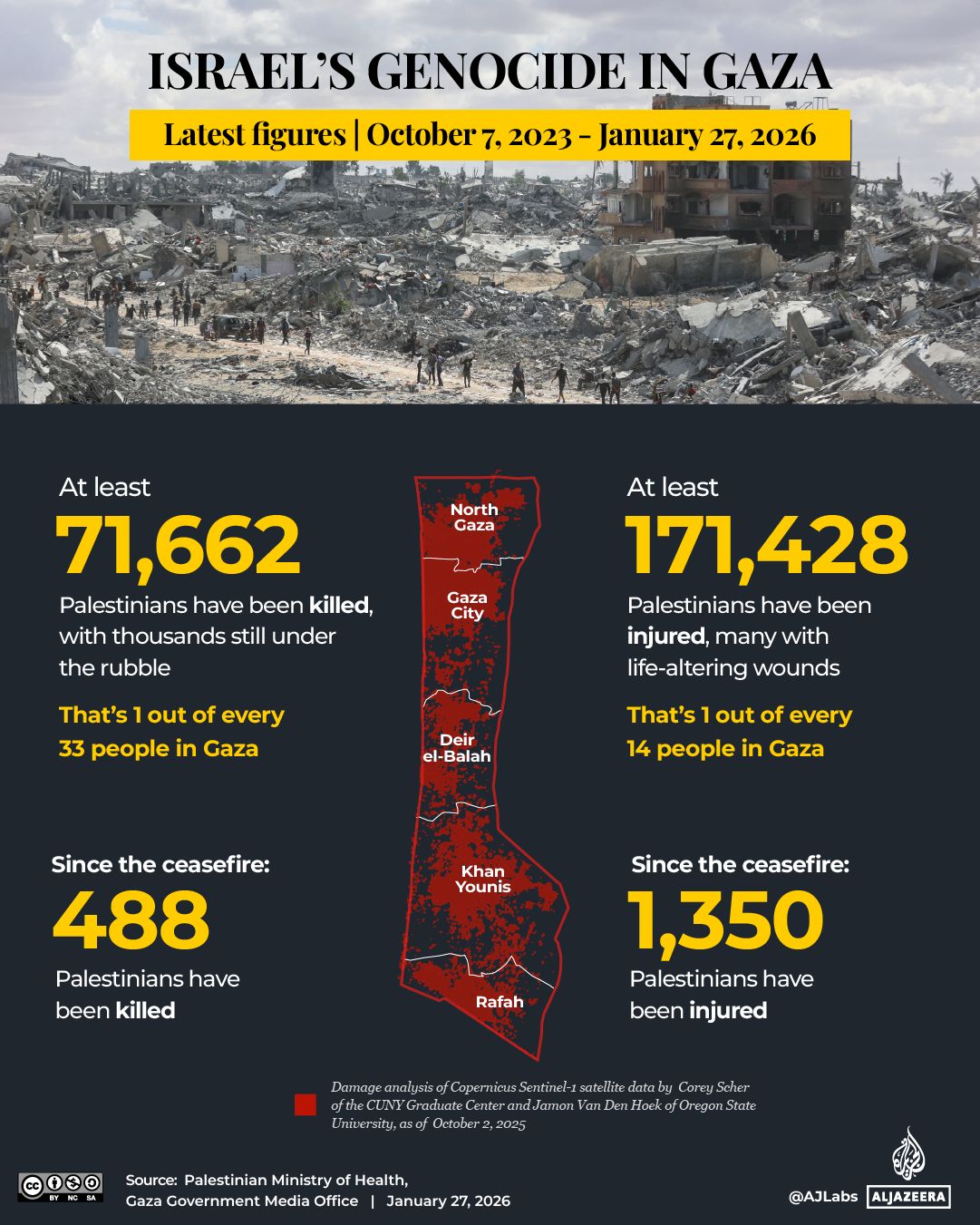
Gaza’s Government Media Office says at least 524 Palestinians have been killed by Israeli forces since a United States-brokered ceasefire in Gaza came into effect on October 10.

Rafah reopening

Residents in the border town of Rafah also reported several air attacks in areas under Israeli control. Israel is due to reopen the Rafah crossing, which links Gaza with Egypt, on Sunday for the first time since May 2024.

The opening of the key entry point is part of the ceasefire agreement with Hamas. It was meant to open during the first phase of the ceasefire, but Israel refused to do so until the body of its last remaining captive was found.

Israel on Saturday said it would only allow a “limited movement of people” who have received security clearance by Israel to enter and exit. No aid or humanitarian supplies will be allowed to enter.

“Only those who fled during the past two years are allowed to come back,” Al Jazeera’s Hani Mahmoud explained. “Those who are born outside the Gaza Strip are not going to be allowed to come back.”

Hamas responded to the Rafah announcement by calling for Israel to allow movement in and out of Gaza “without restrictions”, and urged it to adhere to all aspects of the ceasefire agreement.

Israel’s genocidal war on Gaza has killed more than 71,600 Palestinians since October 7, 2023.

Wave of Israeli air strikes hit southern Lebanon despite ceasefire

NewsFeed

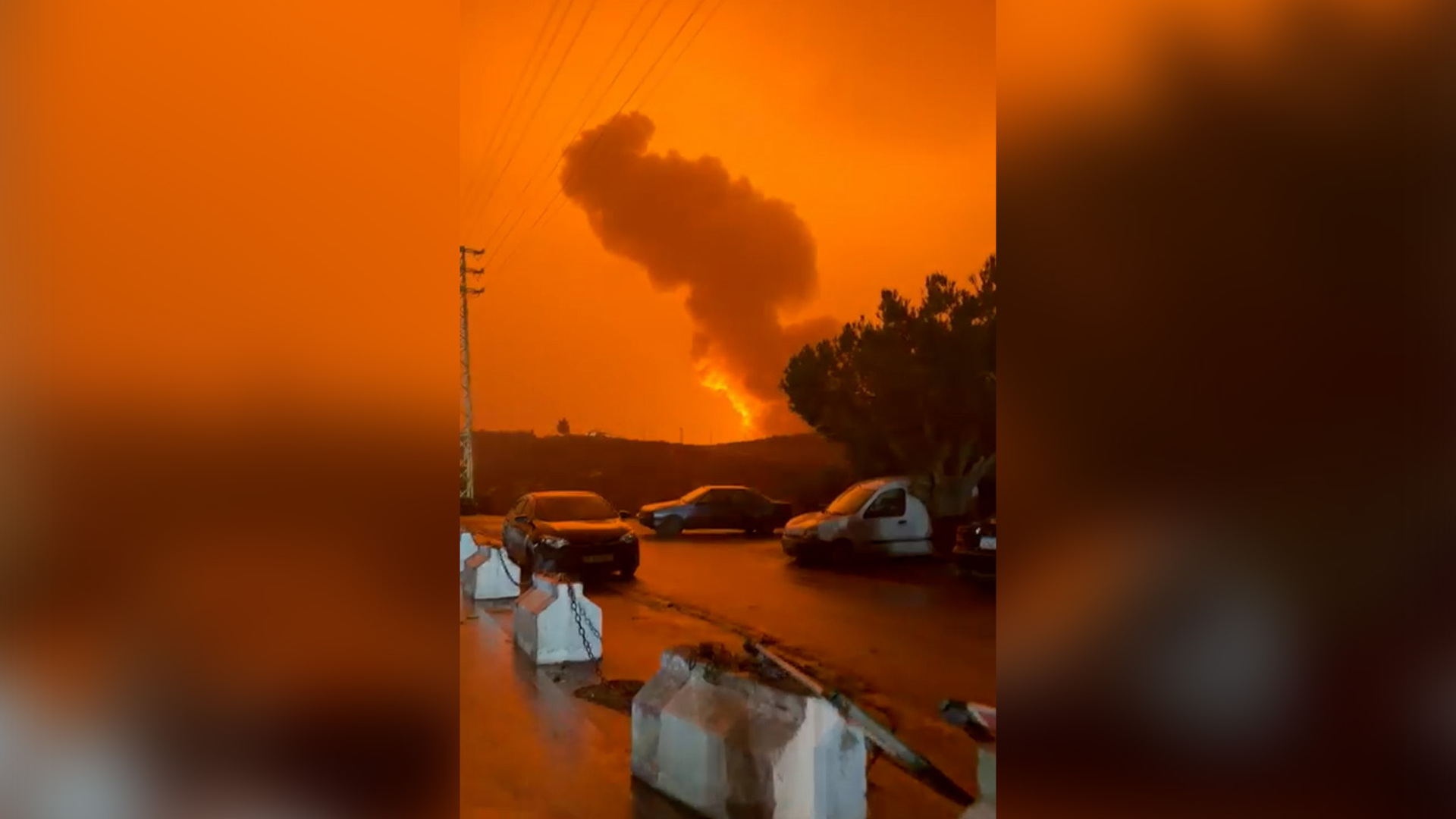
Video shows Israeli air strikes pounding areas in southern Lebanon in violation of the November 2024 ceasefire with Hezbollah. Israel says its near-daily attacks are targeting the group’s members or infrastructure. Lebanese officials say more than 10,000 violations have killed at least 330 people.

Myanmar election delivers walkover win for military-backed political party

Myanmar’s military-backed party secured a sweeping victory in the country’s three-phase general election, according to state media, following the tightly controlled voting held amid civil war and widespread repression.

The final of three rounds of voting last weekend wrapped up an election that began on December 28, more than four years after the military seized power in a coup that overturned the elected government of Aung San Suu Kyi.

Recommended Stories

list of 4 itemsend of list

Dominating all phases of the vote, the Union Solidarity and Development Party (USDP) won an overwhelming majority in Myanmar’s two legislative chambers, state media reports.

The USDP secured 232 of the 263 seats up for grabs in the lower house and 109 of the 157 seats announced so far in the upper chamber, according to results released on Thursday and Friday.

A spokesman for the country’s military rulers, Zaw Min Tun, said Myanmar’s parliament is now expected to convene to elect a president in March, with a new government set to take over in April, according to a report in the pro-military Eleven Media Group.

Myanmar, formerly known as Burma, has been in political turmoil since the 2021 coup, with the crushing of pro-democracy protests prompting a nationwide rebellion. Thousands have been killed, and about 3.6 million people have been displaced, according to the United Nations.

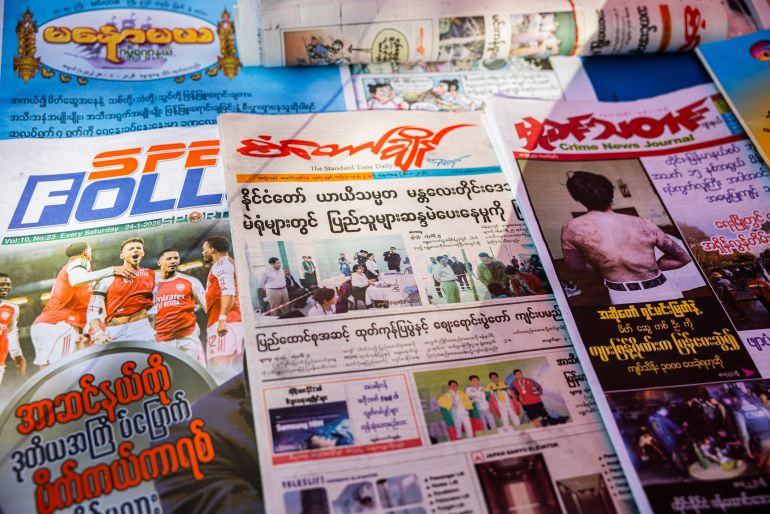
YANGON, BURMA - JANUARY 26: Local newspapers feature headlines covering the conclusion of Myanmar's general election on January 26, 2026 in Yangon, Burma. Myanmar concluded its multi-phase general election on January 25, 2026, after voting began on December 28, 2025, under the military administration that took power in the 2021 coup and has overseen the country amid ongoing conflict. (Photo by Lauren DeCicca/Getty Images)
Local newspapers feature headlines covering the conclusion of Myanmar’s general election on January 26, 2026, in Yangon, Myanmar [Lauren DeCicca/Getty Images]

‘Vote purely out of fear’

The 11-member Association of Southeast Asian Nations (ASEAN) has said it will not endorse Myanmar’s electoral process, and human rights groups and some Western countries have also expressed concerns about the credibility of the election.

The UN human rights office said that large segments of the population, including minorities such as ethnic Muslim-majority Rohingya, were excluded from voting since they have been denied citizenship, and many have also been displaced outside the country.

At least 170 civilians were killed in air strikes during the election period, and about 400 people were arrested, according to the UN.

“Many people chose either to vote or not to vote purely out of fear,” UN human rights chief Volker Turk said.

Myanmar’s military rulers insist the polls were free and fair, and supported by the public.

A spokesperson for the United States Department of State, which has muted its critiques of foreign elections in the second Trump administration, said it was monitoring the situation and “will assess the military regime’s next steps”.

Aung San Suu Kyi’s National League for Democracy was dissolved along with dozens of other parties, and some others declined to take part, drawing condemnation from critics who say the process was designed to legitimise military rule.

Brief US government shutdown begins after funding deadline lapses

The United States government has entered what is expected to be a brief shutdown after Congress failed to approve ⁠a deal to keep a wide swath of operations funded ahead of a midnight deadline.

After hours of delay, ​the US Senate passed the spending package by a bipartisan vote of 71 to 29 late on Friday, but the House of Representatives is not expected to vote on the new budget bills until Monday at the earliest.

Recommended Stories

list of 4 itemsend of list

US President Donald Trump must then sign the bills into law.

As a result, the partial shutdown of the US government took effect at 12:01 am Eastern time (0501 GMT). The shutdown is likely ‍to be brief.

⁠Lawmakers from both parties have been working to ensure a debate over immigration enforcement does not disrupt other government operations, despite mounting Democratic anger over the killing of two people by immigration agents in Minnesota.

This is a marked contrast from last fall, when Republicans and Democrats dug into their positions in a dispute over healthcare, prompting a shutdown that lasted a record 43 days and cost the US economy an estimated $11bn.

“Technically, there will be a partial government shutdown come midnight on Saturday,” Al Jazeera’s Rosiland Jordan said earlier on Friday, reporting from Washington, DC.

“The earliest that the House of Representatives can take a look at the changes, which the US Senate approved late on Friday, is not before Monday. That’s because they’ve been in recess all this week. They should be coming back to Washington this weekend,” Jordan said.

But there is also a concern the shutdown could drag out longer, given political polarisation around Trump’s administration’s harsh immigration raids and the killing of US citizens at those operations.

“So there is the expectation that this could be resolved early next week. But there is the possibility that it may not be,” Jordan added.

The funding impasse has been driven by Democratic anger over aggressive immigration enforcement following the fatal shootings of two US citizens – Alex Pretti and Renee Good – by federal agents in separate incidents this month in the northern city of Minneapolis amid a violent operation against undocumented migrants.

The killings in Minneapolis have become a flashpoint that has hardened opposition to approving new money for the Department of Homeland Security (DHS) without changes to how immigration agencies operate.

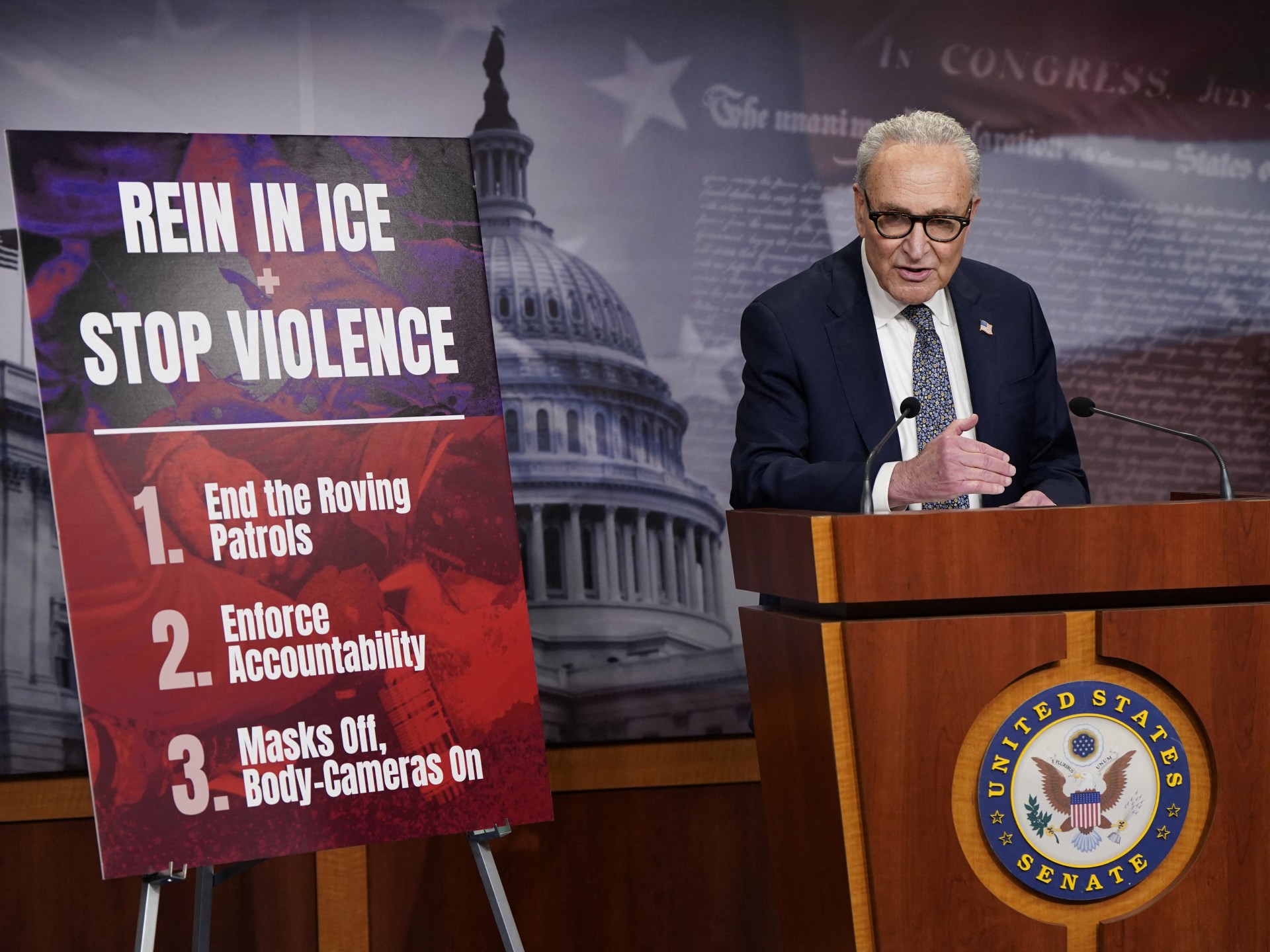
“The nation is reaching a breaking point,” Senate Democratic leader Chuck Schumer said after the vote. “The American people are demanding that Congress step up and force change.”

“Instead of going after drug smugglers, child predators, and human traffickers, the Trump Administration is wasting valuable resources targeting peaceful protestors in Chicago and Minneapolis,” Senate Democratic Minority Whip Dick Durbin posted on social media.

“This Administration continues to make Americans less safe.”

As lawmakers in both parties called for investigations into the fatal shootings, Trump said he didn’t want a shutdown and negotiated the rare deal with Schumer, his frequent adversary. Trump then encouraged members of both parties to cast a “much needed Bipartisan ‘YES’ vote.”

Under the deal negotiated between the White House and Senate Democratic leaders, lawmakers approved five outstanding funding bills to finance most of the federal government through the end of the fiscal year in September.

The deal approved by the Senate separates funding for the DHS – which oversees immigration agencies – from the broader government funding package, allowing lawmakers to approve spending for agencies such as the Pentagon and the Department of Labor while they consider new restrictions on how federal immigration agents operate.

T20 World Cup 2026 stadiums: Where’s India vs Pakistan and the final?

Cricket’s shortest international format will take centre stage over the next month as the ICC T20 World Cup 2026 gets under way on February 7.

Five stadiums across India and three in Sri Lanka will host matches, as 20 teams fight for the world title.

Recommended Stories

list of 4 itemsend of list

Here’s everything you need to know about the venues:

Narendra Modi Stadium

Location: Ahmedabad, India
Capacity: 132,000
Inauguration: 1983
Fixtures: South Africa vs Canada (February 9), South Africa vs Afghanistan (February 11), New Zealand vs South Africa (February 14), India vs Netherlands (February 18), Super 8s Match 3 (February 22), Super 8s Match 7 (February 26), Final (March 8)

The world’s largest cricket stadium is designated to host seven matches, including the final and two Super 8s fixtures.

Before it was renamed after Indian Prime Minister Narendra Modi, the venue was known as the Motera Stadium or the Sardar Vallabhbhai Patel Stadium, after one of India’s best-known independence leaders.

The 2023 ODI World Cup final, in which India lost to Australia, was the biggest international match held at this venue.

The stadium has hosted several political events and rallies, too, including the “Namaste Trump” event in honour of United States President Donald Trump, back in 2020.

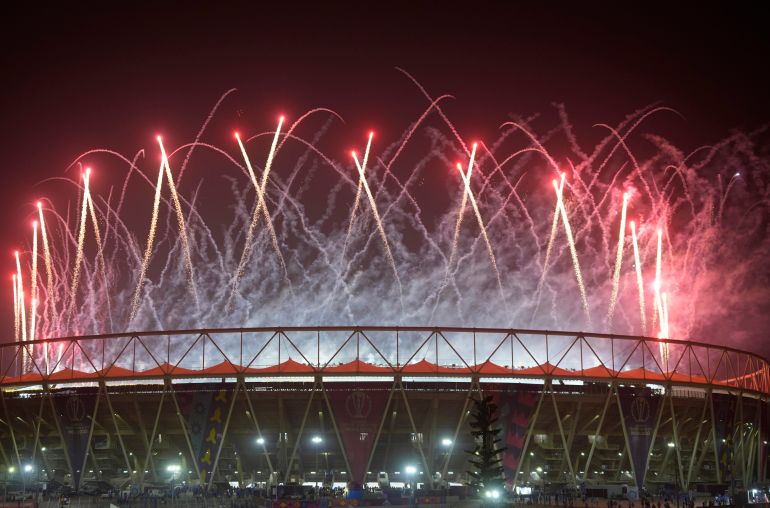
Fireworks light up the sky over the Narendra Modi stadium after Australia won against India by 6 wickets during the ICC Men's Cricket World Cup final match in Ahmedabad, India.
Fireworks light up the sky over the Narendra Modi Stadium after the 2023 ICC ODI World Cup final [File: Ajit Solanki/AP Photo]

Wankhede Stadium

Location: Mumbai, India
Capacity: 33,100
Inauguration: 1974
Fixtures: India vs USA (February 7), England vs Nepal (February 8), England vs West Indies (February 11), Nepal vs Italy (February 12), West Indies vs Nepal (February 15), Scotland vs Nepal (February 17), Super 8s Match 4 (February 23), Semifinal 2 (March 5)

Located in the coastal city of Mumbai, the Wankhede Stadium is no stranger to high-stakes matches. It hosted the 2011 ODI World Cup final, in which India beat Sri Lanka to lift its second world title.

The venue, also the home ground of IPL franchise Mumbai Indians, will host the most games (eight) in India during the tournament, including a semifinal.

Though smaller in size than most of India’s popular stadiums, the Wankhede’s passionate crowd consistently creates one of the best atmospheres.

Cricket - ICC Cricket World Cup 2023 - Semi-Final - India v New Zealand - Wankhede Stadium, Mumbai, India - November 15, 2023 India fans in the stands during the match REUTERS/Francis Mascarenhas
The Wankhede Stadium in Mumbai is known for delivering one of the best fan experiences across the country [File: Francis Mascarenhas/Reuters]

Eden Gardens

Location: Kolkata, India
Capacity: 68,000
Inauguration: 1864
Fixtures: West Indies vs Scotland (February 7), Scotland vs Italy (February 9), England vs Scotland (February 14), England vs Italy (February 16), West Indies vs Italy (February 19), Super 8s Match 12 (March 1), Semifinal 1 (provisional, March 4)

Known as the “home of Indian cricket”, Eden Gardens is the oldest cricket stadium in the country. The venue will host seven matches at the tournament, including possibly the first semifinal.

The first purpose-built ground for the sport in India, Eden Gardens, has hosted matches during five ICC World Cups, including the finals of the 1987 ODI and 2016 T20 World Cups.

It is also the home ground of the IPL’s Kolkata Knight Riders since 2008.

Cricket - ICC Cricket World Cup 2023 - Semi-Final - South Africa v Australia - Eden Gardens, Kolkata, India - November 16, 2023 Australia players during a rain delay REUTERS/Andrew Boyers
The Eden Gardens also hosted a semifinal during the 2023 ODI World Cup in India [File: Andrew Boyers/Reuters]

Arun Jaitley Stadium

Location: New Delhi, India
Capacity: 55,000
Inauguration: 1883
Fixtures: Netherlands vs Namibia (February 10), India vs Namibia (February 12), Canada vs UAE (February 13), Afghanistan vs UAE (February 16), South Africa vs UAE (February 18), Super 8s Match 11 (March 1)

Situated in India’s capital, New Delhi, the Arun Jaitley Stadium has hosted matches at five World Cups. At this tournament, the venue will host six games, including a Super 8s fixture.

Formerly known as the Feroz Shah Kotla Stadium, the venue was renamed after a former finance minister and parliamentarian from PM Modi’s Bharatiya Janata Party, following his death in 2019.

It is the home of the IPL team Delhi Capitals.

India fans in the stands in Arun Jaitley Stadium, Delhi
The Arun Jaitley Stadium was also one of the venues during the 2023 ODI World Cup – the last time India hosted a World Cup [File: Anushree Fadnavis/Reuters]

M A Chidambaram Stadium

Location: Chennai, India
Capacity: 38,200
Inauguration: 1916
Fixtures: New Zealand vs Afghanistan (February 8), New Zealand vs UAE (February 10), USA vs Netherlands (February 13), USA vs Namibia (February 15), New Zealand vs Canada (February 17), Afghanistan vs Canada (February 19), Super 8s Match 8 (February 26)

Located close to one of the longest urban beaches in the world – Chennai’s Marina Beach along the Bay of Bengal – the M A Chidambaram Stadium is known for being home to a sporting and knowledgeable cricket crowd.

Named after former Board of Control for Cricket in India (BCCI) president, M A Chidambaram, the venue is commonly known as the Chepauk Stadium. Home of the Chennai Super Kings IPL franchise, the stadium has hosted matches across four ODI World Cups.

At this edition, it will host seven games, including a Super 8s tie.

CHENNAI, INDIA - JANUARY 24: The England playing squad and coaching staff play football ahead of a England nets session at MA Chidambaram Stadium on January 24, 2025 in Chennai, India. (Photo by Michael Steele/Getty Images)
The Chepauk Stadium rounds up the list of venues in India [File: Michael Steele/Getty Images]

R Premadasa Stadium

Location: Colombo, Sri Lanka
Capacity: 35,000
Inauguration: 1986
Fixtures: Sri Lanka vs Ireland (February 8), Australia vs Ireland (February 11), Australia vs Zimbabwe (February 13), India vs Pakistan (February 15), Sri Lanka vs Zimbabwe (February 19), Super 8s Match 1 (February 21), Super 8s Match 6 (February 25), Super 8s Match 9 (February 27)

The largest stadium in Sri Lanka, the R Premadasa Stadium, will host a majority of the heavyweight fixtures at the tournament, including India vs Pakistan, the most anticipated clash at any ICC event.

The venue is scheduled to host eight games, including three Super 8s fixtures, but two more could be added to its list.

If Pakistan qualifies for the semifinals, the R Premadasa Stadium, considered a neutral venue, will replace Kolkata as the host of the first semifinal. If Pakistan reach the final, that venue will also shift from Ahmedabad to Colombo.

As per an ICC-brokered agreement between India and Pakistan, both countries have the option to play their games at a neutral venue for a tournament hosted by either South Asian nations.

View of the R Premadasa Stadium
Known as the home of Sri Lankan cricket, the R Premadasa Stadium played host to three World Cups [File: Hafsa Adil/Al Jazeera]

Sinhalese Sports Club

Location: Colombo, Sri Lanka
Capacity: 10,000
Inauguration: 1952
Fixtures: Pakistan vs Netherlands (February 7), Zimbabwe vs Oman (February 9), Pakistan vs USA (February 10), Ireland vs Oman (February 14), Pakistan vs Namibia (February 18)

The smallest venue at the tournament, the Sinhalese Sports Club, will host the fewest matches (five), but features the all-important opening match between former champions Pakistan and the West Indies.

Situated only 5km (3.1 miles) away from the R Premadasa Stadium in Colombo, the venue will host a World Cup for only the second time, following its maiden attempt at the 1996 ODI World Cup.

Sinhalese Sports Club Ground, Colombo, Sri Lanka
Sinhalese Sports Club has hosted test matches along with its maiden World Cup game in 1996 [File: Stu Forster/Getty Images]

Pallekele International Cricket Stadium

Location: Kandy, Sri Lanka
Capacity: 35,000
Inauguration: 2009
Fixtures: Sri Lanka vs Oman (February 12), Australia vs Sri Lanka (February 16), Ireland vs Zimbabwe (February 17), Australia vs Oman (February 20), Super 8s Match 2 (February 22), Super 8s Match 5 (February 24), Super 8s Match 10 (February 28)

The Pallekele International Cricket Stadium rounds out the full list of venues at the T20 World Cup 2026. It will host seven games, including three Super 8s matches.

Opened 17 years ago, it is the newest of all venues at this year’s tournament. Situated in central Sri Lanka, the stadium was built for the 2011 ODI World Cup and also used at the 2012 T20 World Cup.

A general view of stadium during the Asia Cup Group A match between India and Nepal at Pallekele International Cricket Stadium
Pallekele International Cricket Stadium played host to the Asia Cup, including the Group A match between India and Nepal in 2023 [File: Surjeet Yadav/Getty Images]