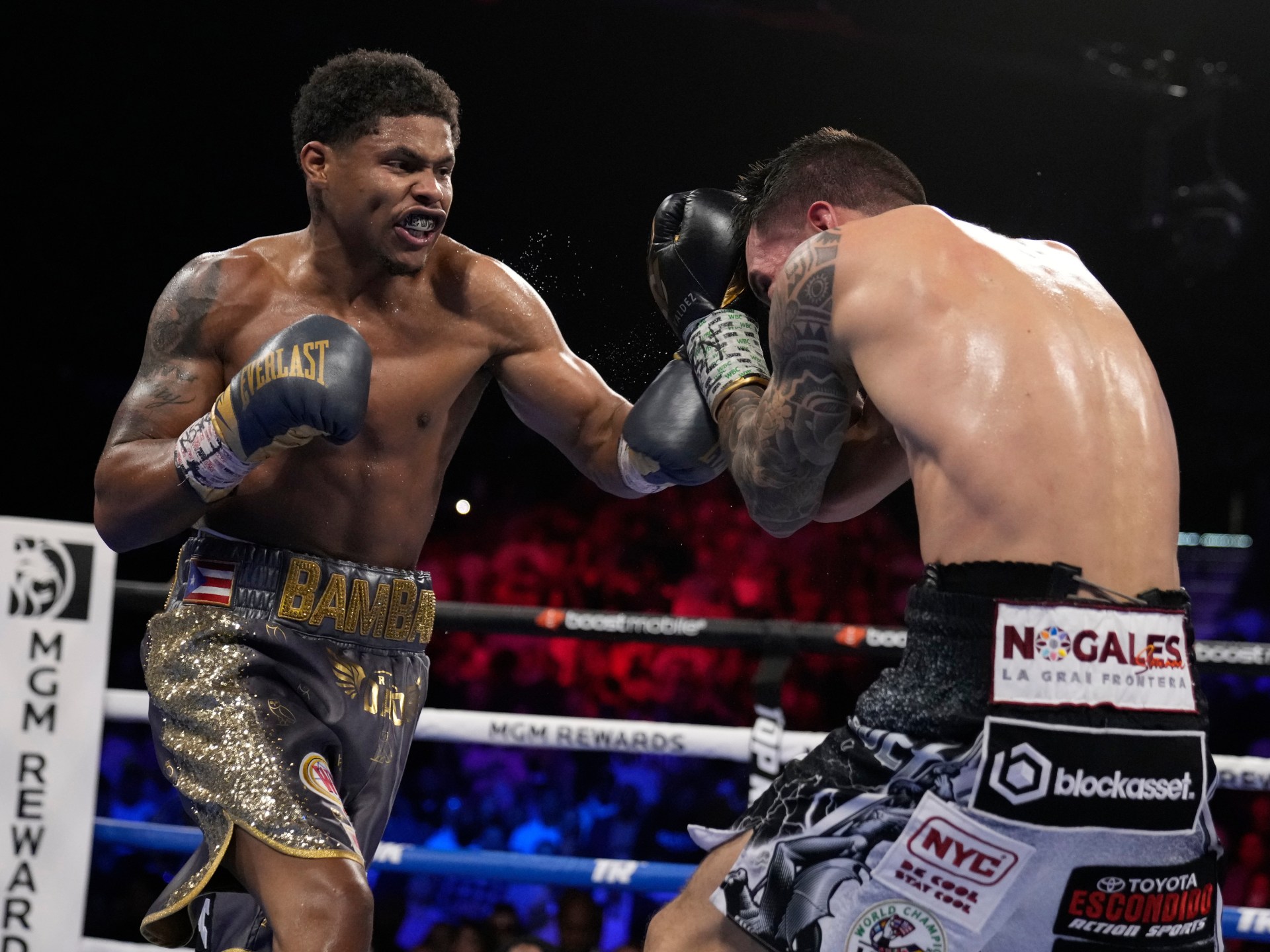
Madison Square Garden says anyone fighting at the arena threatens to be “banned for life” after there were multiple altercations at one of its events.
Video on TMZ.com showed two fights breaking out on Friday, when fighters weighed in for the boxing card Saturday night headlined by Teofimo Lopez and Shakur Stevenson. One of the videos showed a brawl starting as Bill Haney, father of boxer Devin Haney, was conducting an interview near the stage.
Recommended Stories
list of 4 itemsend of list
“Violence will not be condoned at MSG across any type of event including, hockey, basketball, boxing, concerts, or special events,” Madison Square Garden said in a statement. “If any individual is found to participate in violent activity, whether you are part of the event, or a patron, you will be banned for life and unable to attend or participate in any event across all our venues.”
The news conference Thursday for the title fight between Lopez and Stevenson became heated as the fighters on stage traded insults about family members, with people in the audience also shouting.
There was also an altercation near the cage on November 15, when MSG hosted UFC 322.
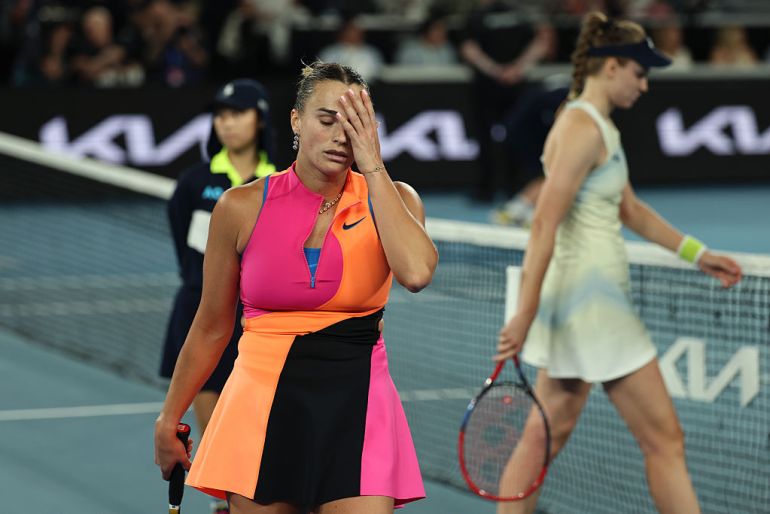
Elena Rybakina produced a thunderous display to dismantle Aryna Sabalenka 6-4 4-6 6-4 on Saturday and capture a maiden Australian Open title, turning the tables on the world number one in their Melbourne Park final rematch from three years ago.
Rybakina returned to the site of her heartbreak in 2023 to complete an impressive victory and earn her second major trophy after Wimbledon 2022, underlining her credentials as the player best equipped to puncture Sabalenka’s hardcourt aura.
Recommended Stories
list of 4 itemsend of list
The 26-year-old Kazakh capped a fortnight of relentless efficiency while largely flying under the radar, adding the Daphne Akhurst Memorial Cup to a resume that also includes the 2025 WTA Finals crown, where she downed Sabalenka.
“It’s hard to find words now but I want to congratulate Aryna for her amazing results in the last couple of years. I hope we’re going to play many more finals together,” Rybakina said.
“I want to say thank you to you guys (fans). Thank you so much to Kazakhstan. I felt the support from that corner a lot. It’s really a Happy Slam and I always enjoy coming here and playing in front of you guys.”
Aryna Sabalenka was seeking a third Australian Open title at Melbourne Park [Phil Walter/Getty Images]
In the first Grand Slam final since 2008 featuring players yet to drop a set, it was top seed Sabalenka who blinked first under the Rod Laver Arena roof as Rybakina came out all guns blazing to break in the opening game and wrest control.
The fifth seed’s huge ball-striking caused all sorts of problems for twice champion Sabalenka, as she comfortably got to set point in the 10th game and finished it off to send alarm bells ringing in her opponent’s dugout.
Having arrived with 46 hardcourt Grand Slam match wins from the last 48, four-time major winner Sabalenka found her groove and started the second set more positively, but Rybakina saved three breakpoints to hold for 1-1.
A wayward forehand from Rybakina handed Sabalenka the chance to level at one set apiece, and the Belarusian gleefully took it to turn the final set into a shootout destined to be decided by whichever player held their nerves.
Having beaten Rybakina from a similar situation in the 2023 title clash, Sabalenka unleashed a flurry of winners to go ahead 3-0, but the Kazakh erased the deficit and broke for 4-3 before securing victory to add to her All England club triumph.
Elena Rybakina celebrates a point in the Women’s Singles Final against Aryna Sabalenka [Phil Walter/Getty Images]
The knockout blow was a huge ace, after which the typically restrained Rybakina walked forward, smiled and pumped her fist before celebrating with her team.
Sabalenka, denied an Australian Open “three-peat” by American outsider Madison Keys in last year’s final, endured heartbreak again as she retreated to her chair and draped a white towel over her head to conceal her anguish.
“I’m really speechless right now,” she said, before turning to her victorious opponent and the fans.
Cuba’s President Miguel Diaz-Canel has denounced what he called an attempt by his United States counterpart, Donald Trump, to “suffocate” the sanctions-hit country’s economy.
Trump signed an executive order on Thursday threatening additional tariffs on countries that sell oil to Cuba, the latest move in Washington’s campaign of pressure on Havana. The order alleged that the government of communist-run Cuba was an “unusual and extraordinary threat” to US national security.
In a social media post on Friday, Diaz-Canel said that under “a false and baseless pretext”, Trump plans “to suffocate” Cuba’s economy by slapping tariffs “on countries that sovereignly trade oil” with it.
“This new measure reveals the fascist, criminal and genocidal nature of a clique that has hijacked the interests of the American people for purely personal ends,” he said, in an apparent allusion to Secretary of State Marco Rubio, a Cuban American and a known anti-Cuban government hawk.
Cuba, which is suffering rolling electricity blackouts blamed on fuel shortages, was cut off from critical supplies of Venezuelan oil after the US abducted Venezuela’s President Nicolas Maduro and his wife in a bloody military night raid on the capital, Caracas, earlier this month. At least 32 members of Cuba’s armed forces and intelligence agencies were killed in the January 3 attack.
The US has since taken effective control of Venezuela’s oil sector, and Trump, a Republican, has issued threats against other left-wing governments in the region, promising to stop oil shipments previously sent to Cuba.
Cuba’s Foreign Minister Bruno Rodriguez on Friday declared an “international emergency” in response to Trump’s move, which he said constitutes “an unusual and extraordinary threat”.
Venezuela’s government also condemned the measure in a statement on Friday, saying it violates international law and the principles of global commerce.
Reporting from Cuba’s capital, Al Jazeera’s Ed Augustin said Trump’s announcement “is a massive psychological blow”, noting that analysts describe it as the “most powerful economic blow the United States has ever dealt the island”.
Days after Maduro’s abduction and transfer to the US, Trump urged Cuba to make a deal “before it is too late,” without specifying what kind of agreement he was referring to.
In a post on social media, Trump suggested Rubio could become the president of Cuba. “Sounds good to me!” he wrote on his Truth Social platform.
‘There’s no solution’
In Havana, residents expressed anger at Trump’s tariff threat, which will only make life harder for Cubans already struggling with an increase in US sanctions.
“My food is going bad. We haven’t had electricity since 6am,” Yenia Leon told Al Jazeera. “You can’t sleep. You have to buy food every day. There’s no solution to the power situation,” she said.
“This is a war,” Lazaro Alfonso, an 89-year-old retired graphic designer, told The Associated Press news agency, describing Trump as the “sheriff of the world” and saying he feels like he is living in the Wild West, where anything goes.
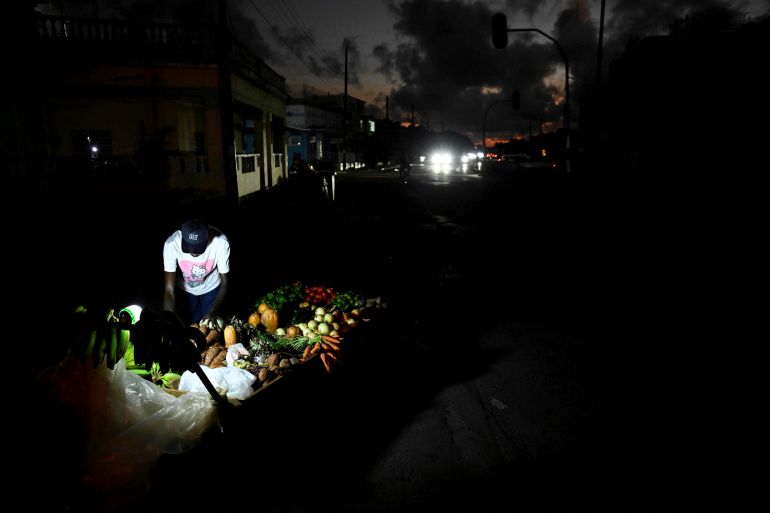
A man sells vegetables on the street during a blackout in Havana on January 22 [Norlys Perez/Reuters]
Alfonso, who lived through the severe economic depression in the 1990s known as the “Special Period” following cuts in Soviet aid, said the current situation in Cuba is worse, given the severe blackouts, a lack of basic goods and a scarcity of fuel.
“The only thing that’s missing here in Cuba … is for bombs to start falling,” he said.
Meanwhile, Mexican President Claudia Sheinbaum said she would seek alternatives to continue helping Cuba after Trump’s announcement following a decision this week to temporarily halt oil shipments to the island amid heightened rhetoric from Trump.
Mexico became a key supplier of fuel to Cuba, along with Russia, after the US sanctions on Venezuela paralysed the delivery of crude oil to the island.
Sheinbaum said cutting off oil shipments to Cuba could trigger a “far-reaching humanitarian crisis” on the island, affecting transportation, hospitals and access to food. She did not say whether Mexico would cut shipments of oil or refined products to Cuba, which she said accounted for 1 percent of Mexico’s production.
“Our interest is that the Cuban people don’t suffer,” Sheinbaum said, adding that she had instructed her foreign minister to contact the US State Department to better understand the scope of the executive order.
Mexico supplied 44 percent of Cuban oil imports and Venezuela exported 33 percent until last month, while some 10 percent of Cuban oil is sourced from Russia. Some oil is also sourced from Algeria, according to The Financial Times figures.
In November last year, a senior United Nations expert said the long-running US sanctions on Cuba must be lifted as they are “causing significant effects across all aspects of life”.
The US imposed a near-total trade embargo on Cuba in 1962, with the goal of toppling the government put in place by Fidel Castro after he took power in a 1959 revolution. Castro himself was the target of numerous assassination attempts by the US’s Central Intelligence Agency, or CIA.
Alena Douhan, special rapporteur on the negative impact of unilateral coercive measures on human rights, said the “extensive regime of economic, trade and financial restrictions” against Cuba marks the longest-running unilateral sanctions policy in US history.
She noted that there are shortages of food, medicine, electricity, water, essential machinery and spare parts in Cuba, while a growing emigration of skilled workers, including medical staff, engineers and teachers, is further straining the country.
Who: Carlos Alcaraz vs Novak Djokovic What: Men’s singles final – Australian Open 2026 When: Sunday, February 1 at 19:30 (08:30 GMT) Where: Rod Laver Arena, Melbourne Park, Melbourne, Australia How to follow: Al Jazeera’s live text and photo stream gets under way at 05:30 GMT
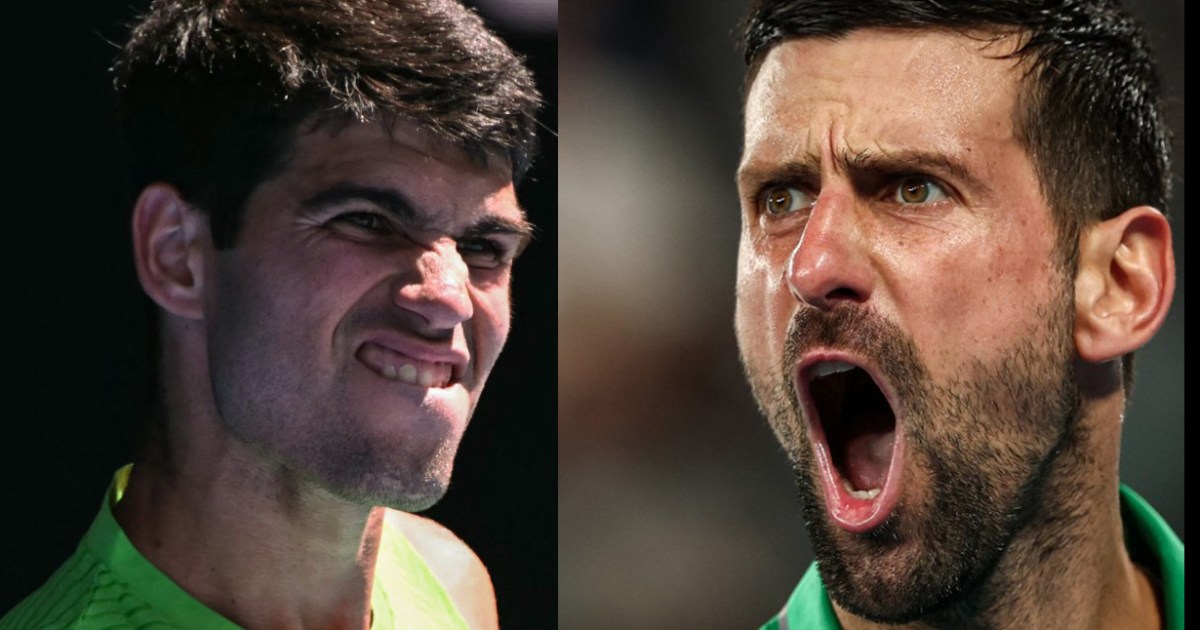
Novak Djokovic stands one step away from cementing his place as the greatest tennis player of all time. In his way, though, is Carlos Alcaraz – a modern adversary seeking a career milestone of his own.
Recommended Stories
list of 4 itemsend of list
Tennis history will be rewritten when the pair meet in the men’s singles final of the Australian Open 2026 on Sunday.
Djokovic is seeking his 25th major title to go past Margaret Court in the all-time Grand Slam winners’ list in the Open Era, while Alcaraz – 16 years his junior – is looking to become the youngest player to complete a Career Grand Slam by winning the only one eluding his trophy cabinet.
At 38 years old, the Serb is already the oldest man to have qualified for a Grand Slam final, but he will be looking to make the most of his appearance in Sunday’s blockbuster final to seal a record-extending 25th men’s title.
Meanwhile, Alcaraz, who was the last man to beat Djokovic in a Grand Slam final at Wimbledon 2024, will aim to convert his debut final at the Australian Open into a night when he seals a career Slam.
Both men enter the match on the back of epic semifinal wins on Rod Laver Arena on Friday, with top seed and world number one Alcaraz having a slightly longer recovery period than fourth-seeded Djokovic.
What’s the Alcaraz-Djokovic tennis rivalry?
In the five years since his first appearance in the main round of a Grand Slam, Alcaraz has swiftly become the face of men’s tennis, and his brief history with the iconic Djokovic is often seen as a passing-of-the-baton inter-generational rivalry.
Alcaraz is known for his speed and power, while Djokovic relies on his experience, consistency and resilience to fend off the next generation of tennis talents.
The young Spaniard’s first meeting against Djokovic came at the Madrid Open in 2022, where the home favourite beat the veteran in straight sets.
Since then, the pair have met in Grand Slam settings on five occasions, with Alcaraz winning both finals but Djokovic emerging victorious at the Olympics to complete his Career Super Slam.
Overall, the Serb edges his rival by five wins to four in their nine meetings.
Their last encounter was in the semifinals of the US Open 2025, where eventual champion Alcaraz was too strong for the four-time winner Djokovic.
The match ended 6-4, 7-6 (7-4), 6-2 in Alcaraz’s favour.
How did Alcaraz reach the Australian Open 2026 final?
An ailing Alcaraz battled past Alexander Zverev in a five-set epic to reach his first Australian Open final in a match lasting five hours and 27 minutes. The world number one outlasted the German third seed in hot conditions with a cramping body.
Road to the final:
First round: Beat Adam Walton 6-3, 7-6(7-2), 6-2
Second round: Beat Yannick Hanfmann 7-6(7-4), 6-3, 6-2
How did Djokovic reach the Australian Open 2026 final?
Djokovic stunned reigning champion Jannik Sinner early on Saturday, with the veteran turning back the clock to upset the Italian in a gruelling four-hour-nine-minute match.
Road to the final:
First round: Beat Pedro Martinez 6-3, 6-2, 6-2
Second round: Beat Francesco Maestrelli 6-3, 6-2, 6-2
Third round: Botic van de Zandschulp 6-3, 6-4, 7-6(7-4)
Fourth round: Beat Jakub Mensik via walkover
Quarterfinal: Beat Lorenzo Musetti 4-6, 3-6, 3-1 retired
What’s being said about the Djokovic-Alcaraz Australian Open final?
Tennis experts, fans and former champions have been weighing in on what promises to be a modern epic.
Rafael Nadal: “I think the favourite is Carlos. He’s young, he has the energy and he’s in his prime. But I mean, Novak is Novak. He’s a very special player. I think it’s a positive example of commitment, of resilience. Novak, for obvious reasons, is not at his prime, but he is still very, very competitive at an age that is difficult to be very competitive. So full respect.”
Andy Roddick: “Man regrets inspiring child.”
How much is the prize money for the Australian Open champion?
The men’s singles champion and runner-up will receive $2.9m and $1.5m, respectively, from the total tournament prize money of $78.1m.
How to stream and follow the Australian Open 2026 final?
A federal judge has halted the Trump administration’s plan to strip deportation protections from thousands of Ethiopians living in the United States.
Judge Brian Murphy in Boston issued the order on Friday, delaying a February 13 deadline that would have forced more than 5,000 Ethiopians to leave the country or face arrest.
Recommended Stories
list of 3 itemsend of list
The ruling represents the latest legal setback to the administration’s broader push to end temporary protections for more than one million people across multiple countries.
Murphy’s decision came during a virtual hearing, where he said the delay would provide time for the Department of Homeland Security to produce records explaining its decision-making process before he considers blocking the move for longer.
“I want to do everything I can to keep this case going,” the judge said.
The case was brought by three Ethiopian nationals and the advocacy group African Communities Together, who filed suit after the DHS announced in December it was terminating the Temporary Protected Status (TPS) first granted to Ethiopia in 2022.
The lawsuit argues the administration unlawfully ended the protections with just 60 days’ notice despite ongoing armed conflict in the African nation.
Plaintiffs also claim Homeland Security Secretary Kristi Noem acted based on an “unconstitutional animus against non-white immigrants”.
The move came even as the State Department continues urging Americans to reconsider travel to Ethiopia due to “sporadic violent conflict, civil unrest, crime, communications disruptions, terrorism and kidnapping”.
The DHS defended the termination by pointing to recent peace agreements, including a 2022 ceasefire in Tigray, despite renewed fighting in the region this month.
DHS spokesperson Tricia McLaughlin said TPS “was never intended to be a de facto amnesty programme, yet that’s how previous administrations have used it for decades”.
The ruling follows a similar decision a day earlier when a federal appeals court found the administration unlawfully ended protections for 600,000 Venezuelans.
That three-judge panel said Noem’s actions were based on “racist stereotyping” and left people “in a constant state of fear that they will be deported, detained, separated from their families”.
About a dozen countries now face TPS terminations as part of Trump’s immigration crackdown.
Some 350,000 Haitians are set to lose protections on February 3, while Somalis face a March 17 deadline, despite the State Department maintaining a “Do Not Travel” warning for Somalia.
Mohamed Ibrahim, a Sudanese doctor, feared he would not live to see the sun go down.
“All around we saw people running and falling to the ground in front of us,” the 28-year-old physician said, according to a report by The Associated Press news agency on Saturday.
Recommended Stories
list of 4 itemsend of list
Ibrahim was recounting the assault on el-Fasher, the capital of Sudan’s North Darfur, by the paramilitary Rapid Support Forces (RSF) that began on October 26 and lasted three days, ending an 18-month siege of the Sudanese army’s last stronghold in the province.
The RSF and the Sudanese army have been waging a brutal civil war for control of Sudan since April 2023, killing thousands of people and displacing millions. The conflict has created what the United Nations describes as the world’s largest displacement and hunger crisis
“We moved from house to house, from wall to wall under nonstop bombardment. Bullets were flying from all directions,” Ibrahim said as he recounted fleeing el-Fasher’s last functioning medical facility.
What followed was a systematic campaign of mass killings and ethnic cleansing, according to the United Nations and human rights groups, triggering war crimes investigations and international sanctions.
Speaking with the AP from the town of Tawila, about 70km (43 miles) from el-Fasher, Ibrahim provided a rare, detailed first-person account.
As RSF fighters swarmed in, they opened fire on civilians scrambling over walls and hiding in trenches in a vain effort to escape, while mowing down others with vehicles, Ibrahim said. He said seeing so many killed felt like he was running towards his own death.
“It was a despicable feeling,” he said. “How can el-Fasher fall? Is it over? I saw people running in terror. … It was like judgement day.”
Within hours, RSF fighters were storming homes, demanding phones at gunpoint and looting property.
Satellite imagery analysed by Yale University’s Humanitarian Research Lab, which has been monitoring the war in Sudan, identified at least 150 clusters of objects consistent with human remains between October 26 and November 1.
Researchers documented systematic efforts to destroy evidence through burning and burial, with RSF vehicles present near the sites.
Sarra Majdoub, a former UN Security Council expert on Sudan, said in a post on X that a “machinery of disappearance” had been operating in the aftermath of the fall of the city, with thousands unaccounted for.
Ibrahim, the doctor, was also held by RSF fighters after being captured, with the fighters demanding a ransom. “I didn’t want to tell them I was a doctor, because they exploited doctors,” he said.
After negotiating his ransom down from a $20,000 initial demand, his family paid $8,000 for his release, the AP report said.
The International Organization for Migration reported that more than 26,000 people fled el-Fasher in just two days following the October 26 takeover, with at least 106,387 people displaced by late November.
The United States, United Kingdom and European Union have imposed sanctions on RSF commanders in recent months.
Nazhat Shameem Khan, deputy prosecutor of the International Criminal Court, said war crimes and crimes against humanity were committed in el-Fasher “as a culmination of the city’s siege by the Rapid Support Forces”.