Miami mayoral election results: What we know about Eileen Higgins’ win

Miami voters on Tuesday elected Democrat Eileen Higgins as mayor, ending a nearly three-decade dry spell for her party after she defeated a Republican endorsed by Donald Trump in the predominantly Hispanic city.

While the election was officially nonpartisan, the race took on national significance, pitting Higgins against Republican Emilio Gonzalez, a former Miami city manager, in a contest closely watched by both parties.

Recommended Stories

list of 1 itemend of list

The win comes in the wake of recent electoral success achieved by the Democratic Party ahead of next year’s midterm elections.

Here is what we know:

What were the final results of the Miami election?

Higgins led Republican Gonzalez 59 percent to 41 percent on Tuesday night, according to preliminary results from the Miami-Dade County Supervisor of Elections Office. She is the first woman ever elected as mayor in the city.

She won Tuesday’s run-off after leading the first round of voting on November 4 with 35 percent of the vote to Gonzalez’s 19 percent.

“Tonight, the people of Miami made history,” Higgins said in a statement. “Together, we turned the page on years of chaos and corruption and opened the door to a new era for our city.”

Higgins’ victory adds to a run of recent Democratic wins, including races in New Jersey and Virginia, as the party looks towards the 2026 midterms. That trend continued with strong results in November’s off-year elections and a solid showing in this month’s special House race in Tennessee.

While Miami’s mayor wields limited formal power, the role is highly symbolic, representing a city with a large Latino population at the centre of national immigration debates.

Home to roughly half a million residents, Miami is Florida’s second-most populous city after Jacksonville. In recent election cycles, it has shifted towards Republicans, making a Democratic win stand out even more. Trump had won Miami-Dade County in the 2024 presidential election against her Democratic rival Kamala Harris.

Hispanic or Latino residents make up roughly 70 percent of Miami’s population. In Miami-Dade County overall, about 69–70 percent of residents identify as Hispanic or Latino – a demographic majority that significantly shapes the region’s cultural and political identity.

What are some of the key issues of this campaign?

Immigration was a key issue in Higgins’ campaign.

In Miami, she often talked about Donald Trump’s immigration crackdown, saying she heard from residents who were worried about family members being detained. She described the election as a referendum on the president’s policies, which have caused concerns about due process.

More than 200,000 people have been arrested since Trump launched the crackdown on migrants in January. At least 75,000 people, who were arrested as part of Trump’s fight against gang members and criminals, had no criminal records, according to new data. He has deported hundreds of migrants and halted asylum and green card applications.

The Trump administration had also ordered the arrest of several students who participated in protests against Israel’s genocidal war on Gaza. Several of them have since been released by the courts.

The difference between the candidates was clear during a debate last month. Higgins called immigration enforcement in Miami “cruel and inhumane” and criticised the detention centre opened by Florida Governor Ron DeSantis, commonly known as “Alligator Alcatraz”.

In that same debate, her opponent, Gonzalez, said he supported federal law enforcement rounding up “people who commit crimes”.

“I support putting down migrant criminals, I cannot in good conscience fight with the federal government and defend a rapist or a murderer,” Gonzalez added.

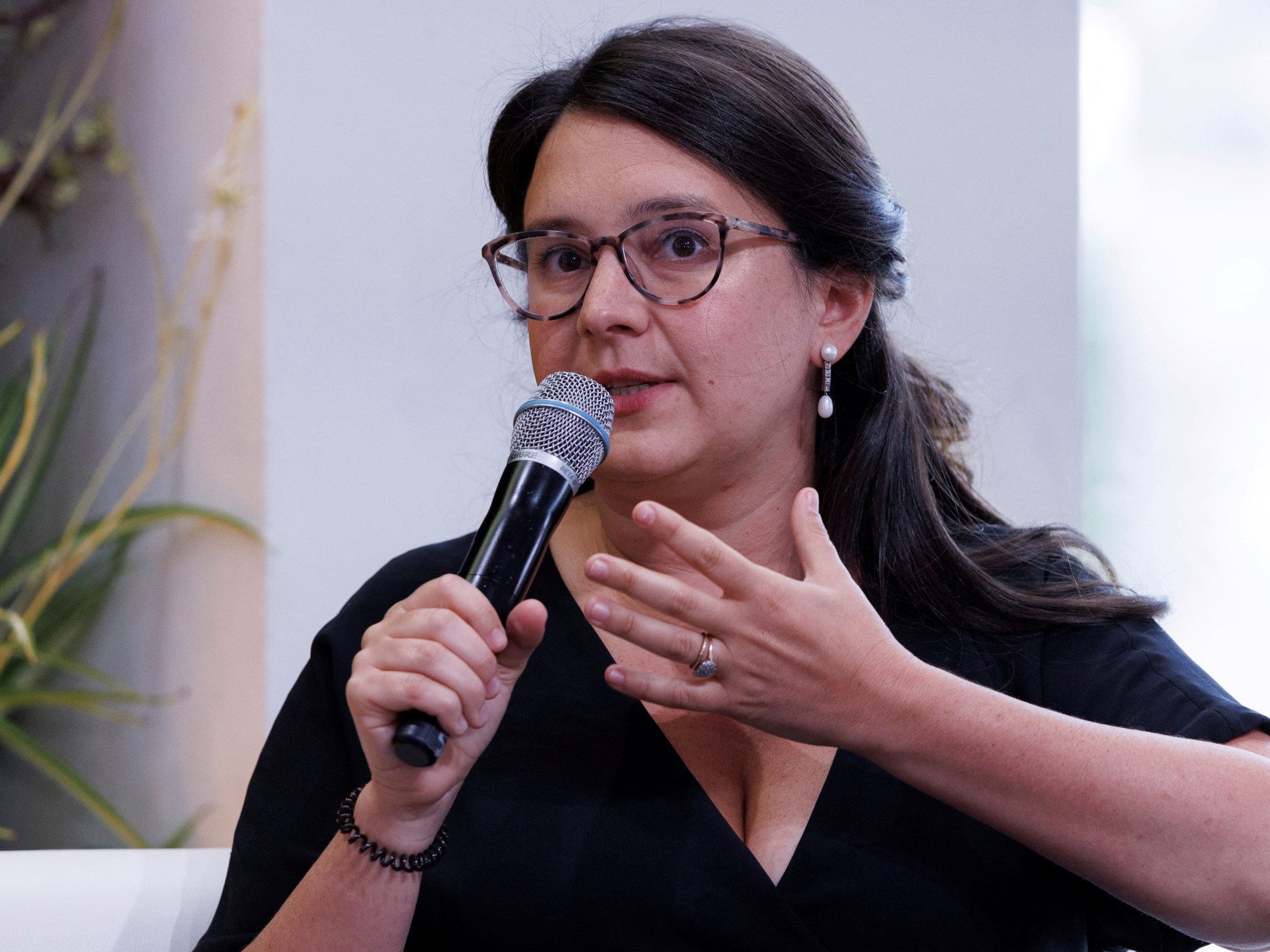
This combination of images shows candidates for mayor of Miami, from left, Republican Emilio Gonzalez and Democrat Eileen Higgins [AP]

Higgins repeated her message in an interview with El Pais this week, drawing a sharp contrast with Trump’s approach.

“He and I have very different points of view on how we should treat our residents, many of whom are immigrants,” she said.

“That is the strength of this community. We are an immigrant-based place. That’s our uniqueness. That’s what makes us special.”

Affordability was also a major issue in the race. Higgins focused her campaign on local concerns such as housing costs, while Gonzalez campaigned on repealing Miami’s homestead property tax and streamlining business permits.

“My opponent is keen on building, building, building,” Gonzalez told CNN. “She wants to put a skyscraper in every corner … then calling it affordable housing, which is a misnomer, because very rarely is it truly affordable.”

During a speech in Pennsylvania on Tuesday, Trump raised the issue of affordability, which Democrats have highlighted. He blamed high prices on his predecessor, Joe Biden.

The cost of living has been on the election campaign agenda in recent gubernatorial and mayoral elections in which Democrats have made gains, including the much-publicised New York mayoral election. The Democratic wins show that the issue has resonated with voters.

Who is Eileen Higgins?

Higgins is Miami’s first non-Hispanic mayor in nearly three decades. Born in Ohio and raised in Albuquerque, New Mexico, she earned a Bachelor of Science in mechanical engineering from the University of New Mexico and later completed an MBA at Cornell University.

Before becoming mayor, Higgins represented a politically conservative district that includes Little Havana, the city’s well-known Cuban enclave.

She has embraced the nickname “La Gringa,” a term commonly used in Spanish to refer to white Americans.

Her professional background spans international development and consulting, with a focus on infrastructure and transportation projects across Latin America. She later served as Peace Corps country director in Belize and went on to work as a foreign service officer for the United States Department of State, where her portfolio included diplomatic and economic development efforts in countries such as Mexico and South Africa.

After her government service, Higgins returned to the private sector before eventually entering local politics in Miami.

Military transport plane crashes in war-torn Sudan, killing crew: Report

A military transport aircraft has gone down while attempting to land at an airbase in eastern Sudan, killing all the crew members in the war-ravaged nation.

An Ilyushin Il-76 crashed on Tuesday as it approached the Osman Digna airbase in Port Sudan, near the city’s main airport, two military sources told the AFP news agency, citing a technical malfunction during the landing attempt.

Recommended Stories

list of 3 itemsend of list

All crew members on board were killed, though the government-aligned Sudanese Armed Forces (SAF) has not disclosed how many people were on the plane.

The last major incident at the airbase occurred in May, when drones struck multiple sites across Port Sudan, including the airfield.

The incident comes as SAF faces mounting losses across the country’s central regions.

On Monday, the Rapid Support Forces (RSF) seized control of the Heglig oilfield, Sudan’s largest oil facility, in West Kordofan province after SAF abandoned their positions, according to the Sudan Tribune.

Military sources told Al Jazeera on Tuesday that the army was also withdrawing from Babnusa in West Kordofan, a strategic gateway that the RSF said it had taken control of in early December.

The loss of Heglig delivers a significant blow to the military-aligned government’s revenue streams. The facility processes between 80,000 and 100,000 barrels of crude oil daily for Sudan and South Sudan, and the pipeline to Port Sudan runs through it.

Ahmed Ibrahim, a former adviser to the Sudanese government, told Al Jazeera on Tuesday that the attack on Heglig was part of an RSF effort to drag South Sudan, where a fragile truce between the country’s dominant forces has only barely held, into the war on its side.

The conflict’s epicentre has shifted to the Kordofan region following el-Fasher’s fall last month, which the United Nations has described as a “crime scene”. RSF gains across the central region now threaten to bisect the country, potentially isolating army-held territory and consolidating paramilitary control over a continuous stretch from Chad to the country’s heartland.

The same day as the plane crash, the United States imposed sanctions on four Colombian nationals and four companies accused of recruiting hundreds of military veterans to fight for the RSF.

However, the sanctions did not target Global Security Services Group, a company in the United Arab Emirates, which, a November report by The Sentry, a United States-based investigative organisation that tracks conflict financing, identified as arranging the deployment of Colombian mercenaries to Sudan.

The UAE has consistently denied providing support to the RSF.

Also on Tuesday, the International Criminal Court (ICC) sentenced Ali Kushayb, a former leader of the Popular Defence Forces (also known as Janjaweed) militia, to 20 years in prison for war crimes and crimes against humanity committed in Darfur between 2003 and 2004.

The conviction marks the first time the ICC has prosecuted crimes in Darfur, a region now witnessing renewed mass atrocities as the RSF, which traces its origins to the Janjaweed, advances across western and central Sudan.

The conflict has killed tens of thousands since April 2023 and displaced more than 12 million people.

The World Food Programme warns that 20 million people face acute food shortages, with six million on the brink of starvation.

Writing for Al Jazeera, Javid Abdelmoneim, international president of Doctors Without Borders (also known by its French initials MSF), warned that the world must not accept “a new normal” of mass atrocities in Sudan.

Where in the world are wealth and income most unequal?

The richest 10 percent of the world’s population now owns three-quarters of all personal wealth, according to the newly released World Inequality Report 2026.

Income is not much different, where the top 50 percent of earners take home more than 90 percent, while the poorest half of the world receives less than 10 percent of total income.

The report, which has been published annually since 2018, notes that the 2026 edition arrives at a critical time. Worldwide, living standards are stagnating for many, while wealth and power are increasingly concentrated at the top.

(Al Jazeera)

The differences between wealth and income inequality

Wealth and income levels do not always go hand in hand. The wealthiest are not necessarily the highest earners, highlighting the persistent divide between what people earn and what they own.

Wealth includes the total value of a person’s assets-such as savings, investments or property, after subtracting their debts.

In 2025, the wealthiest 10 percent of the world’s population owned 75 percent of global wealth, the middle 40 percent held 23 percent, and the bottom half controlled only 2 percent.

Since the 1990s, the wealth of billionaires and centi-millionaires has grown by about 8 percent each year, almost twice the rate of the bottom half of the world’s population.

The wealthiest 0.001 percent – fewer than 60,000 multimillionaires – now control three times more wealth than half of humanity. Their share has climbed from almost 4 percent in 1995 to more than 6 percent today.

The poorest have made small gains, but these are overshadowed by the rapid accumulation at the very top, resulting in a world where a tiny minority holds extraordinary financial power, while billions still struggle for basic economic security.

Income is measured using pre-tax earnings, after accounting for pension and unemployment insurance contributions.

In 2025, the richest 10 percent of the world received 53 percent of global income, the middle 40 percent received 38 percent, and the bottom 50 percent earned just 8 percent.

For example, if the world comprised 10 people and total global income was $100, then the richest person would receive $53, the next four people would collectively earn $38, and the remaining five people would divide $8 among them.

How is wealth and income divided regionally?

Inequality looks very different around the world. A person’s birthplace remains one of the strongest factors in determining how much they earn and the wealth they can build. However, the regions also include poor and wealthy countries, and figures in the report are averages.

In 2025, the average wealth of people in North America and Oceania, which the report has grouped together, stood at 338 percent of the world’s average, making it the wealthiest region globally. Income share stood at 290 percent of the world’s average, also the highest in the world.

Europe and East Asia followed, remaining above the world average, while vast parts of sub-Saharan Africa, South Asia, Latin America and the Middle East remained far below the global average.

INTERACTIVE- Income and wealth inequality across regions-Dec9-2025-1765292712
(Al Jazeera)

Global inequality paints a stark picture, but the scale of wealth and income gaps can vary widely from one country to another. While some nations show slightly more balanced distributions, others reveal extreme concentration of wealth in the hands of a few.

Which countries have the highest income inequality?

South Africa has the highest levels of income inequality in the world. The top 10 percent earn 66 percent of total income, while the bottom half receives only 6 percent.

Latin American countries such as Brazil, Mexico, Chile and Colombia show a similar trend, where the richest 10 percent receive nearly 60 percent of earnings.

European countries offer a more balanced picture. In Sweden and Norway, the bottom 50 percent earn about 25 percent of total income, while the top 10 percent receive less than 30 percent.

Many developed economies, including Australia, Canada, Germany, Japan and the United Kingdom, fall in the middle. The top 10 percent earn roughly 33-47 percent of total income, while the bottom half takes 16-21 percent.

In Asia, income distribution is mixed. Countries like Bangladesh and China have a more balanced structure, whereas India, Thailand, and Turkiye remain top-heavy, with the richest 10 percent earning more than half of all income.

The table below shows where income is divided most unequally.

Which countries have the highest wealth inequality?

When it comes to wealth inequality, once again, South Africa tops the list. The top 10 percent control 85 percent of personal wealth, leaving the bottom 50 percent with negative shares – meaning their debt exceeds assets.

Russia, Mexico, Brazil and Colombia show a similar pattern, with the richest grabbing 70 percent or more, while the poorest receive barely 2–3 percent.

European countries such as Italy, Denmark, Norway and the Netherlands are relatively more balanced. Here, the middle 40 percent capture about 45 percent, and the bottom half takes a slightly larger share, though the top 10 percent still dominate. However, Sweden and Poland’s bottom 50 percent have negative shares in wealth.

Even wealthy nations like the United States, UK, Australia, and Japan are far from equal. The top 10 percent earn more than half of the total income, while the bottom half is left with just 1–5 percent.

Thailand-Cambodia border clashes enter third day as 500,000 flee fighting

Fighting between Thailand and Cambodia has continued for a third day, with cross-border shelling and air raids forcing more than half a million civilians to flee their homes and seek shelter, according to authorities.

Officials from the two Southeast Asian neighbours on Wednesday also accused each other of restarting the conflict that has killed at least 13 soldiers and civilians so far this week and led more than 500,000 people from both sides of the border to evacuate for safety.

Recommended Stories

list of 3 itemsend of list

“More than 400,000 people have been moved to safe shelters” across seven provinces, Thailand’s Ministry of Defence spokesperson Surasant Kongsiri told reporters at a news conference.

“Civilians have had to evacuate in large numbers due to what we assessed as an imminent threat to their safety,” he said.

The Thai military also reported that rockets fired from Cambodia had landed near the Phanom Dong Rak Hospital in Surin on Wednesday morning, prompting patients and hospital staff to take cover in a bunker.

In neighbouring Cambodia, “101,229 people have been evacuated to safe shelters and relatives’ homes in five provinces”, Cambodian Ministry of National Defence spokeswoman Maly Socheata said.

Cambodianess, a website operated by the Cambodian Media Broadcasting Corporation, reported that Thai F-16 jets had attacked two areas in the country, while Thai shelling continued in three other areas.

Thailand’s Matichon Online news portal also reported that the country’s military had deployed F-16s to attack “one Cambodian military target” along the border on Wednesday morning.

Cambodian rockets and artillery fire also targeted 12 front-line areas in four Thai provinces early in the morning, according to Thailand’s The Nation newspaper, citing military sources. There were no immediate reports on casualties.

Al Jazeera’s Rob McBride, reporting from Surin province in Thailand, said the Thai military reported earlier on Wednesday that fighting took place in almost all of the provinces bordering Cambodia.

In Surin province alone, there were reports of exchanges of fire in five different locations, McBride said, adding that many thousands have evacuated.

“Most people have left here,” he said.

“Hundreds of thousands of people now on both sides of the border have sought refuge as they have done in the past and as the fighting continues,” he added.

“The Thais have been saying that they do want peace. But they said peace has to come with what they call security and safety of Thai people. As the attacks are continuing, they have not achieved that yet,” McBride said.

Cambodian soldiers ride a motorcycle along a street in Oddar Meanchey province on Wednesday following clashes along the Cambodia-Thailand border [Cambodia Out via AFP]

Reporting from Oddar Meanchey in northwestern Cambodia, Al Jazeera’s Barnaby Lo said local people are moving to evacuation centres as the fighting has expanded to five border provinces with Thailand.

At one camp housing some 10,000 displaced people, Lo said conditions are “far from ideal” with many people sheltering under makeshift tents of blue tarpaulin, while others do not even have materials to build shelters to protect from the heat and rain.

“People here are saying there is not enough aid going around,” Lo said.

“But the bigger fear or the bigger concern here is the fear. Fear that the violence could spread further, and right now, there are people packing because we’ve been hearing loud explosions even though we are kilometres away from where the fighting is taking place. So people are packing and getting ready to move to another evacuation camp,” he said.

“But the problem is that wherever they go, it seems like danger will follow them.”

Lo added that Cambodia’s Senate President and former leader Hun Sen, who is the commander of the military, suggested retaliatory attacks on Thailand, and the conflict is unlikely to end quickly.

This week’s clashes are the deadliest since five days of fighting in July that killed dozens and displaced some 300,000 people on both sides of the border before a shaky truce was agreed, following an intervention by United States President Donald Trump.

Trump said late on Tuesday that he would make a phone call to stop the renewed fighting.

“I am going to have to make a phone call. Who else could say I’m going to make a phone call and stop a war of two very powerful countries, Thailand and Cambodia,” Trump said while speaking at a rally in the US state of Pennsylvania.

However, Thai Foreign Minister Sihasak Phuangketkeow told Al Jazeera that he saw no potential for negotiations in the border conflict, adding that Bangkok did not start the clashes.

Cambodia’s Defence Ministry also said on Tuesday that its troops had no choice but to take action, accusing Thailand of “indiscriminately and brutally targeting civilian residential areas” with artillery shells, allegations Bangkok rejected.

In a further sign of worsening relations between the two countries, Cambodia announced on Wednesday that it was withdrawing from the Southeast Asian Games, which are currently being held in Thailand, citing “serious concerns”.

Tensions have simmered between Bangkok and Phnom Penh since Thailand last month suspended de-escalation measures that were agreed at an October summit in Trump’s presence in Kuala Lumpur, Malaysia, after a Thai soldier was maimed by a landmine that Bangkok said was newly laid by Cambodia. Cambodian officials have rejected the allegation.

Gaza and the unravelling of a world order built on power

The catastrophic violence in Gaza has unfolded within an international system that was never designed to restrain the geopolitical ambitions of powerful states. Understanding why the United Nations has proved so limited in responding to what many regard as a genocidal assault requires returning to the foundations of the post–World War II order and examining how its structure has long enabled impunity rather than accountability.

After World War II, the architecture for a new international order based on respect for the UN Charter and international law was agreed upon as the normative foundation of a peaceful future. Above all, it was intended to prevent a third world war. These commitments emerged from the carnage of global conflict, the debasement of human dignity through the Nazi Holocaust, and public anxieties about nuclear weaponry.

Yet, the political imperative to accommodate the victorious states compromised these arrangements from the outset. Tensions over priorities for world order were papered over by granting the Security Council exclusive decisional authority and further limiting UN autonomy. Five states were made permanent members, each with veto power: the United States, the Soviet Union, France, the United Kingdom, and China.

In practice, this left global security largely in the hands of these states, preserving their dominance. It meant removing the strategic interests of geopolitical actors from any obligatory respect for legal constraints, with a corresponding weakening of UN capability. The Soviet Union had some justification for defending itself against a West-dominated voting majority, yet it too used the veto pragmatically and displayed a dismissive approach to international law and human rights, as did the three liberal democracies.

In 1945, these governments were understood as simply retaining the traditional freedoms of manoeuvre exercised by the so-called Great Powers. The UK and France, leading NATO members in a Euro-American alliance, interpreted the future through the lens of an emerging rivalry with the Soviet Union. China, meanwhile, was preoccupied with a civil war that continued until 1949.

Three aspects of this post-war arrangement shape our present understanding.

First, the historical aspect: Learning from the failures of the League of Nations, where the absence of influential states undermined the organisation’s relevance to questions of war and peace. In 1945, it was deemed better to acknowledge power differentials within the UN than to construct a global body based on democratic equality among sovereign states or population size.

Second, the ideological aspect: Political leaders of the more affluent and powerful states placed far greater trust in hard-power militarism than in soft-power legalism. Even nuclear weaponry was absorbed into the logic of deterrence rather than compliance with Article VI of the Non-Proliferation Treaty, which required good-faith pursuit of disarmament. International law was set aside whenever it conflicted with geopolitical interests.

Third, the economistic aspect: The profitability of arms races and wars reinforced a pre–World War II pattern of lawless global politics, sustained by an alliance of geopolitical realism, corporate media, and private-sector militarism.

Why the UN could not protect Gaza

Against this background, it is unsurprising that the UN performed in a disappointing manner during the two-plus years of genocidal assault on Gaza.

In many respects, the UN did what it was designed to do in the turmoil after October 7, and only fundamental reforms driven by the Global South and transnational civil society can alter this structural limitation. What makes these events so disturbing is the extremes of Israeli disregard for international law, the Charter, and even basic morality.

At the same time, the UN did act more constructively than is often acknowledged in exposing Israel’s flagrant violations of international law and human rights. Yet, it fell short of what was legally possible, particularly when the General Assembly failed to explore its potential self-empowerment through the Uniting for Peace resolution or the Responsibility to Protect norm.

Among the UN’s strongest contributions were the near-unanimous judicial outcomes at the International Court of Justice (ICJ) on genocide and occupation. On genocide, the ICJ granted South Africa’s request for provisional measures concerning genocidal violence and the obstruction of humanitarian aid in Gaza. A final decision is expected after further arguments in 2026.

On occupation, responding to a General Assembly request for clarification, the Court issued a historic advisory opinion on July 19, 2024, finding Israel in severe violation of its duties under international humanitarian law in administering Gaza, the West Bank, and East Jerusalem. It ordered Israel’s withdrawal within a year. The General Assembly affirmed the opinion by a large majority.

Israel responded by repudiating or ignoring the Court’s authority, backed by the US government’s extraordinary claim that recourse to the ICJ lacked legal merit.

The UN also provided far more reliable coverage of the Gaza genocide than was available in corporate media, which tended to amplify Israeli rationalisations and suppress Palestinian perspectives. For those seeking a credible analysis of genocide allegations, the Human Rights Council offered the most convincing counter to pro-Israeli distortions. A Moon Will Arise from this Darkness: Reports on Genocide in Palestine, containing the publicly submitted reports of the special rapporteur, Francesca Albanese, documents and strongly supports the genocide findings.

A further unheralded contribution came from UNRWA, the UN agency for Palestinian refugees, whose services were essential to a civilian population facing acute insecurity, devastation, starvation, disease, and cruel combat tactics. Some 281 staff members were killed while providing shelter, education, healthcare, and psychological support to beleaguered Palestinians during the course of Israel’s actions over the past two years.

UNRWA, instead of receiving deserved praise, was irresponsibly condemned by Israel and accused, without credible evidence, of allowing staff participation in the October 7 attack. Liberal democracies compounded this by cutting funding, while Israel barred international staff from entering Gaza. Nevertheless, UNRWA has sought to continue its relief work to the best of its ability and with great courage.

In light of these institutional shortcomings and partial successes, the implications for global governance become even more stark, setting the stage for a broader assessment of legitimacy and accountability.

The moral and political costs of UN paralysis

The foregoing needs to be read in light of the continuing Palestinian ordeal, which persists despite numerous Israeli violations, resulting in more than 350 Palestinian deaths since the ceasefire was agreed upon on October 10, 2025.

International law seems to have no direct impact on the behaviour of the main governmental actors, but it does influence perceptions of legitimacy. In this sense, the ICJ outcomes and the reports of the special rapporteur that take the international law dimensions seriously have the indirect effect of legitimising various forms of civil society activism in support of true and just peace, which presupposes the realisation of Palestinian basic rights – above all, the inalienable right of self-determination.

The exclusion of Palestinian participation in the US-imposed Trump Plan for shaping Gaza’s political future is a sign that liberal democracies stubbornly adhere to their unsupportable positions of complicity with Israel.

Finally, the unanimous adoption of Security Council Resolution 2803 in unacceptably endorsing the Trump Plan aligns the UN fully with the US and Israel, a demoralising evasion and repudiation of its own truth-telling procedures. It also establishes a most unfortunate precedent for the enforcement of international law and the accountability of perpetrators of international crimes.

In doing so, it deepens the crisis of confidence in global governance and underscores the urgent need for meaningful UN reform if genuine peace and justice are ever to be realised.